
Section 01
Mortgage discount points can lower the interest rate on a mortgage, but the lower rate is not free. The borrower pays more at closing and then needs enough time for the monthly savings to recover that upfront cost.
That is why the most useful question is not simply, “How much lower is the rate?” The better question is, “How long will it take to earn back the money, and am I likely to keep this loan that long?”
The answer is your break-even point. Once you know that number, discount points become much easier to evaluate.
Section 02
What Are Mortgage Discount Points?
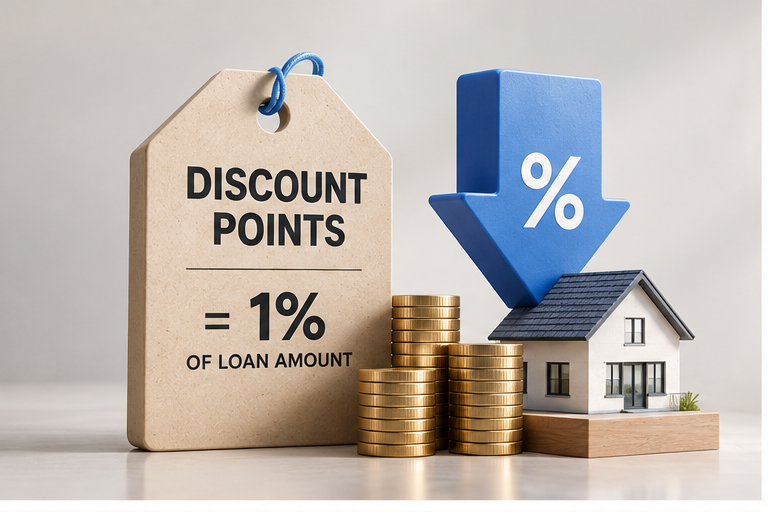
Mortgage discount points are upfront charges paid to the lender in exchange for a lower interest rate. One point equals 1% of the loan amount.
The CFPB explains that points listed on the Loan Estimate and Closing Disclosure must be connected to a discounted interest rate. However, there is no universal rule saying one point will reduce the rate by a specific amount. The change depends on the lender, loan program, borrower profile, market, and pricing available when the rate is locked.
You can review the CFPB’s explanation of lender credits and discount points for additional context.
On the Loan Estimate, points generally appear in Section A under Origination Charges. Do not assume every charge in that section is a discount point. An origination fee can pay for originating or processing the loan, while a discount point is tied to a lower interest rate.
If the description is unclear, ask the loan officer to separate three things:
- The interest rate
- The cost specifically connected to points
- Other lender or origination charges
Section 03
Why a Lower Rate Is Not Automatically the Better Choice
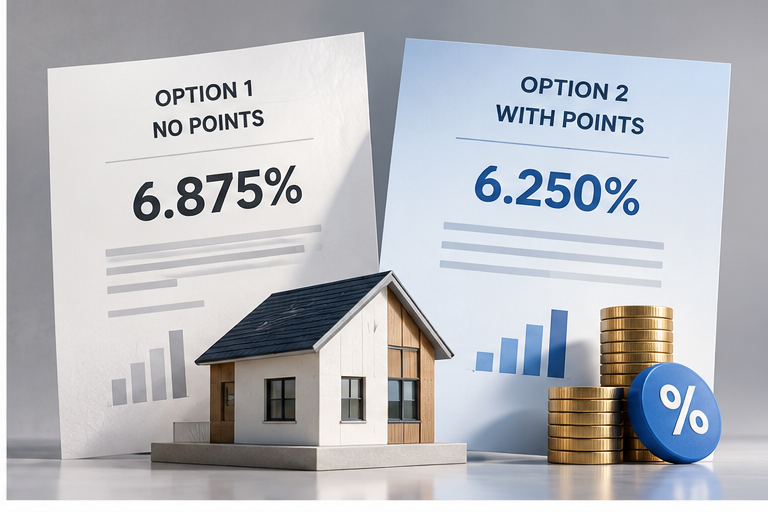
A lower rate sounds better because it reduces the scheduled principal-and-interest payment. But paying points moves money out of the borrower’s bank account on closing day.
The decision is therefore a trade-off:
Pay more cash now to reduce the borrowing cost over time.
That trade-off works only when the borrower keeps the mortgage long enough. If the home is sold or the loan is refinanced before the break-even point, the borrower may not recover the full cost of the points.
Points are also generally not refunded simply because the borrower later decides to replace the loan.
Section 04
How to Calculate the Mortgage Points Break-Even
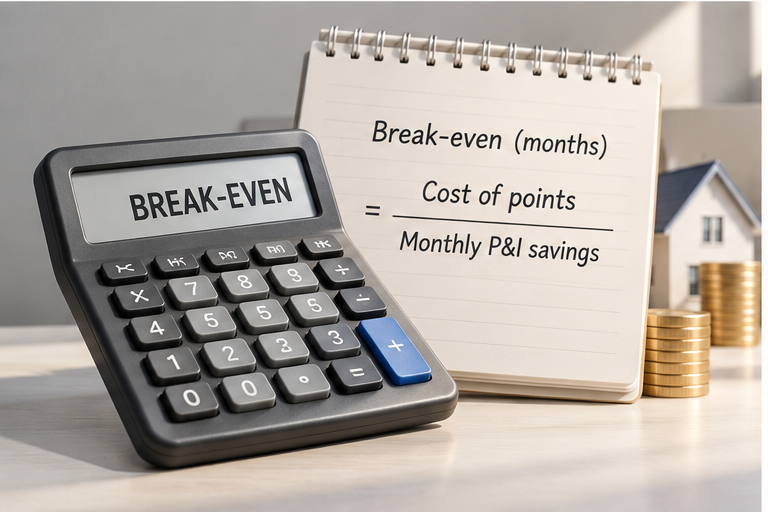
The break-even calculation uses two figures from the same lender and the same loan scenario:
- The additional upfront cost of the option with points
- The monthly principal-and-interest savings created by those points
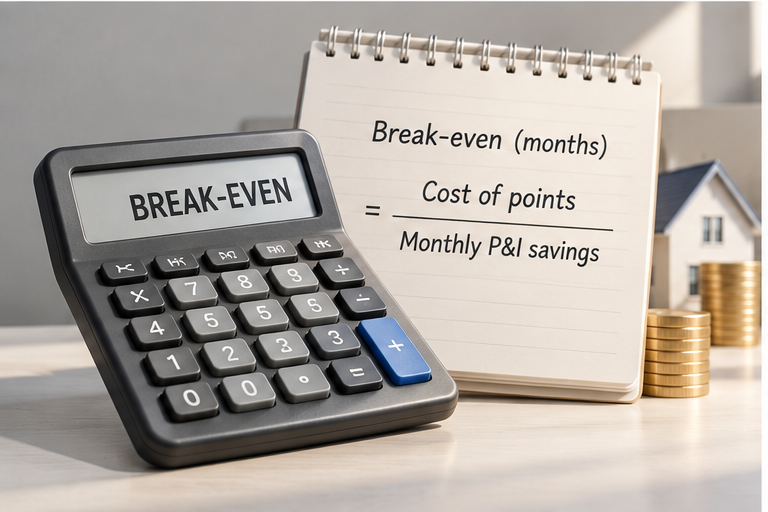
Use this formula:
Break-even in months = Cost of points ÷ Monthly principal-and-interest savings
For example, suppose the calculation produces a break-even of 60 months. That means the borrower needs to keep the mortgage for approximately five years before the accumulated monthly savings recover the upfront cost.
Before that month, the borrower has not fully recovered the cost. After that month, the lower payment begins producing net savings, assuming the mortgage remains in place and the comparison does not change.
The calculation should use principal and interest only. Property taxes, homeowners insurance, HOA dues, and other housing costs generally do not decrease because the borrower purchased points.
Section 05
Ask for a True Side-by-Side Comparison
Do not compare a rate from one day with another rate quoted several days later. Market movement can make the difference look larger or smaller than the effect of the points themselves. Ask the loan officer to provide two options at the same time using the same:
- Loan amount
- Loan program
- Loan term
- Property type
- Occupancy
- Down payment
- Credit profile
- Rate-lock period
The only major difference should be the rate-and-points combination. That makes the break-even calculation meaningful. If possible, review the options on comparable Loan Estimates rather than relying on a text message showing only a rate and payment.
Section 06
Four Questions That Decide Whether Points Make Sense
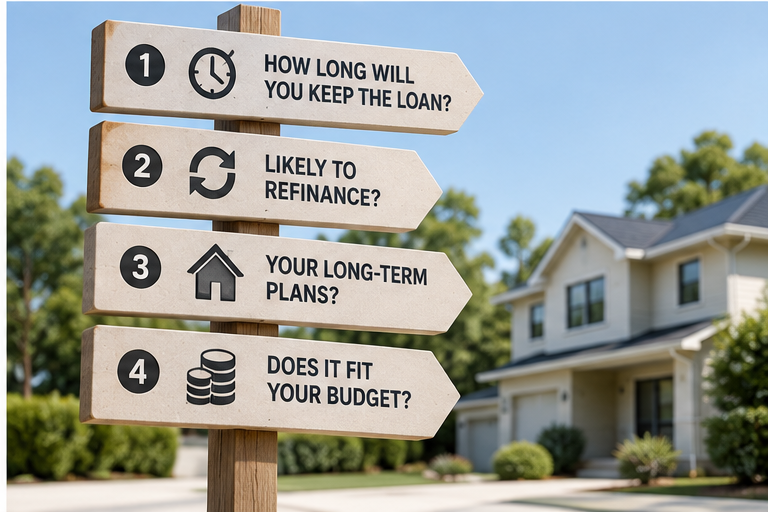
The break-even number is only the beginning. It needs to be compared with the borrower’s actual plans.
1. How long are you likely to keep this mortgage?
This is different from asking how long you will own the home.
You may plan to stay in the property for many years but refinance earlier. Selling and refinancing both end the mortgage on which the points were paid.
If the realistic loan-holding period is shorter than the break-even period, paying points may not make sense. Wonder Rates’ guide comparing ARM vs fixed-rate mortgages explains why the expected time in a loan affects many financing decisions.
2. How likely are you to refinance?
Nobody can predict future mortgage rates with certainty. Still, the borrower may already know that the current loan is temporary.
For example, the borrower may expect to sell another property, remove a co-borrower, complete renovations, or refinance after a documented financial change. When replacing the mortgage appears likely, a long break-even period deserves extra caution.
Do not justify points by assuming a future refinance will happen at exactly the right time. Qualification, property value, available programs, costs, and market conditions may all be different later.
3. How much cash will remain after closing?
Paying points reduces the cash left for moving, repairs, furniture, deductibles, maintenance, and emergencies.
A lower mortgage payment may feel comfortable, but it does not help much if the borrower has almost no cash available when the roof leaks or income is interrupted.
Compare the potential savings with what else that cash could do. Preserving emergency reserves or avoiding higher-cost debt may be more valuable than reducing the rate.
4. Do the points materially affect qualification?
Because permanent points can reduce the note rate and principal-and-interest payment, they may affect the lender’s debt-to-income calculation.
That does not mean points will solve every qualification problem. The lender still evaluates income, liabilities, assets, credit, property eligibility, reserves, and the selected program.
Ask the loan officer whether points are being discussed as a financial choice, a qualification tool, or both. Those are different conversations.
Section 07
Permanent Points vs a Temporary Buydown
Permanent discount points and a temporary buydown both reduce payments, but they work differently.
Permanent discount points
The borrower or an eligible contributing party pays an upfront cost connected to a lower note rate. The lower rate remains with that mortgage for as long as the loan stays in place.
Temporary buydown
Funds are deposited at closing and used to subsidize part of the scheduled payment during an initial period. After the temporary period ends, the borrower makes the full payment required by the note.
A temporary buydown does not permanently change the note rate. It also should not be treated as proof that the full payment will become affordable later.
Wonder Rates’ guide to what happens when a temporary mortgage buydown ends explains the payment transition and budgeting questions.
Section 08
Which Option Fits Which Goal?
Permanent points may be worth evaluating when:
- The borrower expects to keep the mortgage well beyond break-even
- Cash reserves remain strong after closing
- The lower note rate meaningfully improves the long-term loan comparison
- The reduced qualifying payment matters to the file
A temporary buydown may be worth evaluating when:
- An eligible seller or builder contribution is available
- The borrower values lower payments during the first part of ownership
- The full payment already fits the budget
- The written terms clearly explain the schedule and unused funds
Neither option is automatically better. The source of funds, seller-contribution limits, underwriting treatment, loan program, and written agreement all matter.
Section 09
Be Careful With Seller Credits
When a seller offers a credit, the buyer may need to decide whether to use it for points, a temporary buydown, other eligible closing costs, or another permitted purpose.
Do not assume the largest immediate payment reduction creates the strongest overall transaction. Compare:
- How long the benefit lasts
- Whether the benefit affects qualification
- The expected loan-holding period
- Cash needed at closing
- The full payment after any temporary subsidy ends
- What happens if the loan is paid off early
Seller contributions are subject to loan-program limits and cannot always be used in every way the parties prefer.
Section 10
What About Taxes?
Mortgage points may receive specific tax treatment depending on whether the transaction is a purchase or refinance, how the points were paid, the property use, and the borrower’s tax situation.
A loan officer should not promise that points are deductible. Consult a qualified tax professional before including a potential tax deduction in the decision.
Section 11
Questions to Ask Before Paying Mortgage Discount Points
- What is the exact dollar cost of the points?
- How much do they change the interest rate?
- How much do they change principal and interest each month?
- What is the break-even month?
- Does the comparison use the same lock period?
- How much cash will remain after closing?
- Would the loan still qualify without points?
- What happens if the mortgage is refinanced or paid off early?
- Is an eligible seller credit available?
- Would another use of that credit be more valuable?
Section 12
Frequently Asked Questions
Are mortgage discount points worth it?
They may be when the borrower expects to keep the mortgage well beyond the break-even point and can pay the upfront cost without weakening cash reserves. They may be less useful when a sale or refinance is likely before break-even.
How much does one point lower the rate?
There is no fixed reduction. Pricing depends on the lender, program, borrower, property, market, and lock timing. Compare written options prepared at the same time.
Are points the same as an origination fee?
No. Points are connected to a discounted rate. An origination fee may compensate the lender or broker for originating the loan.
Is a temporary buydown better than permanent points?
It depends on the goal. A temporary buydown concentrates the benefit in the early period. Permanent points may provide value for longer if the borrower keeps the loan past break-even.
Can seller credits pay for points?
They may be permitted when the program, contribution limits, contract, and lender requirements allow it. Confirm before negotiating the credit.
Are mortgage points tax deductible?
Tax treatment depends on the transaction and borrower. Consult a qualified tax professional rather than assuming a deduction applies.
Section 13
Final Takeaway
Mortgage discount points are not simply a way to obtain a lower rate. They are a decision to spend more cash today in exchange for potential savings over time.
Calculate the break-even first. Then compare that month with how long you realistically expect to keep the mortgage, how much cash will remain after closing, and whether a sale or refinance is likely.
The lower rate may be attractive. The better choice is the option that still makes sense after the upfront cost, timeline, and cash reserves are included.
Compare Your Mortgage Options Before Paying Points
Not sure whether paying points fits your plans? Get started with Wonder Rates to review options with and without discount points. Ask for a comparison of upfront costs, monthly principal-and-interest payments, and the estimated break-even period based on how long you expect to keep the mortgage.
Duc Pham, Mortgage Broker | NMLS# 844897
Wonder Rates, Inc. | NMLS# 1518655
Equal Housing Lender.
AZ, CA, CO, FL, GA, LA, MI, OK, PA, SC, TX, VA, WA, OH, AL, OR, NC
This article is for educational purposes only and is not a commitment to lend, tax advice, or a guarantee of savings. Loan approval is subject to creditworthiness, acceptable income and asset verification, property eligibility, and current underwriting guidelines. Loan programs, interest rates, pricing, points, seller-contribution rules, and lender fees may change without notice. Review your official Loan Estimate and consult qualified tax or financial professionals before making a financing decision.



