
Section 01
You have been pre-approved. Maybe you have already found a home, or you are sitting deep in underwriting. Then you check your credit and the number has dropped. The first question that hits is simple and understandably panicked: does this ruin everything?
Usually, no. What actually happens depends on when the drop occurred, which credit score your lender is actually using, whether you still meet the requirements of your specific loan program, and whether the change affects your pricing or your underwriting file at all. Here are three things worth knowing right away. A credit score drop does not automatically mean denial. A decline can affect your eligibility, your pricing, or how closely your lender reviews the rest of your file, but it does not always do any of those things. And the smartest first move is to figure out what actually caused the drop, then call your loan officer, before you do anything else that could change your credit profile further.
Disclaimer: This article is provided for general educational and informational purposes only and does not constitute financial, mortgage, credit, tax, or legal advice. Mortgage eligibility, credit-score requirements, loan pricing, mortgage insurance, and underwriting decisions depend on the applicable loan program, current agency guidelines, lender requirements, credit reporting information, and the borrower’s individual circumstances. Credit scores may differ across scoring models, credit reporting agencies, and reporting dates. The hypothetical examples in this article are for illustrative purposes only and do not guarantee a particular credit-score change, loan approval, interest rate, or closing outcome. Requirements and guidelines may change. Readers should contact their loan officer for guidance on their specific mortgage application and consult the relevant credit bureaus or qualified professionals when appropriate.
Section 02
1. What Happens When Your Credit Score Drops During the Mortgage Process?
Does a Credit Score Drop Automatically Disqualify You?
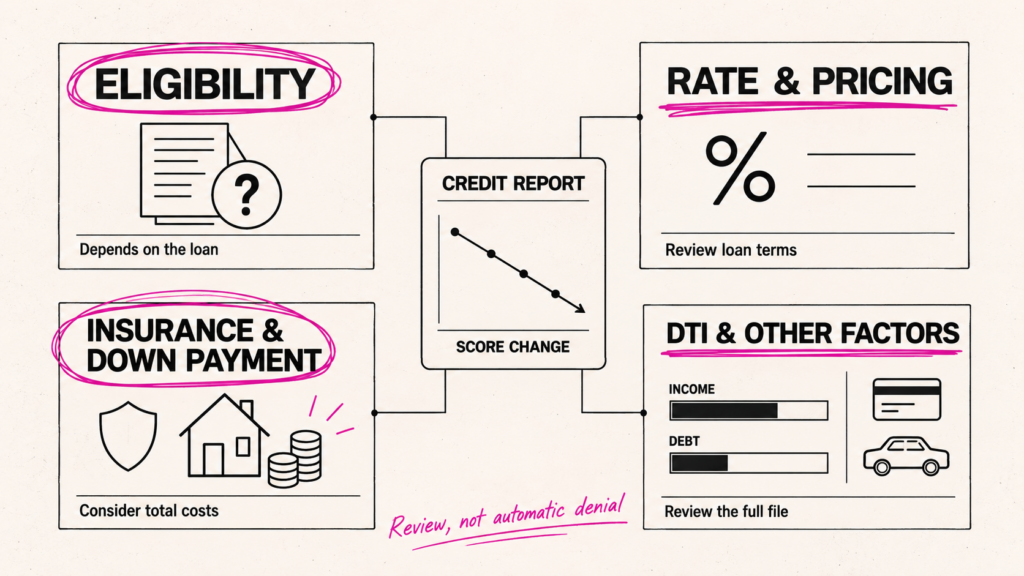
No, not automatically. Mortgage underwriting looks at more than one single number. Your lender also reviews your full credit report, your payment history, outstanding debt, income, assets, down payment, and every other eligibility factor tied to your loan. A decline genuinely matters when it pushes you below an applicable program or lender threshold, changes the score used for pricing, or shows up alongside new information that shifts your lender’s overall assessment. A small decline often changes nothing at all, as long as you continue meeting every applicable requirement. There is no universal “safe” number of points you can lose. That threshold simply does not exist as a single rule across every mortgage.
What If Your Score Drops After Pre-Approval?
Pre-approval is not the same thing as final loan approval. Your lender may still need to verify your credit, income, assets, employment, debts, and property details before you actually close. If your score drops after pre-approval, ask your loan officer directly whether the change affects your loan program, your pricing, or the underwriting findings already on file. Your lender may need to review updated credit information or reassess part of your application. Pre-approval never guarantees your original loan terms or approval decision will stay frozen in place. If you want to better understand what mortgage pre-approval actually confirms and what lenders may still review afterward, see our guide to Mortgage Pre-Approval.
What If Your Score Drops During Underwriting?
What matters here is whether the new credit information actually changes your eligibility or triggers a need for additional review. A lower score might lead your lender to reassess your application, request updated documentation, or confirm whether your loan still fits the applicable guidelines. There is a real difference between a numerical score decline and a brand-new negative item on your credit report. A missed payment, a new collection account, or a jump in your debt can raise separate underwriting questions that go well beyond the score number itself.
What If Your Score Drops Just Before Closing?
Lenders can pull or review credit information shortly before closing. The Consumer Financial Protection Bureau confirms that lenders may check credit both when you first apply and again right before closing. If new information shows up that changes your application, your lender may need to reassess your eligibility or your loan terms. Do not assume that an earlier approval means later credit changes simply get ignored. A credit score drop does not automatically cancel your transaction either. Your lender assesses the actual circumstances against the applicable requirements, not a worst-case assumption.
Section 03
2. Why Do Credit Scores Drop Before a Mortgage Closes?
Increased Credit Card Balances
Credit utilization, meaning how much of your available revolving credit you are actually using, can genuinely affect your score. If you put moving expenses, furniture, appliances, or other purchases on a credit card, a higher reported balance can push your score down. Different scoring models respond differently, and the real impact depends on your overall credit profile. Paying the balance down can help in some cases, but do not assume a payment produces an instant score bump, or that every scoring model updates on the same schedule.
A Missed or Late Payment
Payment history affects both your credit score and your mortgage underwriting. A late payment reported to a credit bureau can cause a decline, with the actual impact depending on the account, how long the delinquency lasted, and the rest of your credit file. Verify whether a reported late payment is even accurate. If you actually paid on time, or the reporting itself is wrong, contact the creditor and the relevant credit bureau to dispute it. Not every late payment gets reported at the same point, and not every one produces the same impact.
Applying for New Credit or Opening an Account
Applying for a credit card, auto loan, personal loan, or other new credit can trigger a hard inquiry and affect your score. Opening a new account can also shift your credit profile through new debt, a shorter average account age, or other scoring factors. The CFPB recommends avoiding unnecessary new credit applications shortly before or during the mortgage process. One important exception worth knowing: mortgage rate-shopping inquiries are treated differently from unrelated credit applications under most scoring models. Do not avoid legitimate mortgage shopping out of fear that comparing a few mortgage offers will stack up as separate score penalties.
Closing or Paying Off Existing Credit Accounts
You might expect your score to rise after paying off debt, but that outcome is not guaranteed. Closing a revolving account can actually reduce your available credit, which can raise your utilization ratio. Paying off an installment loan can shift your credit profile too, in ways that are not always obvious in advance. Ask your loan officer before closing any account or making a substantial change to your existing credit during underwriting.
Errors, Identity Theft, or Unexpected Credit Report Changes
A decline can come from inaccurate information, an account you genuinely do not recognize, a duplicated collection, or an incorrectly reported late payment. Review your actual credit report rather than relying only on the score shown in a consumer app. If you spot a real error, document it and contact the relevant credit bureau and the furnisher of that information to dispute it. Do not assume a dispute automatically removes the item, and do not assume your lender can simply disregard an unresolved item without reviewing it first.
Section 04
3. Which Credit Score Does a Mortgage Lender Use?
Why Your Mortgage Credit Score May Differ From a Consumer App
You can have several different credit scores at once, since scoring models, credit bureau data, and calculation dates all vary. A score shown in a banking app or a credit-monitoring service might not match the score your mortgage lender actually uses. The CFPB explains that mortgage lenders commonly review credit information from the major credit reporting companies, and the score used for your mortgage can differ from other scores you happen to see elsewhere. Ask your loan officer directly which credit report and score matter for your specific application. A score from one consumer app does not, by itself, determine your mortgage eligibility.
How Are Mortgage Credit Scores Selected?
Mortgage credit-score selection follows the applicable underwriting rules and scoring framework. Under Fannie Mae’s guidance, a lender generally selects the lower of two scores, or the middle score when three are available, for each individual borrower. For a loan with more than one borrower, the lender typically applies this same method to each person, then uses the lowest resulting score across all borrowers as the score for the loan overall. The exact score-selection rules can shift depending on the underwriting circumstances and whether the loan is processed manually or through automated underwriting. If you have a co-applicant, ask your lender how the final score gets determined for your specific file, rather than assuming scores simply get averaged together.
Does a Credit Score Drop Affect Every Borrower on the Application?
Each borrower has their own individual credit profile, but how your lender treats those profiles depends on the applicable loan program and its underwriting rules. A change in one applicant’s score can affect the loan’s overall qualifying score, depending on how that specific program determines the relevant figure. A stronger co-borrower’s credit does not automatically cancel out the effect of a weaker applicant’s score. Ask your loan officer directly how the score gets calculated for your specific application.
Section 05
4. How a Credit Score Drop Can Affect Mortgage Eligibility and Pricing
Minimum Credit Score Requirements
Minimum score requirements vary by loan program, lender, underwriting method, and the specifics of your transaction. Some programs allow lower scores under defined conditions, while individual lenders can impose stricter requirements on top of that. There is no single universal “minimum mortgage credit score” that applies across every program and every lender. If you want an exact threshold for a conventional, FHA, VA, or USDA loan, confirm the current figure directly with your lender, since published minimums and lender overlays can both shift over time.
Interest Rates and Loan Pricing
Credit scores can genuinely influence your mortgage pricing, including the interest rate and other costs tied to a specific offer. The CFPB confirms that credit scores and credit reports can affect both your ability to get a mortgage and the rate you end up paying. That said, a lower score does not automatically mean your lender raises your interest rate. The real effect depends on the score actually used, the loan product, specific pricing adjustments, current market rates, individual lender policies, and whether your rate is already locked.
Mortgage Insurance and Down Payment Considerations
A credit score change can affect mortgage insurance costs or other loan terms in some conventional mortgage scenarios, depending on the applicable pricing and eligibility rules in play. Do not assume you can always compensate for a lower score simply by putting more money down. A different down payment can change your loan-to-value ratio, your pricing, your mortgage insurance, and your cash needed to close, but it does not automatically resolve every credit eligibility issue on its own.
Debt-to-Income Ratio and Other Underwriting Factors
Your debt-to-income ratio, or DTI, measures your qualifying monthly debt against your qualifying income. Your credit score reflects something entirely different: information pulled from your credit profile. These are two separate parts of the underwriting picture. If a score decline is tied to a new auto loan, a higher credit card balance, or a missed payment, your lender may need to factor in that new debt or credit history alongside the score itself. Strong income or a low DTI does not automatically override a program’s credit requirements, in the same way that a high score does not automatically guarantee approval. For a closer look at how lenders calculate and use this ratio during mortgage qualification, see our guide to Debt-to-Income Ratio (DTI). If you want to estimate your own debt-to-income ratio, the Wonder Rates DTI Calculator can help you see how your monthly debts compare with your qualifying income.
Section 06
5. What Happens to Your Mortgage Rate If Your Credit Score Drops?
Can a Lender Change Your Mortgage Rate After a Credit Score Drop?
It depends on the status of your rate lock, the exact terms of that lock agreement, and whether anything about your application or loan terms has actually changed. The CFPB explains that once a rate is locked, it generally should not change during the lock period, as long as you close within the specified timeframe and nothing about your application changes. If your rate is not locked, it can still move. A rate lock does not automatically protect every aspect of your mortgage regardless of what happens to your credit or your application. Your lender still has to review the lock terms and any conditions attached to it.
What If the Lender Issues a Revised Loan Estimate?
A revised Loan Estimate can show up when important information about your application changes. The CFPB specifically names a credit score change, a new loan, or a missed payment as circumstances that can affect your loan terms or estimated costs. Compare any revised terms against your previous Loan Estimate line by line, and ask your lender to explain exactly what changed in the rate, the fees, the mortgage insurance, or any other cost. Not every credit score decline automatically entitles a lender to change your loan terms. The actual reason behind the change, and the applicable disclosure rules, both matter here.
What Borrowers Should Review Before Accepting New Loan Terms
Whether your interest rate is locked, and when that lock actually expires. Whether the rate, points, lender credits, or other charges have shifted. Whether mortgage insurance or other monthly costs have changed. Whether the revised terms affect the cash you will actually need at closing. And whether your lender has clearly explained the reason behind each change. Ask for a specific explanation rather than assuming every adjustment traces back to your credit score alone.
Section 07
6. What to Do If Your Credit Score Drops Before Closing
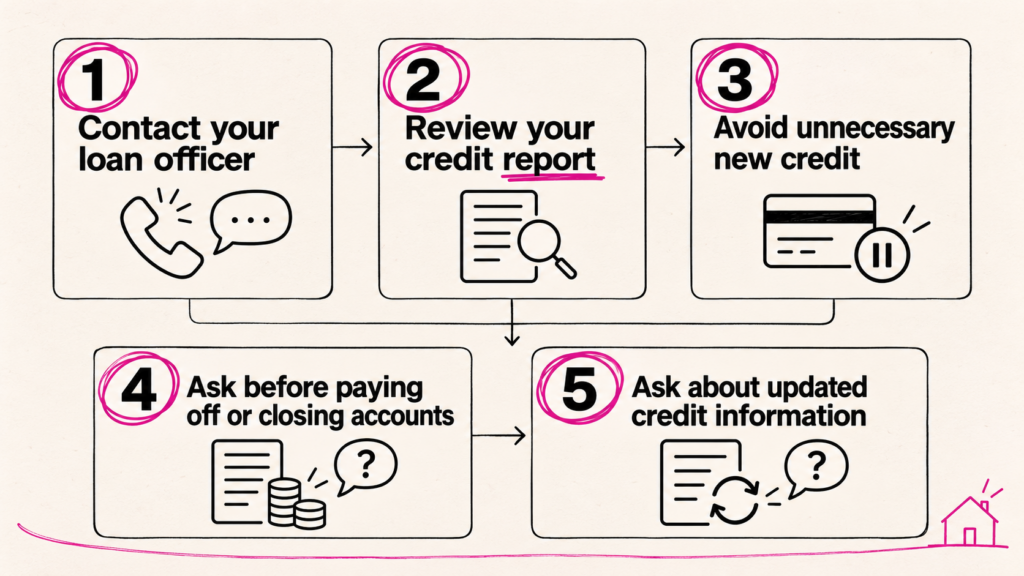
Step 1, contact your loan officer promptly. Disclose the change and ask directly whether it affects your applicable loan requirements, pricing, or underwriting findings. Do not try to hide new credit activity, and do not assume your lender simply will not check again. Lenders can pull updated credit information before closing, and giving them accurate information upfront helps your team properly assess the situation.
Step 2, review the credit report, not just the score. Identify exactly which account or event actually caused the decline. Look at reported balances, your payment history, new inquiries, collection accounts, and anything unfamiliar. If something looks wrong, document it and follow the proper dispute process, and ask your loan officer whether that issue needs any specific documentation during underwriting.
Step 3, avoid unnecessary new credit applications. Applying for a new credit card, car loan, or personal loan creates additional inquiries and can change your debt obligations at exactly the wrong time. Delay any unnecessary credit application until you have talked through the potential consequences with your loan officer. This does not mean freezing all financial activity. It means separating necessary spending from new credit commitments that can simply wait.
Step 4, ask before paying off or closing accounts. Paying off debt or closing accounts can affect your credit profile, your cash reserves, or your DTI in ways that differ depending on the specifics. A large payment pulled straight from savings can also reduce the assets available for your closing or your reserves. Get guidance before making a substantial move here, especially if you are already deep in underwriting or close to closing.
Step 5, ask whether updated credit information can be considered. Credit reports and scores update as new account information gets reported. If your decline traces back to an error or an unusually high reported balance, ask your loan officer whether your lender can review updated information before closing. Do not assume your lender can instantly refresh a score, or that any score will rise by a specific amount. The timing and availability of an updated credit review depends on your lender, the credit reporting process, and the applicable rules.
Section 08
7. Can You Recover Your Credit Score Before Closing?
Paying Down High Credit Card Balances
Reducing revolving balances can improve your credit utilization, depending on your overall credit profile and the specific scoring model being used. Timing matters here, since your lender or the scoring model relies on information from your credit report at a specific point in time. Ask your loan officer whether a lower reported balance could actually matter for your application, and whether your lender has an approved process for reviewing updated information before closing.
Correcting Credit Report Errors
Fixing inaccurate information can help restore a more accurate picture of your credit, but the dispute process rarely moves instantly. Keep your evidence, contact the credit bureau and the relevant furnisher, and ask your loan officer what documentation might actually help your case. Do not count on a disputed item disappearing before closing, and do not assume your lender has to disregard an item that is still unresolved.
Making Payments on Time
Staying current on your existing obligations helps prevent further negative events from piling on. Keep making every required payment even while you work through a score decline. A single new on-time payment does not automatically erase the effect of an earlier late payment, and it does not instantly restore your previous score either.
Why Opening a New Credit Account Is Usually Not a Quick Fix
Opening a new account shortly before closing can trigger a hard inquiry, shift your credit profile, and potentially add a new debt obligation right when you need stability most. A new account also needs time to build any real payment history of its own. Avoid trying to game the system with a last-minute account change. The right next step always depends on what actually caused the decline and what your specific lender actually requires.
Section 09
8. Common Mistakes to Avoid After a Credit Score Drop
Assuming the credit score in an app is the mortgage score. Consumer-facing scores often use different models or different reporting dates than your mortgage lender uses. Ask directly which score and credit report matter for your application.
Making large financial changes without consulting the loan officer. Paying off loans, moving significant savings, opening accounts, or taking on new debt can all affect your credit profile, your cash available to close, or your underwriting assessment. Ask first, before you act.
Ignoring new credit report information. Do not assume a score decline is just a temporary blip. An unfamiliar account, a missed payment, or a reporting error deserves prompt investigation, not a wait-and-see approach.
Assuming pre-approval or a rate lock guarantees final approval. Pre-approval and a rate lock serve two entirely different purposes. Pre-approval is not final underwriting approval, and a rate lock concerns your interest rate under the specific terms of that lock agreement. Neither one is a guarantee that every loan condition has already been met.
Section 10
9. Practical Examples: How a Credit Score Drop May Affect a Mortgage
Example 1: A Credit Card Balance Increases Before Closing
A hypothetical buyer has been pre-approved, then puts $3,000 of moving expenses on a credit card. The reported balance rises, and the buyer notices a lower credit score. This buyer should tell the loan officer right away and ask whether the new balance affects the score used for the mortgage, the DTI, or any other loan condition. Paying the balance down might help in some circumstances, but the timing of reporting and the lender’s own process determine what can actually be considered before closing.
This hypothetical scenario is for general educational purposes only. The effect of a balance increase on a credit score or mortgage application depends on the borrower’s credit profile, scoring model, reporting date, loan program, and lender review. No particular score change or mortgage outcome is guaranteed.
Example 2: A Borrower Discovers an Incorrect Late Payment
A hypothetical borrower sees a score decline after a creditor reports a payment as late, even though the borrower is confident the payment was actually made on time. This borrower should gather payment records, contact the creditor, and dispute the inaccurate reporting with the appropriate credit bureau. Notify the loan officer too, and ask whether any documentation is needed while the issue gets reviewed. There is no guarantee the disputed item gets removed before closing, and no guarantee the mortgage lender can simply ignore it either.
This hypothetical example illustrates general steps for addressing potentially inaccurate credit information. The outcome and timing of a dispute, as well as its effect on mortgage eligibility, depend on the facts, credit reporting process, applicable guidelines, and lender review.
Example 3: A Borrower’s Score Drops After Opening a Car Loan
A hypothetical buyer opens a car loan after receiving mortgage pre-approval. The new loan creates an extra monthly obligation, and the buyer later notices a lower credit score. Here, the loan officer likely needs to evaluate both the score change and the new debt obligation together. Even if the score stays above a particular program’s threshold, that extra monthly payment can still affect DTI or shift the underwriting findings. The real outcome depends on the complete application and the applicable rules, not simply how many points the score dropped.
This hypothetical scenario does not predict mortgage denial or approval. The effect of a new loan depends on the borrower’s credit profile, debt obligations, income, loan program, underwriting results, and lender requirements.
Section 11
10. Final Takeaways: Mortgage Requirements After a Credit Score Drop
A credit score drop does not automatically disqualify you from getting a mortgage. The real impact depends on the score your lender actually uses, the cause and timing of the decline, and the applicable program requirements tied to your specific loan. A lower score can affect your eligibility, your pricing, your mortgage insurance, or how closely your lender reviews your file, but not every decline changes your loan terms. Your lender may review credit information again right before closing, so never assume pre-approval alone locks in your final outcome. Contact your loan officer, review your actual credit report rather than a single app number, and avoid any unnecessary financial changes while the issue gets sorted out.
The right response is always to understand exactly what changed before trying to fix it. You likely have real options here, but which steps actually apply depends on the specific credit issue and where your mortgage currently sits in the process.
One more thing worth having on your radar: HUD announced on September 10, 2026, that FHA will begin accepting two newer credit score models, VantageScore 4.0 and FICO Score 10T, alongside the familiar Classic FICO score, for FHA case numbers assigned on or after January 1, 2027. This has not taken effect yet, and it does not change current requirements. But if your FHA loan file is opened after that date, the score your lender pulls, and how it is calculated, could look different from what this article describes today. Ask your loan officer which model applies to your file once that date arrives.
Section 12
Sources
- Consumer Financial Protection Bureau, Does my credit score affect my ability to get a mortgage loan or the mortgage rate I pay?
- Consumer Financial Protection Bureau, When will my lender run or obtain a copy of my credit report?
- Consumer Financial Protection Bureau, What happens when a mortgage lender checks my credit?
- Consumer Financial Protection Bureau, Mortgage Loan Estimate explainer
- Fannie Mae Selling Guide, B3-5.1-02, Determining the Credit Score for a Mortgage Loan
- HUD Single Family Housing Policy Handbook 4000.1
This article also touches on loan-to-value ratio when discussing pricing and down payment, and mortgage points when comparing loan costs.
Duc Pham, Mortgage Broker | NMLS# 844897, Wonder Rates, Inc. | NMLS# 1518655 | DRE# 02047445 | DFPI# 60DBO-59134 | Equal Housing Opportunity. Equal Housing Lender. | Licensed in: AL, AZ, CA, CO, FL, GA, LA, MI, NC, OH, OK, OR, PA, SC, TX, VA, WA.



