
Section 01
Buying a townhouse generally takes the same core qualifications as other home loans. Lenders look at your credit, income, assets, debt-to-income ratio, down payment, and the home’s appraisal. But townhouse financing adds one thing that a typical detached house may not have. The lender also needs to know how the townhouse is legally set up.
That is because a townhouse is not automatically a condo. It could be a condo or a unit in a planned unit development (PUD). It could also be a home you own outright on its own lot. Each setup can change how the lender reviews the property. Fannie Mae requires lenders to figure out whether a unit is in a condo or a PUD. Lenders then use the right loan documents and appraisal forms.
So here is the big idea behind this guide. The mortgage requirements for buying a townhouse depend on both you and the townhouse itself. We will walk through your qualifications and how townhouses are classified. Then we cover HOA rules, loan options, costs, and how to prepare.
Section 02
What Are the Mortgage Requirements for Buying a Townhouse?
Lenders usually look at two groups of requirements. The first is about you as the borrower. The second is about the property.
Borrower Requirements
On the borrower side, the lender reviews your credit, income, job history, debts, assets, and down payment. In some cases, it also checks whether you will have cash reserves left after closing.
Property Requirements
On the property side, the lender looks at the appraisal, the title, the insurance, and the home’s condition. If the townhouse is in a condo or PUD, the lender may also check the HOA and the whole project.
Why Townhouse Financing Can Involve Both
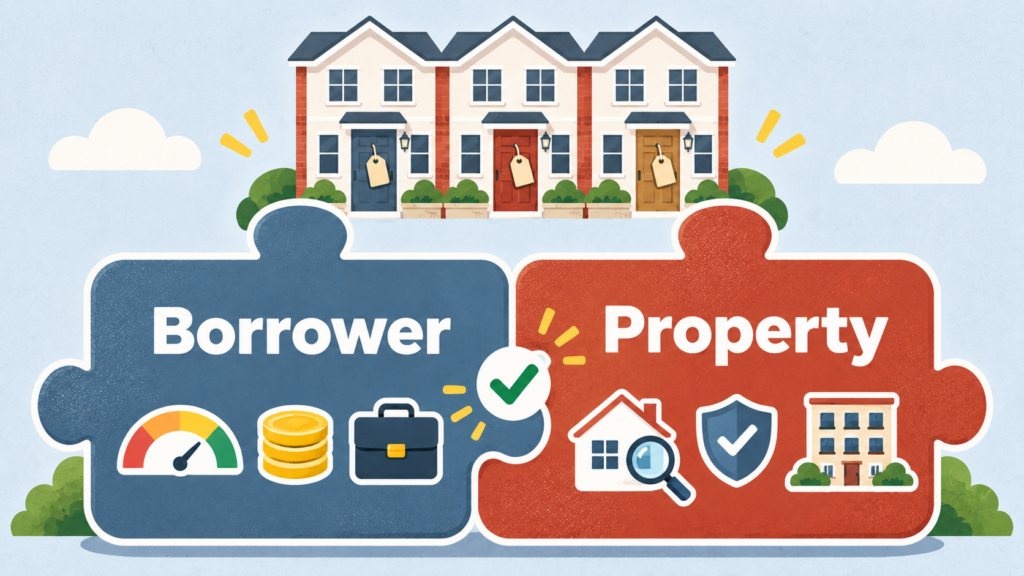
Fannie Mae explains that its project review is in addition to the lender’s review of the borrower, the loan terms, and the unit’s appraisal. In other words, for homes in a condo, co-op, or PUD, the project can add a layer to the review. You can qualify and the property still might not. That is why it pays to understand how your townhouse is classified before you go too far.
Section 03
Is a Townhouse a Condo or a Single-Family Home?
A Townhouse Is a Building Style, Not Necessarily a Mortgage Classification
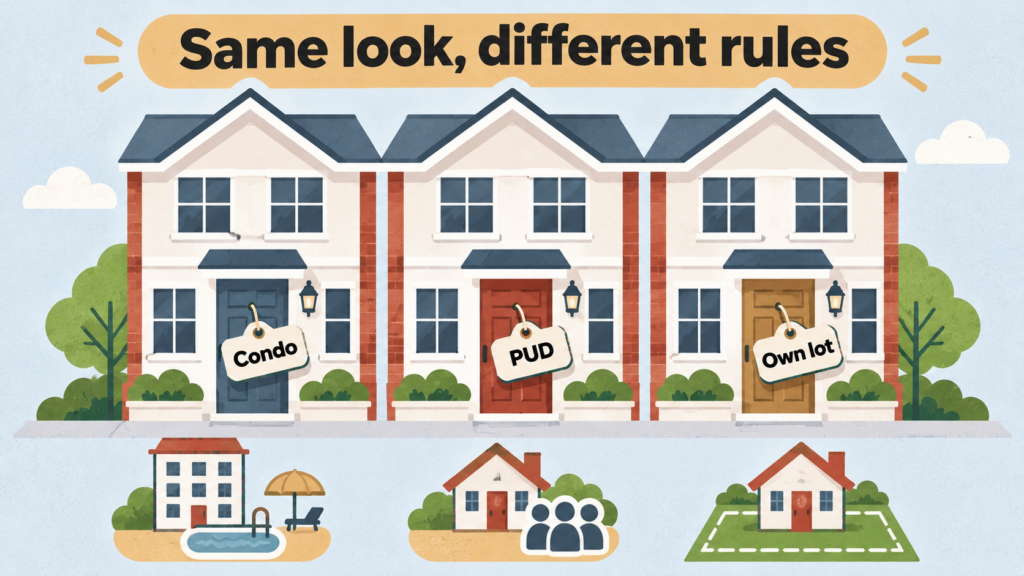
The word “townhouse” describes how a home looks and is built. It usually means a multi-level home that shares one or more walls with its neighbors. But a townhouse is a building style, not a loan type. The legal ownership can vary.
A townhouse might be:
- Part of a condominium project, where you own your unit plus a share of the common areas
- Part of a PUD, where you own the home and the land under it, plus a share in an HOA that manages common areas
- Owned outright on its own lot, sometimes called fee simple, with or without an HOA
Why Legal Classification Matters for Your Mortgage
Two townhouses can look exactly alike and still be financed under different rules. Same look, different rules. One might be a condo that needs a project review. The one next door, in a different community, might be a PUD where the full project review is often waived.
Under Fannie Mae’s current rules, several things shape the type of review. These include the number of units and whether the unit is attached or detached. The project type, whether it is new or established, and the loan itself matter too. For example, Fannie Mae generally waives the full project review for PUD units, though some basic requirements still apply. Attached condo units in larger projects, on the other hand, often need a fuller review.
How to Find Out What Type of Townhouse You Are Buying
Do not guess based on how the home looks. Instead, check these sources:
- The listing, which may say “condo,” “PUD,” or “townhome”
- The purchase contract
- The title report and recorded legal documents
- The HOA’s governing documents, such as the declaration or covenants
- Your lender, title company, and appraiser
If you are not sure, ask early. Knowing the classification helps your lender pick the right path for your loan.
Section 04
Townhouse Mortgage Requirements: Borrower Qualifications
Now let’s turn to you, the borrower. These requirements look much the same as for any home loan.
Credit Score Requirements
There is no single minimum credit score for every townhouse mortgage. The credit rules come from the loan program and the lender, not from the word “townhouse.” A conventional loan, an FHA loan, and a VA loan can each have different standards.
Income and Employment Requirements
Lenders want to see that your income is steady and likely to continue. They review your job history and how much you earn. They also check the records that prove it, such as pay stubs, W-2s, or tax returns.
Debt-to-Income Ratio
Your debt-to-income ratio, or DTI, compares your monthly debt payments to your gross monthly income. Our guide on debt-to-income ratio (DTI) explains how it works in detail.
For townhouse buyers, one point matters a lot. Fannie Mae’s rules for monthly housing expense include HOA dues along with principal, interest, taxes, and insurance. So do not judge affordability by principal and interest alone.
Assets and Down Payment Funds
You will need to show where your down payment and closing funds come from. These can include checking and savings accounts, eligible investment accounts, and gift funds where the loan program allows them. The lender will want records that trace any large deposits. Whether you need extra cash reserves depends on the loan and your profile.
Section 05
How Much Down Payment Do You Need for a Townhouse?
Is There a Special Down Payment Requirement for Townhouses?
No. There is no separate down payment rule just because a home is a townhouse. Your down payment depends on the loan program and how you will use the home. Your finances, the home’s legal setup, and the lender’s rules also play a part. And you may not need 20% down. Our guide on why a 20% down payment is not always required explains why.
Conventional Townhouse Down Payment
Conventional loans may be available for townhouses when both you and the property meet the program’s rules. The Consumer Financial Protection Bureau (CFPB) notes that some conventional loans can require as little as 3% down for eligible buyers. With less than 20% down, you will usually pay private mortgage insurance. How much you put down also affects your loan-to-value ratio (LTV), which can shape your pricing and mortgage insurance.
FHA Townhouse Down Payment
FHA loans can be used for eligible one-family homes, including qualifying condo units. According to HUD, FHA down payments can be as low as 3.5% for buyers who qualify.
VA and USDA Financing
VA and USDA loans may allow eligible buyers to purchase with no down payment. But both depend on borrower eligibility and property rules. We cover them in more detail below.
Section 06
Do HOA Fees Affect Townhouse Mortgage Qualification?
Why Townhouses Often Have HOA Fees
Many townhouse communities have a homeowners association, or HOA. The HOA may take care of common areas, landscaping, building exteriors, amenities, private roads, and other shared upkeep. You help pay for that through HOA dues.
Are HOA Dues Included in Your Mortgage Payment?
Usually not. The CFPB explains that HOA dues are usually paid directly to the HOA, not to your mortgage servicer. It also notes that dues can range from a few hundred dollars a month to more than $1,000 a month. HOA dues may skip your mortgage bill, but they never skip your budget.
Do HOA Dues Affect Mortgage Qualification?
Yes, they can. HOA dues are a real monthly housing cost. As noted above, Fannie Mae counts them as part of the monthly housing expense used in qualifying. So higher dues can raise your DTI and lower how much you can borrow.
What About Special Assessments?
A special assessment is an extra charge the HOA bills owners. It often pays for a big repair or a budget gap. It can be a large one-time bill or a set of payments over time. Fannie Mae’s monthly housing expense rules also count special assessments, so they can affect your DTI too. An assessment can also be a sign that the community has repair needs or money problems. Depending on the loan, the lender may look into the project’s finances when assessments are in place.
Section 07
Townhouse Property Requirements for a Mortgage
Now let’s look at the property side.
Appraisal Requirements
The lender usually needs an appraisal or another approved value review. The appraisal estimates what the home is worth and helps confirm that the value supports the loan.
Property Condition
Lenders care about the home’s condition. They may look at structural issues, safety, and whether the home is livable. They also check for put-off upkeep and repairs needed before closing.
Title and Ownership
The title must be clear enough to support the loan and the ownership setup. Your title company will check for liens, legal claims, and the recorded documents that define what you own.
Homeowners Insurance
Insurance needs depend on the ownership setup and the loan program. If the HOA has a master policy that covers the building, you may need a smaller policy for your unit. If you own the whole structure, you may need a full homeowners policy. Your lender will tell you what coverage is required.
HOA and Project Documentation
If your townhouse is part of an HOA or project, the lender may ask for HOA documents. This leads into the project review, which we cover next.
Section 08
What Is a Townhouse Project Review?
Not every townhouse needs the same level of review. But when one is needed, it looks at the whole community, not just your unit.
Why the Lender May Review the Entire Development
Fannie Mae explains that the project as a whole can affect loans on units in condo, co-op, and PUD projects. Risks it lists include the project’s financial health and condition. Lawsuits and weak insurance are on the list too. The project review is meant to address these risks, separate from your own credit.
What Can the Lender Look At?
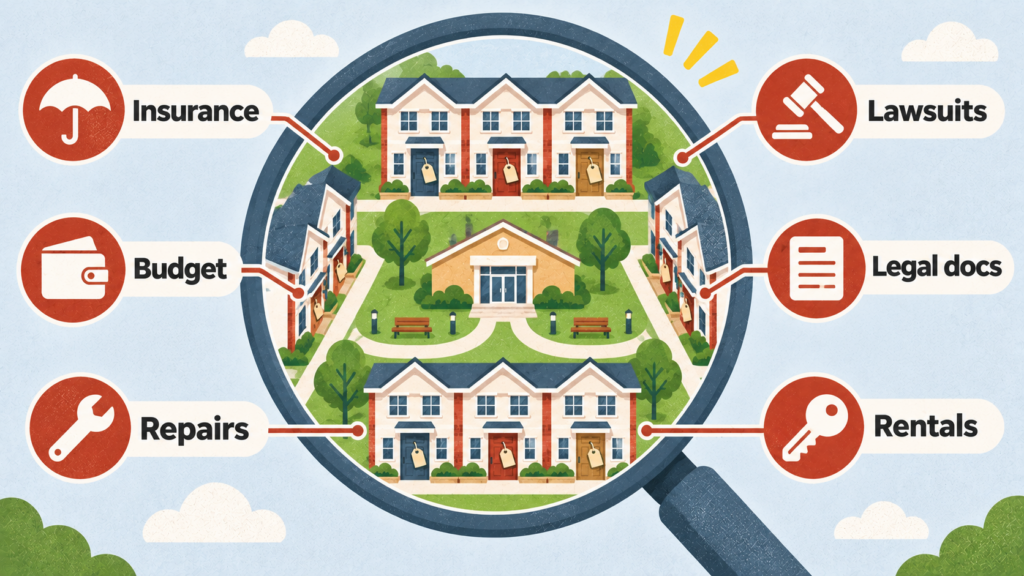
Depending on the project and loan, a review may cover:
- Master insurance coverage
- The HOA’s budget, reserves, and financial health
- Critical repairs or deferred maintenance
- Lawsuits involving the HOA or project
- The project’s legal structure
- Commercial space in the project
- Rental activity and owner-occupancy
- How the HOA is managed
Does Every Townhouse Require the Same Project Review?
No. Under Fannie Mae’s rules, the review method depends on project type, unit type, project status, the number of units, and the transaction. For instance, Fannie Mae generally waives the full review for PUD units and detached condo units. Some basic rules still apply. Other lenders and loan programs, such as FHA and VA, have their own approaches.
Section 09
Townhouse vs. Condo Mortgage Requirements
Ownership Structure
A condo owner typically owns the inside of a unit plus a share of the common areas. A townhouse owner may own the unit and the land under it, but that depends on the legal setup.
HOA and Common Areas
Condos almost always have an HOA. Townhouses often do, but not always.
Project Review
For condos, a project review is often part of the process. For townhouses, it depends on whether the townhouse is legally a condo, a PUD, or something else.
Mortgage Approval
For both, approval depends on you and the property. For a condo, the project review often plays a larger role.
Why the Exterior Appearance Does Not Tell You Everything
| Feature | Townhouse | Condo |
|---|---|---|
| Physical style | Usually multi-level attached design | Varies |
| Legal structure | Can vary | Condominium ownership |
| HOA | Common, but not universal | Common |
| Project review | Depends on legal structure | Often relevant |
| Mortgage requirements | Borrower + property | Borrower + property/project |
Keep in mind that townhouses are not always easier to finance than condos, or harder. It depends on the specific property and loan.
Section 10
Conventional Mortgage Requirements for a Townhouse
Borrower Qualification
For a conventional loan, the lender reviews your credit, income, assets, DTI, and down payment under the program’s rules.
Property Eligibility
The property or project must meet the requirements of Fannie Mae or Freddie Mac, depending on who will buy the loan. Freddie Mac also has its own project eligibility rules for condo units.
Condo vs. PUD Classification
Fannie Mae’s project standards treat condos and PUDs differently. For many PUD units, the full project review is waived. For many attached condo units in larger projects, a fuller review is needed. That is why the classification of your townhouse matters so much for conventional financing.
Why Conventional Financing May Require HOA Documentation
If the townhouse is part of a project, the lender may need HOA documents. These can include the budget, insurance, and legal papers that show the project meets the rules.
Borrower Qualification
For a conventional loan, the lender reviews your credit, income, assets, DTI, and down payment under the program’s rules.
Property Eligibility
The property or project must meet the requirements of Fannie Mae or Freddie Mac, depending on who will buy the loan. Freddie Mac also has its own project eligibility rules for condo units.
Condo vs. PUD Classification
Fannie Mae’s project standards treat condos and PUDs differently. For many PUD units, the full project review is waived. For many attached condo units in larger projects, a fuller review is needed. That is why the classification of your townhouse matters so much for conventional financing.
Why Conventional Financing May Require HOA Documentation
If the townhouse is part of a project, the lender may need HOA documents. These can include the budget, insurance, and legal papers that show the project meets the rules.
Section 11
FHA Mortgage Requirements for a Townhouse
Can You Buy a Townhouse With an FHA Loan?
Possibly, yes. It depends on whether both you and the property meet FHA’s requirements.
FHA Townhouse That Is a Condominium
If the townhouse is legally a condo, FHA condo rules may apply. According to HUD, FHA can insure loans on units in FHA-approved condo projects. It can also insure units in projects that are not FHA-approved but meet its Single-Unit Approval rules. For Single-Unit Approval, the project must be complete and have at least five units. It must also meet other rules, such as ones on financial condition and owner-occupancy.
FHA Townhouse That Is Not a Condo
If the townhouse is not a condo, FHA’s condo approval rules may not apply. That is why it matters to know the legal classification before you assume a condo approval is needed.
FHA Mortgage Insurance
FHA loans generally come with two kinds of mortgage insurance: an upfront premium and an annual premium that is usually paid monthly. These costs raise your monthly payment, so include them when you compare an FHA loan with other options.
Section 12
VA Mortgage Requirements for a Townhouse
Can VA Loans Be Used for Townhouses?
Yes, VA loans can often be used for townhouses, as long as the borrower and property meet VA rules.
VA Borrower Eligibility
VA loans are for eligible veterans, service members, and certain surviving spouses. You will also need to meet the lender’s standards for credit and income.
Property Eligibility and Appraisal
The home must meet VA’s property standards and receive a VA appraisal.
HOA and Condo Considerations
If the townhouse is legally a condo, VA has its own process for reviewing condo projects. Your lender can check whether the project is accepted.
Section 13
USDA Mortgage Requirements for a Townhouse
USDA Property Eligibility
USDA guaranteed loans are for homes in eligible rural areas. The property must also meet program standards.
Borrower Eligibility
According to the USDA, household income cannot exceed 115% of the area’s median income. You must also live in the home as your main residence.
Townhouse Location Matters
Since USDA is tied to location, a townhouse in a suburb may or may not qualify. Income limits also change by county and household size. Check the address and the income limits with USDA tools before you count on this option.
Section 14
What Documents Do You Need to Buy a Townhouse?
Borrower Documents
- A government-issued ID
- Income records, such as pay stubs and W-2s
- Bank statements
- Job history information
- Tax returns, when needed
- Details on your current debts
Property Documents
- The purchase contract
- The appraisal
- Title information
- Proof of insurance
- HOA documents, if there is an HOA
HOA and Project Documents
If the townhouse is part of an HOA or project, your lender may ask for some of these:
- The HOA budget
- The master insurance policy
- HOA financial statements
- Governing documents, such as the declaration or covenants
- A project questionnaire filled out by the HOA
- Information on any lawsuits
- Details on any special assessments
Not every lender will ask for all of these. It depends on the property and the loan.
Section 15
How HOA and Project Problems Can Affect Townhouse Financing
Even if you qualify on credit and income, problems with the project can slow down or block a loan.
Inadequate Insurance
If the HOA’s master policy does not provide enough coverage, the project may not meet loan rules.
Critical Repairs or Deferred Maintenance
Serious repair needs, especially ones tied to safety or structure, can make a project ineligible for some loans until they are fixed.
Significant Litigation
A major lawsuit involving the HOA or the project can raise red flags for lenders.
Weak HOA Financials
A tight budget or low reserves may signal that big costs could fall on owners later.
Special Assessments
Large or ongoing special assessments can point to repair or funding problems.
Commercial or Short-Term Rental Activity
Some loan programs have limits on commercial space or hotel-like rental activity in a project.
The key takeaway is that you can qualify on paper while the project still causes a financing issue. That is why it helps to learn about the HOA early.
Section 16
How Much Does It Cost to Buy a Townhouse?
Qualifying is one thing. Affording the home is another. Here are the main costs to plan for. Our home buying costs checklist covers them in more detail.
Down Payment
The amount you pay upfront toward the price, based on your loan program.
Closing Costs
Fees for the loan, appraisal, title, recording, and more, paid at closing.
Mortgage Insurance
PMI on conventional loans with less than 20% down, or mortgage insurance premiums on FHA loans.
HOA Dues
The regular fees you pay to the HOA, often monthly.
Property Taxes
Taxes on the home, often paid monthly through an escrow account.
Homeowners Insurance
Coverage for your unit or home, based on the ownership setup.
Special Assessments and Maintenance
Extra HOA charges and the upkeep you are responsible for. As the CFPB suggests, be sure to factor HOA dues into whether you can afford the home.
Section 17
How to Estimate Your Monthly Townhouse Payment
Your Mortgage Payment Is More Than Principal and Interest
Your full monthly housing cost can include principal, interest, property taxes, homeowners insurance, mortgage insurance, and HOA dues where they apply.
HOA Dues May Be Separate From Your Mortgage Payment
As noted earlier, HOA dues are usually paid straight to the HOA. So even if they are not part of your mortgage bill, add them to your monthly budget.
Use the Wonder Rates Mortgage Payment Calculator
The Wonder Rates Mortgage Payment Calculator can estimate principal, interest, property taxes, insurance, PMI, and HOA dues in one place. Try a few scenarios with different down payments and HOA amounts to see how the total changes.
Section 18
Townhouse Mortgage Example
Let’s walk through a made-up townhouse purchase to see how the numbers fit together.
Hypothetical Townhouse Purchase
- Purchase price: $500,000
- Down payment: 10%, or $50,000
- Loan amount: $450,000
- Interest rate: 6.5% fixed for 30 years
- Property taxes: $500 a month
- Homeowners insurance: $100 a month
- Private mortgage insurance: $150 a month
- HOA dues: $300 a month
Here is how the monthly cost adds up:
| Cost | Monthly Amount |
|---|---|
| Principal and interest | About $2,844 |
| Property taxes | $500 |
| Homeowners insurance | $100 |
| Private mortgage insurance | $150 |
| Mortgage payment subtotal | About $3,594 |
| HOA dues (usually paid to the HOA) | $300 |
| Total monthly housing cost | About $3,894 |
Now say the buyer earns $12,000 a month before taxes and has $500 a month in other debt payments. With HOA dues included, the DTI would be about 36.6%. Without the HOA dues, it would be about 34.1%. That gap shows why HOA dues matter in qualifying.
What This Example Does Not Tell You
This example does not show whether this buyer would be approved, or what rate they would get. Your real payment depends on your rate, loan program, credit, LTV, taxes, insurance, HOA dues, the property, and the lender. The DTI shown is not a maximum or a passing score.
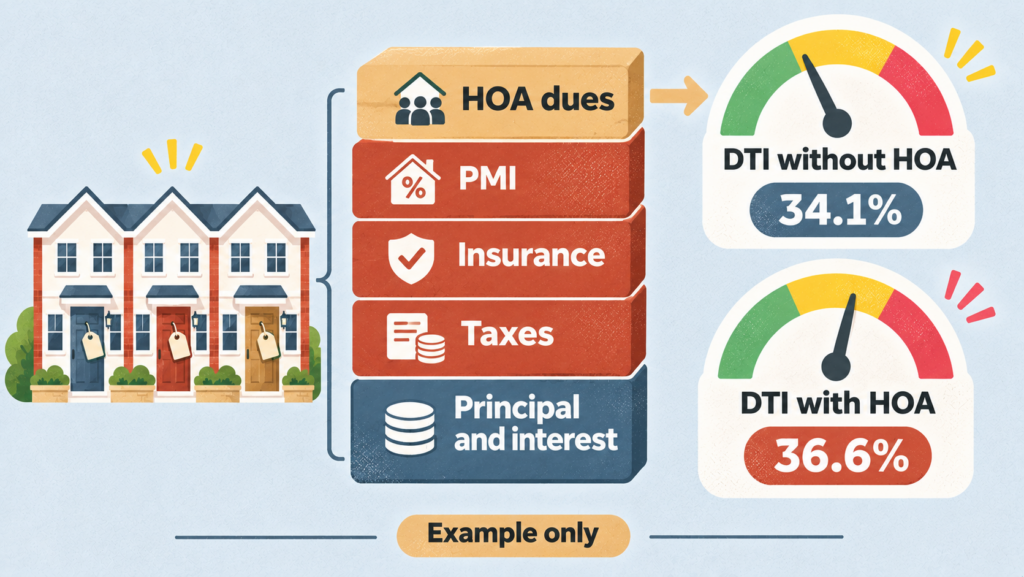
Disclaimer: This scenario is hypothetical and provided solely for educational purposes. The purchase price, down payment, interest rate, taxes, insurance, HOA dues, mortgage insurance, and payment amounts are illustrative and do not represent an offer, quote, or guarantee of actual loan terms. Actual costs and qualification requirements vary by borrower, property, lender, loan program, location, and applicable guidelines.
Section 19
Common Reasons a Townhouse Mortgage Can Be Delayed or Denied
Borrower Does Not Meet Underwriting Requirements
Your credit, income, DTI, or assets may not meet the loan’s rules.
Appraisal Issues
The appraisal may come in lower than the price, or it may flag needed repairs.
HOA Documentation Is Missing
If the HOA is slow to send documents, your loan can stall.
Project Has Financial or Insurance Problems
Weak finances, low reserves, or poor insurance can make the project ineligible for some loans.
Property Classification Is Unclear
If no one is sure whether the townhouse is a condo or a PUD, the lender may need time to sort it out.
The Townhouse Has Unacceptable Property Characteristics
Some property features, such as unusual ownership setups or certain use restrictions, may not meet loan rules.
All of these point back to the same idea. Mortgage approval is about both the borrower and the property.
Section 20
How to Prepare Before Making an Offer on a Townhouse
Confirm the Townhouse’s Legal Classification
Ask the listing agent and check the documents to learn whether the home is a condo, a PUD, or owned outright.
Ask About HOA Dues
Find out the current dues and whether they are likely to rise.
Ask About Special Assessments
Ask if any assessments are in place or planned.
Review HOA Financial Information When Available
If you can, look at the HOA’s budget, reserves, and meeting notes for signs of trouble.
Get Pre-Approved Before Shopping
A pre-approval gives you a clearer sense of your budget and shows sellers you are serious.
Give Your Lender the Property Details Early
The CFPB recommends sharing details like property taxes and HOA dues with lenders, so your Loan Estimates are more accurate.
Section 21
How to Compare Mortgage Options for a Townhouse
Compare the Same Loan Type
Make sure each offer is for the same loan type, amount, and term.
Compare Interest Rate and APR
The APR helps show the cost of the loan beyond the rate alone.
Compare Closing Costs
Look at the lender charges and third-party costs on each Loan Estimate.
Compare Mortgage Insurance
PMI and FHA mortgage insurance work differently, so compare them carefully.
Include HOA Dues
Add the HOA dues to each scenario, since they affect your budget and your DTI.
Compare the Full Monthly Housing Cost
Look at the total of principal, interest, taxes, insurance, mortgage insurance, and HOA dues. Since HOA dues can change your qualifying ratio, it helps to understand how lenders calculate your debt-to-income ratio. The Wonder Rates Rate Comparison Calculator can also help you compare two loan offers side by side.
Section 22
What to Know Before Buying a Townhouse With a Mortgage
Townhouse mortgage requirements are not set by the word “townhouse” alone. Your approval still depends on your credit, income, assets, debts, down payment, and the loan program’s rules. But the townhouse itself also needs to meet property requirements and, in some cases, project requirements.
So the most important early question is not just “Can I qualify?” It is also “How is this townhouse legally set up?” and “Does it meet the rules of the loan I want?” This matters most when the townhouse is part of a condo or PUD. As Fannie Mae’s current guidelines show, the project type and unit type can change the review method and the eligibility rules.
Section 23
Explore Your Townhouse Mortgage Options
Thinking about a townhouse? Start by talking through your scenario with a mortgage professional. They can help you see which options may fit you and the property. Get Started with Wonder Rates to review your options, or explore mortgage options for buying a home.
Section 24
Disclaimer
This article is provided for general educational and informational purposes only and should not be considered mortgage, financial, legal, tax, real estate, or investment advice. Mortgage requirements vary by loan program, lender, investor, borrower qualifications, property characteristics, location, and applicable underwriting guidelines.
A townhouse is a property type or architectural style and may be legally structured in different ways, including as a condominium, planned unit development, or other ownership structure. The mortgage requirements and project review applicable to a specific townhouse depend on its legal and ownership structure, the applicable loan program, and current lender and investor guidelines. A townhouse that appears similar to another property may not have the same financing requirements.
Any credit score, down payment, debt-to-income ratio, loan amount, interest rate, mortgage insurance, HOA fee, property tax, insurance cost, monthly payment, or other figure used in an example is hypothetical and provided for educational purposes only. Examples are not loan quotes, offers, commitments to lend, guarantees of approval, or representations of actual mortgage terms.
FHA, VA, USDA, Fannie Mae, and Freddie Mac requirements are subject to applicable program guidelines and may change over time. Meeting a general program guideline does not guarantee mortgage approval. Lenders may have additional requirements, and the final determination of eligibility is based on the specific borrower, property, transaction, documentation, and underwriting decision.
HOA dues, special assessments, project insurance, financial condition, litigation, repairs, rental restrictions, commercial use, and other project characteristics may affect the financing review for certain townhouses. Not every lender or loan program reviews these factors in the same manner.
Monthly payment estimates should not be used as a substitute for an official Loan Estimate or other loan disclosure. Actual payments and closing costs may vary based on interest rate, loan amount, taxes, insurance, mortgage insurance, HOA dues, lender fees, prepaid items, and other transaction-specific factors.
Readers should verify current requirements with the applicable government agency, mortgage lender, and other qualified professionals before making a financing decision. References to government agencies or government-sponsored enterprises are provided for informational purposes and do not constitute an endorsement of Wonder Rates or any mortgage product.
Duc Pham, Mortgage Broker | NMLS# 844897, Wonder Rates, Inc. | NMLS# 1518655 | DRE# 02047445 | DFPI# 60DBO-59134 | Equal Housing Opportunity. Equal Housing Lender. | Licensed in: AL, AZ, CA, CO, FL, GA, LA, MI, NC, OH, OK, OR, PA, SC, TX, VA, WA.



