
Section 01
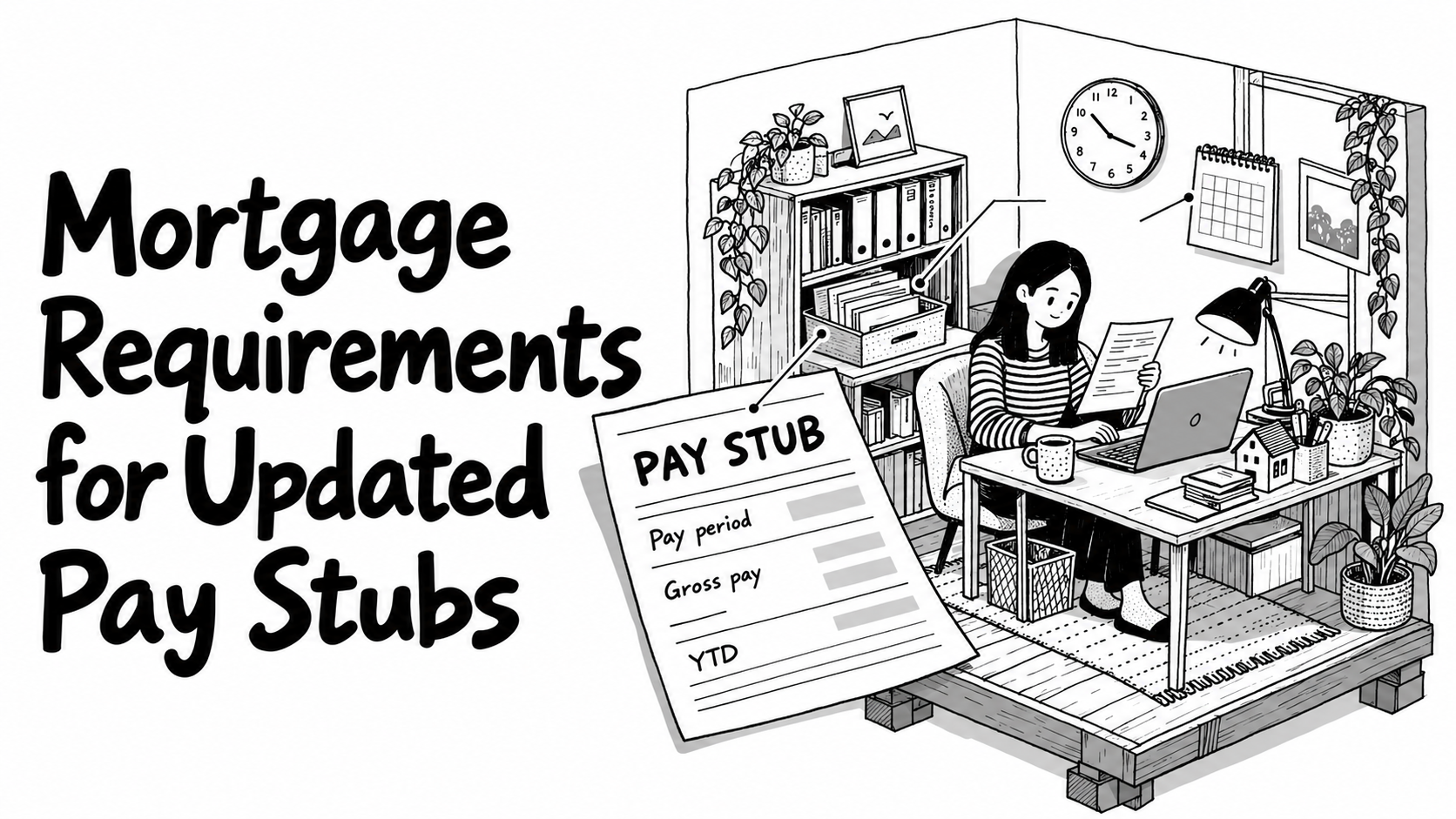
Imagine you have already sent your pay stubs, W-2s, and bank statements. Your lender has been giving you updates. Then one morning you get a new request: “Please upload your latest pay stub.”
It is easy to worry. Did something go wrong? Why are the old documents not enough?
Usually, nothing is wrong. Mortgage underwriting, which is the lender’s review of your file, does not end on day one. The lender must show that your income is real, current, and likely to continue. So it may ask for fresh papers as the loan moves forward. An updated pay stub request is common. It is not a warning sign by itself.
There are three main reasons a lender may ask:
- Your earlier document is now too old for the rules that apply.
- The lender needs newer facts, such as year-to-date pay, hours, overtime, or commissions.
- Closing is near, and the lender must recheck your job or look at a change in your pay.
A request for new papers does not mean your approval is gone. This guide explains the timing, the details a pay stub must show, what happens when your pay changes, and how to respond. It uses plain words and simple numbers.
Section 02
What Are Updated Pay Stubs in a Mortgage Application?
An updated pay stub is a newer earnings statement. The lender asks for it after you have already sent older income papers. The request can come at any stage, such as early review, conditional approval, final review, or just before closing.
A pay stub is not the same as a W-2, a bank statement, or a job check. Each one answers a different question. So one often cannot stand in for another. This review is part of the broader mortgage underwriting process, where the lender evaluates your income, assets, debts, credit, and other parts of the application.
What a Pay Stub Tells the Mortgage Lender
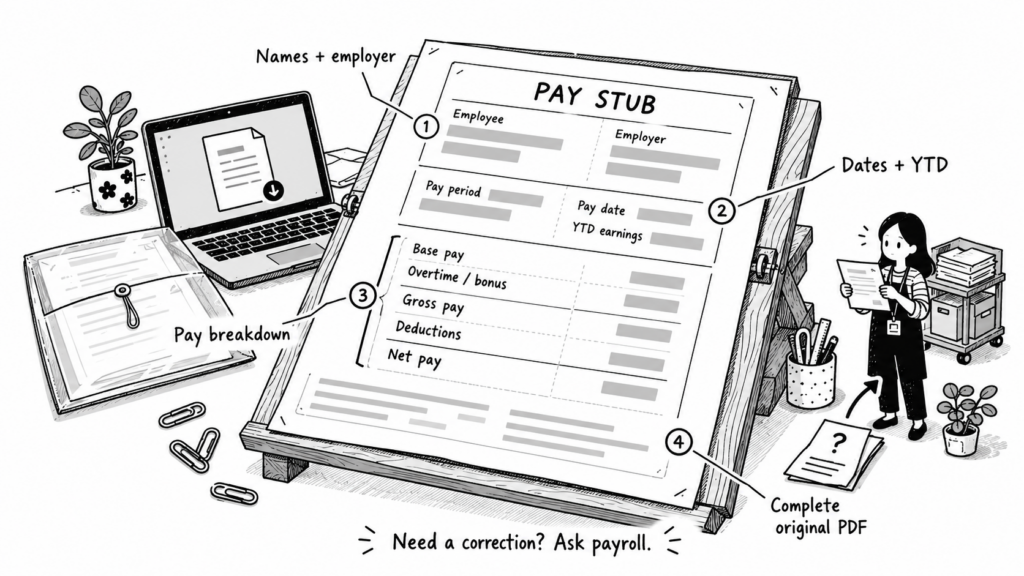
A pay stub usually shows:
- The employer and employee names
- The pay period and the payment date
- Gross pay for that period
- Year-to-date earnings
- Regular pay, overtime, commissions, or bonuses, if you get them
- Deductions and take-home pay
Gross pay and year-to-date totals matter most. Lenders do not qualify you using only the money that lands in your bank account. They calculate qualifying income under the rules of the loan program.
Updated Pay Stubs Versus W-2s and Bank Statements
Here is how the documents differ:
- A pay stub shows recent pay and year-to-date earnings.
- A W-2 shows the wages and tax withholding for a full calendar year.
- A bank statement can show your savings and where money came from. A paycheck deposit alone does not show everything needed to calculate income.
- A verification of employment, or VOE, confirms your job through your employer or an approved outside source.
Some programs allow other ways to verify income. But do not send a bank statement in place of a pay stub unless your lender says that is fine.
Why a Lender May Ask for Another Pay Stub After Conditional Approval
Conditional approval means the lender likes your file so far, but some items are still open. A new pay period may have passed. Your old stub may have become too old. Or the lender may need new numbers to finish the income math.
Conditional approval is not a promise of final approval. The open items must still be cleared.
Section 03
How Recent Do Pay Stubs Need to Be for a Mortgage?
There is no single age limit for every loan program at every stage. The rules depend on the program, your type of income, the lender, and where your loan is in the process. So the honest answer is “it depends.” The next sections show you how it works in practice.
Pay Stub Age Rules Under Conventional Guidelines
Conventional loans often follow Fannie Mae or Freddie Mac rules. Here is a clear example.
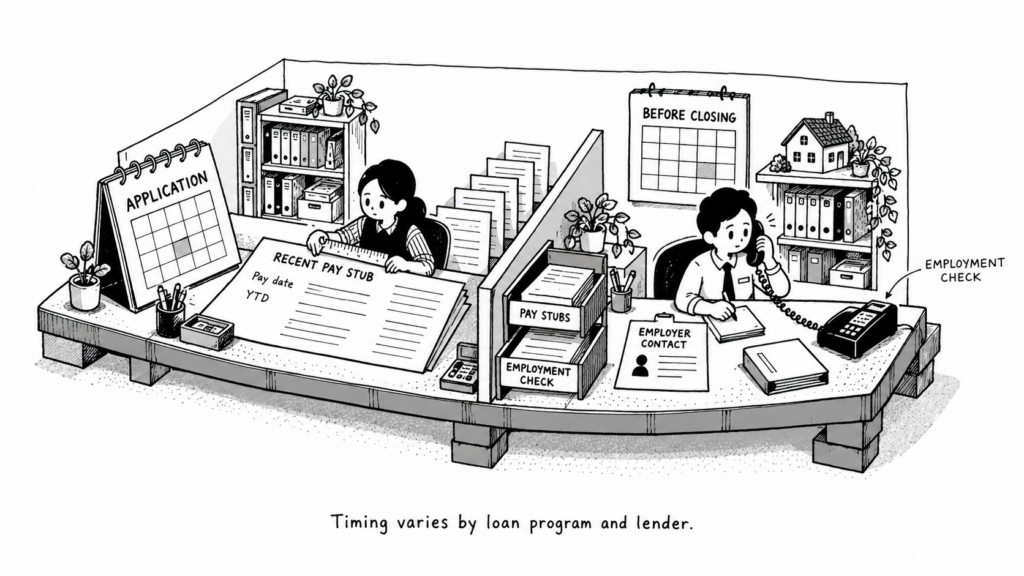
Fannie Mae’s Standards for Employment and Income Documentation says the most recent pay stub must be dated no earlier than 30 days before the initial loan application date. It must also show all year-to-date earnings. Other document-age rules can apply as well, which Fannie Mae covers in its guide on the age of documents.
Freddie Mac has a similar idea. Its Guide Section 5302.2 also covers pay stub dates for employed borrowers, and the details are in its published guide.
Example: A borrower’s initial application date is March 10. A pay stub dated February 20 is 18 days earlier, so it fits the 30-day window. A pay stub dated January 30 is 39 days earlier, so it is too old for that rule.
Example disclaimer: This is a simple illustration of one conventional rule. It is not a rule for every lender or loan program. Your lender will tell you the dates that apply to your file.
A pay stub that was fine at the start may not be enough later. The lender may need newer papers or extra checks as the loan moves along.
Updated Pay Stubs Before Closing
Near closing, lenders must finish a job recheck. For Fannie Mae loans, the lender must confirm your employment within 10 business days before the note date. The note date is usually your closing date. You can read the rule in Fannie Mae’s verbal verification of employment section.
Here is the key point. That rule is a job check, not a command to send a new pay stub 10 business days before closing. The lender can often meet it with a phone call to your employer. Fannie Mae also lists other ways, such as a written verification or an email exchange with your employer’s work email.
Example: Say your note date is Friday, October 30. Ten business days before that is about Friday, October 16, if no federal holiday falls in between. So the lender’s job check would happen on or after that date.
Example disclaimer: This is calendar math for illustration only. Holidays, the exact note date, and each company’s counting rules can change the dates. Your lender will confirm the real timeline.
Freddie Mac handles this step a bit differently. Its guide lists a few ways to complete the check. One option is a year-to-date pay stub from the pay period right before the note date, dated no more than 15 business days before it. You can see the details in Freddie Mac’s Guide Section 5302.2.
So a new pay stub is sometimes part of the closing check, and sometimes it is not. A pay stub proves your income. A job check proves your job. Lenders often need both.
Why the Timing Can Differ by Loan Program and Lender
Conventional, FHA, VA, and other programs each have their own rules. FHA rules are in the HUD handbook. VA rules are in the VA Lender’s Handbook. Lenders may also have their own steps on top of those rules.
So ask your lender for your exact dates and documents, not a generic checklist. Be careful with online claims like “every lender wants your last 30 days of pay stubs” or “you must always send two stubs.” They are too broad to trust.
Section 04
How Many Pay Stubs Do You Need for a Mortgage?
No single number fits every borrower. The count depends on how often you are paid, what each stub shows, the loan program, and whether the lender needs more proof of your income.
Weekly, Biweekly, and Semimonthly Pay Schedules
Pay schedules change the count. A person paid weekly may have four stubs in a month. A person paid every two weeks may have two. A person paid twice a month may also have two.
So the question is not just “how many?” The better question is “do my stubs cover the period the lender wants, and do they show enough to calculate my income?”
Why Year-to-Date Earnings Matter
Year-to-date earnings show what you have earned so far this year. A lender can compare that total with your normal pay and, when it matters, with last year’s income.
This is especially helpful when your hours or pay change. One big paycheck does not automatically become your normal monthly income. The lender looks at the bigger pattern.
When a Lender May Ask for Additional Pay Stubs
A lender may ask for more stubs in cases like these:
- Year-to-date totals are missing or unclear.
- You had a recent raise or a change in hours.
- You earn overtime, commissions, or bonuses.
- You had a gap in work or just returned to work.
- The numbers on your stubs, W-2s, and application do not match.
These requests are meant to solve a specific question. They do not mean you failed.
Section 05
What Information Must Updated Pay Stubs Include?
A good pay stub gives the lender enough to read your income without guessing. Use this section as a checklist.
Employer and Employee Information
The stub should name you and your employer. It should also be easy to trace back to a real source. Many lenders accept pay stubs downloaded from a payroll portal when they are complete and easy to read. Ask your lender which format it wants.
Screenshots, cropped pages, and stubs without employer details often lead to follow-up requests.
Pay Period, Payment Date, and Year-to-Date Earnings
The pay period is the span of days the pay covers. The payment date is when you got paid. They are not the same. The lender may need to confirm that your stub shows the latest expected pay period and the year-to-date totals it needs.
If the lender asks for a set of stubs, send the whole set. Do not pick only the pages with the biggest numbers.
Gross Income, Variable Pay, and Deductions
The lender needs to see your base pay apart from extra pay. Overtime, commissions, bonuses, and shift pay can be treated differently from a fixed salary.
Deductions help explain why your take-home pay is lower than your gross pay. But a lender does not qualify you using take-home pay alone.
Complete and Genuine Documentation
Send the original PDF from your employer or an unchanged download from your payroll site. If a stub has a mistake, ask your payroll team to fix it and send a new one.
Never edit a pay stub. Ask payroll to fix it. Changing a date, an amount, or a name can create serious problems with your loan and may lead to legal trouble.
Section 06
Why Mortgage Lenders Request Updated Pay Stubs Before Closing
This is the question most borrowers ask. The short answer is that the lender must be sure your file is still true on the day you close.
To Confirm Your Qualifying Income Is Still Accurate
The lender must document the income it uses to approve you. When a new pay period has passed, a current stub can confirm that your pay still matches the file. It can also explain a change in your year-to-date total.
To Verify Your Employment Has Not Changed
Your ability to repay can change if you lose a job, work fewer hours, take unpaid leave, switch from salary to hourly pay, or get a new pay plan.
That is why Fannie Mae asks lenders to confirm your job close to the note date. The rules also allow some other methods in certain cases. See the Fannie Mae guide for the details.
To Clear Up Differences Between Documents
The lender may compare your pay stubs with your application, W-2s, and employer records. A difference does not always mean a problem. But it may need an explanation.
For example, your year-to-date income may look low because you started a new job midyear, took unpaid leave, or changed your pay schedule. The lender needs enough proof to understand why.
To Finish Remaining Underwriting or Closing Conditions
Final review may include open items, a job recheck, or a last look at your income math. Not every loan needs a new pay stub. Some approved checks can meet the rule without one. Your lender will tell you what your file needs.
Section 07
What Happens If Your Updated Pay Stub Shows a Different Income?
A change in pay does not automatically end your approval. The lender must learn why the numbers changed. Then it decides whether the income in your file is still supported under the loan’s rules.
Your Paycheck Is Higher Than Before
A higher check can come from overtime, a bonus, a commission, a raise, extra shifts, or a payroll fix. But extra pay does not always count as extra qualifying income.
The lender may look at what kind of pay it is, how long you have received it, and whether it is likely to continue. If your income structure has also changed, such as moving from W-2 employment to 1099 work, the lender may evaluate that income differently. See our guide to 1099 vs. W-2 Mortgage Qualification for more detail. Fannie Mae treats base pay differently from bonus, commission, overtime, and tip income. Its income assessment update explains the document rules for base income. Its section on bonus, commission, overtime, and tip income covers variable pay. Higher pay on one stub is not always higher qualifying income.
Your Paycheck Is Lower Than Before
Lower pay can come from fewer hours, unpaid leave, less overtime, a pay cut, or a short break in work.
The lender may ask whether the change is short-term or lasting. If your regular hours or base pay have dropped, the lender may need to review your income and your whole application again.
Your Year-to-Date Earnings Do Not Match What the Lender Expected
Year-to-date totals can differ from a simple yearly guess. A job change, a gap in work, a new pay schedule, unpaid leave, or changing hours can all cause it.
Explain the difference honestly and send proof if the lender asks. Do not make up a new number and expect the lender to accept it without checking. If you want to see how changes in income can affect your overall debt-to-income ratio, the Wonder Rates DTI Calculator can help you estimate the relationship between your monthly debts and qualifying income.
Your Pay Stub Shows a Raise or a New Pay Plan
A new pay rate may need proof of the start date, whether it is permanent, and how the lender can document it. A raise on a stub can help. But the lender must still follow the income and document rules for your loan.
The practical advice is simple. Answer fast, explain big changes honestly, and let the lender decide how the update affects your income.
Section 08
Three Simple Examples of Updated Pay Stub Requests
These examples are made up. They show how requests can look in real life.
Example 1: A Salaried Borrower Is Asked for a New Pay Stub
A borrower earns a $78,000 salary and is paid every two weeks. That is $3,000 per pay period before taxes. When the borrower applied, the pay stub showed $30,000 in year-to-date earnings after 10 pay periods. Weeks later, the lender asks for a newer stub. It shows $33,000 after 11 pay periods.
Nothing changed in the salary. A new pay period simply passed. The lender uses the new stub to confirm that the pay still matches the file.
Example 1 disclaimer: This is a hypothetical illustration for education only. It does not show a universal pay stub rule, and it does not guarantee approval. The documents and timing you need depend on your loan program, the underwriting conditions, and your lender.
Example 2: An Hourly Borrower’s New Pay Stub Shows Fewer Hours
A borrower usually works 40 hours a week at $25 an hour. That is $1,000 a week before taxes. A new stub shows only 32 hours because of a short schedule change. That check is $800, which is $200 lower.
The lender may ask why the hours dropped and for more pay history. It wants to know if the drop is a short blip or a lasting change.
Example 2 disclaimer: This scenario is hypothetical and does not predict how a lender will treat any real income change. The treatment of changing pay depends on your documented history, the reason for the change, the underwriting rules, and the lender’s review.
Example 3: A Borrower Gets a Raise Close to Closing
A borrower’s pay goes from $25 to $27 an hour. At 40 hours a week, weekly pay rises from $1,000 to $1,080. The new stub shows the higher rate.
The lender may ask for the date the raise took effect and proof that it is permanent. Then it decides whether the new pay can be used under the rules for the loan.
Example 3 disclaimer: This is a hypothetical illustration. It is not a promise that a raise will raise your qualifying income or improve your loan terms. The lender must verify the change and apply the income and underwriting rules that fit your loan.
Section 09
Updated Pay Stub Requirements for Different Types of Employment Income
Two borrowers can get different requests even for similar loans. The type of income is a big reason why.
Salaried Employees
A fixed salary is often simple to document when it is steady and matches the rules. A new stub can confirm your pay rate and year-to-date total. If you changed jobs, got a raise, or took leave, the lender may need more papers.
Hourly Employees With Changing Hours
Hourly pay moves with your hours, shifts, time off, and pay rate. The lender may need to build a pay history and decide whether your income is steady. A single week with extra hours does not become your normal pay.
Employees Who Earn Overtime, Bonuses, or Commissions
Extra pay often gets a closer look than base pay. The lender may study your past earnings, your year-to-date totals, and how often you get paid this way.
Fannie Mae’s guide on bonus, commission, overtime, and tip income asks for a completed verification of employment, or the most recent pay stub plus two years of W-2s. It recommends a two-year history. It can accept at least 12 months of income when positive factors support the shorter history. Check the current guide for exceptions.
Borrowers Who Recently Started a New Job
A new job may mean the lender must confirm your start date, pay plan, and terms. It must also decide whether the income can be used under the rules.
Some borrowers have an offer but have not started yet. Fannie Mae has a separate section on employment offers and contracts with its own conditions. Do not assume an offer letter can replace a pay stub the lender asks for.
Borrowers With More Than One Job
The lender may need papers for each job whose income it uses. A stub from one job does not prove what you earn at a second job.
If the second job is new, seasonal, or has changing hours, the lender may ask for more records to show a steady history.
Section 10
What to Do If You Have Not Received Your Next Pay Stub Yet
Sometimes the lender wants a new stub, but your next payday is days away. Here is how to handle it.
Ask the Lender Which Item Is Still Open
Find out exactly what the lender needs. It might be a certain pay period, an updated income figure, proof of current work, or something else. A quick question can save you from sending the wrong document.
Check Your Employer’s Payroll Portal
Many employers post pay statements online. You may be able to download the latest one yourself. It must be a real, finished pay statement. A preview or an estimate is not a finished pay stub, so do not present it as one.
Ask Whether Another Verification Method Is Allowed
Some programs allow your employer or an approved outside service to verify your job or income. Whether that works depends on the program and your file. Do not assume a bank statement, offer letter, or employer email will replace a pay stub. Let the lender decide.
Tell the Lender Early if a Document Will Be Late
Tell your loan officer when your next pay statement is due. Ask if the timing affects underwriting or closing. Never create or change a document to meet a deadline. Share the timing issue and follow the lender’s steps.
Section 11
Common Mistakes to Avoid When Submitting Updated Pay Stubs
Uploading Only the Page With the Biggest Paycheck
The lender needs complete and accurate papers. If it asks for several pages or pay periods, send all of them.
Sending Screenshots That Leave Out Key Details
A cropped screenshot may hide the employer name, the pay period, or the year-to-date total. Upload the original PDF or a complete, easy-to-read download whenever you can.
Thinking a Higher Paycheck Always Helps You Qualify
A one-time boost from overtime or a bonus may not count the same as a permanent raise in base pay. The rules decide what counts.
Leaving Out a Cut in Hours or a Job Change
Big changes at work can affect your loan. It is better to tell your lender early and send what it asks for than to let a surprise show up later.
Waiting Until the Last Minute
A late document can slow the lender’s review. Reply quickly. If you are not sure of the deadline, ask.
Assuming New Pay Stubs Guarantee Final Approval
A pay stub is one piece of your file. Your income, job, savings, credit, and the home may all need checking before the loan can close.
Section 12
Mortgage Updated Pay Stub Checklist
Before you upload new pay stubs, make sure you have these items:
- The latest finished pay stub for the pay period the lender asked for
- Full pages with your name and your employer’s name visible
- Gross pay and year-to-date earnings that are easy to read
- Proof of any recent raise, pay change, bonus, commission, or job change, if requested
- Any extra pay periods or W-2s the lender named
- A short, honest explanation of big differences from your earlier papers
- The lender’s deadline and its preferred way to upload
Follow your lender’s exact request. The right documents depend on your income, your loan program, and where you are in the process. Ask your lender for your exact dates, not a generic checklist.
Section 13
Final Thoughts on Mortgage Requirements for Updated Pay Stubs
Updated pay stubs are a normal part of income checks in many mortgage deals. They help the lender confirm that your pay and your job still match what is in your file. Complete, accurate, and timely papers make that review go more smoothly.
Still, the final decision comes from the full underwriting review. A pay stub is one piece of that picture. If you stay in touch with your lender and send what it asks for, you give your file the best chance to stay on track.
Section 14
Sources
- Fannie Mae Selling Guide, B3-3.2-01, Standards for Employment and Income Documentation
- Fannie Mae Selling Guide, B3-3.1-04, Verbal Verification of Employment
- Fannie Mae, Income Assessment, Now Simplified
- Fannie Mae Selling Guide, B3-3.3-02, Bonus, Commission, Overtime, and Tip Income
- Fannie Mae Selling Guide, B3-3.3-03, Employment Offers or Contracts
- Fannie Mae Selling Guide, B1-1-03, Allowable Age of Credit Documents and Federal Income Tax Returns
- Freddie Mac Seller/Servicer Guide, Section 5302.2, Employed Income Documentation and Verification Requirements
- HUD, FHA Single Family Housing Policy Handbook 4000.1
- VA, Lender’s Handbook, VA Pamphlet 26-7
Disclaimer: This article is provided for general informational and educational purposes only and does not constitute financial, mortgage, tax, legal, or credit advice. Mortgage documentation requirements vary by loan program, investor guidelines, lender policies, income type, employment circumstances, and individual borrower circumstances. References to Fannie Mae, Freddie Mac, FHA, VA, or other mortgage guidelines are for general educational purposes and should be verified against the current official requirements applicable to a specific loan. The examples in this article are hypothetical and do not guarantee mortgage approval, a particular qualifying income calculation, or a specific closing timeline. Borrowers should follow their lender’s document requests and consult qualified professionals when necessary.
Duc Pham, Mortgage Broker | NMLS# 844897, Wonder Rates, Inc. | NMLS# 1518655 | DRE# 02047445 | DFPI# 60DBO-59134 | Equal Housing Opportunity. Equal Housing Lender. | Licensed in: AL, AZ, CA, CO, FL, GA, LA, MI, NC, OH, OK, OR, PA, SC, TX, VA, WA.



