
Section 01
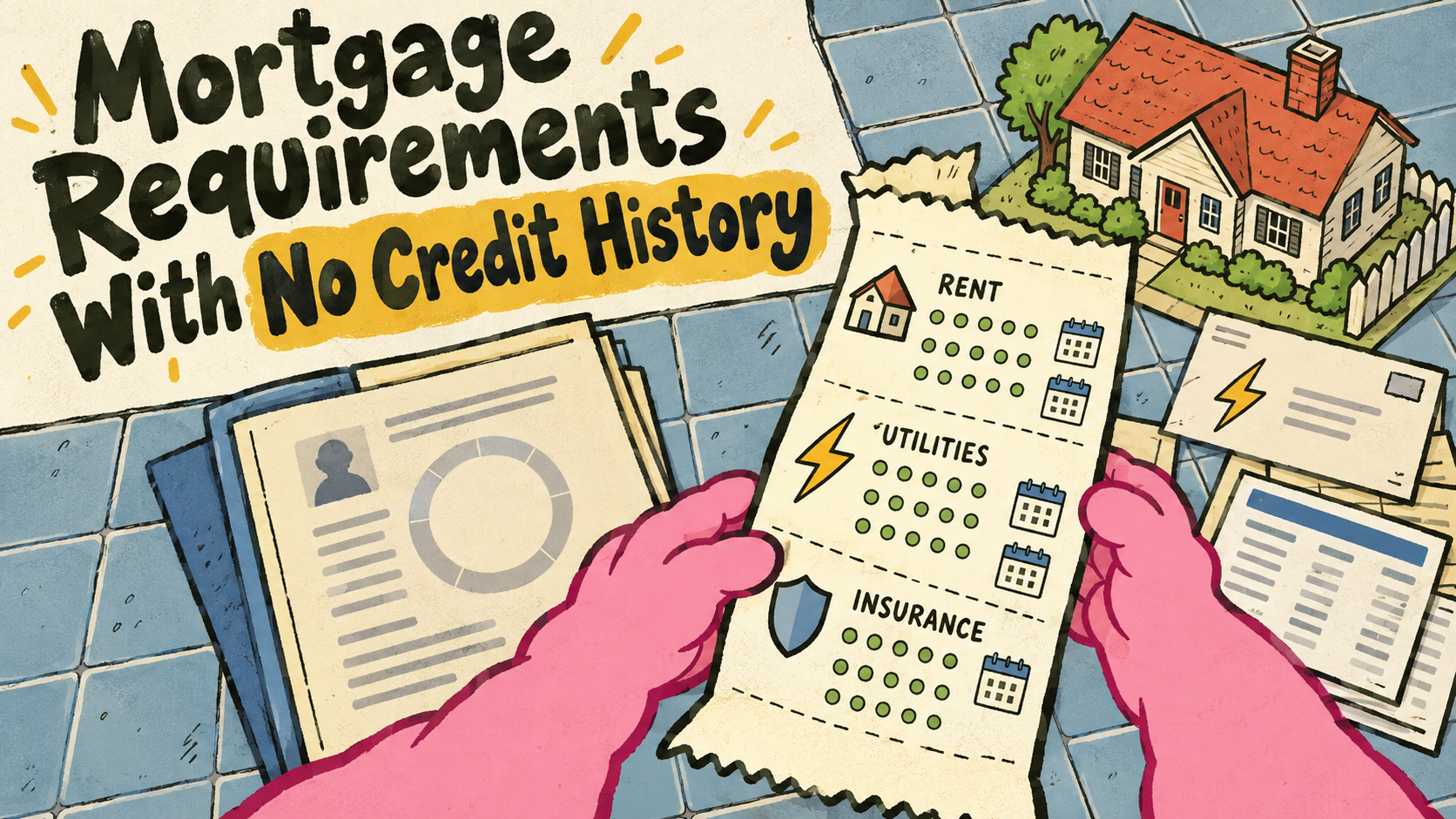
Can you get a mortgage if you have never used credit? Sometimes, yes. Having no credit history is not the same as having bad credit, and a missing credit score does not automatically mean a mortgage is out of reach.
This guide explains the mortgage requirements with no credit history in plain language. You will learn how lenders may use rent and utility payments as proof of responsible habits, which documents to gather, and how the process usually works. Every program has its own rules, so treat this as a map and not a promise.
Section 02
What Is the Difference Between No Credit History and Bad Credit?
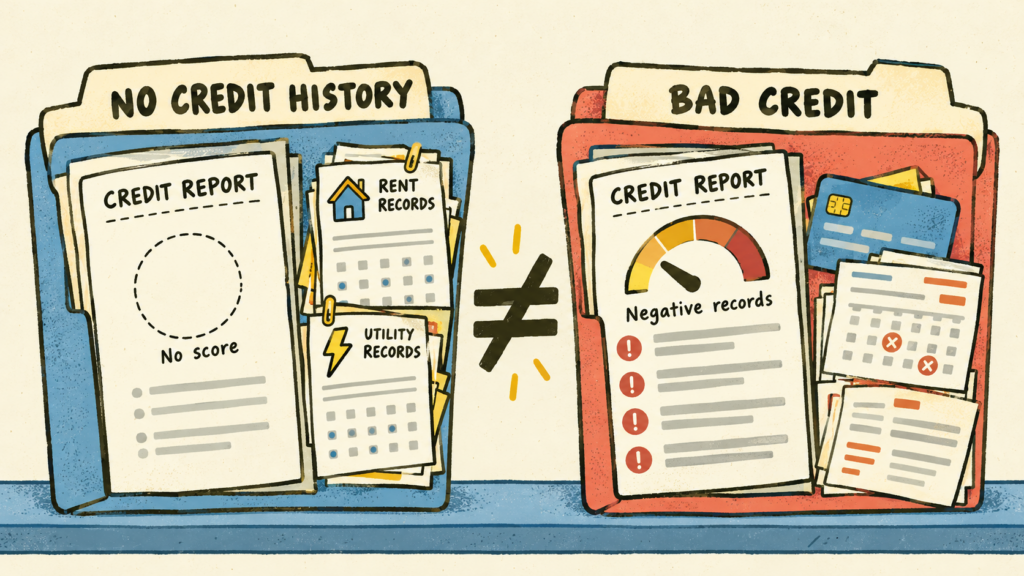
No credit history generally means there is not enough traditional credit information to produce a credit score. Bad credit is different. It usually means a credit file shows late payments, high balances, collections, or other negative marks.
Picture someone who has paid rent, utilities, and insurance on time for years but never opened a credit card. That person may have excellent habits and still have no score. On the other hand, a person with a score of 540 has a file full of information, and not all of it is positive. A missing history does not guarantee a strong profile, and it does not guarantee a mortgage either.
What Does It Mean to Be Credit Invisible?
A person is sometimes called credit invisible when they have little or no information in the traditional credit reporting system. This happens when someone has never had a credit card, a reported installment loan, or another account that reports to the major credit bureaus.
Before treating a file as “no credit,” a lender must confirm the missing score is real. Under Fannie Mae’s guide, the lender checks all three major credit repositories. The lender must also make sure the credit report shows the right name, Social Security number, and current address, so that a typo is not the reason a score could not be produced.
What if You Have a Credit Score That Is Too Low?
Having a low score is not the same as having no score. Nontraditional credit is not a universal workaround for someone who has enough traditional credit to generate a score that falls below the minimum.
Under Fannie Mae’s guide, a lender generally cannot use nontraditional credit when the borrower has enough credit for a score but the score is below the required minimum. There is a limited exception for certain HomeReady loans. A lender also cannot use it to skip over significant negative events such as a prior bankruptcy or foreclosure.
Why This Difference Matters for Mortgage Approval
The difference decides which path a lender can use. A borrower with no score may need alternative payment records. A borrower with a low score may need to work on the items that are lowering the score.
That is why the first step is to get your credit reports and read them. You and your Loan Officer can then tell whether you have a true lack of history, a reporting error, or negative information that needs attention.
Section 03
What Is Nontraditional Credit History?
Nontraditional credit history is documented proof of regular payments that may not appear on a standard credit report. When traditional data is missing, a lender may look at these records to see how you handle recurring bills. This depends on the loan program and the lender.
It is not simply a list of bills you say you paid. The lender needs acceptable evidence, and it must follow the rules of the specific program. Fannie Mae, for example, publishes separate guidance on the number and types of references and on how they must be documented.
Examples of Nontraditional Credit References
Depending on the program, common examples may include:
- Rent paid to a landlord or property management company
- Utilities such as electricity, gas, water, phone, television, and internet
- Insurance payments, such as renter’s or auto insurance
- Other recurring obligations that the program recognizes
Fannie Mae’s guide says eligible references are payments made on a regular basis, with no more than three months between payments. It also says utilities cannot count as a separate reference if they are already included in your housing payment. Not every bill counts, and not every lender accepts every type.
Why Rent Payment History Can Be Important
Rent is often the most useful reference because it shows you can handle your biggest recurring bill. For Fannie Mae loans underwritten through Desktop Underwriter that require nontraditional credit, a housing payment must be included as one of the references.
Under the guide, housing payments are documented for the most recent 12 consecutive months. Acceptable proof may include canceled checks, bank statements, or money orders that clearly show who was paid, how much, and that payments were steady. A landlord may also verify the rent directly, whether the landlord is a person or a property management company.
Can Utility Bills Help You Qualify?
They may. Utility payments can help show a pattern when they qualify as references under the program. The lender usually needs records that identify the account, the payment amount, and a steady payment history.
Paying utilities on time is a good habit. Documenting them is what lets a lender count them. Even so, on-time utility bills do not create a credit score, and they do not guarantee mortgage approval.
Does Nontraditional Credit Guarantee Approval?
No. Alternative payment records may help address the missing score, but you still must meet the program’s rules. Income, employment, debts, assets, down payment, and the property all still matter.
Section 04
Mortgage Options for Borrowers With No Credit History
Some mortgage programs and underwriting paths can consider borrowers who do not have a traditional credit score. Availability and terms vary, so it helps to compare program rules and ask each lender directly whether it can review a no-score file.
Conventional Mortgages With Nontraditional Credit
Conventional financing may be possible for some borrowers with no credit score, depending on agency rules and the underwriting method. Fannie Mae, for example, has specific rules for loans that rely on nontraditional credit, and they differ between manual underwriting and Desktop Underwriter, often called DU.
The details show why no program is available to everyone. For manually underwritten Fannie Mae loans that rely on nontraditional credit, the guide currently requires a one-unit principal residence and a purchase or limited cash-out refinance. It also limits the loan to the baseline loan limit and caps the debt-to-income ratio at 36%. If no borrower can document a housing payment history, 12 months of reserves are required. Please check the current guide before relying on these details, since agencies update them.
FHA Loans With No Credit History
An FHA-approved lender can explain how current FHA underwriting applies when no traditional score can be produced. It is important to separate a true lack of history from a low score or a negative credit history.
No one can promise that FHA will approve a borrower based on rent or utility payments alone. The lender must follow current FHA requirements, choose the right underwriting path, and review the complete application.
Other Lender Programs and Portfolio Loans
Some lenders offer portfolio or other programs with their own rules. These may consider alternative payment history or other strengths, but availability, pricing, and eligibility differ. Freddie Mac also publishes its own guidance for borrowers without credit scores, so it is wise to ask which standard a lender follows.
A few good questions to ask are whether the lender has experience with no-score files, what documents it accepts, and whether the loan follows agency standards or the lender’s own portfolio rules.
How to Compare Your Options
Look beyond the minimum down payment and the advertised rate. Ask about credit-history requirements, eligible property types, reserves, debt-to-income limits, documentation, mortgage insurance, fees, and whether the lender can review a borrower without a score.
A program that accepts no-score borrowers is not automatically the best choice for every buyer. Compare real eligibility and total cost using your own numbers.
Section 05
What Documents Do You Need to Get a Mortgage Without Credit History?
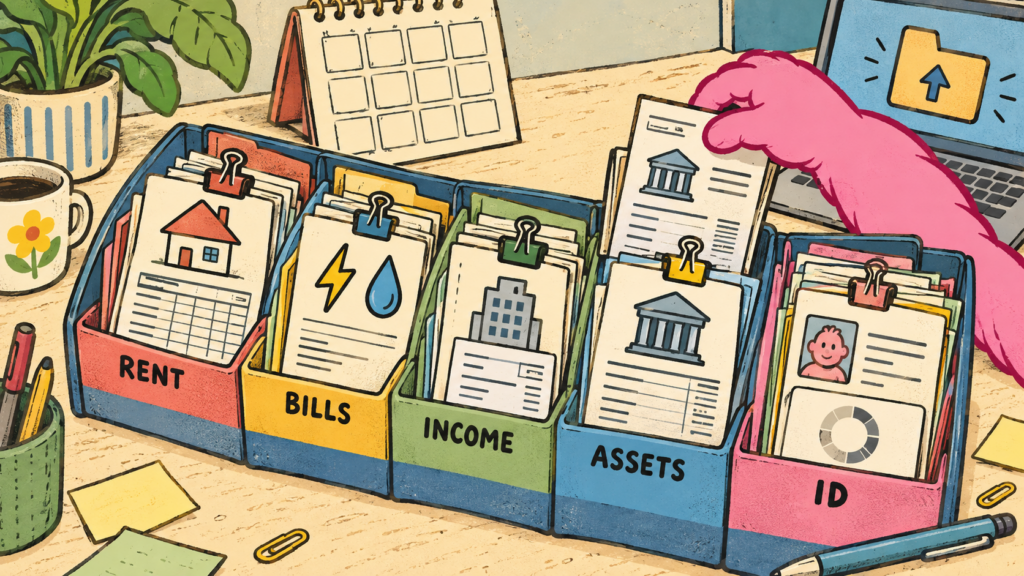
A lender may need documents from several areas, including alternative credit references, income, employment, assets, debts, and the property. The exact list depends on the program and the underwriting method. Use this section as a preparation guide and not as a universal checklist.
Rent Payment Documentation
A lender may request a landlord verification, a payment ledger, bank statements, canceled checks, or other acceptable proof of housing payments. The records should clearly show who was paid, how much, and when.
Keep records for the full period the lender asks for. For Fannie Mae loans, that is the most recent 12 consecutive months. A note that says you always paid on time is usually not enough without the supporting records the program requires.
Utility and Other Recurring Bill Records
Keep statements and proof of payment, especially if you pay by automatic withdrawal or online bill pay. The lender decides which accounts qualify and how many references it needs. A pile of bills is not helpful if the records do not meet the program’s standards.
Fannie Mae’s guide also says a lender must include all of the credit references, not just the ones that look good. So expect the lender to review the full 12 months, including any late payments.
Income and Employment Documents
No credit history does not remove the need to prove you can repay the loan. Depending on your job, the lender may ask for pay stubs, W-2s, tax returns, employer verification, or self-employment records. If your job or income recently changed, expect extra questions.
Bank Statements and Asset Documentation
Bank statements can show your funds for the down payment and closing costs, any reserves, and sometimes recurring payments. They can also help prove a payment history when they clearly show the payee and amount.
A bank balance alone does not prove a payment history. The lender looks at assets, income, and credit history as separate but related parts of your file.
Identity and Credit Report Verification
The lender must verify your identity and confirm that your credit report is accurate. If no score appears because of a mistake in your identifying information, the fix may be to correct the error, not to apply as a no-credit borrower.
Organizing Your Documents Before Applying
Sort your records by account and month. Keep complete statements instead of single pages. Ask your lender which format it prefers and whether electronic records are fine. If you paid rent in cash or through an informal arrangement, ask early what verification is possible.
Good organization can prevent avoidable delays, but the lender still decides whether your records meet the program’s rules.
Section 06
How Lenders Evaluate a Mortgage Application With No Credit Score
Alternative payment records are only one piece of the file. Here is the general flow.
Step 1: Confirm That No Score Can Be Generated
The lender reviews your credit report to confirm that the missing score reflects too little credit information. It should not be an error, and it should not be an existing score that simply misses the minimum.
Step 2: Determine Whether the Program Allows Nontraditional Credit
The lender identifies the loan program, the underwriting method, and the rules for a borrower without a score. Some paths require nontraditional references. Others may allow different ways to assess your history under specific conditions.
Step 3: Verify the Required Payment History
The lender reviews your eligible references and supporting documents. The number of references and the history required depend on the guidelines. Under Fannie Mae’s guide, for example, manually underwritten loans generally require four references per borrower without a score, while loans run through DU require at least two when DU calls for nontraditional credit. These numbers apply to that program and can change.
The guide also sets standards for what a lender looks for in those records. For example, there should be no late housing payments in the past 12 months, no more than one other account with a 30-day late payment in that time, and no collections other than medical ones, or judgments, in the past 24 months.
Step 4: Evaluate Income, Debts, Assets, and Reserves
Next the lender looks at your ability to repay, using the usual income, debt, and asset review. You may have a perfect rent record and still need enough qualifying income, manageable debt, funds to close, and any required reserves. The relationship between your income and monthly debt obligations is also an important part of mortgage qualification. For a closer look at how lenders use this calculation, see our guide to Debt-to-Income Ratio (DTI). If you want to estimate your own debt-to-income ratio before speaking with a lender, the Wonder Rates DTI Calculator can help you see how your monthly debts compare with your qualifying income.
Step 5: Review the Property and Complete Underwriting
The property must meet the loan program’s requirements, including appraisal and eligibility standards. The lender then reviews the whole file and decides whether the loan can be approved, whether conditions remain, or whether the application does not meet the requirements.
Section 07
Common Challenges When Applying for a Mortgage Without Credit History
You Have Paid Bills on Time but Cannot Prove It
You may have a strong real-world payment history but few records. If rent was paid in cash or bills were paid informally, proof can be harder. Ask the lender what records or verification methods are allowed before assuming your history can be used.
Your Rent Is Paid by a Family Member or Roommate
Payments made by another person may not show your own payment history in the same way. The lender needs to know who is legally responsible, who makes the payments, and what proof the program accepts.
Shared housing does not automatically disqualify you. Fannie Mae’s guide, for instance, says that when two borrowers on the same loan are both named on the lease, that housing record counts as one reference for each of them, even if only one has been paying. Rules differ by program, so ask.
You Have Never Used a Credit Card
You do not have to open several cards just to start a mortgage conversation. The first step is to learn whether a no-score path exists and which alternative records are accepted.
If building credit would help your longer-term plans, a qualified lender or credit counselor can explain responsible ways to start. Avoid taking on debt only to chase a mortgage.
You Have Credit History in Another Country
Foreign credit records may matter in some cases, but acceptance depends on the program and lender. Fannie Mae’s guide says that when a non-U.S. citizen or foreign borrower lacks enough U.S. references, the lender must use references from foreign countries to reach the required number.
Foreign history is not automatically the same as a U.S. credit score. Ask the lender which records it can consider and what translation or verification it needs. If immigration status is part of your situation, our guide on the ITIN mortgage and home buying process may also help.
Your Co-Borrower Has a Credit Score, but You Do Not
A co-borrower’s credit may affect how the file is reviewed, but it does not erase every requirement for the borrower without a score. The lender must look at both borrowers under the program rules and decide what extra documentation is needed.
Some programs have special rules. In Fannie Mae’s HomeReady program, for example, a borrower with no score and no references can still be eligible if no more than 30% of the loan’s qualifying income comes from that borrower. Tell your lender early and ask how it will review everyone’s credit, income, and debts.
You Have No Credit History and Limited Savings
A missing score and limited savings are two separate challenges. Even if a program can consider alternative credit, you still need to meet down payment, closing cost, and reserve requirements. Review the whole budget before you apply, including the monthly payment, property taxes, homeowners insurance, and cash needed at closing.
Section 08
Should You Build Credit Before Applying for a Mortgage?
There is no single right answer. It depends on your timeline, your financial profile, the loan programs available, and what a lender tells you. Some borrowers can explore mortgage options right away with nontraditional credit. Others may do better by building traditional credit first.
When Applying With No Credit History May Make Sense
It may be reasonable to talk to a lender now if you have stable qualifying income, a documented payment history, enough funds, and a realistic timeline. A Loan Officer can tell you whether a no-score path exists without asking you to open accounts first. If you want to understand how lenders may evaluate the money you have available after closing, see our guide to Mortgage Cash Reserves.
When Building Traditional Credit May Be Worth Considering
Establishing credit may widen your options or make underwriting smoother. But it takes time, and you should not open accounts or take on debt without understanding how it affects your finances.
How to Build Credit Responsibly
A few general ideas include considering a suitable starter credit product if it fits your situation, making payments on time, keeping balances manageable, and checking your reports for accuracy. No set number of months or accounts guarantees a score or a mortgage approval.
Questions to Ask a Loan Officer Before Deciding
- Can you evaluate a borrower with no traditional credit score?
- Which loan programs and underwriting paths are available?
- What alternative credit references and documents do you accept?
- Would building traditional credit materially improve my options?
- What else in my financial profile should I prepare before applying?
The best next step is to understand the paths available before you make unnecessary financial changes.
Section 09
Practical Examples of Mortgage Qualification With No Credit History
These examples are made up. They show general ideas and do not promise any result.
Example 1: A First-Time Buyer Who Has Always Paid Rent
A buyer has never opened a credit card or taken out a traditional loan. They have rented the same apartment for several years and can provide rental records and bank statements showing regular payments.
The lender may be able to review that rent history as a nontraditional credit reference if the program allows it and the records meet the documentation rules. The lender would still review income, assets, debts, and other factors before deciding whether the borrower qualifies.
Disclaimer: This hypothetical scenario is for educational purposes only. The availability of a nontraditional credit pathway and the acceptability of rent documentation depend on the applicable loan program, underwriting method, lender requirements, and the borrower’s full financial profile.
Example 2: A Borrower Has No Credit Score but Pays Utilities on Time
A borrower has no score but has kept electricity, internet, and phone accounts for more than a year. They want to use these payments to show responsible habits.
The lender must decide which accounts qualify and whether the records meet the program’s rules. Some accounts may not count separately if their cost is already part of another payment, and the number of references needed depends on the underwriting method.
Disclaimer: This is a hypothetical illustration, not a guarantee that any particular utility account will be accepted. Eligible reference types and documentation requirements vary by loan program and lender.
Example 3: A Borrower Has No Credit History and Little Savings
A borrower has paid rent on time for years and has no score, but has saved only a small amount toward the purchase.
Documented payment history may help with the credit-history question, but it does not replace the money needed for the down payment, closing costs, and any reserves. This borrower may need to review the budget and savings plan before applying. Understanding how the down payment shapes your loan, including the loan-to-value ratio, can help with that planning.
Disclaimer: This hypothetical scenario is for general education only. Down payment, closing cost, reserve, and underwriting requirements depend on the loan program, lender, property, and borrower circumstances.
Example 4: A Borrower Has a Low Credit Score Rather Than No Score
A borrower has a few credit accounts, but the resulting score is below the minimum for the program they want. They ask whether rent and utility records can replace the score.
This is different from having no score, because the borrower has an established traditional profile. Under Fannie Mae’s nontraditional credit rules, alternative credit is generally not a substitute for a score that falls below the minimum, with limited program exceptions. The borrower should ask the lender to review the credit report and explain the options for their actual situation.
Disclaimer: This hypothetical example illustrates a general distinction and is not a determination of eligibility. Specific program exceptions and current underwriting rules must be reviewed by the lender.
Section 10
How to Prepare for a Mortgage Application With No Credit History
Step 1: Review Your Credit Reports
Confirm whether you truly have no score or whether a reporting problem, wrong personal information, or an existing account changes things. Fixing an error may be better than applying under a no-credit path.
Step 2: Gather Your Alternative Payment Records
Organize rent records, utility bills, payment confirmations, bank statements, and any other possible references. Ask the lender which records are acceptable and how much history is needed before assuming every bill will count.
Step 3: Prepare Income and Asset Documentation
Get the usual mortgage paperwork ready, such as pay stubs, tax documents, bank statements, and records of the funds you plan to use for the down payment and closing costs.
Step 4: Ask About Loan Programs That Accept No-Score Borrowers
Speak with a Loan Officer who can explain the options and any program limits. Ask whether your loan can be reviewed with nontraditional credit, which underwriting method applies, and which documents are needed.
Step 5: Review the Full Budget and Timeline
Look at the expected monthly payment, property taxes, homeowners insurance, maintenance, and cash needed at closing. If building traditional credit would improve your options, weigh the benefits of waiting against your current timeline.
A missing credit score is a situation to investigate, not a reason to assume mortgage approval is impossible.
Section 11
Final Takeaways: Mortgage Requirements With No Credit History
No credit history is not the same as bad credit. Some mortgage programs and underwriting paths may allow lenders to review borrowers who do not have a traditional score. Eligible rent or utility payment history may help document payment behavior when the program accepts it, and the lender may require specific records and a minimum history to verify it.
You still need to meet the program’s income, debt, asset, property, and other underwriting rules. The best next step is to confirm that you truly have no credit history, gather your documents, and ask a Loan Officer about suitable options before making unnecessary financial changes. If you have never used traditional credit, you can talk with a Loan Officer about your available mortgage options and the documents needed to review your situation.
Section 12
Disclaimer
This article is provided for general educational and informational purposes only and does not constitute financial, mortgage, credit, tax, or legal advice. Mortgage eligibility and underwriting decisions depend on the applicable loan program, current agency guidelines, lender requirements, and the borrower’s individual circumstances. Nontraditional credit history may be accepted only when permitted by the applicable program and supported by acceptable documentation. The hypothetical examples in this article are illustrative and do not guarantee mortgage approval. Requirements may change, so readers should confirm current guidelines with their Loan Officer and consult a qualified financial or credit professional when appropriate.
Duc Pham, Mortgage Broker | NMLS# 844897, Wonder Rates, Inc. | NMLS# 1518655 | DRE# 02047445 | DFPI# 60DBO-59134 | Equal Housing Opportunity. Equal Housing Lender. | Licensed in: AL, AZ, CA, CO, FL, GA, LA, MI, NC, OH, OK, OR, PA, SC, TX, VA, WA.



