
Section 01
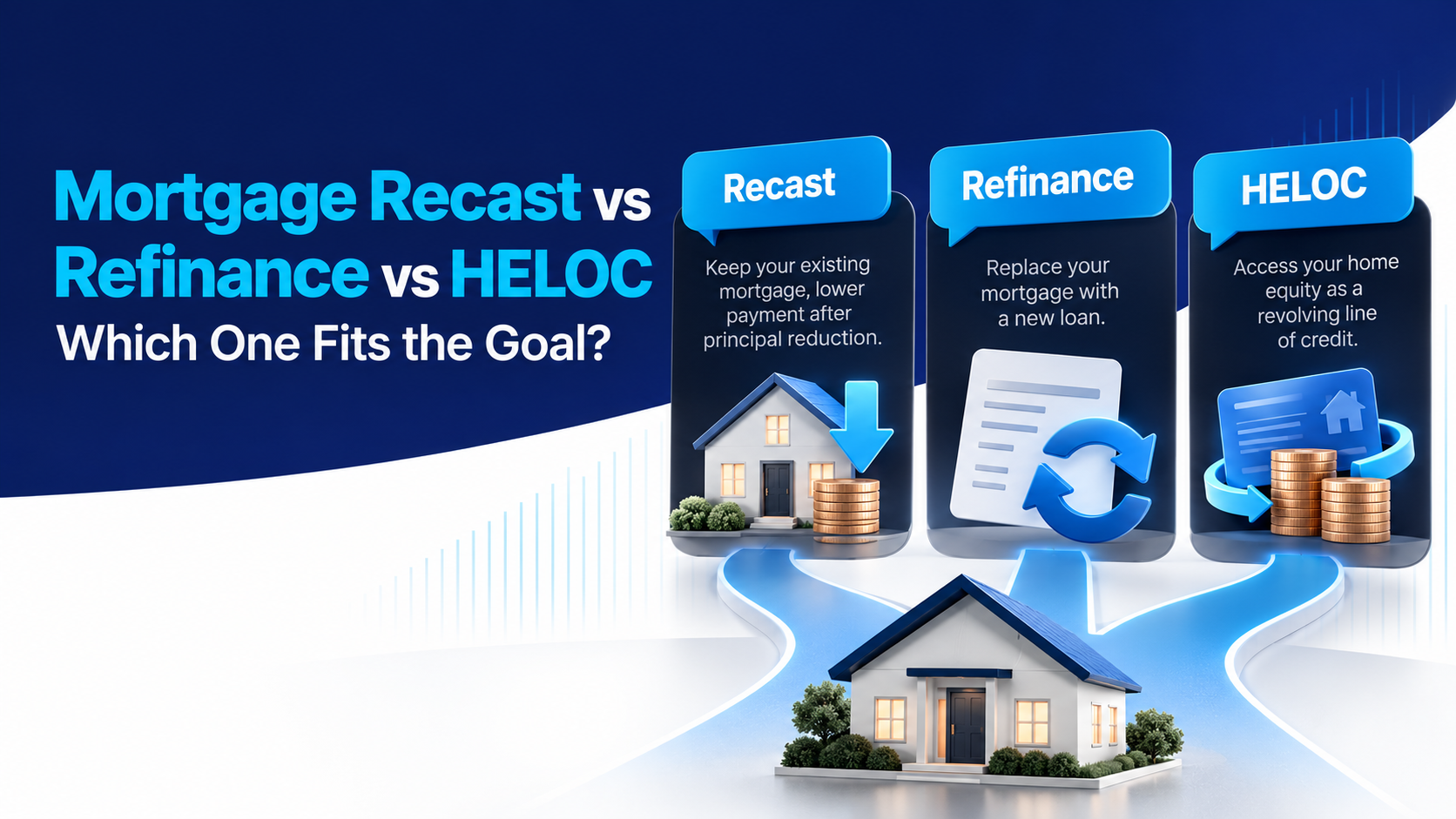
Mortgage recast vs refinance vs HELOC is not a comparison of three interchangeable products. A recast uses a principal reduction to recalculate the payment on an existing eligible mortgage. A refinance replaces the current mortgage. A HELOC is a separate revolving line secured by available home equity.
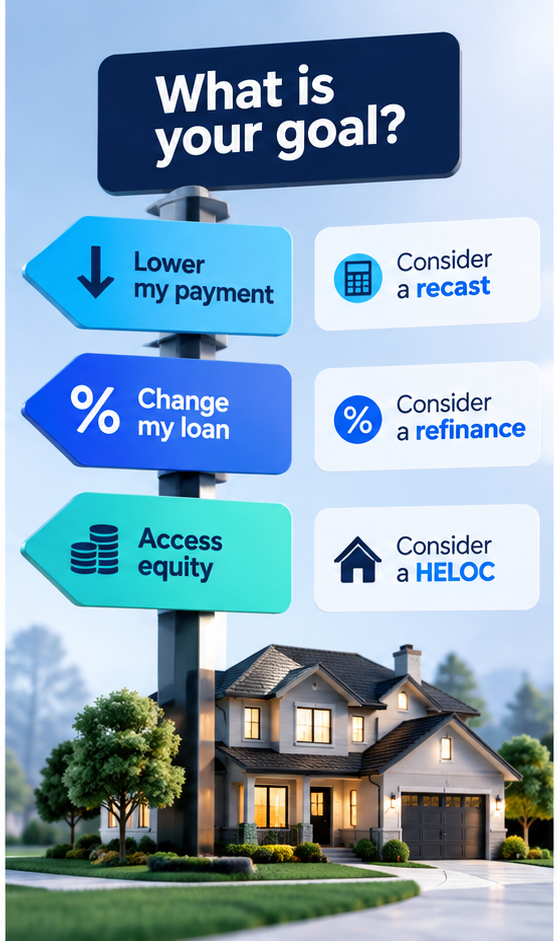
The correct starting point is the homeowner’s goal: lower the required payment, change the loan, or access funds.
Section 02
Mortgage Recast vs Refinance vs HELOC at a Glance
| Feature | Recast | Refinance | HELOC |
|---|---|---|---|
| Existing first mortgage | Usually remains | Replaced | Usually remains |
| Requires new loan | Generally no | Yes | Yes, as a separate lien |
| Uses homeowner cash | Usually requires principal payment | May or may not | No principal payment required to open |
| Provides cash to homeowner | No | Possible in eligible cash-out structure | Provides access through the credit line |
| Changes first-mortgage rate | Generally no | Yes | No, but HELOC has its own terms |
| Closing costs or fees | Servicer fee may apply | New-loan costs may apply | Line costs and fees may apply |
| Underwriting | Servicer eligibility review | Full new-loan review | New credit and property review |

Section 03
When a Recast May Fit
A homeowner who receives proceeds from selling another property, an inheritance, bonus, or business distribution may want to reduce the required payment without replacing a favorable existing mortgage.
The servicer must confirm eligibility. Not every loan can be recast, and the lump-sum payment should not be sent on the assumption that the payment will automatically change.
Wonder Rates’ guide to mortgage recast vs refinance explains what normally changes and what stays the same.
Section 04
When a Refinance May Fit
A refinance can change the rate, term, program, borrowers, or equity structure, subject to eligibility. It creates a new loan and therefore requires underwriting, disclosures, property review when applicable, title work, and closing.
The value of refinancing depends on the entire transaction. A lower required payment can come from a different rate, longer term, reduced balance, or changed insurance structure. Extending repayment can lower the payment while increasing the time debt remains outstanding.
Review Wonder Rates’ refinance options for an overview of possible goals and the information needed for a scenario review.
The Houston refinance case file shows how a break-even calculation can be presented for one completed transaction. Its figures are specific to that borrower and should not be treated as a forecast for another homeowner.

Section 05
When a HELOC May Fit
A HELOC provides revolving access to approved equity for uses such as renovations, education, business needs, or reserves. It generally creates a second lien and has its own payment, rate structure, draw period, and repayment terms.
The CFPB’s explanation of a home equity line of credit describes the draw and repayment periods consumers should understand before opening a line.
Keeping the existing first mortgage can be attractive, but the household must qualify for and manage both obligations. Variable pricing, payment changes, annual fees, inactivity provisions, and line reductions should be understood before relying on the account.
Section 06
The Break-Even Question
Break-even analysis compares upfront and ongoing transaction costs with the expected financial benefit over the period the homeowner expects to keep the financing.
A simple calculation can be a useful starting point, but it should not ignore:
- Change in remaining loan term
- Principal paid at closing
- Cash received
- Mortgage insurance
- Tax and insurance changes
- HELOC payment behavior
- Opportunity cost of using a lump sum
- Plans to sell, move, or pay off the debt
Do not describe the result as guaranteed savings. It depends on future behavior and assumptions.
Section 07
A Decision Framework
Goal: Lower the required payment while keeping the current loan
Ask the servicer whether the mortgage is eligible for recasting and how much principal reduction is required.
Goal: Change the first mortgage
Compare refinance scenarios using the new term, total costs, cash to close, and break-even horizon.
Goal: Access equity without replacing the first mortgage
Review a HELOC or other second-lien option, including variable-rate and repayment risk.
Goal: Use a large lump sum wisely
Compare recasting, making a principal-only payment without recasting, retaining liquidity, and other financial priorities with qualified professionals.
Section 08
What If You Already Have a HELOC?
Refinancing the first mortgage while keeping a HELOC may require subordination. Paying it off may require closing the line and releasing the lien.
Wonder Rates’ guide to refinancing with a HELOC explains why lien priority and lender approval can affect the timeline.
Section 09
Documentation to Gather
- Current mortgage statement
- Note or loan terms when available
- Servicer recast policy
- HELOC statement and line agreement
- Property value information
- Income, asset, and credit documents for new financing
- Estimated closing costs
- Expected ownership horizon
- Clear purpose for cash or payment reduction
Section 10
Frequently Asked Questions
Does a recast lower the interest rate?
Generally no. It usually recalculates the payment using the lower balance, remaining term, and existing rate.
Is refinancing worthwhile whenever the new rate is lower?
Not automatically. Costs, term, loan balance, mortgage insurance, time horizon, and goals all matter.
Does a HELOC replace my mortgage?
Usually it is a separate lien and credit line, although specific consolidation transactions can be structured differently.
Can I take cash out through a recast?
No. A recast follows a principal reduction and does not distribute equity to the homeowner.
Which option has the least paperwork?
A recast may involve less underwriting than a new loan, but availability and servicer requirements vary. Simplicity alone should not determine the decision.
Section 11
Final Takeaway
Use a recast to ask whether a principal reduction can lower the required payment without replacing the loan. Use a refinance to evaluate a new first mortgage. Use a HELOC to evaluate access to equity while generally keeping the first mortgage. Compare each path against the goal, total costs, liquidity, risk, and expected time horizon.
Talk with Wonder Rates about which option fits your goal →
Duc Pham, Mortgage Broker | NMLS# 844897
Wonder Rates, Inc. | NMLS# 1518655
Equal Housing Lender.
AZ, CA, CO, FL, GA, LA, MI, OK, PA, SC, TX, VA, WA, OH, AL, OR, NC
This article is for educational purposes only and is not a commitment to lend, financial advice, tax advice, or a guarantee of savings. Recast eligibility, refinance terms, HELOC availability, costs, payments, and property requirements vary by servicer, lender, borrower, property, program, and market conditions.



