
Section 01
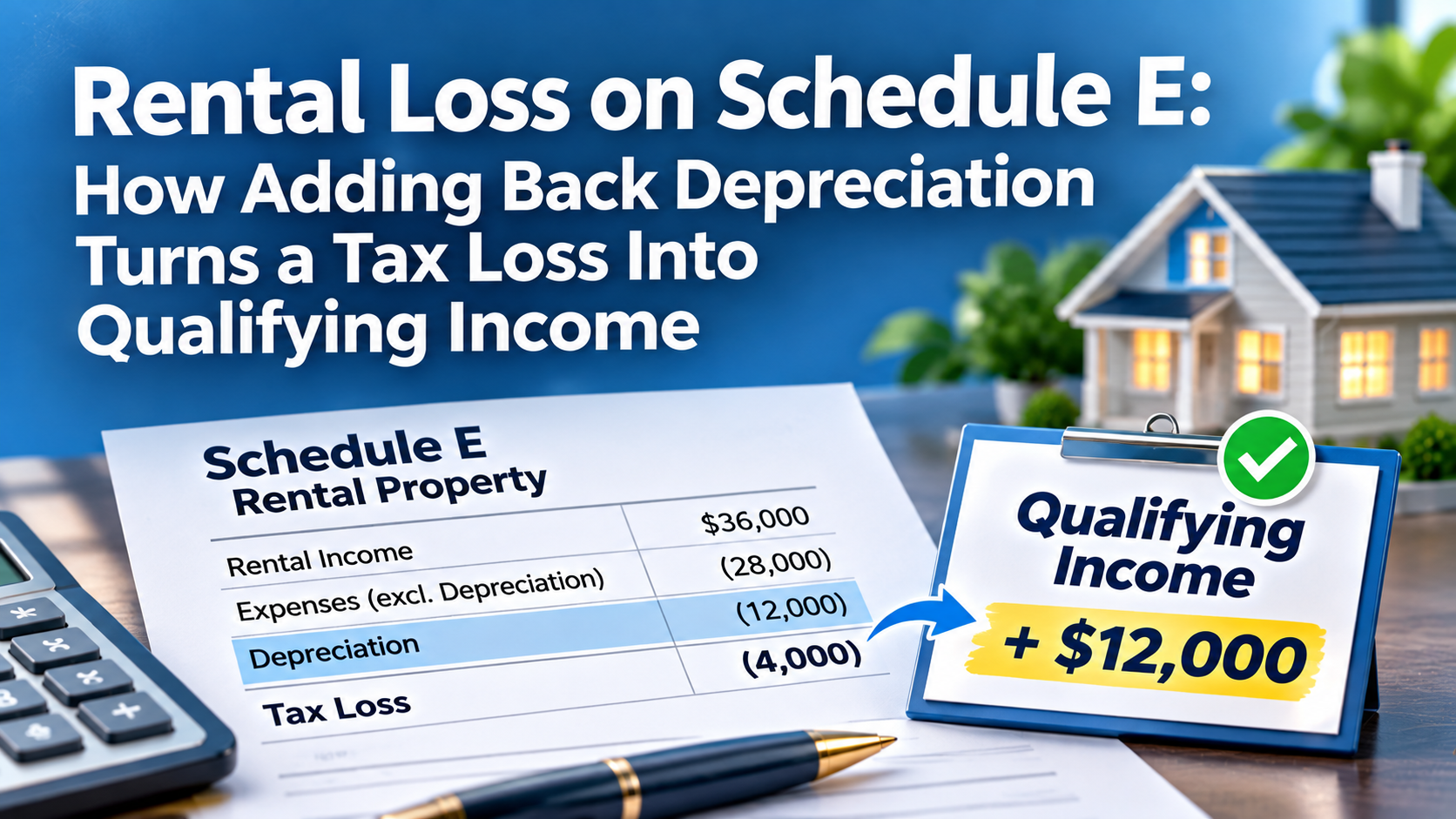
Your tax return shows a $6,000 loss on your rental property, and you assume that loss will hurt your next mortgage application. In many cases, it will not. The loss on Schedule E is a tax number, built from deductions that include large non-cash items like depreciation and expenses that the lender already counts elsewhere. Underwriters reverse those items before deciding what the property really earns.
Section 02
Schedule E (Form 1040) is where individual landlords report rental income and expenses. Each property gets its own column: rents received at the top, then a list of deductible expenses, and finally a net income or loss for that property. That bottom-line number answers a tax question, not a lending question.
The tax code lets you deduct expenses that never left your bank account in that year, and expenses that are financing costs rather than operating costs. As a result, a property that puts cash in your pocket every month can still show a loss on paper. Understanding the gap between the two is the starting point for every add-back.
Tax loss vs cash flow
A tax loss means your deductible expenses exceeded rents received. Cash flow means the money left after you actually pay the bills, including the mortgage. The two can move in opposite directions: depreciation increases the tax loss without changing cash flow, while principal payments reduce cash flow without appearing as an expense at all.
Lenders care about cash flow, because that is what pays the new mortgage. Their task is to rebuild an approximation of cash flow from the tax return, using lines that show up in a consistent place on every Schedule E.
| Schedule E line | What it reports | Cash spent this year? | Typical lender treatment |
|---|---|---|---|
| Line 3, rents received | Gross rent collected | Cash in | Starting point |
| Line 9, insurance | Hazard insurance premiums | Yes | Added back, then counted in PITIA |
| Line 12, mortgage interest | Interest paid to the lender | Yes | Added back, then counted in PITIA |
| Line 16, taxes | Property taxes | Yes | Added back, then counted in PITIA |
| Line 18, depreciation or depletion | Non-cash recovery of building cost | No | Added back |
| Line 19, other (when HOA is itemized) | HOA dues and other expenses | Yes | HOA added back if specifically identified, then counted in PITIA |
| Repairs, management, utilities, cleaning | Operating expenses | Yes | Stay deducted |
Why depreciation creates paper losses
According to IRS Publication 527, residential rental property is generally depreciated over 27.5 years. On a building worth $275,000, excluding land, that is about $10,000 a year of deduction, every year, even though you wrote no check for it.
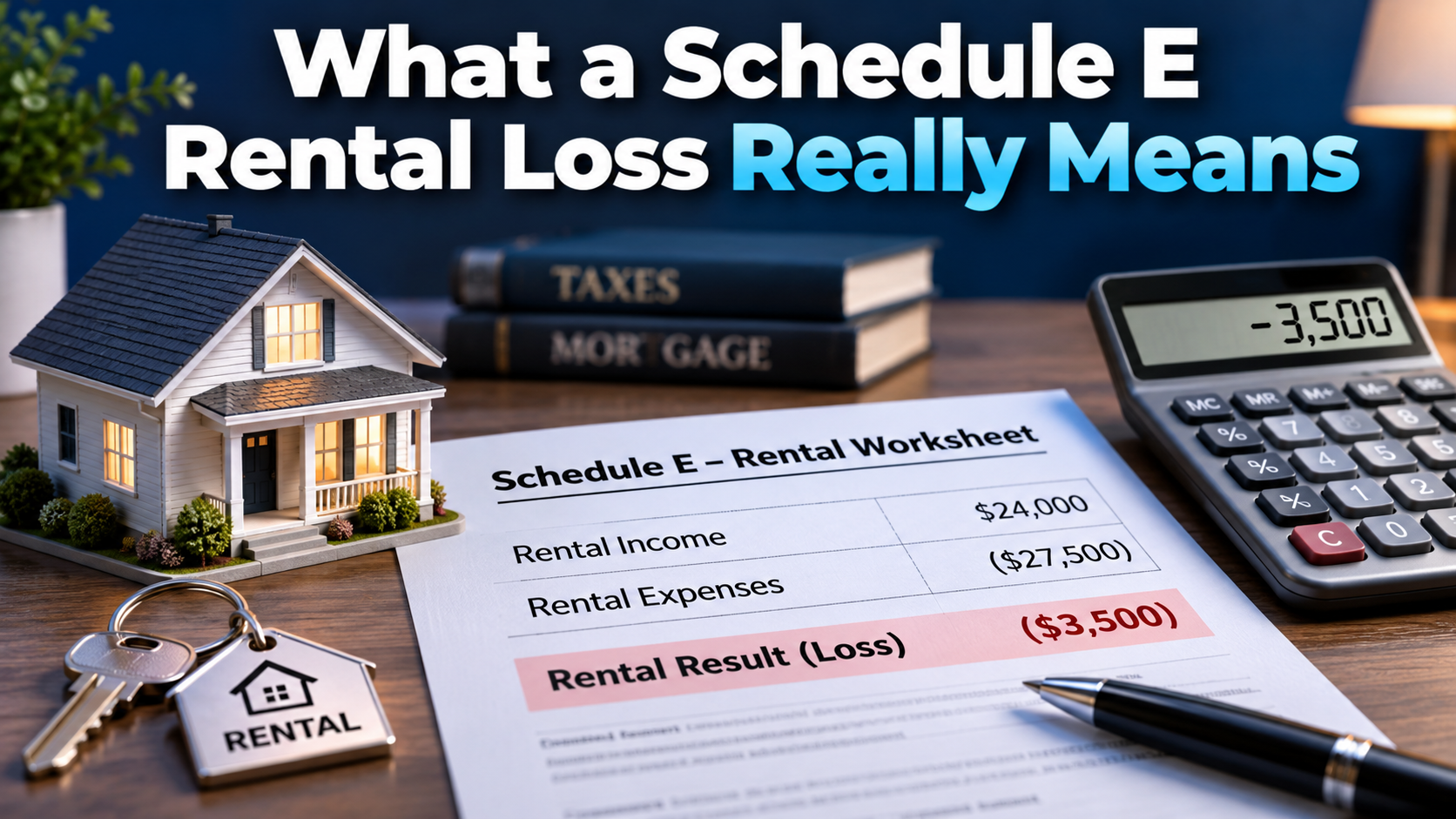
That deduction alone can turn a modestly profitable rental into a reported loss. Since no cash left your account, underwriters treat depreciation as the clearest add-back of all, and it is often the single largest reason a Schedule E loss shrinks or disappears in the lender’s calculation.
Section 03
How Lenders Use Schedule E to Calculate Rental Income
Lenders do not take your Schedule E at face value, and they do not ignore it either. They use it as raw material for a standardized calculation, usually on a worksheet such as Fannie Mae Form 1038 for individual rental income, so that every underwriter reaches a similar result from the same return.
Under Fannie Mae’s guidance on Schedule E income, adjustments are made for depreciation and any one-time extraordinary expenses, such as repairing damage from a natural disaster, and lenders must add back the parts of the mortgage payment already deducted on the return so those costs are not counted twice.
When Schedule E is used instead of a lease
Schedule E is the primary source when the property appears on your most recent tax return for a full year of rental. If the property was acquired or first rented after the last return was filed, lenders usually rely on a lease or the appraiser’s market rent, multiplied by 75% to allow for vacancy and expenses.
Fannie Mae’s rental income guidance lays out which documentation applies in each situation. The method matters, because Schedule E can produce a higher or lower figure than 75% of the lease, depending on how your actual expenses compare with the 25% allowance.
The add-back formula
The calculation follows the same order on almost every worksheet. Start with rents received, subtract total expenses, add back the eligible items, average over 12 months (or documented months in service when a lease exception applies) and subtract the monthly payment for that property.
The result is either positive net rental income, which is added to your qualifying income, or a negative number, which is counted as a monthly liability in your debt-to-income ratio.
| Step | Calculation | Source |
|---|---|---|
| 1 | Rents received | Schedule E, line 3 |
| 2 | Minus total expenses | Schedule E, total expenses |
| 3 | Plus insurance, mortgage interest, taxes | Lines 9, 12 and 16 |
| 4 | Plus HOA dues, if specifically identified | Usually line 19 |
| 5 | Plus depreciation or depletion | Line 18 |
| 6 | Plus documented one-time extraordinary expenses | Supporting evidence required |
| 7 | Average over 12 months; over documented months in service only if the property meets a qualifying exception for use of a lease agreement | Fannie Mae B3-3.8-04, non-subject investment property |
| 8 | Minus monthly PITIA for the property | Mortgage statement, tax and insurance records |
How Fannie Mae, Freddie Mac and FHA compare
Fannie Mae and Freddie Mac use very similar Schedule E add-back logic, including depreciation, interest, taxes, insurance and HOA dues. FHA also allows depreciation to be added back when calculating rental income from tax returns, though its documentation and calculation details differ.
Because lenders implement these rules through their own worksheets and overlays, the same Schedule E can produce slightly different numbers at different lenders. If your rental income is close to the line, ask to see the worksheet the underwriter used.
Section 04
The Add-Backs, Step by Step
Each add-back exists for one of two reasons. Either the expense was not a cash outlay in that year, like depreciation, or it is part of the property’s mortgage payment, which the lender subtracts separately at the end. Adding it back first prevents the same dollar from being counted twice.
Knowing which reason applies to each line helps you predict how a lender will treat unusual items on your return, and where you may need to provide documentation.
Depreciation, depletion and amortization
Depreciation on line 18 is added back in full, because it is a non-cash deduction. Depletion, which applies to natural resource properties, is treated the same way on the same line. Some worksheets also allow amortization of items such as loan costs to be added back when it is clearly identified.
This is true no matter how large the depreciation is. Accelerated methods and bonus depreciation can create very large tax losses in a given year, but because the add-back is the full amount on the return, they do not reduce your qualifying rental income.
Interest, taxes, insurance and HOA dues
Mortgage interest, property taxes, hazard insurance and HOA dues are real cash costs, but they are also components of PITIA. Since the lender subtracts the full current PITIA at the end, it first adds these expenses back to avoid double counting. HOA dues are generally added back only when they are specifically identified on the return.
Some lenders add back taxes and insurance only when they are included in the PITIA figure they subtract, for example when they are escrowed or otherwise verified. If you pay taxes and insurance outside escrow, provide the bills so the lender can include them in PITIA and treat the add-back consistently.
| Expense | Why it is added back | Documentation lenders commonly want |
|---|---|---|
| Depreciation or depletion | Non-cash deduction | The tax return itself |
| Amortization (where allowed) | Non-cash deduction | Clear identification on the return or statement |
| Mortgage interest | Included in the PITIA subtracted later | Mortgage statement |
| Property taxes | Included in PITIA | Tax bill or escrow statement |
| Insurance | Included in PITIA | Declarations page or escrow statement |
| HOA dues | Included in PITIA | HOA statement, shown separately on the return |
One-time extraordinary expenses, and what never comes back
A non-recurring cost, such as a casualty loss or a major repair after storm damage, can be added back when there is evidence of its nature. The test is whether the expense is genuinely one-time, not part of normal wear and tear. Replacing a roof after a hurricane may qualify; repainting between tenants usually does not.
Routine operating expenses stay deducted: repairs and maintenance, property management, utilities you pay, cleaning, advertising, legal and accounting fees, and supplies. These are the costs of running a rental every year, and they are exactly what the lender wants reflected in the income figure. A letter of explanation with invoices is the best way to support a claimed one-time expense.
Section 05
Worked Example: From a $6,000 Tax Loss to Qualifying Income
The numbers below follow one rental property through the full calculation. All figures are hypothetical and rounded, chosen to show how each add-back moves the result.
The borrower owns a single family rental that was rented all 12 months of the prior year. They earn $10,000 a month from their job and have $3,500 a month in other debts, including the payment on their own home.
What the tax return shows
The property collected $24,000 in rent. Expenses on Schedule E total $30,000, so the return reports a $6,000 loss. To a borrower, this looks like the property costs $500 a month.
But more than a third of those expenses are depreciation and financing costs. The table separates the expenses lenders add back from the ones that stay.
| Schedule E item | Amount | Added back? |
|---|---|---|
| Rents received | $24,000 | Starting point |
| Insurance | $1,500 | Yes |
| Mortgage interest | $10,000 | Yes |
| Property taxes | $3,000 | Yes |
| HOA dues (itemized) | $1,200 | Yes |
| Depreciation | $9,000 | Yes |
| Repairs and maintenance | $2,500 | No |
| Property management | $2,400 | No |
| Utilities | $400 | No |
| Total expenses | $30,000 | |
| Net result on Schedule E | −$6,000 |
The add-back math
Add back $1,500 + $10,000 + $3,000 + $1,200 + $9,000 = $24,700. Adjusted rental income is −$6,000 + $24,700 = $18,700 for the year. With 12 months in service, that is about $1,558 a month.
This figure represents what the property earns before its mortgage payment, after real operating costs. It is the number the lender compares with the property’s monthly PITIA.
Netting against PITIA and the DTI effect
The property’s monthly PITIA is $1,925: $1,450 principal and interest, $250 taxes, $125 insurance and $100 HOA. Net rental income is $1,558 − $1,925 = about −$367 a month, which is counted as a monthly liability. The same property with $30,000 in rent would show a $0 tax result but about +$133 a month that could be added to qualifying income, assuming the borrower has at least 12 months of experience managing rental properties.
The table compares the correct calculation with two common mistakes. Treating the Schedule E loss as the answer, or subtracting both the loss and the full PITIA, can make the borrower look far weaker than they are. Use the Wonder Rates mortgage calculator to test how a new payment fits once rental income is calculated correctly.
| Approach | Monthly rental effect | Total monthly debts | DTI on $10,000 income |
|---|---|---|---|
| Correct: add-backs, then subtract PITIA | −$367 | $3,867 | About 38.7% |
| Mistake: Schedule E loss only, PITIA ignored | −$500 | $4,000 | About 40.0% |
| Mistake: Schedule E loss plus full PITIA | −$2,425 | $5,925 | About 59.3% |
Figures are illustrative and based on the assumptions above. Actual results depend on your return, the lender’s worksheet and current guidelines.
Section 06
Advanced Scenarios Where the Math Changes
The basic formula works for a property rented all year with ordinary expenses. Real portfolios are messier: properties bought mid-year, aggressive depreciation strategies, several rentals on one return and two to four unit homes where the owner lives in one unit.
Each of these changes one step of the calculation. Getting them right is often the difference between an approval and a counteroffer.
Partial years and fair rental days
Schedule E line 2 reports fair rental days, the days the property was rented at a fair price. For a non-subject investment property on Schedule E, Fannie Mae generally averages the result over 12 months. If the property meets a qualifying exception for use of a lease agreement, average the Schedule E result over the documented months in service. A property bought in September and rented for about four months is averaged over four months only when it meets that exception; otherwise the result is averaged over 12 months.
The flip side matters too. If you owned the property all year but it shows few fair rental days because it sat vacant, lenders may ask why, and the low result is still averaged over 12 months, which lowers the income figure.Expect questions, and be ready with leases and rent receipts showing the property is now rented.
Cost segregation and bonus depreciation
Investors sometimes use a cost segregation study to accelerate depreciation, producing a very large Schedule E loss in the first year. Because the full depreciation figure on line 18 is added back, this strategy usually does not hurt mortgage qualifying, even though the tax loss looks dramatic.
The caution is consistency. If an accelerated deduction is reported somewhere other than line 18, for example through a separate form or a business entity, make sure the lender can trace it, or it may not be added back. Your CPA can provide a short reconciliation.
Multiple properties and two to four unit homes
With several rentals, each property is calculated on its own, and the results are combined: positive properties add to income, negative ones add to liabilities, depending on the lender’s method. Owning several financed properties also brings in separate limits, explained in our guide to Fannie Mae’s financed property limit.
For a two to four unit home that is your primary residence, the treatment is different: rental income from the other units is generally added to your income, while the full payment on the building is counted as your housing expense rather than netted against the rent. Ask your lender which method applies before you rely on a particular figure.
Section 07
The Tax Side: Why the Same Loss Means Different Things
A Schedule E loss serves your tax return and your mortgage application in very different ways. For taxes, the loss may reduce what you owe, may be suspended for future years, and will eventually affect your tax bill when you sell. For underwriting, much of it is reversed through add-backs.
Keeping both views in mind helps you avoid a common trap: optimizing purely for the lowest tax bill in the year before you apply for a mortgage, then discovering that the same choices weakened your qualifying income.
Passive loss limits and the $25,000 allowance
Rental real estate is generally a passive activity. According to IRS Publication 925, if you actively participate in a rental, you may deduct up to $25,000 of rental losses against other income, with that allowance phasing out as modified adjusted gross income rises from $100,000 to $150,000. Losses you cannot use are suspended and carried forward.
Underwriters generally work from the per-property results on Schedule E, before passive loss limits are applied on other forms. So a suspended loss does not, by itself, change the lender’s rental income calculation, but a lender reviewing your overall return may still ask about large carryforwards.
Depreciation recapture when you sell
Depreciation lowers your taxes while you own the property, but it also lowers your cost basis. When you sell, the gain attributable to depreciation on real property, often called unrecaptured section 1250 gain, is taxed at a maximum federal rate of 25%, rather than the usual long-term capital gains rate.
For mortgage purposes, recapture has no effect on today’s qualifying income. It matters when you plan an exit: selling one rental to fund a down payment may produce less cash than expected after tax, and a 1031 exchange may defer that tax if you reinvest in another property.
| Item | Effect on your tax return | Effect on mortgage qualifying |
|---|---|---|
| Depreciation | Increases deductions, lowers taxable income | Added back, no effect |
| Passive loss limits | Losses may be suspended above income thresholds | Generally no direct effect on per-property calculation |
| Suspended loss carryforward | Used in future years or at sale | Usually not part of the rental income calculation |
| Depreciation recapture | Taxed at up to 25% when you sell | None today; affects net sale proceeds |
| Routine repairs | Deductible expense | Stays deducted, lowers qualifying income |
Section 08
Common Mistakes and the Documentation That Prevents Them
Most rental income problems in underwriting come from how the return was prepared or how the file was assembled, not from the property itself. A few predictable mistakes cause the bulk of lower-than-expected income figures and last-minute conditions.
The good news is that each one can be avoided with planning, often months before you apply.
Mistakes that cost borrowers qualifying income
The first is lumping expenses together. When HOA dues, insurance or one-time repairs are buried in a general “other” line, the underwriter may not be able to add them back. The second is deducting personal or mixed-use costs aggressively in the year before applying, which lowers the income figure without a matching add-back.
A third is relying on a short rental history: a property placed in service late in the year may not support a full annual figure. Borrowers with business or self-employment income face the same documentation discipline across all income types, as explained in our comparison of 1099 vs W-2 mortgage qualification.
| Mistake | Effect on qualifying | Fix |
|---|---|---|
| HOA or insurance not itemized | Expense cannot be added back | Report each on its own line or provide a breakdown |
| One-time repair recorded as routine maintenance | No add-back | Keep invoices and describe the event; supply a letter of explanation |
| Heavy personal or mixed-use deductions | Lower adjusted income | Review with your CPA before filing in the year you plan to borrow |
| Missing fair rental days or partial-year data | Income spread incorrectly or not used | Confirm line 2 and keep lease start dates |
| Using the Schedule E loss as the answer | Overstates the liability | Ask the lender to apply the add-back worksheet |
Documentation checklist
An organized file lets the underwriter apply every add-back you are entitled to on the first pass. Gather these items before you apply, and keep a copy of the worksheet the lender used.
The list covers the most common requests for individual rental properties reported on Schedule E:
- The most recent one or two years of signed personal tax returns with all Schedule E pages.
- Current mortgage statements for each rental, showing principal, interest and escrow.
- Property tax bills and insurance declarations pages if they are not escrowed.
- HOA statements showing monthly dues.
- Current leases, especially for properties rented for only part of the last tax year.
- Invoices and a short explanation for any one-time extraordinary expense.
- A schedule of real estate owned that matches the properties on Schedule E.
Section 09
Schedule E Rental Loss FAQs
Landlords applying for a mortgage tend to ask the same questions about rental losses and add-backs. The answers below summarize how lenders usually approach them.
Worksheets and overlays vary, so confirm the details with your loan officer and CPA.
Does a rental loss on Schedule E hurt my mortgage application?
Not necessarily. Lenders add back depreciation, mortgage interest, taxes, insurance, HOA dues and documented one-time expenses, then subtract the property’s PITIA. A paper loss often becomes a small liability, break-even or positive income.
A property that truly loses cash after real operating costs will still count against you.
Why do lenders add back mortgage interest if it is a real cost?
Because the lender subtracts the full monthly PITIA at the end of the calculation. Adding the interest back first prevents counting it twice.
The same logic applies to property taxes, insurance and HOA dues.
Can bonus depreciation or cost segregation hurt my qualifying income?
Usually not. The full depreciation amount reported on Schedule E is added back, so accelerated depreciation increases the tax loss without reducing qualifying rental income.
Make sure the depreciation is clearly reported so the lender can trace it.
Which expenses cannot be added back?
Routine operating costs such as repairs, maintenance, property management, utilities, cleaning and advertising stay deducted. Only genuinely one-time extraordinary expenses with evidence can be added back.
These costs are exactly what the lender wants reflected in the property’s income.
What if the property was rented for only part of the year?
For a non-subject investment property on Schedule E, Fannie Mae generally averages the result over 12 months. If the property meets a qualifying exception for use of a lease agreement, average the Schedule E result over the documented months in service.
Be ready to explain short rental periods on a property you owned all year.
Is Schedule E always better than using 75% of the lease?
Not always. If your real operating costs are well below 25% of rent, Schedule E with add-backs can produce more income. If they are higher, the lease method may produce more.
Which method applies is usually set by the lender based on your documentation, not by your preference.
Section 10
Bottom Line on Schedule E Rental Losses
A rental loss on Schedule E is a tax figure, not a verdict on your property’s cash flow. Lenders rebuild cash flow by adding back depreciation, mortgage interest, taxes, insurance, itemized HOA dues and documented one-time expenses, generally averaging over 12 months and then subtracting the property’s full PITIA. In our example, a $6,000 tax loss became a liability of about $367 a month, and the same property with slightly higher rent became positive qualifying income for a borrower with at least 12 months of property management experience.What cannot be erased are real operating costs, so clean reporting, itemized expenses and complete documentation are what turn your return into the strongest possible income figure.
Own rentals and planning your next purchase or refinance? Connect with Duc Pham and the Wonder Rates team to run your Schedule E through a lender worksheet before you apply and see exactly how your rental income will be counted.
Disclaimer: This article is for general information only and is not tax, legal or financial advice. All figures are illustrative examples based on assumptions. Rental income calculations depend on current agency guidelines, lender worksheets and overlays, and tax rules can change. Confirm with a licensed loan officer and a qualified tax professional before making decisions.




