
Section 01
You run your own business. Money comes in, the bills get paid, and your savings look solid. So why does a mortgage lender want such a big stack of paperwork from you?
The short answer is that a lender can’t just look at the money flowing into your business account. It needs to figure out how much of that money counts as your income for a home loan. To do that, it looks at your tax returns, your business costs, how your income has changed over time, and who owns the business. Fannie Mae’s guidelines even treat the income a business reports on its tax return differently from the cash the owner actually takes home.
This self-employed mortgage documents checklist will help you get ready. Think of it as a prep tool, not a rulebook. Your exact list depends on your loan type, how your business is set up, and what your lender finds when it reviews your file.
Below, you’ll find the core papers most borrowers gather, the records tied to your type of business, the bank and asset statements you may need, and the extra items a lender might ask for along the way.
Section 02
Quick Self-Employed Mortgage Documents Checklist
Want the short version first? Here is a starting list you can work from today. You likely won’t need every item, and your lender will tell you which ones fit your file.
Personal Income and Tax Documents
- Your most recent signed federal tax returns, with all schedules
- The prior year’s federal tax return, if your lender asks for two years
- IRS tax transcripts, if your lender requests them
- Schedule C, E, F, or K-1, based on how you report your income
- W-2s or 1099s, if they are part of your income history
- A year-to-date profit and loss statement, if asked
- A short letter about big income changes or unusual items, if needed
Many lenders ask for two years of tax returns, but that is not a rule for every loan. Fannie Mae allows one year in some cases when certain conditions are met.
Business Documents
- Business federal tax returns, if your business files its own
- A business license or state registration, if asked
- Articles of organization or incorporation, an operating agreement, or a partnership agreement
- Business bank statements
- A current profit and loss statement
- A business balance sheet, if asked
- Proof of your ownership share, if your tax papers don’t show it
A freelancer, a one-person LLC, and an S corporation owner won’t all hand in the same papers. The word “LLC” or “Inc.” on your business card doesn’t decide it. What matters most is how your business is set up for taxes.
Assets and Funds for Closing
- Checking and savings account statements
- Investment or retirement account statements, if you plan to use them
- Papers that explain large deposits or transfers
- A gift letter, if a family member is helping and your loan allows gifts
- Business account statements, if business money will cover part of your costs
A big business balance doesn’t count as your personal cash by default. If you want to use it, the lender may first check that pulling it out won’t hurt your business.
Personal and Property Documents
- A government-issued photo ID
- Your current address and past addresses, if asked
- Your signed purchase contract, once you have an accepted offer
- Homeowners insurance details, when you have them
- Mortgage statements or leases for any other homes you own
- Notes or papers about debts or credit issues, if asked
Start by gathering what fits your situation. Then confirm the exact list with your lender before you send a large stack of private financial files.
Section 03
Why Self-Employed Borrowers Need Different Mortgage Documentation
When you work for someone else, a lender can check your pay stubs and W-2 and quickly see what you earn. When you’re your own boss, there’s no employer to vouch for you. Your income shows up in tax returns and business records instead, and those take more work to read. (For a closer look at that process, see our guide on how mortgage lenders verify income.)
A business can bring in a lot of money and still leave its owner with a smaller paycheck. Rent, supplies, staff, loan payments, and slow seasons all take a bite. That’s why lenders look past the top line.
Revenue is not income.
The lender’s close review of your file is called underwriting. During underwriting, the lender is trying to answer a few simple questions:
- Is your income steady, and is it likely to keep coming?
- How much of it can count toward your loan?
- Is your business in good financial shape?
- Do your tax returns, bank records, and other papers tell the same story?
- Would taking money out of the business to buy a home weaken it?
Fannie Mae’s self-employed borrower guidelines cover these same points. They look at how stable your income is, what kind of business you run, how strong it is, and whether it can keep paying you.
Business Revenue Is Not the Same as Qualifying Income
Four numbers can look alike but mean very different things:
- Gross receipts are all the money your business takes in.
- Business expenses are what it costs to keep the business running.
- Taxable income is what’s left on your return after allowed deductions.
- Qualifying income is the amount the lender decides it can use for your loan.
These numbers can be far apart. A lender doesn’t simply add up your deposits or use the top line of your return. It follows the rules for your loan type. For example, it may add back certain non-cash costs, like depreciation, which is a tax write-off for wear on equipment or property. It may also account for losses or one-time items. So your qualifying income could come out higher or lower than you expect.
The Documents Help Build a Clear Financial Picture
Lenders often compare your personal returns, business returns, bank statements, and current financial statements side by side. When those records don’t match perfectly, it isn’t always a problem. The lender may just need a short note or one more record to understand why.
The goal of all this paperwork is clarity. No bank balance, credit score, or number of years in business guarantees approval on its own. Clear, complete records simply help the lender see your full picture faster.
Section 04
Personal Tax Returns and IRS Tax Transcripts
For many self-employed borrowers, tax returns are the heart of the file. They show what you earned, what you spent to earn it, and how that changed over time. Plan on sending complete returns, not just the first page or a summary from your tax software.
Fannie Mae’s tax return guidance generally calls for signed personal federal returns for the most recent two years. It also asks for business returns when they apply. At the same time, it allows some alternatives and exceptions under set conditions.
Personal Federal Income Tax Returns
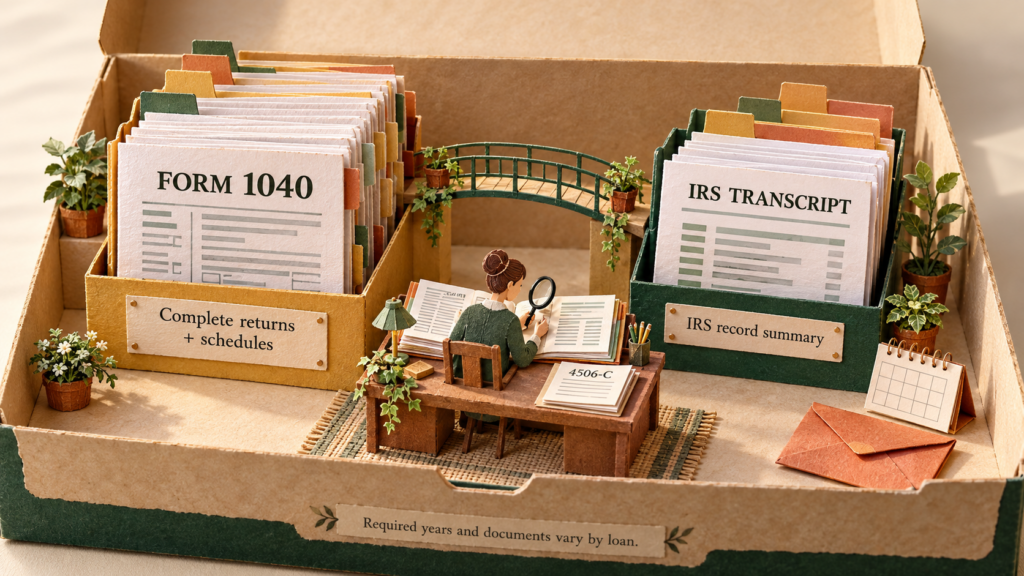
Find full copies of your Form 1040 for each year your lender asks about. Include every schedule that touches your income. That can mean business income and expenses, rental income, or income passed to you from a partnership or S corporation.
Before you send them, check three things:
- The copies are clear and easy to read.
- They cover the right tax years.
- Every page and schedule is there.
If you filed electronically, your lender may ask for proof that the IRS received your return. Or it may confirm your filing another way that its rules allow.
IRS Tax Transcripts
A tax transcript is a summary of your tax records that comes straight from the IRS. It lists key lines from a return you already filed. You can get one for free through the IRS Get Transcript tool.
Many lenders will also ask you to sign IRS Form 4506-C. This form lets the lender order your transcripts from the IRS so it can check that your returns match.
Keep in mind that a transcript isn’t always a full stand-in for your return. It may leave out details a lender needs, like certain schedules. Your lender decides whether a transcript works for your file or whether it needs more, based on its underwriting rules.
How Many Years of Tax Returns You May Need
Two years is a common starting point, but it isn’t a rule for every borrower or every loan. Here’s how it can vary:
- Some loans call for two years of personal and business returns.
- Fannie Mae may allow just one year in certain cases, such as when a business has a longer track record and other conditions are met.
- If you own more than one business, each one may need its own papers.
- A newer business may get a closer look at your past work and income.
- Lenders can add their own stricter rules, called overlays. FHA, VA, jumbo, and non-QM loans (loans outside the standard agency rules) may also work differently.
So treat Fannie Mae’s rules as one helpful reference point. They are not the final word for every loan. For example, FHA loans follow HUD’s own handbook.
If Your Most Recent Tax Return Has Not Been Filed
Timing matters here. If you apply early in the year, your latest return may not be filed yet. If you filed for an extension, the return may still be months away. The IRS lets you ask for more time to file with Form 4868, but that extension doesn’t give you more time to pay.
Don’t assume an extension or a draft from your tax preparer will take the place of a filed return. Instead, tell your loan officer which years you’ve filed and whether you requested an extension. The lender can then tell you what it can accept for your loan and your timeline.
Section 05
Business Tax Returns and Documents by Business Structure
How your business is set up for taxes shapes which papers you’ll need. Some business income lands right on your personal return. Some shows up on a separate business return, and some appears on both. Fannie Mae has separate guidance for sole proprietors, partnerships, S corporations, and corporations.
The lists below are common starting points. Your lender will tell you what your own file needs.
Sole Proprietors and Independent Contractors
A sole proprietor is someone who runs a business alone without forming a separate company. Most report their business income and costs on Schedule C, which they file with Form 1040. Many independent contractors who get 1099 forms report their income the same way.
Papers you may need:
- Complete personal federal tax returns
- Schedule C and any related schedules
- 1099 forms, if they apply
- A year-to-date profit and loss statement, if asked
- Business bank statements, if the lender wants to see recent activity
Keep one thing in mind. A 1099 shows what a client paid you, but it doesn’t show what you kept after expenses. That means it can’t prove your qualifying income by itself.
Single-Member LLCs
An LLC is a legal way to set up a business, and how it’s taxed is a separate question. By default, the IRS treats a one-owner LLC as a “disregarded entity.” In plain terms, its income usually goes on the owner’s personal return, unless the LLC chose to be taxed as a corporation.
So don’t assume your LLC files its own business return. Prepare the returns that match how the IRS actually taxes your LLC. Your lender may also ask for your operating agreement or state registration to confirm that you own it.
Partnerships and Multi-Member LLCs
A business with two or more owners is often taxed as a partnership. The business files its own return, Form 1065, and gives each owner a Schedule K-1. Your K-1 shows your share of the profit, which then flows to your personal return.
Here’s the catch. A K-1 shows the profit assigned to you, but it doesn’t prove you received that much in cash.
Papers you may need:
- Personal federal tax returns
- The partnership’s business return, if required
- Your Schedule K-1
- The partnership or operating agreement, if the lender needs to confirm ownership or payout rights
- Current business financial records, if asked
The lender may also check that the business is healthy and could pay you without hurting its operations.
S Corporations and Corporations
An S corporation files its own return, Form 1120-S. It generally passes its profit through to owners on Schedule K-1. Owners who work in the business often draw a W-2 salary too. A C corporation works differently. It pays its own taxes on Form 1120, and owners get income through wages or dividends.
Depending on your setup, a lender may ask for business returns, your K-1, W-2s from your company, ownership records, and current financial statements. Not every owner needs the same mix of forms.
Business Ownership Records
Your ownership share can decide which income rules apply to you. Fannie Mae generally treats anyone who owns 25% or more of a business as self-employed. Other loan programs may draw that line in a different place. If your returns don’t make your share clear, your lender may ask for records that do.
Section 06
Profit and Loss Statements and Business Financial Records
Tax returns look backward. If you apply in the fall, your latest return could be almost a year old. That’s why a lender may ask for current numbers to see how your business is doing right now. Freddie Mac lists year-to-date profit and loss statements and balance sheets among the papers lenders may use for self-employed borrowers. Its Seller/Servicer Guide covers these records in more detail.
Year-to-Date Profit and Loss Statement
A profit and loss statement, often called a P&L, sums up what your business earned and spent over a set period. “Year-to-date” means from January 1 to a recent date this year. It should line up with your accounting software or your books.
Be ready to show:
- Your business name and the dates the P&L covers
- Your revenue and main expense categories
- Your net profit or loss
- Who prepared it, if that applies
- Backup records, in case the lender has questions
A P&L you make yourself may not be accepted in every case. Your lender may ask for a certain format or date range. It may also ask for one prepared by an accountant.
Business Balance Sheet
A balance sheet is a snapshot of your business on a single date. It shows what the business owns, what it owes, and what’s left over. This helps a lender see how much cash your business has and how much debt it carries. It also shows whether money you plan to use for your home is needed to keep the business running.
When Interim Financial Statements May Be Requested
“Interim” statements cover part of a year rather than a full one. Lenders may ask for them when:
- Your income rises and falls a lot
- Your current numbers look very different from past returns
- A lot of time has passed since your last filed return
- You plan to use business money for your down payment or closing costs
These statements add to the lender’s review. They usually don’t replace tax returns when returns are required.
Section 07
Personal and Business Bank Statements
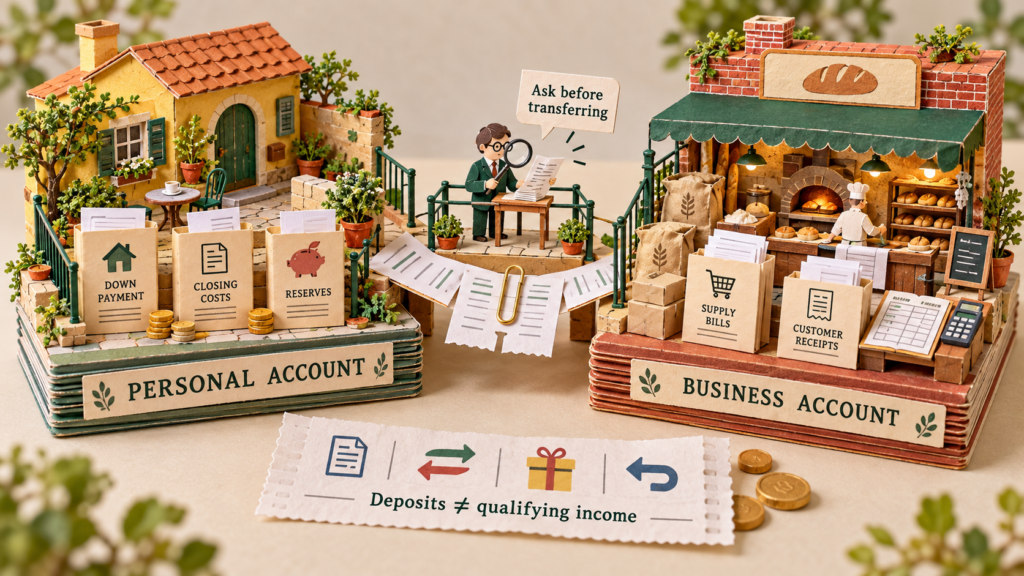
Bank statements show the money you have, where it came from, and how cash moves through your business. On their own, though, they usually don’t prove your qualifying income. A deposit could be a client payment, a transfer, a loan, or a refund, and the lender needs to know which one it is.
A deposit is not a paycheck.
Personal Bank Statements
Gather statements for any account you plan to use for your down payment, closing costs, or reserves. Reserves are savings you still have after closing, kept as a cushion for future mortgage payments. Your lender will tell you which months or statement periods it needs.
Some items often need backup papers:
- Large or unusual deposits
- Transfers between your own accounts
- Gift money from family
- Money from selling something, like a car
- New loans that show up as deposits
Please don’t shuffle money around just to make your accounts look neater. Keep honest records, and explain any transaction truthfully if your lender asks about it.
Business Bank Statements
Your lender may want business statements to check recent cash flow or business assets. These statements can help show how your reported revenue lines up with the cash you actually receive. Still, deposits are not the same as net income, so expect the lender to look at both.
Using Business Funds for a Home Purchase
Using business money for a personal down payment raises a bigger question than “Is there enough?” The lender may need to confirm that taking the money out won’t hurt your business. Fannie Mae’s guidance explains how lenders review business assets used for a down payment, closing costs, or reserves.
Before you move any money from a business account to a personal one, talk it over with your loan officer.
Section 08
Business Licenses, Registration, and Proof of Ownership
Sometimes your tax returns tell the lender everything it needs about your business. Other times, it needs proof that the business exists or that you own the share you say you do. This often comes up when the tax records don’t clearly show your ownership percentage.
Documents That Can Show Your Business Is Real
Depending on your business and your lender, these records may help:
- A business license
- State registration records
- Articles of organization or incorporation
- An operating agreement
- A partnership agreement
- Your IRS letter assigning an Employer Identification Number (EIN)
- Other trusted records that show your business name and owners
You won’t need all of these. A freelancer who reports income on Schedule C may need very little here, while an S corporation owner may need more.
Matching Names and Details Across Records
Lenders notice when details don’t line up. Your business name, address, business type, or ownership share might look different from one paper to the next. For example, you may market your business under a trade name, often called a “DBA” (doing business as), while your tax returns show the legal company name.
That’s usually easy to explain. Point out these differences early, and back them up with real records like your DBA filing.
Never edit an original document.
If something looks off, explain it instead. Changing a financial document can lead to a denied loan and serious legal trouble, so honest notes are always the safer path.
Section 09
Additional Documents for Special Income Situations
Not every business fits a neat checklist. If your income is new, seasonal, falling, or comes from more than one source, your lender may ask for extra records to understand it.
Recently Self-Employed Borrowers
A short track record doesn’t rule you out, but it does mean a closer look. Under Fannie Mae’s guidelines, income from less than two years of self-employment may still count in some cases. Generally, you’d need at least 12 months on your own. You’d also need a recent history of work in the same or a similar field, at a similar or higher income.
Helpful records may include your new business’s tax returns and proof of your past jobs or training. Records that show you’ve stayed in the same line of work can help too. In the end, the lender decides whether your file meets the rules.
Seasonal or Fluctuating Income
Picture a landscaper who earns most of their money from spring through fall. A strong summer looks great, but the lender wants to see the full year. One big month or one new contract may not prove that your income is steady.
If your income has dropped from one year to the next, expect a few questions. The lender may want to know why it fell and whether it has leveled off. Year-to-date financial statements, past tax returns, and business bank statements can all help tell that story.
Multiple Businesses or Multiple Income Sources
If you own more than one business, each may need its own set of papers. That’s especially true when they’re taxed differently or trending in different directions. Don’t count on strong income from one business to cover a loss in another, because the lender may look at each one on its own.
Business Debt and Personal Obligations
Business loans, personal guarantees on business debt, and business debts that show on your credit report can all affect your review. How each one is treated depends on your loan rules and your records. These debts can also change your debt-to-income ratio, or DTI, which compares your monthly debts to your monthly income.
Be upfront about any business debts. Have loan statements ready in case your lender asks for them.
Section 10
Documents for Down Payment, Closing Costs, and Cash Reserves
Proving your income and proving your cash are two separate jobs. You might earn enough to qualify and still need to show where your down payment is coming from. On the flip side, a big savings balance doesn’t prove you earn enough, either. If you’d like to see how your down payment changes your monthly payment, try our mortgage calculator.

Personal Asset Statements
Gather statements for any checking, savings, investment, or retirement accounts you plan to use. Your lender will tell you which accounts and months it needs. Some accounts, like retirement plans, may have withdrawal limits or penalties. Those limits can change how much of the balance the lender is able to count.
Gift Funds and Proceeds From Asset Sales
Money from a gift, from selling something, or from moving funds between accounts often needs backup. A deposit that shows up on a statement isn’t always enough on its own.
Depending on your loan, the lender may ask for:
- Proof of where the money came from
- A paper trail that shows the transfer
- A signed gift letter from the person giving the money
- A bill of sale or closing statement for something you sold
Business Funds and Reserve Requirements
Lenders often treat money in your personal account differently from money in your business account. If you plan to use business funds for closing or reserves, the lender may check how the withdrawal affects your business’s cash and daily operations. Fannie Mae’s guidance walks lenders through this review.
Ask first, then move money.
Figure out early which accounts will pay for your home. Then ask your lender what source-of-funds papers it needs before any money changes accounts.
Section 11
Common Reasons a Lender Requests More Documents
Don’t panic if your lender asks for more papers after you apply. It happens all the time with self-employed borrowers. Most of the time, the lender just needs to clear up one detail before it can finish reviewing your income or assets.
More paperwork is not a no.
Missing Schedules or Incomplete Tax Returns
Sending only the first two pages of a return leaves out key details. The schedules are where your business income, costs, pass-through income, and losses show up. Send the full return each time, with every schedule your lender asks for.
Differences Between Tax Returns and Current Financial Statements
Your year-to-date P&L might show a different trend than last year’s return. Maybe sales dipped, or maybe you had a big one-time expense. The lender may ask about the dates your P&L covers, any unusual costs, or changes in your business.
Answer honestly, and back up your answer with records when you can. Simply saying a drop is “temporary” won’t carry much weight without proof.
Unclear Deposits or Transfers
Unexplained deposits, money moving between business and personal accounts, or newly borrowed funds can all lead to questions. Keep a clear record of your transactions. While your loan is in process, try not to move money around unless you truly need to.
Unclear Business Ownership or Financial Obligations
If your ownership share isn’t clear, your business name doesn’t match across papers, or you carry business debt, expect a request or two. The lender needs to understand both your income and the bills that come with it.
Section 12
How to Organize Self-Employed Mortgage Documents Before Applying
A little setup now can save you days of back-and-forth later. Good organization won’t guarantee approval, but it does make the whole process smoother for you and your lender.
Create a Folder for Each Document Category
Make a separate folder, digital or paper, for each group:
- Personal tax returns and transcripts
- Business tax returns and schedules
- Current business financial statements
- Personal bank and asset statements
- Business bank statements
- Business registration and ownership records
- Extra items your lender requests
Check Dates, Completeness, and Consistency
Look over each document before you send it. Make sure it covers the right dates, has every page, and shows the right person or business name. Every file should be a true copy from you, your accountant, or your bank.
If something is missing, out of date, or doesn’t match another record, tell your loan officer. It’s far better to explain a gap than to try to fix the original.
Ask for a Loan-Specific Checklist
The fastest path is to ask your lender for a list made just for you. It should reflect your business type, your loan program, and the income you’re using to qualify. A sole proprietor, an S corporation owner, and someone using company cash to close may each need very different papers.
If you’re shopping for a home, you can explore our home purchase loan options to see what may fit. When you’re ready, start your application here, and a loan officer can help you build a document checklist around your business.
Section 13
Self-Employed Mortgage Documentation Examples
The right document package can look very different from one borrower to the next. These three made-up stories show how your business setup and your plans can change what a lender asks for.
Example 1: A Freelancer Reporting Income on Schedule C
Maya is a freelance graphic designer. She works alone as a sole proprietor and reports her income and costs on Schedule C. She’s ready to buy her first home and plans to use her personal savings for the down payment.
Her starting package might include:
- Complete personal federal tax returns with Schedule C
- Any 1099 forms from her clients
- Personal bank statements for the savings she’ll use
- A year-to-date profit and loss statement, if her lender asks
After reviewing her income history, her lender may still ask for more based on the rules for her loan.
Example disclaimer: This is a hypothetical illustration for educational purposes only. Actual documentation requirements and qualifying income depend on the borrower’s circumstances, loan program, lender requirements, and underwriting review. This example does not represent a promise of mortgage approval.
Example 2: An S Corporation Owner With W-2 Wages and K-1 Income
James owns all of a small marketing firm that is set up as an S corporation. He pays himself a salary and gets a W-2. The business also passes its profit to him on a Schedule K-1. James assumes his W-2 alone shows everything a lender needs to see.
In reality, his lender may want his personal returns, the company’s Form 1120-S, his W-2, and his K-1. It may also check whether the business can support the income he draws without weakening the company.
Example disclaimer: This scenario is hypothetical and is not a statement of universal underwriting requirements. Required documents and the treatment of wages, pass-through income, and business distributions vary by loan program and individual file. No approval outcome is implied.
Example 3: A Business Owner Planning to Use Company Funds for Closing
Rosa runs a small neighborhood bakery. Her business checking account holds enough to cover her down payment and closing costs. She figures that balance is all the proof she needs.
Her lender may ask for business bank statements and other financial records first. It wants to confirm she’s allowed to use the money and that taking it out won’t hurt the bakery. Rosa’s best move is to talk with her loan officer before she transfers a single dollar.
Example disclaimer: This is a hypothetical scenario, not financial or underwriting advice for a specific borrower. Whether business funds can be used for a mortgage transaction depends on the applicable loan rules, documentation, and lender analysis.
Section 14
Final Self-Employed Mortgage Documents Checklist
Save or print this list as you get ready to apply. It’s a prep tool to help you get started, not the final word for every mortgage application.
- Know your business structure and how your income is reported for federal taxes.
- Gather the personal federal tax returns and schedules your lender asks for.
- Prepare business tax returns and K-1s, if they apply to you.
- Pull together a current profit and loss statement or balance sheet, if requested.
- Collect personal bank statements and statements for any other assets you’ll use.
- Have business bank statements ready if asked, or if business funds will be used.
- Find your business registration and ownership records, if needed.
- Decide where your down payment, closing costs, and reserves will come from.
- Write short, honest notes with backup records for unusual deposits or big income changes.
- Confirm the exact document list and accepted formats with your loan officer.
Here’s the big takeaway. As a self-employed borrower, you’ll need to show more than how much your business earns. You’ll also show how that income is reported, how it has held up over time, and where your closing money comes from. Get those pieces in order, and the road to your new home gets a lot clearer.
Disclaimer: This article is provided for general educational and informational purposes only and is not financial, tax, legal, or mortgage underwriting advice. Mortgage documentation requirements vary by loan program, lender, borrower circumstances, business structure, income type, and applicable underwriting guidelines. The documents listed in this article are examples of records a lender may request and are not a guarantee that every item will be required or that the list is complete for any particular application. Lenders may request additional documentation to verify income, assets, business ownership, liabilities, and the source of funds. Consult a qualified mortgage professional regarding your specific circumstances and a qualified tax or legal professional for tax or legal questions. Mortgage approval, qualifying income, loan terms, and eligibility are not guaranteed.
Duc Pham, Mortgage Broker | NMLS# 844897
Wonder Rates, Inc. | NMLS# 1518655 | DRE# 02047445 | DFPI# 60DBO-59134
Equal Housing Opportunity. Equal Housing Lender.
Licensed in: AL, AZ, CA, CO, FL, GA, LA, MI, NC, OH, OK, OR, PA, SC, TX, VA, WA.



