
Section 01
Most borrowers assume that if a trust pays them every month, that money counts as income on a mortgage application. In trust income mortgage qualification, the deposits are only part of the story. Sometimes trust payments count in full. Sometimes they do not count at all, even when they arrive like clockwork.
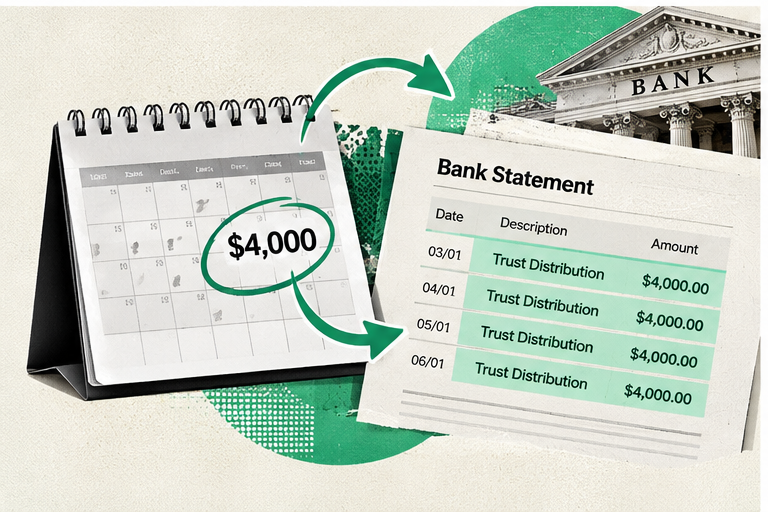
Here is a situation we see. A borrower’s parents set up a family trust years ago. Every month, $4,000 lands in her checking account. When she applies for a mortgage, the lender asks for the trust agreement, a statement from the trustee, and proof the payments will keep going for years to come. She has none of those ready, and her bank statements alone are not enough.
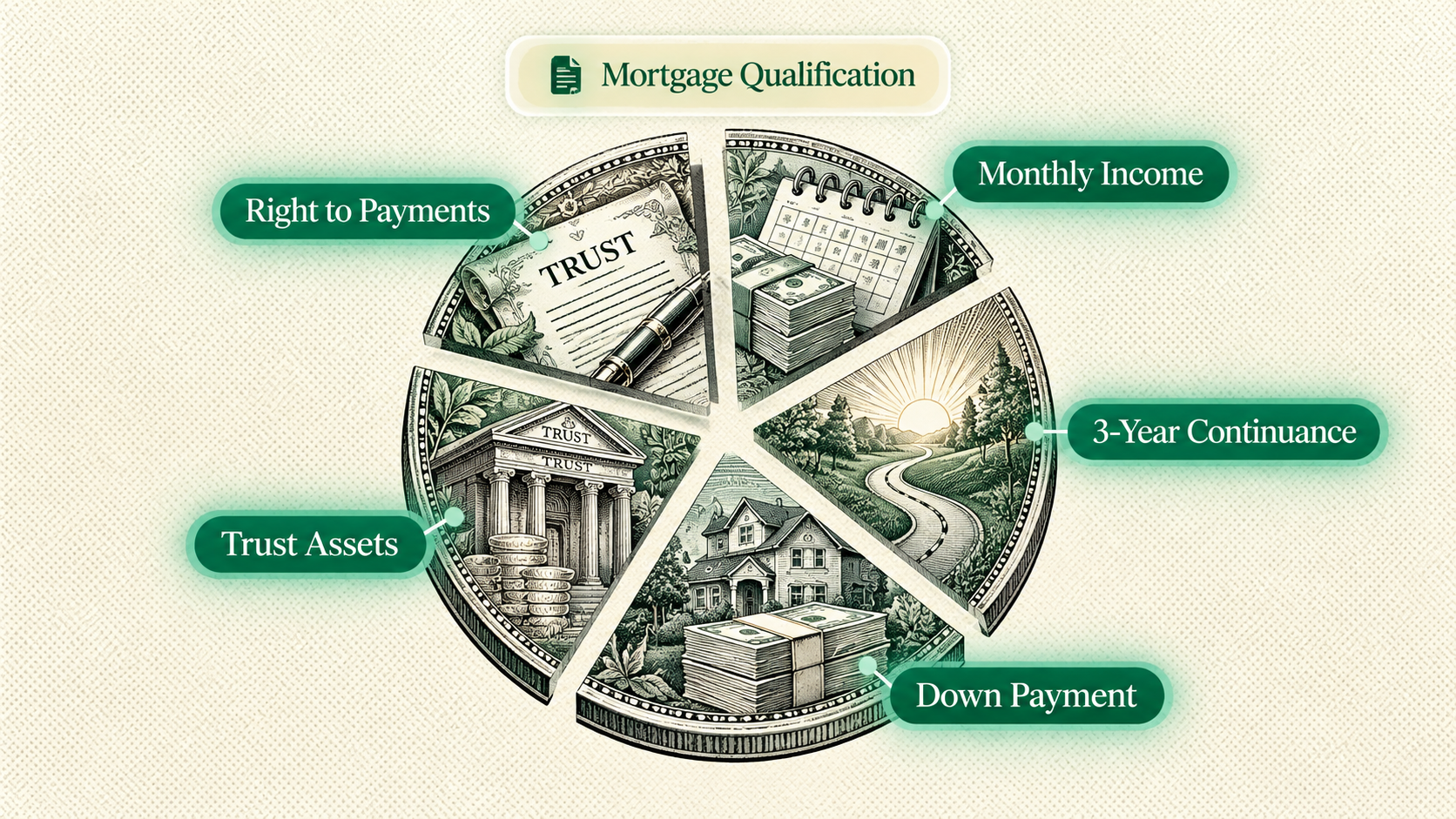
The lender is not doubting the money. It is trying to answer three questions. Does she have a legal right to these payments? How much is paid, and how often? Will the payments continue? This article explains how lenders answer those questions, what documents to prepare, and how to keep trust income and trust assets from working against each other at closing.
Section 02
Myth: If a Trust Pays Me Every Month, It Counts as Income
This is the most common belief we hear about trust income. It makes sense on the surface. The money shows up, it shows up on schedule, and it pays real bills.
Section 03
Reality: Lenders Need Proof of Three Things
A deposit proves that money arrived. It does not prove why it arrived or whether it will keep coming. To count trust payments as qualifying income, a lender typically needs to confirm three things.
You have a right to the payments. The trust agreement spells out who receives money, how much, and under what conditions. Being named in a trust is not the same as being entitled to a payment. The lender needs to see language that gives you that right.
The amount and frequency are clear. The lender needs to know exactly what you receive and how often. Monthly, quarterly, and yearly payments are all workable, as long as the schedule is documented.
The payments will continue. This is where many files get stuck. Under Fannie Mae guidelines, income continuance depends on the type of income received through the trust. Fixed payments from a depleting asset must be expected to continue for at least three years from the mortgage application date. Income derived from rental property does not have that same three-year continuance requirement. Ask your loan officer which standard applies to your trust and loan.
Section 04
Why Trust Money Gets Treated So Differently
The confusion usually comes from mixing up two things that live inside the same trust: income and assets.
Trust income is the stream of payments you receive on a schedule. It can help you qualify for your monthly mortgage payment. Trust assets are the money and investments held inside the trust. Depending on your access, they may help cover your down payment, closing costs, or reserves. A lender looks at each one separately, and the same dollar usually cannot do both jobs.
How the trust pays also matters a great deal.
Fixed payments are the easiest to work with. If the trust requires a set amount on a set schedule for a defined period, a lender can usually verify it with the trust agreement or a trustee’s statement.
Variable payments change from year to year, often because they depend on investment returns. Lenders usually want to see a history of what you have actually received, and they may average it rather than use your best year.
Discretionary payments depend on the trustee’s decision. If the trustee can choose to pay you less or nothing at all, it is harder to show the income is stable, even if you have received money for years.
One-time distributions are not monthly income. A large lump sum from a trust may still help as an asset for closing, but it should never be presented as a recurring payment.
Fannie Mae publishes its trust income requirements in its Selling Guide. FHA, VA, and non-QM programs can treat trust income differently.

Section 05
Example: When Your Down Payment Undercuts Your Income
Example for educational purposes only. This is a simplified illustration. It leaves out investment returns, taxes, and trust fees, and real lender calculations vary.
Assume a trust holds $400,000 in assets that are being depleted to fund fixed payments of $4,000 a month. She wants to qualify using that income, and she also wants to use trust money for her down payment.
Step 1. How much the trust must cover over three years: $4,000 × 36 months = $144,000
Step 2. Scenario A, she withdraws $300,000 for the down payment: $400,000 − $300,000 = $100,000 left in the trust
How long the remaining balance can keep paying her: $100,000 ÷ $4,000 = 25 months
Twenty-five months is short of the 36 months the lender needs to see. Her income may no longer count, even though nothing about the monthly payment has changed yet.
Step 3. Scenario B, she withdraws $200,000 instead: $400,000 − $200,000 = $200,000 left in the trust
$200,000 ÷ $4,000 = 50 months
Fifty months is more than 36, so the trust can still show it supports three years of payments. The remaining assets meet this simplified continuance test; the lender must still verify the trust terms, income history and other qualification requirements.
The lesson is not that one scenario is always right. It is that the down payment decision and the income decision are connected. Run both numbers with your loan officer before you move any trust money.
Section 06
What to Do Before You Apply
Gather the right documents early. Trust paperwork often sits with a trustee or attorney, and getting copies can take weeks. Most lenders will ask for some combination of the following:
- The trust agreement, or the certified pages that show your rights and the payment terms
- A trustee’s statement confirming the amount, frequency, and expected duration of your payments
- Bank statements showing you actually received the payments
- A current statement of the trust’s assets
- Tax forms related to the distributions, when they apply
Send complete pages. A partial copy that leaves out a condition, a termination date, or the trustee’s discretion usually leads to more questions later, not fewer.
Ask the right questions first. Before you get pre-approved, find out whether your payments are required or up to the trustee, how often they are paid, and when the trust ends. Also ask whether you can withdraw principal, and whether your closing funds would come from the same trust that pays your income. The answers shape which loan options fit.
Do not move trust money yet. Taking a distribution before your loan officer reviews the file can create the problem shown in the example above. It can also break the paper trail lenders use to confirm where your closing funds came from. Our guide on how lenders trace the source of your closing funds explains why a clean trail matters.
Bring in the right professionals. Your loan officer can explain what the lender needs and why. Questions about your legal rights under the trust belong with an estate-planning attorney or the trustee. Questions about taxes on a distribution belong with a tax professional. Getting all three on the same page early tends to save time during underwriting. To see what happens once your file is submitted, read about what underwriters check before they approve a file.

Section 07
Frequently Asked Questions
Can trust income be used to qualify for a mortgage? Yes, in many cases. The lender needs to confirm that you have a right to the payments, how much you receive and how often, and that the payments will continue. Fixed, scheduled payments are usually the most straightforward to document. Discretionary or one-time distributions are harder to count as income, though a lump sum may still help as an asset for closing.
How long does trust income need to continue to qualify? For Fannie Mae loans, the continuance test depends on the underlying income type. Fixed payments from a depleting asset must be expected to continue for at least three years from the application date. Trust income derived from rental property does not carry that same requirement. Assets used for down payment, closing costs or reserves must be deducted before checking continuance.
Can I use trust assets for my down payment or reserves? Often, yes, if you have documented access to the funds and they meet your loan program’s requirements. Be careful if the same trust also pays the income you are using to qualify. A large withdrawal can reduce the assets that support future payments. That can make it harder to show the income will continue. Review both decisions with your loan officer before you take any distribution.
Can discretionary trust distributions count as income? They are harder to count. When the trustee decides whether and how much to pay you, a lender cannot easily confirm the payments will continue, even if you have received money regularly for years. Some programs may still consider them with strong documentation and history. The answer depends on the trust’s language and the loan program, so share the full trust terms with your loan officer early.
Do I have to give the lender my entire trust agreement? Not always. Some lenders accept the certified pages that show your rights, the payment terms, and any restrictions or end dates, along with a trustee’s statement. Others ask for the full document. Either way, the pages you provide need to tell the whole story. Leaving out a condition or a termination date usually creates more questions during underwriting, which can slow down your closing.
Section 08
Not Sure How a Lender Would View Your Trust Income?
A Wonder Rates loan officer can review your trust documents, explain how your payments may be counted, and help you plan your down payment so it does not work against your income.
Duc Pham, Mortgage Broker | NMLS# 844897
Wonder Rates, Inc. | NMLS# 1518655
Equal Housing Lender.
AZ, CA, CO, FL, GA, LA, MI, OK, PA, SC, TX, VA, WA, OH, AL, OR, NC
This article is for educational purposes only and is not a commitment to lend or legal, trust, estate-planning, tax, or investment advice. Income calculations, asset treatment, documentation, and eligibility depend on the trust, borrower, program, lender, investor, and current guidelines.



