

Section 01
A DSCR loan is a mortgage for rental property. The lender looks closely at the rent the property can earn. It does not lean mainly on your paycheck or your tax returns. That is the short answer to “what is a DSCR loan.”
DSCR stands for debt service coverage ratio. The name sounds heavy. The idea is simple. Does the rent cover the mortgage payment?
This guide is for people who are new to mortgages. You will learn how the math works, what lenders may ask for, what it can cost, and when this kind of loan may fit. We will use plain numbers. We will also be honest about the limits. Every lender sets its own rules, so nothing here applies to every loan.
A high DSCR tells you the rent covers the payment. It does not tell you the property makes money.
Keep that line in mind. It is the most useful idea in this whole article.
Section 02
What Does DSCR Stand For in Real Estate?
DSCR means Debt Service Coverage Ratio. It is a way to check if the income from an asset can pay its debt. In a rental mortgage, the question is easy to say. Can the property’s rent support the loan payment?
That is why DSCR matters to real estate investors. They buy homes and small buildings to rent out. The rent is the engine. The mortgage is the cost of building it.
There is one catch you should know early. The term DSCR is used in two ways.
In business and commercial real estate, DSCR is often net operating income divided by total debt service. Net operating income means rent minus operating costs. In many residential DSCR mortgage programs, the math is simpler. The lender divides qualifying monthly rent by a monthly housing payment. That payment includes principal, interest, taxes, insurance, and association dues. NerdWallet describes this rent-to-payment method for rental property loans.
The two methods are related. They are not the same. When a lender quotes a DSCR, ask which method they use.
What does the ratio tell a lender?
A ratio above 1.00 usually means the income in the formula is larger than the payment in the formula. A ratio of 1.00 means they are equal. A ratio below 1.00 means the income is smaller than the payment.
Notice the careful wording. The formula may leave out costs like repairs, vacancy, utilities, and management fees. So a high ratio is not proof of profit. It is a coverage score.
Why DSCR matters for rental property financing
DSCR gives a lender a clear way to judge a rental. It can help when an investor owns several properties. It can also help when an investor is self-employed, or when tax returns do not show the true cash flow of one rental.
Pillar Private Lending explains that these loans often suit rental investors whose taxable income does not match their real investing power. Still, DSCR is only one piece. Credit, savings, property condition, and loan-to-value ratio can all matter.
Note: This section explains general terms. Calculation methods differ by lender and program.
Section 03
How Does a DSCR Loan Work?
Think of it from the investor’s side. You find a rental property that fits a lender’s program. The lender checks the rent the property can earn and the loan you want. Then it decides if the deal fits its rules.
A regular mortgage leans hard on your personal income and your debt-to-income ratio. A DSCR loan leans on the property’s rent compared with its debt. That does not mean the lender ignores you. Your credit, savings, and experience may still count.
Here are the steps, one at a time.
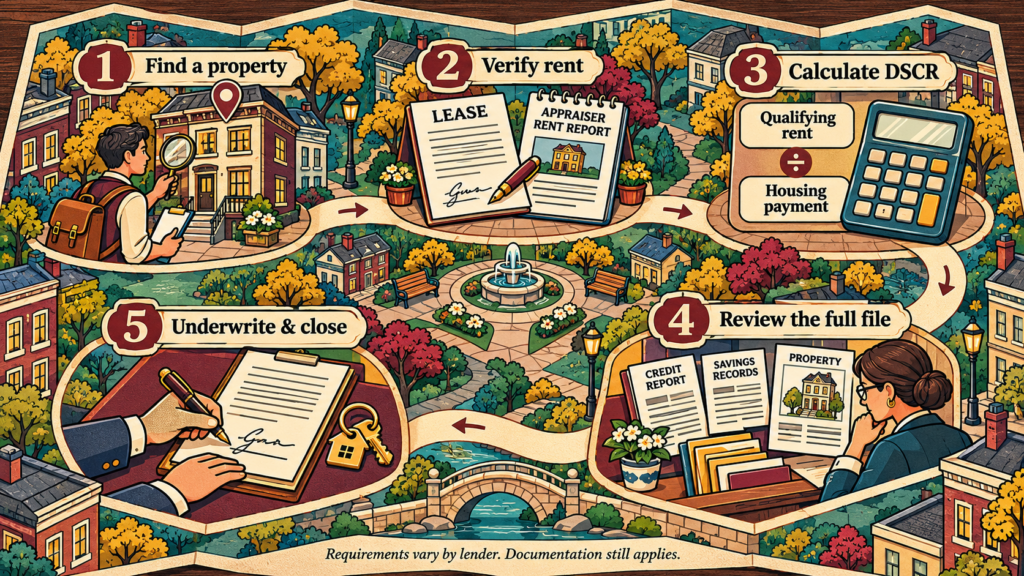
Step 1: Find an eligible investment property
The property has to fit the lender’s rules. Some programs focus on one-unit homes and small rentals. Others allow certain multifamily buildings or short-term rentals.
Check this before you count on any rent. Property type, condition, location, and local rental rules can all decide if a program works. Pillar notes that a habitable, rental-ready property is a very different case from one that needs major work.
Step 2: Establish the qualifying rent
The lender needs a rent number it trusts. It may use a signed lease, rental records, or an appraiser’s market rent estimate. For short-term rentals, it may use another approved method.
The rent you hope to collect is not always the rent the lender will use. That gap catches many new investors off guard.
Step 3: Calculate the property’s DSCR
Next comes the math. In many programs, the lender compares qualifying monthly rent to the monthly housing payment. You will see the exact formula in the next section.
Ask which costs sit in the payment. Ask how the rent was set. Small changes in either one can move the result.
Step 4: Review you and the property
The lender may also look at your credit score, down payment, loan-to-value ratio, savings after closing, the appraisal, title, insurance, and how you plan to hold the property. Each lender weighs these in its own way.
Step 5: Finish underwriting and close
Underwriting is the lender’s full review. The lender checks your records, clears any open items, and confirms the deal follows the program rules. Then you close.
Many DSCR programs do not qualify you mainly through traditional personal income papers. They still need paperwork that fits the deal. DSCR loans are not documentation-free.
Note: Steps and timelines vary by lender and transaction.
Section 04
How to Calculate the DSCR for a Rental Property
This is the heart of the article. The math is easy. You only need division.
The common formula used in residential DSCR mortgage programs
Here is the formula many residential programs use:
DSCR = Qualifying Monthly Rental Income ÷ Monthly PITIA
PITIA is a short way to list the parts of a housing payment:
- P is for principal. This is the part of your payment that pays down the loan balance.
- I is for interest. This is what the lender charges you to borrow.
- T is for taxes. These are property taxes the lender counts.
- I is for insurance. This is the property insurance the lender counts.
- A is for association dues. These are HOA dues, when the program includes them.
This is a common method, not a universal rule. Some lenders adjust the rent or the payment in their own way. Pillar points out that one lender may use the lower of market rent and lease rent, while another may add vacancy or expense adjustments.
If you want to test numbers yourself, start with the Wonder Rates DSCR calculator. You can also try the free DSCR loan calculator from NerdWallet or the DSCR calculator from Pillar.
Example calculation with a ratio above 1.00
Say a rental has qualifying monthly rent of $3,000. The monthly PITIA is $2,400.
DSCR = $3,000 ÷ $2,400 = 1.25
The ratio is 1.25. That means the qualifying rent is 125% of the included housing payment. It does not mean you keep the extra $600 as profit. Other costs may still eat into it.
Example disclaimer: This is a hypothetical calculation for education only. It assumes a program that divides qualifying monthly rent by monthly PITIA. Actual lender calculations, qualifying rent, payment parts, and eligibility limits may differ.
Example calculation at a DSCR of 1.00
Now say the qualifying rent is $2,400. The monthly PITIA is also $2,400.
DSCR = $2,400 ÷ $2,400 = 1.00
The rent exactly matches the payment. There is no cushion. A single repair, an empty month, or a utility bill could create a loss. The formula does not count those costs.
This does not mean every lender needs at least 1.00. Some programs may allow a lower ratio under certain terms. Others may ask for more.
Example disclaimer: This hypothetical calculation shows the arithmetic only. A DSCR of 1.00 does not guarantee loan eligibility, positive cash flow, or mortgage approval. Actual program rules and property costs must be checked on their own.
Why lender calculations may differ from your own analysis
You may figure your cash flow after vacancy, repairs, management, utilities, and big future costs. The lender’s formula may use fewer inputs than you do. That is normal.
The lender’s math and your math answer two different questions. The lender asks if the loan fits its program. You ask if the investment is worth it. Do both.
Note: Formulas and inputs differ by lender. Confirm the exact method in writing.
Section 05
What Is a Good DSCR for a Rental Property?
There is no single “good” number for every lender. Some programs may accept a ratio near 1.00 or even lower under set terms. Others may want a higher one. NerdWallet says that requirements and costs vary by lender and property type.
DSCR above 1.25
When rent is divided by PITIA, a ratio of 1.25 means the rent is 25% higher than the payment in the formula. That gives a bigger cushion than 1.00. NerdWallet lists a ratio around 1.25 or higher as a common target for many lenders, though not all.
A bigger cushion is still not proof of profit. It also does not promise better loan terms.
DSCR between 1.00 and 1.24
In this range, the rent covers the payment. The margin is thinner. The lender may weigh it alongside credit, loan-to-value ratio, savings, and property type.
DSCR below 1.00
Here, the qualifying rent is smaller than the payment in the formula. Some lenders offer programs for this case, often with different pricing, lower leverage, or other conditions. NerdWallet notes that a ratio at or below 1.00 may mean paying more interest and putting more money down. Other programs will not accept it at all.
Treat none of these ranges as a universal rule. Always confirm the minimum with the lender’s current program guide.
Why a higher DSCR is not the same as a profitable investment
DSCR measures coverage. It is not a full return analysis. A property can pass the lender’s test and still earn little after vacancy, repairs, management, utilities, turnover, and major fixes.
Run your own cash flow numbers too. We show how in the examples below.
Note: The ranges above are general and for education only. They are not lender requirements.
Section 06
DSCR Loan Requirements
Requirements change from lender to lender. DSCR products usually come from non-QM or investor-focused lenders. Non-QM means “non-qualified mortgage,” or a loan that does not follow standard agency rules. Because there is no single rulebook, never assume two lenders ask for the same things.
For a rough picture, here is what one consumer source lists as common. On October 20, 2026, NerdWallet listed a credit score of about 620 or higher, a down payment of about 20% or more, a minimum loan near $100,000, and three to six months of mortgage payments set aside. It also described a rent-ready property. Treat these as illustrative market examples from one source. They are not guaranteed terms. Verify any number with the lender’s current program guide.
Minimum DSCR requirement
Each lender sets its own minimum ratio for each program. The minimum may depend on the rent, the loan size, your credit, and the program you pick.
Some lenders allow a lower ratio with higher pricing or lower leverage. Others want stronger coverage. Ask for the exact calculation method and the minimum before you make an offer on a property.
Credit score and credit history
Even when rent leads the review, the lender may check your credit score, payment history, other debts, and recent credit events. There is no universal minimum score. Credit rules depend on the program. They can affect whether you qualify, the pricing, how much you can borrow, and how much savings you need.
Down payment and loan-to-value ratio
Loan-to-value ratio, or LTV, is the loan amount divided by the property’s value. A bigger down payment usually means a lower LTV. The highest LTV allowed depends on the program, the property, the type of deal, and your profile.
Lenders may set different limits for a purchase, a rate-and-term refinance, and a cash-out refinance. Pillar explains that each of these deals raises different questions. So do not rely on a single down payment number.
Cash reserves
Reserves are savings you still have after closing. They show the lender you can keep paying if the property sits empty or needs a repair. Lenders often count reserves as months of housing payments. The amount can vary by loan size, credit, number of financed properties, and program.
Property eligibility and appraisal
The property must fit the lender’s rules for type, condition, value, and marketability. The lender must also settle on a rent number, using a lease, an appraisal, a rent schedule, or another approved method.
A listing may advertise strong rent. If the appraisal supports a lower number, the lender may use the lower one.
If you are buying a property with added rooms or other changes, you may also want to check the property’s permit history before you apply. Eligibility can hinge on it.
Entity ownership and documentation
Some investors buy through an LLC or another legal entity. Whether a program allows that depends on the lender, the title rules, and the deal. Pillar advises that you settle the vesting question early, because a late change can affect title, insurance, the appraisal, and closing papers. For legal and tax effects, ask a qualified professional.
Note: All requirement figures in this article are illustrative. Lender rules change. Confirm current terms before you rely on them.
Section 07
What Documents Are Needed for a DSCR Loan?
DSCR loans may rely less on personal income papers. They are not paperwork-free. The lender still needs to know who you are, what the property is, how much rent it earns, and where your cash comes from.
Rental income documentation
Depending on the property and program, the lender may ask for:
- A current signed lease
- A rent roll or rental history
- An appraisal or market rent schedule
- Short-term rental records or an approved income method, if the program allows it
- Any other papers that support the rent figure
What counts can differ for an occupied long-term rental, a vacant home, and a short-term rental.
Borrower and credit documentation
Expect to give identification and permission for a credit check. Some programs may ask for housing history, proof of assets, or a short note about a credit event.
Asset and reserve documentation
Bank or investment statements may be used to prove your down payment, closing costs, and reserves. NerdWallet lists two months of bank statements as a typical request. If an entity’s funds are involved, the lender may ask where the money came from and whether the entity can use it.
If you want to get your accounts ready, plan this early. Move money in one clear step. Avoid large, unexplained deposits.
Property and entity documents
Depending on the deal, you may need a purchase contract, an appraisal, proof of insurance, title papers, and LLC papers such as an operating agreement. In a refinance, you may also need your current mortgage statement.
Ask the lender for its own checklist. Do not assume “no income verification” means “no documents.”
Note: Document lists vary by lender, property, and transaction.
Section 08
DSCR Loans for Long-Term Rentals vs. Short-Term Rentals
How you rent the property can change how the lender counts your income. A long-term rental with a signed lease is not underwritten the same way as a vacation rental built on nightly bookings.
Some programs accept short-term rentals. Others use long-term market rent, or do not allow the plan at all. NerdWallet says these loans can be used for short-term and vacation rentals. Pillar adds that short-term rentals may need extra review. So check eligibility before you buy, not after.
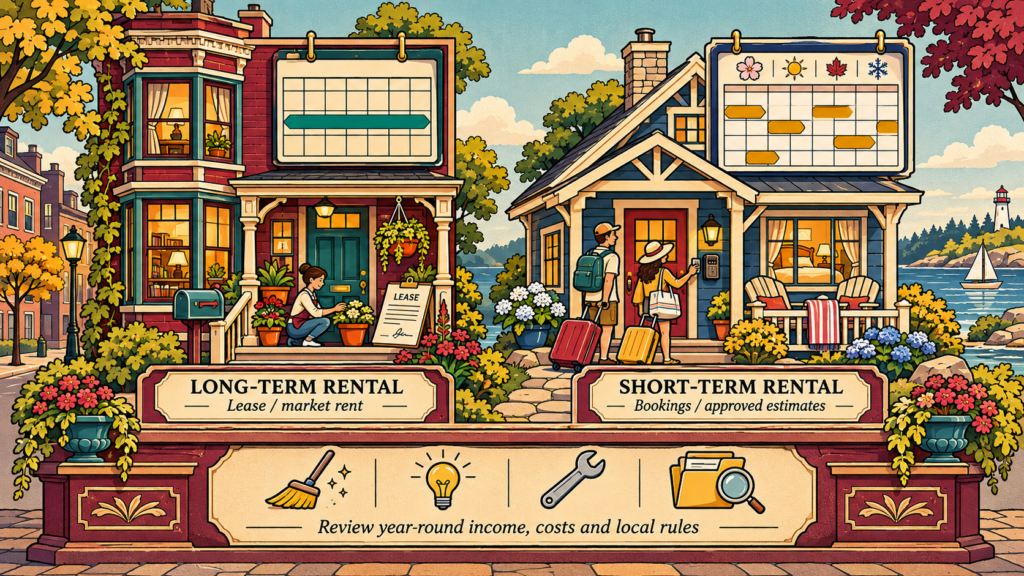
Long-term rental properties
The lender may use a lease, a market rent figure from an appraisal, or another approved method. The right one depends on whether the home is already rented, empty, newly bought, or under a lease that does not meet the lender’s rules.
Short-term rental properties
Depending on the program, qualifying income may come from past booking records, an approved market projection, a long-term rent comparison, or another set method.
Do not assume that projected Airbnb or Vrbo revenue will count. Often it does not, at least not in full.
Seasonality, occupancy, and operating expenses
Short-term income moves with the seasons, local rules, platform fees, cleaning, utilities, and how often the place is booked. A lender’s approved number may not show every cost you will pay.
Look at the whole year. Do not plan around your best month.
Local rules and property restrictions
Zoning, city or county rules, HOA rules, and lease terms can limit short-term rentals. A good DSCR does not prove the use is legal. Check the rules before you buy.
Note: Short-term rental eligibility varies widely by lender and by location.
Section 09
DSCR Loan Rates, Fees, and Other Costs
A DSCR loan may cost more than some conventional investment property loans. The gap depends on you, the property, the market, the lender, and the loan setup. NerdWallet notes that DSCR loans can be more expensive. This article does not quote a rate, because any rate would be out of date soon. Ask for a written quote instead.
What affects DSCR loan pricing?
Many things can move your offer:
- Your credit profile and payment history
- The DSCR itself
- The LTV and your down payment
- The property type and how you plan to rent it
- The loan size and type of deal
- Your savings and other lender rules
- Prepayment terms and other loan features
Each factor matters more or less depending on the program. Compare real loan estimates, not broad averages.
Origination fees and closing costs
You may see fees for origination, underwriting or processing, the appraisal, title and escrow, insurance, prepaid taxes, and more. The exact charges depend on the lender, the location, and the deal. A DSCR loan does not erase normal closing costs.
Prepayment penalties and loan structure
Some investor loans carry a prepayment penalty. That is a fee if you pay the loan off early. NerdWallet lists prepayment penalties as a common drawback. Pillar says they deserve close review because they can change the cost of selling or refinancing fast.
Some programs also offer interest-only periods. Pillar notes that this can lower the early payment, but the payment may rise when principal payments begin. Ask to see both numbers.
Compare the total cost, not just the interest rate
A low rate can hide a high price. Look at the rate, points, fees, prepayment terms, payment structure, reserves, and how long you plan to hold the property. Weigh them together.
Note: Costs vary by lender and borrower. No rate or fee in this article is a quote.
Section 10
DSCR Loan vs. Conventional Investment Property Mortgage
Neither loan is better for everyone. The right pick depends on your documented income, the property’s cash flow, and your ability to meet each program’s rules. Conventional loans follow agency guidelines, such as those set by Freddie Mac, and those guidelines have their own limits.
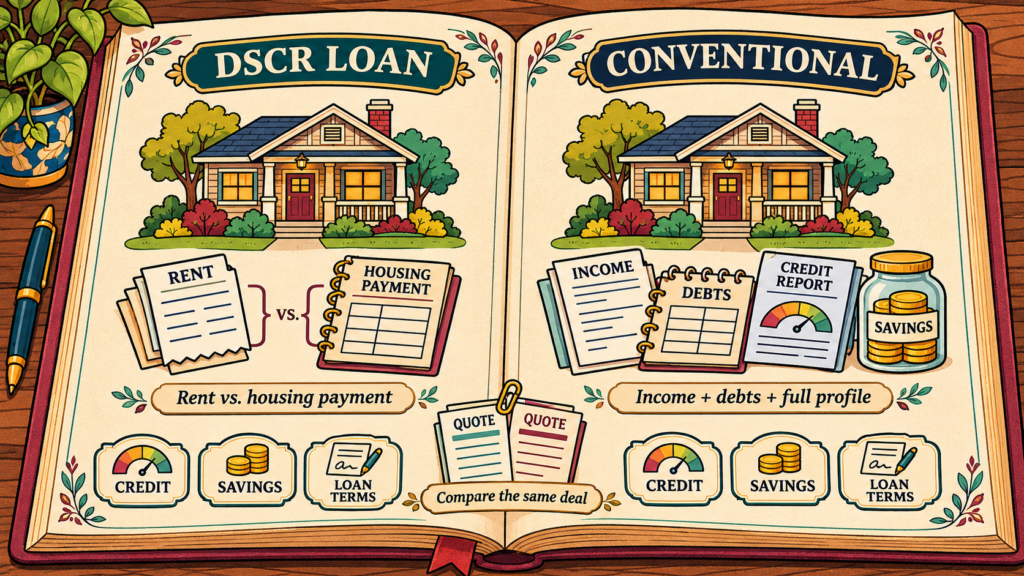
| Feature | DSCR loan | Conventional investment property mortgage |
|---|---|---|
| Main focus | Property rent compared with the debt payment | Your income, debts, credit, assets, and the property |
| Personal income papers | May be reduced or used differently, depending on the program | Generally required |
| Debt-to-income review | May not be the main test | Generally used, or the agency framework applies |
| Property cash flow | Central to the ratio | May count under program rules |
| Credit and savings | Still relevant in many programs | Relevant under the rules |
| Costs and terms | Vary by program and lender | Vary by loan type, borrower, and lender |
| Eligible property and deal | Depends on the DSCR program | Depends on agency and lender rules |
When a DSCR loan may make sense
It may be worth a look if you want approval to center on the property’s rent. It may also help if your income papers are complex, or if you need a loan setup that fits your plan. NerdWallet suggests it may suit people planning several properties.
That is not a promise. Not every investor with complex taxes will qualify, and no program allows unlimited purchases without limits.
When a conventional investment property mortgage may be worth comparing
If you have strong documented income and a healthy debt-to-income ratio, conventional financing may be competitive. NerdWallet says a first-time investor with strong finances may find slightly lower rates or better terms with a conventional mortgage. Conventional loans also have loan limits, property rules, and paperwork needs.
Debt-to-income ratio, or DTI, compares your monthly debts to your monthly income. Conventional lenders lean on it heavily. DSCR lenders may not. You can see your own number with the Wonder Rates DTI calculator.
How to make a meaningful comparison
Ask each lender for a written quote on the same property, the same price, the same loan amount, and the same down payment. Then compare paperwork needs, savings required, closing costs, prepayment terms, and how each loan fits your hold plan.
Note: This comparison is general. Actual terms depend on the lender and your profile.
Section 11
Benefits and Risks of DSCR Loans
A fair guide shows both sides. DSCR loans can help some investors. They do not remove the risks of borrowing or of a weak property.
Potential benefits
DSCR financing may:
- Focus more on rent than on personal income papers
- Offer a path for some self-employed investors or people with complex income records
- Support certain purchase or refinance plans when the program allows
- Let you judge a deal by that property’s own rent and payment
These are possible features. They are not guaranteed in every program.
Potential drawbacks
Costs may be higher. The property may need to meet strict cash flow rules. You may need a larger down payment and cash reserves. There may be prepayment penalties, less flexibility, and different ideas of what rent counts.
A property that fails one lender’s DSCR test may pass another’s. That does not mean switching is always possible or smart.
Investment risks beyond the DSCR calculation
A property can meet the ratio and still struggle. Vacancy, big repairs, higher insurance, higher property taxes, management costs, softer rental demand, and rental rules can all hurt.
Stress test your plan. Try lower rent, higher costs, and months with no tenant. If the deal only works in the best case, it is not a safe deal.
Note: Benefits and drawbacks vary by program. This is not investment advice.
Section 12
DSCR Loan Examples for Real Estate Investors
These examples are hypothetical. Each one keeps its numbers the same from start to finish. Each one also shows the gap between the lender’s ratio and your real cash flow.
Example 1: A rental property with a DSCR of 1.25
An investor looks at a rental with qualifying monthly rent of $3,250. The monthly PITIA is $2,600.
DSCR = $3,250 ÷ $2,600 = 1.25
The ratio is 1.25 under this method. The rent is 25% higher than the included payment. Still, repairs, vacancy, maintenance, and management are not in the math.
The lender would also review credit, LTV, savings, property eligibility, and other program rules before it lets the loan move ahead.
Example disclaimer: This hypothetical example is for education only. It assumes the lender divides qualifying monthly rent by monthly PITIA. It does not set a universal minimum DSCR, guarantee eligibility, or predict real rent or returns.
Example 2: A rental property with a DSCR below 1.00
An investor looks at a property with qualifying monthly rent of $2,200. The monthly PITIA is $2,450.
DSCR = $2,200 ÷ $2,450 ≈ 0.90
The rent is about 90% of the included payment. In this math, the rent does not fully cover the payment. The investor would need to review the price, expected rent, loan setup, and other costs before deciding if the deal makes sense.
Some programs may allow ratios below 1.00 under set terms. Others will not. Confirm the lender’s rules instead of assuming.
Example disclaimer: This hypothetical calculation shows the DSCR formula only. A ratio below 1.00 does not decide eligibility across all lenders, and it does not imply any loan outcome. Actual terms, qualifying income, and costs may differ.
Example 3: A property meets the lender’s ratio but has thin cash flow
Take a property with qualifying rent of $3,000 and PITIA of $2,400. The DSCR is 1.25, so it may meet a lender’s coverage test. On paper, there is a $600 cushion each month.
Now the investor builds a real monthly budget:
- Vacancy reserve at 5% of rent: $150
- Property management at 8% of rent: $240
- Repairs and big future costs: $200
Here is the math.
$3,000 rent − $2,400 PITIA − $150 − $240 − $200 = $10 left each month
The $600 cushion shrinks to $10. That is before any utility bills or surprise costs. The loan may pass the lender’s test. The investment may still disappoint.
Example disclaimer: This scenario is hypothetical and does not predict returns for any real property. The 5%, 8%, and $200 figures are made-up planning amounts, not market averages. Rental income, costs, loan terms, and results depend on the property, the market, the lender, and the investor.
Section 13
How to Evaluate a DSCR Loan Before Applying
Use this simple process to compare loans before you commit. Passing a ratio test does not guarantee approval.
Confirm the lender’s DSCR calculation method
Ask how rent is set. Is it a lease, an appraisal, or documented short-term income? Ask which costs are in the payment. Ask if the lender adjusts the rent.
Review the complete loan terms
Ask for these in writing: the minimum DSCR, credit rules, maximum LTV, down payment, reserves, fees, rate structure, and any prepayment rules. Confirm that your property type and rental plan are allowed.
Calculate cash flow separately
Build your own budget. The Wonder Rates investment ROI calculator can help. Include the mortgage payment, taxes, insurance, HOA dues, repairs, vacancy, management, and utilities. Then stress test with lower rent and higher costs.
Compare financing alternatives
If you could qualify for conventional financing, compare both. The best loan depends on your finances, the property’s numbers, your timeline, and your goals.
Before you rely on your rent estimate or a first DSCR calculation, talk through the real property and loan plan with a qualified mortgage professional.
Section 14
Key Takeaways About DSCR Loans
- A DSCR loan is rental property financing that focuses on the property’s rent compared with its debt payment.
- DSCR means Debt Service Coverage Ratio. The method can differ between residential DSCR mortgages and commercial finance.
- A ratio above 1.00 usually means qualifying income is larger than the payment in the formula. It does not mean the property is profitable.
- Credit, down payment, LTV, reserves, property eligibility, and loan terms may still matter.
- DSCR loans may need less personal income paperwork. They are not documentation-free.
- Compare total loan cost, and judge cash flow on your own.
If you are weighing a rental property purchase or refinance, you can review your expected rent, loan setup, and paperwork needs with a qualified mortgage professional before you move forward. You can start the conversation here.
Section 15
Disclaimer
This article is provided for general educational and informational purposes only and is not financial, tax, legal, investment, or mortgage advice. DSCR loan requirements, calculation methods, qualifying rental income, credit standards, loan-to-value limits, interest rates, fees, reserve requirements, and other terms vary by lender, loan program, property type, transaction, and borrower circumstances. Hypothetical examples are for illustration only and do not guarantee loan eligibility, mortgage approval, rental income, cash flow, or investment returns. A DSCR calculation is not a complete assessment of property profitability or investment risk. Readers should independently evaluate property expenses, local rental restrictions, financing costs, and their financial circumstances, and consult qualified professionals before making financing or investment decisions.
Sources referenced: NerdWallet, Should You Use a DSCR Loan for Your Rental Property? (updated Jul 17, 2026); Pillar Private Lending, DSCR Loans: A Complete Guide for Real Estate Investors (published Aug 12, 2026); Freddie Mac Single-Family. Third-party figures were checked on October 20, 2026 and may change.
Duc Pham, Mortgage Broker | NMLS# 844897, Wonder Rates, Inc. | NMLS# 1518655 | DRE# 02047445 | DFPI# 60DBO-59134 | Equal Housing Opportunity. Equal Housing Lender. | Licensed in: AL, AZ, CA, CO, FL, GA, LA, MI, NC, OH, OK, OR, PA, SC, TX, VA, WA.



