Section 01
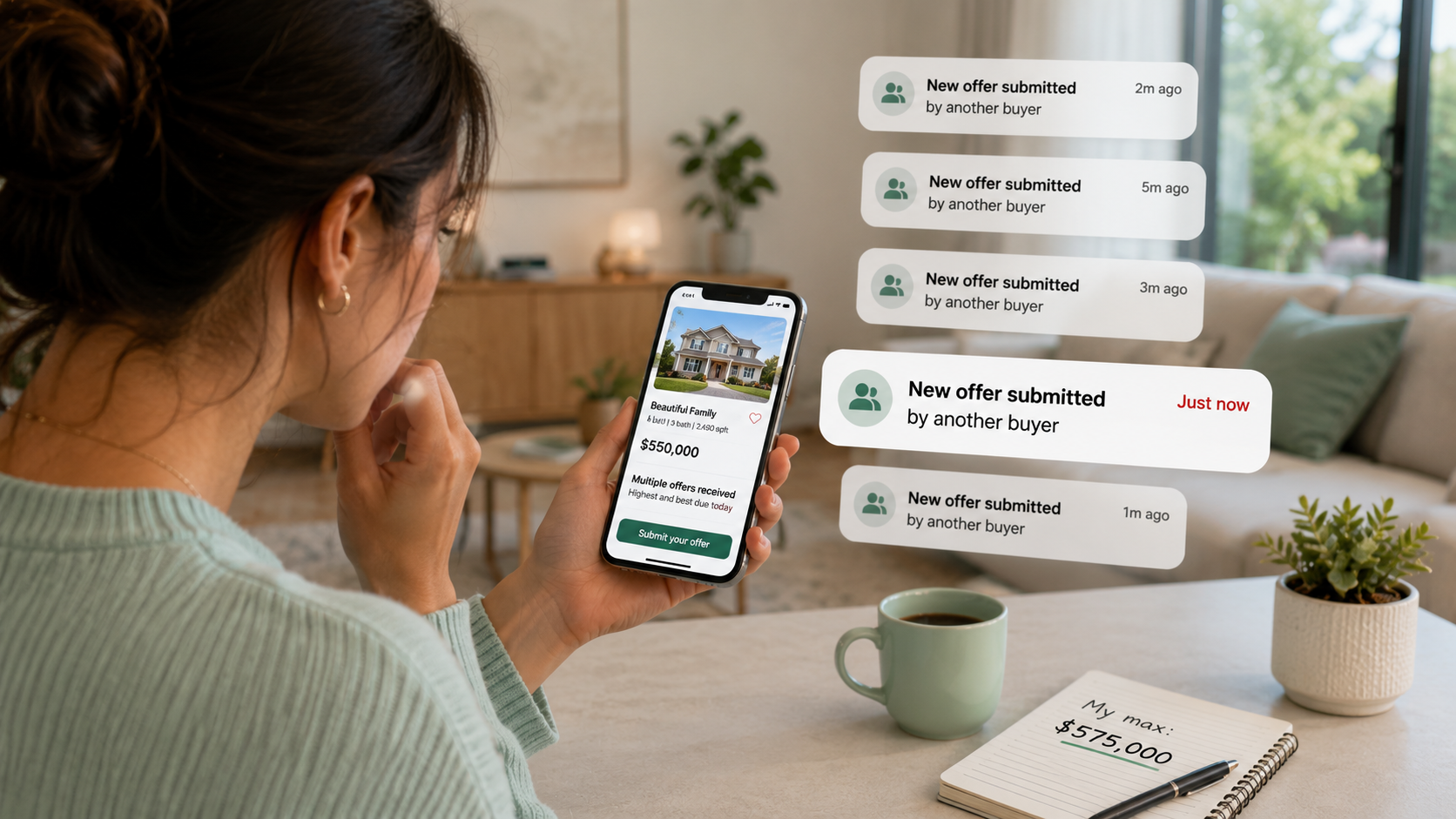
Buying a home can create a strange psychological situation. You spend months looking at listings. Then suddenly you find the one. The kitchen is perfect, the neighborhood is exactly what you wanted, and the backyard works for your family. And then your agent says there are already multiple offers.
Suddenly, the question changes. You were originally comfortable paying $550,000. Now you’re wondering whether you should offer $575,000, or maybe even $590,000. The house has not necessarily become more valuable. Your fear of losing it has changed. That is fear of missing out, or FOMO.
FOMO can affect almost every stage of homebuying, from deciding when to enter the market to choosing a house, making an offer, increasing your offer, and even deciding which mortgage to take. The goal here is not to eliminate emotion from homebuying. The goal is to recognize when fear of losing an opportunity is starting to override the numbers.
Section 02
What Is FOMO in Homebuying?
Fear of missing out, commonly shortened to FOMO, is the feeling that you might lose an opportunity if you do not act immediately. In homebuying, it can sound like thinking that if you don’t offer now, someone else will get the house, or wondering whether you’ll ever find another house like this one. It can also sound like assuming that because everyone else seems to be buying, maybe you should too, or feeling that because the seller has multiple offers, you probably need to go above asking price.
None of these thoughts automatically means a buyer is making a bad decision. The problem is when urgency replaces evaluation entirely.
FOMO Is Not the Same as Urgency
Sometimes the market really is competitive. A desirable property can genuinely receive multiple offers, a seller may have a real deadline, and another buyer may submit a genuinely stronger offer than yours. Fannie Mae notes that putting in an offer can be an emotional journey, especially for first-time buyers, and that it’s common for homes to receive multiple offers, with sellers sometimes selecting an offer above the asking price.
So the answer here is not to never act quickly. The better principle is to know your limits before you need to act quickly, so a real deadline doesn’t force you into a decision you haven’t actually thought through.
Section 03
Why Homebuying Creates Such Strong FOMO
A home is different from most purchases because it combines a large financial commitment, a personal emotional connection, genuine scarcity, real competition, uncertainty, and time pressure, often all at once. A buyer can spend weeks looking at dozens of houses without feeling strongly about any of them, and then one property suddenly feels perfect. That emotional contrast makes the possibility of losing it feel much larger than it might otherwise.
The “This Is the One” Effect
Before the showing, you might be thinking simply that you’re looking at houses. After the showing, that can quietly shift to feeling like you need this specific house. That subtle change can affect how you interpret everything that happens afterward. A high asking price starts to feel like it’s probably worth it. A repair becomes something you can deal with later. A high HOA fee suddenly doesn’t seem like that much. A longer commute becomes something you’ll just get used to.
At that point, the buyer may not really be evaluating the property anymore. They may be defending a decision they’ve already made emotionally, without fully realizing it.
Section 04
FOMO Can Start Before You Even Find a House
Homebuying FOMO does not begin only when there are multiple offers on a specific property. It can start much earlier, with the belief that if you don’t buy now, you’ll miss your chance entirely. This can come from headlines about home prices, interest rate predictions, friends buying homes, family pressure, social media, or a general fear that prices or rates will rise and you’ll be priced out later.
None of those outside pressures actually tell you whether your personal finances are ready. The CFPB recommends evaluating your finances, spending, savings, and target home price before you even begin the shopping process, since that groundwork gives you something solid to return to when outside pressure builds.
Section 05
"What If Home Prices Go Up?" Is Not a Complete Buying Strategy
Example: Suppose a buyer is considering a $500,000 home and thinks that if prices increase 5%, they’ll regret not buying now. A 5% increase on $500,000 comes to $25,000, so the future price would be $525,000. That sounds scary in the moment. But the buyer still has to ask whether they can comfortably afford the $500,000 home today, how much cash they’ll have after closing, what their monthly housing cost will actually be, how stable their income is, how long they expect to stay, and what other financial goals they’d have to delay to make this purchase. The hypothetical $25,000 future increase is uncertain and cannot be reliably predicted. The buyer’s current budget is something they can actually evaluate right now. This example uses a simplified, hypothetical percentage for illustration only and does not represent an actual market forecast.
Section 06
FOMO During a Bidding War
This is where FOMO becomes particularly powerful. Imagine a home is listed at $600,000, and you planned to stay around $610,000. Then you hear that the seller has five offers. Your brain immediately starts calculating whether you should go to $620,000, $630,000, or higher.
The question should not be how much you need to pay to beat everyone else. It should be what the maximum amount is that actually makes sense for you to pay for this specific home. Those are genuinely different questions, even though they can feel identical in the heat of the moment.
Section 07
The Difference Between Asking Price and Your Maximum Budget
An asking price is simply the seller’s starting point. It is not automatically the property’s market value, and it is certainly not automatically your own affordable price.
Example: A listing price is $600,000, and your comfortable maximum is $625,000. You could decide before submitting the offer that if competition pushes the price beyond $625,000, you’re out. That decision is much easier to make before you’re emotionally attached to winning. Once you’re imagining your furniture in the house, walking away can start to feel like losing something you already own, even though you never actually did. This example uses simplified, hypothetical numbers for illustration only.
Section 08
Why "Winning" the House Can Become the Goal
A bidding war can subtly change the underlying objective. Originally, the goal is to buy the right home at a sustainable cost. During active competition, the goal can quietly shift to simply beating the other buyers. Those are not the same goal, even though they can feel that way in the moment, and you can technically “win” a bidding war while still making a decision you later regret.
A successful purchase isn’t really about having beaten six other offers. A successful purchase is buying a home that fits your needs and finances without taking on a commitment you cannot comfortably manage.
Section 09
The "Only $100 More a Month" Trap
Suppose increasing your offer results in an estimated additional housing cost of $100 per month. That sounds small in isolation. But $100 times 12 comes to $1,200 per year, which becomes $6,000 over five years and $12,000 over ten years. These are simple arithmetic illustrations, not predictions of actual mortgage costs, since the real payment difference depends on loan amount, interest rate, down payment, taxes, insurance, mortgage insurance where applicable, HOA dues, and other factors. The psychological trick here is that monthly numbers simply feel smaller than lifetime commitments, even when the underlying math says otherwise.
Whenever someone frames a difference as $150 more per month, it helps to translate that into $1,800 more per year instead, since seeing the annual figure tends to make the trade-off easier to evaluate honestly.
Section 10
A $25,000 Increase Is Bigger Than It Looks
Example: A buyer planned to purchase for $575,000, but FOMO pushes the offer to $600,000, a $25,000 increase in purchase price. The financial impact isn’t necessarily just that $25,000 figure in isolation. The additional purchase price can affect the loan amount, down payment, principal and interest, mortgage insurance where applicable, closing costs, property taxes, and potential cash reserves, depending on how the transaction is structured. That is why buyers should evaluate the full financial effect of an increase, rather than treating the additional $25,000 as a single, isolated number. This example uses simplified, hypothetical figures for illustration only and does not represent an actual transaction.
Section 11
FOMO Can Make Buyers Ignore Closing Costs and Cash Reserves
This is particularly important for first-time buyers, who may not yet have a strong intuition for how much cash a purchase actually requires beyond the down payment. A buyer might feel confident they can afford a higher offer, but affordability is not just about the purchase price itself.
The CFPB recommends accounting for closing costs, moving costs, emergency savings, and other financial goals when determining how much cash is actually available for closing, and notes that closing costs typically range from 2% to 5% of the home purchase price, not including the down payment, while emphasizing that your actual costs depend on the price of the home, your down payment, lender costs, loan type, and location.
Example: Using a purely illustrative 2% to 5% planning range on a $500,000 purchase price, 2% comes to $10,000 and 5% comes to $25,000, before even considering the down payment itself. The exact closing costs depend on the loan, lender, property, location, and transaction. So when FOMO pushes a buyer to increase the purchase price, it’s worth revisiting how much cash you’ll actually need to close, and how much will remain afterward. This example uses the CFPB’s general planning range for illustration only and does not represent actual closing costs for any specific transaction.
Section 12
FOMO Can Make Buyers Stretch Beyond What They Can Comfortably Afford
This is one place where it helps to clearly separate qualification from affordability, since the two get conflated constantly. The CFPB explicitly states that how much you could borrow is very different from how much you can afford to repay without stretching your budget for other important items too thin, and that lenders do not take into account all of your family and financial circumstances when arriving at that borrowing figure.
Example: A lender may determine that a borrower qualifies for a mortgage associated with a $650,000 home, but the buyer’s personal comfort zone may realistically sit closer to $575,000. That does not mean the lender made a mistake. It means qualification and personal affordability are answering two different questions. FOMO becomes dangerous specifically when a buyer starts treating the maximum approval amount as a target to reach, rather than as an upper boundary they may never need to approach. This example uses simplified, hypothetical figures for illustration only.
Section 13
FOMO and Mortgage Rate Anxiety
FOMO can also show up around interest rates rather than just property competition. A buyer might think that if they don’t lock a rate now, rates will go up, or conversely that if rates might fall later, they should wait entirely. Both are possible scenarios, and neither is guaranteed. Mortgage rates change over time for reasons well outside any individual buyer’s control.
Instead of trying to perfectly predict what rates will do next month, a more useful question is whether this purchase works for your finances under the loan terms you’re actually being offered today, using realistic assumptions rather than a hoped-for future rate.
Section 14
FOMO Can Affect Mortgage Shopping Too
Here’s an angle many homebuying articles miss entirely. You can have FOMO about the house itself, and then rush the mortgage as a direct result. You find a property you love, you need financing quickly, and you accept the first lender option because it feels like there’s no time to compare.
The CFPB recommends contacting multiple lenders, exploring your loan choices before you even find a home, and comparing Loan Estimates once you do have a specific property under contract. The excitement around a unique property should not prevent you from carefully understanding the interest rate, APR, loan term, lender credits, points, closing costs, monthly payment, and cash needed to close. The house may genuinely be unique. That does not mean you should stop evaluating the financing that goes with it.
Section 15
The "Everyone Else Is Buying" Version of FOMO
Not all FOMO comes from sellers or competing buyers. Sometimes it comes from other people entirely. You see a friend’s post about just buying their first home, a coworker buys, a sibling buys, and suddenly friends are talking about refinancing and building equity. It’s easy to start feeling behind.
But someone else’s purchase does not actually tell you whether buying is right for your own financial situation. Two households can have completely different incomes, debts, savings, credit profiles, family responsibilities, housing costs, and long-term plans. A home that makes sense for one household may not make sense at all for another, even at a similar life stage.
Section 16
FOMO Can Make "Good Enough" Feel Like "Not Enough"
Another psychological trap is constantly upgrading your criteria as the search continues. You might start with wanting three bedrooms, then add an office, then a large backyard, then a pool. Eventually, you’re no longer searching for a suitable home. You’re searching for an impossible combination of every desirable feature at once.
Before touring homes, it helps to build a genuine must-have list, meaning features that materially affect your family’s actual needs, separate from a nice-to-have list, meaning features that would be enjoyable but aren’t essential. Having that distinction written down gives you something objective to return to when FOMO starts inflating your criteria mid-search.
Section 17
How FOMO Makes Buyers Overlook Inspection Findings
FOMO can become especially risky after an offer is already accepted. You’ve finally “won,” and then the inspection reveals an estimated $7,000 in repairs. The instinct at that point can be to think you already got the house and don’t want to lose it now.
That is exactly when slowing down matters most. The CFPB notes that buyers should consider contingencies such as financing and a satisfactory inspection as part of their contract, while acknowledging that exact contract terms depend on the specific transaction. Rather than asking how to avoid losing the house, it helps to ask what you learned about this house that you didn’t know when you made the original offer. That reframes the decision around new information rather than fear of loss.
Section 18
A FOMO Decision Framework Before You Increase Your Offer
Before increasing an offer, it helps to stop and work through a short series of questions rather than reacting immediately.
First, what was your original maximum, written down before you saw any competition? Second, why are you increasing it now? Is there genuinely new information about the property, or are you simply reacting to another buyer’s presence? Third, what does the increase actually cost, once you calculate the effect on your down payment, loan amount, estimated monthly payment, closing costs, and remaining cash? Fourth, what would you have to give up as a result, whether that’s emergency savings, retirement contributions, travel, childcare plans, or flexibility after moving in? And fifth, and perhaps most importantly, if someone else buys this house instead, what is your actual plan? Knowing you can walk away and keep searching takes away a meaningful amount of FOMO’s power over the decision.
Section 19
The "Walk-Away Number" Strategy
Before entering a competitive situation, it helps to establish a walk-away number ahead of time. For example, you might set a comfortable range of $550,000 to $575,000, with an absolute maximum of $585,000. If competition pushes the property above $585,000, you stop, not because the property suddenly became bad, but because your predetermined financial boundary has been reached.
Deciding this number before the emotion peaks matters, because your judgment when calmly sitting at home is likely to differ quite a bit from your judgment when you have thirty minutes to respond to a seller’s counteroffer. The number should be determined based on your finances and priorities, not on the emotional intensity of the moment you happen to be in.
Section 20
What to Do When the Seller Says There Are Multiple Offers
Multiple offers do not automatically mean you have to overpay. They mean there is competition, which is a different thing entirely. Your real estate agent can help you understand the local market and structure an offer, while your mortgage professional can help you understand the financing implications of any adjustment you’re considering. Fannie Mae specifically recommends working closely with your real estate agent to craft an offer that genuinely makes sense for you, rather than one designed purely to win.
Before responding, it’s worth asking what the comparable sales data actually suggests, what your maximum comfortable price genuinely is, what this new price would mean for your monthly housing cost, what contingencies you’re being asked to change or waive, how much cash you’ll need to close, and what will remain in savings afterward.
Section 21
FOMO Does Not Mean You Should Always Walk Away
This is important for balance. The lesson here is not that feeling emotional means you shouldn’t buy. You can genuinely love a house and still make a financially sound decision. You can also decide to pay above asking price and still make a reasonable purchase. The key question is whether the decision is actually supported by your budget, market information, the property’s condition, your financing, your long-term goals, and your own priorities, rather than by fear alone.
It’s completely reasonable to think you really want a particular house, and then follow that thought with making sure the numbers still work before you commit. That combination is a much healthier relationship with emotion than trying to suppress it entirely.
Section 22
A Practical FOMO Checklist for Homebuyers
Before making or increasing an offer, it helps to review a few categories together. On the financial side, ask whether the purchase is within your personal budget, what the estimated total monthly housing cost will be, how much cash you’ll need upfront, how much will remain after closing, and whether you’ve accounted for closing costs and ongoing maintenance.
On the property side, ask whether the home meets your actual must-haves, what the inspection revealed, whether there are HOA fees or pending special assessments, and whether there are obvious future repair costs waiting.
On the market side, ask what comparable properties actually suggest, whether your offer is based on market evidence or competition anxiety, and whether you’re paying more simply because you’re afraid someone else will get the house.
And on the emotional side, ask whether you’d still want this house without the bidding war, whether you’re afraid of losing the house or genuinely comfortable with the price itself, and whether you have a backup plan if you do lose this particular property.
Section 23
A Simple Numerical Example: FOMO vs. Budget
Example: A buyer decides their comfortable maximum housing budget supports a home around $575,000. They find a home listed at $565,000 and love it. Then they hear there are multiple offers, and they start considering $600,000, a $35,000 increase from the original listing price. Instead of asking only whether they can technically qualify, they should recalculate the full financial picture, evaluating how the additional $35,000 affects the loan amount, down payment, closing costs, and estimated monthly housing expense. If the new price would force the buyer to drain savings or abandon important financial goals, the emotional cost of losing the house may end up being smaller than the financial cost of winning it. This example uses simplified, hypothetical numbers for illustration only and does not represent an actual transaction or recommendation.
Section 24
The Biggest FOMO Mistakes to Avoid
One common mistake is confusing preapproval with permission to overspend. A preapproval helps establish your borrowing capacity, but it does not define your personal financial comfort zone. Another is treating multiple offers as proof of a property’s value, when competition simply proves that multiple buyers are interested, not what the property is actually worth to you specifically.
Some buyers make the mistake of looking only at purchase price, when the real financial picture includes applicable taxes, insurance, mortgage insurance, HOA fees, maintenance, and other costs the CFPB specifically recommends considering when determining affordability. Others rush the mortgage itself, forgetting that finding the house doesn’t mean you should stop comparing financing options. And finally, some buyers act as though this is their only chance ever, when in reality there may be another house, or there may not be, but a major financial decision shouldn’t be made solely out of fear that there won’t be.
Section 25
How to Turn FOMO Into a Better Homebuying Process
Rather than trying to eliminate FOMO completely, which is unrealistic for most people, it helps to build a process that makes it harder for FOMO to control the final decision.
Before house hunting even begins, it’s worth establishing your target purchase range, maximum comfortable monthly payment, down payment plan, closing cost budget, cash reserve target, and your must-have versus nice-to-have lists. The CFPB recommends preparing your finances and determining how much you want to spend before you start shopping, precisely so this groundwork exists before emotion enters the picture.
Before making an offer, it helps to review comparable properties, the total monthly cost, the cash required, the property’s condition, HOA obligations, and long-term fit. And before increasing an offer specifically, it’s worth pausing to ask what actually changed besides your fear of losing the property. That single question can prevent a surprisingly expensive decision made purely on impulse.
Section 26
The Bottom Line: You Don't Have to Win Every House
The homebuying process can make losing feel much worse than it actually is. You spend time searching, you imagine your life there, you make an offer, and then another buyer gets it. It can feel like you failed. You didn’t.
Sometimes the best outcome is walking away from a house that would have required you to stretch beyond what genuinely makes sense for your life. The goal is not to win every bidding war. The goal is to buy a home that fits your life without letting the fear of missing out decide how much you’re willing to pay.
Before you increase an offer, it’s worth asking yourself directly: if there were no other buyers at all, would you still think this price was right for you? If the answer is no, that’s a good moment to take a breath and look at the numbers again.
Section 27
Sources
- Fannie Mae, Making an Offer
- CFPB, How can I figure out if I can afford to buy a home and take out a mortgage?
- CFPB, Figure out how much you want to spend
- CFPB, Shopping for a Mortgage
This article is for educational and informational purposes only and does not constitute financial, mortgage, legal, tax, investment, appraisal, or real estate advice. All examples and dollar amounts are hypothetical illustrations only and are not quotes, guarantees, predictions, or recommendations regarding any specific property, mortgage, interest rate, offer price, or future market condition. Actual affordability and mortgage qualification depend on the borrower’s income, assets, debts, credit profile, loan program, interest rate, property, taxes, insurance, HOA costs, lender requirements, and other factors. Market conditions and seller behavior can change quickly. Buyers should work with appropriate licensed professionals and independently evaluate the property, financing, contract terms, and their own financial circumstances before making an offer or purchasing a home.
Duc Pham, Mortgage Broker | NMLS# 844897 | 408-600-1900 | dp@wonderrates.com Wonder Rates, Inc. | NMLS# 1518655 | DRE# 02047445 | DFPI# 60DBO-59134 Equal Housing Opportunity. Equal Housing Lender. Licensed in: AL, AZ, CA, CO, FL, GA, LA, MI, NC, OH, OK, OR, PA, SC, TX, VA, WA