Section 01
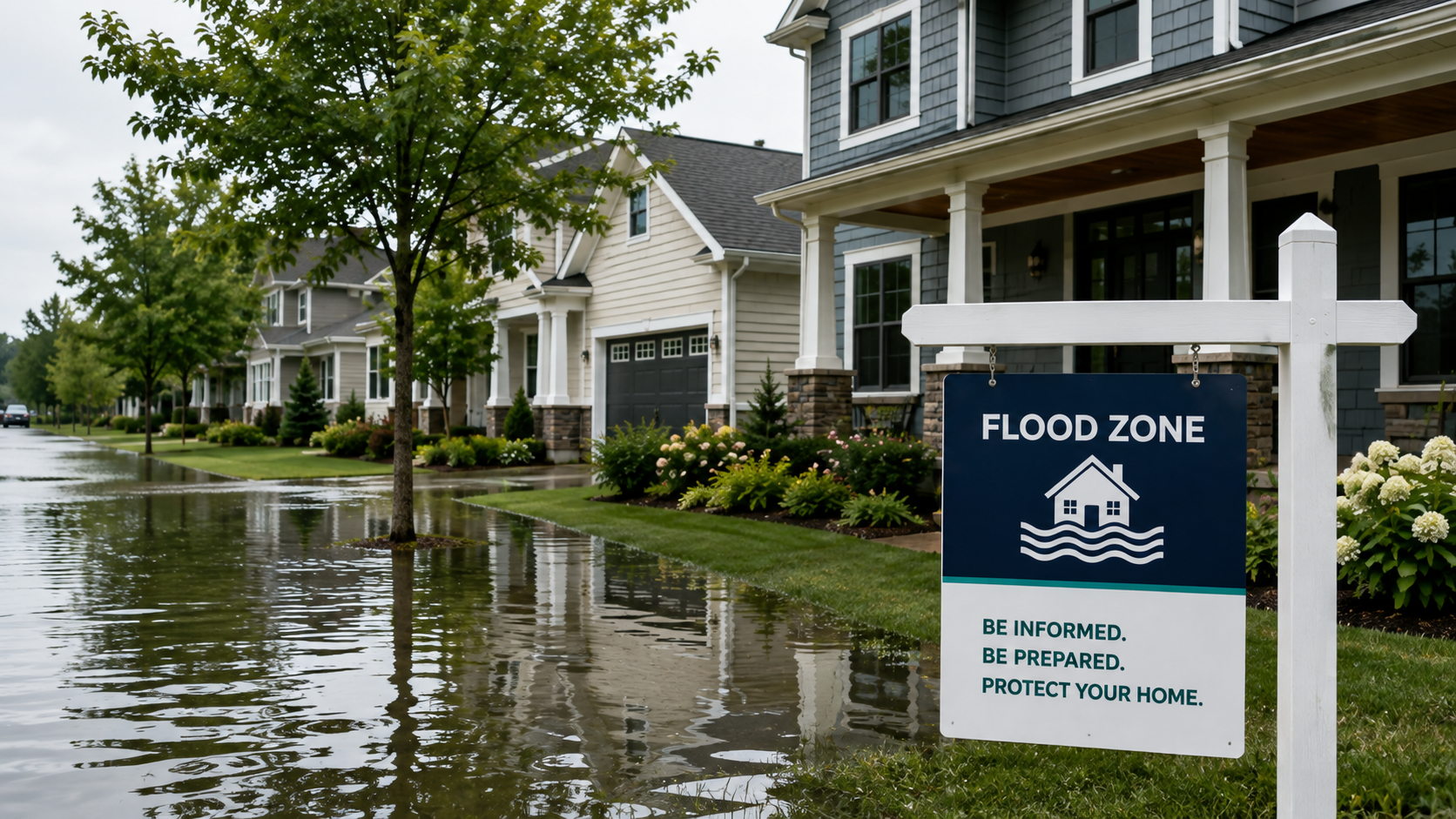
Buying a home in a flood zone does not automatically mean you cannot get a mortgage. But it does mean there are a few more things you should understand before making an offer.
A property’s flood zone can affect flood insurance, monthly housing costs, property risk, and potentially your financing process. And one important point often gets overlooked: a home does not have to be next to a river or sitting directly on the coast to have flood risk.
Flooding can happen in many areas, including places buyers may not immediately think of as flood-prone. The CFPB notes that standard homeowners insurance typically does not cover flood damage and that buyers should consider flood risk even when a property is outside a designated high-risk area.
Section 02
What Is a Flood Zone?
A flood zone is a geographic designation used on flood maps to describe the potential flood hazard in a particular area. In the United States, FEMA’s flood maps are an important source for identifying these areas.
It helps to understand that flood zones are risk designations, not predictions that a property will definitely flood. This distinction matters quite a bit for first-time buyers. A property located in a higher-risk zone is not guaranteed to flood, and a property outside a high-risk zone is not guaranteed to remain dry.
Section 03
What Is a Special Flood Hazard Area (SFHA)?
FEMA generally uses the term Special Flood Hazard Area, or SFHA, to describe areas associated with the 1-percent-annual-chance flood, commonly called the 100-year flood.
The probability is worth unpacking, since it is easy to misread. A 1-percent annual chance does not mean a flood happens only once every 100 years. Over the life of a 30-year mortgage, the cumulative chance of experiencing at least one such flood is significantly higher. FEMA’s glossary notes a 26 percent chance of flood damage during a 30-year mortgage for a structure located within an SFHA, and the CFPB similarly describes this as roughly a one in four chance over the life of a 30-year mortgage.
What Does “1% Annual Chance” Actually Mean?
If an area has a 1% annual chance of experiencing the designated flood event, that probability resets every year. It does not become 0% after one year without flooding, and it does not mean the area is “due” for a flood after several dry years either. This is one of the most important misconceptions to correct early, since it shapes how buyers think about risk over time rather than in any single year.
Section 04
Common FEMA Flood Zones Explained
Rather than turning this into a giant glossary, it helps to focus on the zones a homebuyer is most likely to encounter.
Zone A and Zone AE
Zone A areas fall within the SFHA. For Zone AE specifically, FEMA maps include a Base Flood Elevation, or BFE, determined through detailed analysis. FEMA identifies Zone AE as an area subject to the 1-percent-annual-chance flood event with BFEs shown on the map.
The BFE matters to buyers because it can help professionals evaluate how the property’s structure relates to expected floodwater elevation, which in turn can affect insurance pricing and building requirements.
Zone V and Zone VE
Zone V and Zone VE describe coastal high-hazard areas. Zone VE includes additional hazards associated with storm-induced wave action and has BFEs shown on applicable maps. This distinction is especially relevant for buyers in coastal communities, where wave action adds risk beyond standing floodwater alone.
Zone X
Zone X generally represents areas outside the SFHA, with shaded and unshaded versions corresponding to different levels of mapped flood risk. It is worth being clear here: Zone X does not mean “no flood risk.” FEMA distinguishes shaded Zone X from unshaded Zone X, with shaded areas including certain areas associated with the 0.2-percent-annual-chance floodplain.
This is a good place to correct a common misconception, since many buyers assume “not in a flood zone” means “cannot flood.” That is not quite accurate, and it is worth keeping in mind throughout the rest of this article.
Section 05
Does Being in a Flood Zone Mean You Cannot Get a Mortgage?
Not necessarily. Flood zone status and mortgage eligibility are not the same thing. The key issue is generally whether flood insurance is required for the particular loan and property circumstances, rather than whether the zone itself disqualifies a buyer.
For properties in a designated Special Flood Hazard Area, taking out a mortgage generally means flood insurance is required. The CFPB specifically advises buyers to determine whether flood insurance is required when purchasing a home in an SFHA. It would be inaccurate to say that FEMA requires every homeowner in a flood zone to buy insurance. What actually matters in the lending context is the combination of the mortgage lender’s requirements and the federal flood insurance rules that apply to federally regulated or federally related mortgages.
Section 06
Why Flood Insurance Matters When You Have a Mortgage
It helps to draw a clear line between homeowners insurance and flood insurance, since buyers sometimes assume these overlap more than they actually do.
Standard homeowners insurance typically does not cover flood damage. Flood insurance is generally a separate policy entirely. This distinction is critical because buyers sometimes assume their homeowners insurance covers everything, when in reality it does not necessarily cover flooding at all.
Section 07
How Flood Insurance Can Affect Your Monthly Housing Cost
This is where flood zone status becomes genuinely practical rather than just informational, since your mortgage payment is not necessarily your entire monthly housing cost.
Example: Suppose a buyer has mortgage principal and interest of $3,200 per month, property taxes of $700 per month, homeowners insurance of $180 per month, and flood insurance of $150 per month. Combined, that comes to a potential monthly housing cost of $4,230. The point here is not that $150 is a typical flood insurance premium, since premiums vary significantly by property and coverage. The point is that flood insurance can become another recurring housing expense, and it is worth getting quoted before you commit to a purchase. This example uses simplified, hypothetical numbers for illustration only and does not represent an actual quote or typical premium for any specific property.
Section 08
How Much Does Flood Insurance Cost?
There is no single universal number here, and it is worth understanding why. FEMA’s current Risk Rating 2.0 methodology, officially called Risk Rating 2.0: Equity in Action, uses property-specific characteristics to determine flood insurance pricing, including where the property is located and characteristics of the building itself, rather than relying primarily on the flood zone shown on the map.
Factors that can influence pricing include the property’s location, its distance to flooding sources, ground elevation, building characteristics, and the coverage selected. FEMA specifically explains that Risk Rating 2.0 considers the “where, how, and what” of the property, which is a meaningful shift from older methodologies that leaned much more heavily on flood zone alone.
For a general sense of scale, average National Flood Insurance Program premiums have run roughly $1,100 per year for lower and moderate-risk properties, and more than $1,600 per year for high-risk and coastal high-risk properties, according to recent industry reporting. These are national averages rather than a quote for any specific property, and individual premiums can fall well above or below these figures depending on the factors above.
Section 09
Example: Two Homes with Similar Prices Can Have Very Different Costs
Example: Home A has a purchase price of $650,000, with mortgage-related housing expenses of $3,100 for principal and interest, $700 for property tax, $180 for homeowners insurance, and $0 for flood insurance, for an estimated monthly total of $3,980. Home B has a purchase price of $630,000, with $3,000 for principal and interest, $700 for property tax, $180 for homeowners insurance, and $250 for flood insurance, for an estimated monthly total of $4,130. Home B is cheaper by $20,000 in purchase price, but its estimated monthly housing cost is actually higher once flood insurance is factored in. This example uses simplified, hypothetical numbers for illustration only and does not represent actual quotes, typical premiums, or a guaranteed cost comparison for any specific properties.
Section 10
Does Flood Zone Affect Home Value?
This deserves a careful answer, since it is not accurate to claim that flood-zone properties are automatically worth less.
Instead, buyers may consider a combination of factors, including the property’s flood history, insurance cost, location, comparable sales, condition, elevation, local demand, and perceived risk. One buyer may be entirely comfortable with the risk and the added cost, while another buyer may remove the property from consideration immediately. That difference in buyer demand can matter when the property is eventually resold, even if the flood zone designation itself does not directly set the price.
Section 11
What Buyers Should Check Before Making an Offer
Check the FEMA Flood Map
It is worth using FEMA’s official mapping resources directly to identify the property’s mapped zone, rather than relying solely on the listing description, which may be outdated or incomplete.
Ask About Previous Flooding
Asking the seller and real estate agent directly whether the property has experienced flooding or flood-related damage is a reasonable and often revealing question.
Get an Insurance Quote Early
It is worth doing this before becoming emotionally attached to the house. A home that looks affordable at $650,000 may feel very different once insurance and other recurring costs are added to the picture.
Ask About Elevation
For properties in relevant areas, it is worth asking whether an Elevation Certificate exists and whether it may be useful for insurance or property-risk evaluation. Having one does not automatically lower insurance costs, but it can provide useful information for both the buyer and the insurer.
Review the Property’s Condition
Looking closely at the foundation, basement or crawlspace, HVAC equipment, electrical systems, any signs of past water damage, drainage, and grading helps buyers understand the property beyond its listing photos, which is especially important for homes with any flood exposure.
Section 12
A Practical Flood Zone Buying Scenario
Example: A first-time buyer finds a home listed for $575,000. The property looks close to perfect, with three bedrooms, a large backyard, and a great location. The listing also mentions that the home is in Zone AE. Instead of immediately rejecting the property, the buyer asks whether flood insurance is required for this mortgage, what the insurance quote looks like, whether an existing Elevation Certificate is available, whether the property has experienced previous flooding, what the inspection shows, and how the total monthly cost compares with similar homes outside the flood zone. This example is illustrative only and is meant to demonstrate a reasonable approach to due diligence, not to predict the outcome of any specific transaction.
The mindset worth taking away here is simple: don’t panic, and don’t ignore it either. Investigate it.
Section 13
What If the Home Is in Zone X?
This deserves its own section because buyers frequently misunderstand it. Zone X generally represents areas outside the SFHA, but that does not mean the property has zero flood risk. Flooding can occur outside mapped high-risk areas, sometimes due to heavy rainfall, poor local drainage, or other causes not fully captured on flood maps.
Zone X does not equal guaranteed flood-free. A buyer can still consider flood insurance depending on their own circumstances and risk tolerance, even when it is not required by their lender.
Section 14
Can You Buy a Home Without Flood Insurance?
This is worth explaining with some nuance, since there is a real difference between required flood insurance and optional flood insurance.
For a property in an SFHA with a federally regulated or federally related mortgage, flood insurance is generally required under applicable federal rules. The CFPB states that taking out a mortgage on a home in a designated SFHA generally means flood insurance is required. Outside those designated areas, flood insurance may not be mandatory under the same rule, but the buyer can still choose to purchase coverage voluntarily.
It is worth reinforcing a point that gets lost easily here: required does not mean unnecessary, and not required does not mean unnecessary either. Both required and optional flood insurance decisions deserve real consideration based on the property’s actual risk.
Section 15
Flood Zone vs. Flood Insurance: Don't Treat Them as the Same Thing
A flood zone is a geographic risk classification. Flood insurance is financial protection against covered flood losses. A mortgage requirement is a lender’s obligation to ensure required flood coverage is in place where applicable. Actual flood risk can depend on much more than the label shown on an MLS listing.
Keeping these four ideas separate in your head, rather than treating them as interchangeable, tends to lead to clearer decision-making throughout the buying process.
Section 16
Common Mistakes Buyers Make with Flood Zone Properties
One common mistake is assuming that “Zone X” means no risk at all, when it really means the mapped risk is lower, not zero. Another is waiting until after the offer to think about flood insurance, since by then the cost can become an unpleasant surprise rather than something factored into the decision from the start.
Some buyers look only at the purchase price without accounting for monthly insurance and other ownership costs, which can lead to a very different actual monthly budget than expected. Others assume homeowners insurance covers floods, which, as covered earlier, is generally not the case. Finally, some buyers automatically reject every flood-zone home without further investigation, when in reality some buyers may find the location and property well worth the additional cost and preparation once they understand the numbers.
Section 17
A Simple Flood Zone Checklist for Homebuyers
Before touring seriously, check the FEMA flood map for the property. Before making an offer, ask about flood history and get a sense of insurance requirements. During due diligence, review inspection findings and any relevant property documents closely. Before closing, confirm the required insurance coverage and understand the recurring cost it adds to your monthly budget. Before deciding, compare the home’s total cost with similar properties outside the flood zone, so you are comparing full housing costs rather than purchase price alone.
Section 18
The Bottom Line
A flood zone label should not automatically make you walk away from a home. But it should make you ask better questions.
The real question is not simply whether a house is in a flood zone. It is what the flood risk actually means for this specific property, your insurance, your monthly housing cost, and your long-term plans. For some buyers, the answer may be that the property is still a great fit. For others, the additional insurance cost or risk may make another home a better choice.
The important part is knowing the numbers and the risks before you commit.
Section 19
Sources
- FEMA, Flood Zones
- FEMA, Special Flood Hazard Area (SFHA)
- FEMA, Risk Rating 2.0: Equity in Action
- Consumer Financial Protection Bureau (CFPB), What questions should I ask about flood and disaster risk when buying a house?
- U.S. News & World Report, How Much Does Flood Insurance Cost?
This article is for educational purposes only and does not constitute financial, mortgage, insurance, legal, tax, or real estate advice. Flood-zone designations, insurance requirements, premiums, property values, and mortgage requirements vary by property, location, lender, loan program, insurer, and applicable regulations. Examples and dollar amounts are illustrative only and are not quotes, guarantees, or predictions of actual costs. A property located outside a designated high-risk flood area may still experience flooding, and a flood-zone designation does not by itself determine whether a property is suitable for a particular buyer. Always verify the property’s current flood designation, obtain an insurance quote, and consult the appropriate licensed professionals before making a purchase or financing decision.
Duc Pham, Mortgage Broker | NMLS# 844897 | 408-600-1900 | dp@wonderrates.com Wonder Rates, Inc. | NMLS# 1518655 | DRE# 02047445 | DFPI# 60DBO-59134 Equal Housing Opportunity. Equal Housing Lender. Licensed in: AL, AZ, CA, CO, FL, GA, LA, MI, NC, OH, OK, OR, PA, SC, TX, VA, WA