

Section 01
It is a common question among immigrant homebuyers, and the answer is more nuanced than a simple yes or no.
“I own property outside the U.S. Do I need to tell my lender?”
If you are an immigrant buying a home in the United States, you may have financial ties to more than one country. You might own a home in your home country, keep savings in a foreign bank account, receive rental income from overseas property, or plan to transfer money from abroad for your down payment.
Having foreign assets does not automatically prevent you from qualifying for a U.S. mortgage. However, those assets can become relevant to your mortgage application depending on how they are connected to your income, debts, available funds, or the money you plan to use for the purchase.
The key is to understand the difference between simply owning an asset overseas and relying on that asset as part of your mortgage application.
This article is for general educational purposes only. It is not financial, legal, tax, or immigration advice. Mortgage requirements vary by lender, loan program, investor, and individual circumstances. Always confirm your specific situation with a licensed Loan Officer.
Section 02
What Are Foreign Assets?
Foreign assets are assets held or located outside the United States. For immigrant homebuyers, they can be part of an ordinary financial life that existed before moving to the U.S. or that continues after immigration.
Common examples include real estate in another country, foreign checking or savings accounts, investments held through foreign financial institutions, retirement or investment accounts outside the U.S., and ownership interests in a foreign business.
Foreign assets can also include money from the sale of property overseas or savings accumulated before moving to the United States.
The fact that an asset is located outside the U.S. does not automatically make it a problem for a mortgage application. What matters is how the asset relates to the transaction and whether the lender needs to verify it as part of the borrower’s financial profile.
For example, owning a fully paid-off apartment overseas that is not being sold, used for income qualification, or used to provide funds for the purchase is different from selling that apartment and using the proceeds for a down payment.
Section 03
Do You Have to Tell Your Lender About Property You Own Overseas?
There is no single documentation requirement that applies to every borrower who owns property outside the United States. The information your lender needs will depend on the loan program, the borrower’s financial situation, and how the property relates to the mortgage application.
However, you should not intentionally leave out relevant financial information when completing your mortgage application.
Lenders generally review a borrower’s income, assets, debts, credit history, and available funds when evaluating a mortgage application. The Consumer Financial Protection Bureau recommends preparing documentation related to income, assets, bank accounts, and the source of the down payment when applying for a mortgage. CFPB: Create a Loan Application Packet
If you own property overseas, tell your Loan Officer about it and explain whether the property has a mortgage, generates rental income, is being sold, or is connected to funds you plan to use for your U.S. purchase. Your Loan Officer can then determine what information and documentation may be relevant to your particular loan.
Section 04
Does Owning Property Overseas Automatically Hurt Your Mortgage Application?
No. Owning property overseas does not automatically disqualify a borrower from getting a U.S. mortgage.
At the same time, the property may still be relevant to underwriting if it creates debt, generates income, or provides funds for the transaction. A lender is interested in understanding the borrower’s complete financial picture rather than looking at foreign property ownership in isolation.
Consider two borrowers who each own a home overseas. The first owns a property that is fully paid off and does not generate income. The second has a mortgage on the property and receives monthly rental income from it. Although both borrowers own foreign real estate, the financial circumstances are very different.
In the second situation, the lender may need to consider the related debt and determine whether the rental income can be documented and used for qualifying purposes.
That is why the more useful question is not whether foreign property is “good” or “bad” for a mortgage. The question is how that property affects the borrower’s overall financial profile and whether it is connected to the mortgage transaction.
Section 05
When Can Foreign Property Become Important to Underwriting?
Foreign property can become particularly important when it is connected to debt, income, or funds being used for the purchase.
If the Property Has a Mortgage
If you still owe money on an overseas property, the related debt may be relevant when the lender reviews your financial obligations. The exact treatment depends on the applicable loan program and underwriting requirements.
For this reason, be prepared to provide information about the property and its financing if your lender requests it. Do not assume that a foreign mortgage will automatically be ignored simply because the property is outside the United States.
If the Property Generates Rental Income
Rental income from an overseas property is another situation that may require additional documentation.
A lender may need to determine whether the income is stable, how it can be verified, and whether it meets the requirements of the applicable loan program. Documentation can become more complicated when rent is received in a foreign currency, deposited into an overseas bank account, or reported through foreign tax documents.
Receiving rental income does not automatically mean the full amount can be counted toward mortgage qualification. The lender needs to determine what portion, if any, is eligible under the applicable guidelines.
If You Plan to Sell the Property
If you are selling an overseas property and intend to use the proceeds toward your U.S. home purchase, the property becomes directly connected to your mortgage transaction.
In that situation, the lender may need documentation showing the sale, the amount of the proceeds, the transfer of the money, and the source of the funds. Keeping the relevant sale and banking records can make it easier to establish a clear paper trail.
If You Borrow Against the Property
Some homeowners use an existing property to obtain financing. If you borrow against an overseas property and transfer the proceeds to the United States, the lender may need to understand both where the money came from and whether the transaction created a new debt obligation.
Because the treatment varies by loan program and lender, discuss this with your Loan Officer before moving the funds whenever possible.
Section 06
What If You Want to Use Foreign Funds for Your Down Payment?
This is one of the situations where it is particularly helpful to speak with your Loan Officer before transferring money.
Suppose you have $100,000 in a bank account in Vietnam and want to use $80,000 toward the purchase of a home in California. Even though the money belongs to you, the lender may need to verify the source of the funds and confirm that they meet the requirements for the mortgage program.
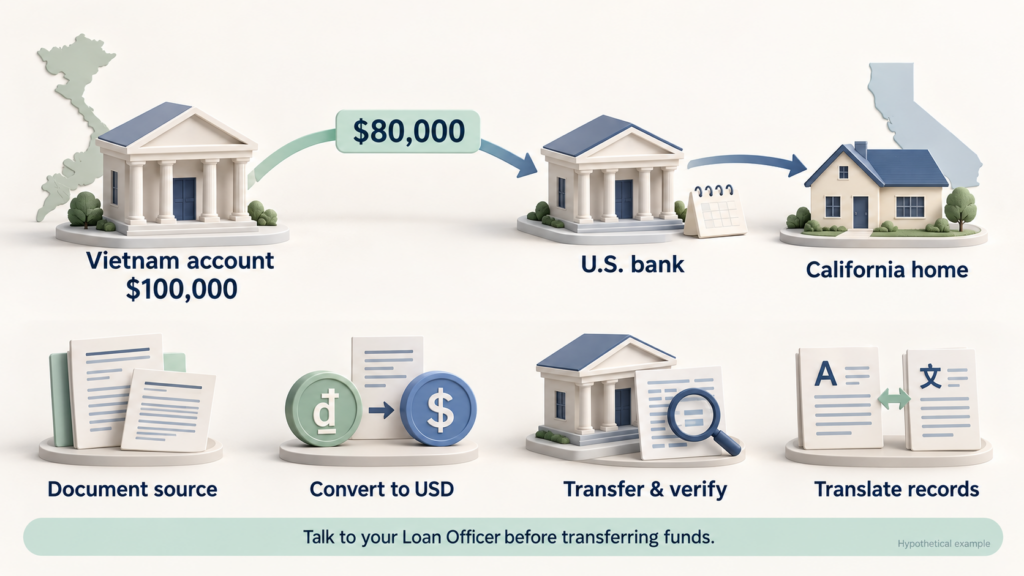
For conventional loans following Fannie Mae’s applicable guidelines, funds originating from assets outside the United States and used for a down payment, closing costs, or reserves must meet specific requirements. The guidelines address documentation of the foreign assets, conversion into U.S. dollars, transfer to a U.S. or state-regulated financial institution, and verification of the funds before closing. Foreign-origin documents must also be in English or accompanied by a complete and accurate translation. Fannie Mae: Foreign Assets
Freddie Mac also has requirements for funds originating from assets outside the United States, including requirements related to transferring and verifying those funds under its applicable guidelines. Freddie Mac Single-Family Seller/Servicer Guide
The practical takeaway is simple: do not move a large amount of money internationally right before closing and assume the lender will be able to verify it immediately.
Instead, tell your Loan Officer where the money is held, what the funds are from, and how much you expect to use. The lender can then explain what documentation may be needed and how the transfer should be handled.
If you are still estimating how much cash you may need for your purchase, the Down Payment Calculator can give you a starting point before you speak with a lender.
Section 07
What Documents Might You Need for Foreign Assets?
There is no universal document checklist for every borrower. The documents required will depend on the asset, the transaction, the loan program, and how the asset is being used.
Depending on your situation, your lender may ask for documents such as foreign bank statements, property ownership records, mortgage statements, sale documents, rental agreements, evidence of rental income, foreign tax records, investment account statements, currency conversion records, wire transfer confirmations, or documentation showing the source of the funds.
The purpose of these documents is generally to establish what the asset is, who owns it, where the money came from, and how the funds are connected to the mortgage transaction.
This becomes especially important when a large amount of money suddenly appears in a U.S. bank account shortly before closing. The balance itself does not necessarily explain its source. A clear record showing the movement of the money can help the lender verify it.
The CFPB advises borrowers to be prepared to provide information about their finances and the source of their down payment, and to respond to additional documentation requests from their lender during the mortgage process. CFPB: Submit Documents and Answer Requests From the Lender
Section 08
What If Your Foreign Documents Are Not in English?
This is common for borrowers who still have financial documents from their home country.
A foreign bank statement, property record, tax document, or sale agreement may be written entirely in another language. That does not necessarily mean the document cannot be used, but your lender may require a translation that meets the applicable guidelines.
For example, Fannie Mae’s foreign asset guidance states that foreign-origin documents must be in English or accompanied by a complete and accurate translation. Fannie Mae: Foreign Assets
Translation requirements can vary by lender and loan program, so it is better to ask your Loan Officer what is acceptable before paying for a translation or submitting documents.
Section 09
What If Your Foreign Assets Are in Another Currency?
Currency conversion can also affect how foreign funds are documented.
An immigrant borrower may have savings in Vietnamese dong, Mexican pesos, Canadian dollars, euros, Korean won, or another currency. When those funds are being used in a U.S. mortgage transaction, the lender needs to establish their value in U.S. dollars and verify the funds according to the applicable loan requirements.
Under Fannie Mae’s applicable foreign asset guidelines, qualifying funds originating from foreign assets must be converted into U.S. dollars and transferred to a U.S. or state-regulated financial institution before closing, with verification of the funds in U.S. dollars. Fannie Mae: Foreign Assets
This is one reason international transfers should be planned with the lender instead of being treated as a last-minute task.
Section 10
What If You Receive Income From Another Country?
Foreign income is a separate issue from simply owning foreign assets.
You might receive rental income from an overseas property, income from a foreign business, payments from an employer outside the United States, or investment income generated abroad.
Whether foreign income can be used to qualify for a mortgage depends on the loan program and whether the income can be properly documented and verified.
The lender may need information about the source, amount, history, stability, and continuity of the income. Currency conversion and foreign tax documentation may also become relevant.
For example, Fannie Mae has specific requirements for documenting foreign employment income under its applicable conventional loan guidelines. Fannie Mae: Standards for Employment-Related Income
So if you receive income from another country, do not assume that regular deposits automatically make the income qualifying income. Tell your Loan Officer about it early so they can determine what documentation applies.
Section 11
Foreign Assets, Foreign Income, and Foreign Debt Are Not the Same Thing
These terms are sometimes used interchangeably, but they represent different parts of a borrower’s financial profile.
A foreign asset is something of value that you own outside the United States, such as a house, savings account, or investment account.
Foreign income is money you receive from a source outside the United States, such as rent from an overseas property or income from a foreign business.
Foreign debt is an obligation you owe outside the United States, such as a mortgage on an overseas property.
One borrower can have all three at the same time.
For example, imagine you own an apartment in Vietnam that has an outstanding mortgage and is rented to a tenant. The apartment is a foreign asset, the mortgage is foreign debt, and the rent is foreign income. If you also keep the rental proceeds in a Vietnamese bank account and plan to transfer some of that money to the U.S. for a down payment, the foreign bank account and the transfer of funds become relevant as well.
Looking at each part separately helps explain why lenders may ask additional questions about a borrower’s international financial ties.
Section 12
What If You Have a Foreign Bank Account but Are Not Using the Money?
Not every foreign bank account is being used for a mortgage transaction.
You may still have an account overseas because you recently moved to the U.S., support family members abroad, receive rental income, maintain savings in your home country, or simply have not closed an old account.
The existence of a foreign bank account does not automatically mean that the money in it will be used for your home purchase.
However, if the account becomes a source of funds for the transaction, the lender may need to verify the funds and their source. This is particularly important when the account is used to transfer a significant amount of money shortly before closing.
If you are unsure whether a particular account matters to your mortgage application, mention it to your Loan Officer rather than trying to decide on your own which financial information is relevant.
Section 13
What About Large Transfers From Overseas?
Large deposits and transfers can lead to additional questions because the lender needs to establish the source of the funds.
For example, imagine that you normally have $15,000 in your U.S. checking account and then receive a $75,000 international transfer shortly before closing. Even if the money belongs entirely to you, the lender may need documentation showing where it came from and why it was transferred.
The source could be savings, the sale of a property, an investment account, a business, or another legitimate source. Each situation can require different documentation.
The CFPB advises borrowers to be prepared to explain and document their financial information and to respond to lender requests during the closing process. CFPB: Submit Documents and Answer Requests From the Lender
If you expect to transfer a large amount of money from overseas, talk to your Loan Officer before making the transfer when possible. That gives you an opportunity to understand the documentation requirements and avoid unnecessary complications later.
Section 14
Can You Use Money From Selling Foreign Property?
Potentially, yes, depending on the loan program and documentation.
If you sell a property overseas and plan to use the proceeds for your U.S. home purchase, the lender may need to establish a clear connection between the property sale and the funds eventually used for the mortgage transaction.
For example, the paper trail could involve the original property ownership documents, the sale agreement, documentation of the sale proceeds, the foreign bank account receiving the proceeds, the international transfer, and the U.S. account where the money is ultimately deposited.
Keeping those records can make the source of funds easier to document.
Do not assume that transferring the money into your U.S. account is enough by itself. Ask your lender what records should be retained before the transaction takes place.
Section 15
Can Foreign Rental Income Help You Qualify?
It may be possible in some circumstances, but receiving rental income does not automatically mean the full amount can be counted as qualifying income.
The lender may need to evaluate the property’s rental history, lease documentation, tax records, bank deposits, ownership records, and other information required by the applicable loan program.
Foreign rental income can also involve currency conversion and documents issued by a foreign government or financial institution, which may require additional verification or translation.
If the income is important to your ability to qualify, discuss it with your Loan Officer before assuming that it will be included in your qualifying income.
Section 16
What Are the Biggest Mistakes to Avoid?
Moving Money Before Asking Your Lender
If you plan to transfer a substantial amount of money from overseas, ask your lender about the process first. The timing and documentation of the transfer can matter.
Assuming Foreign Assets Are Automatically Ignored
A property or account outside the U.S. does not necessarily become irrelevant simply because it is overseas. If it affects your debts, income, assets, or source of funds, it may need to be documented.
Assuming Every Foreign Asset Must Be Used
The opposite assumption can also create unnecessary stress. You do not automatically have to sell an overseas property or move your foreign savings into the U.S. simply because you are applying for a mortgage.
Mixing Funds Without Keeping Records
If money moves through several accounts or countries, keep statements and transfer records that establish a clear history of the funds.
Waiting Until the Last Minute
Foreign documents may require translation, additional verification, or more time to obtain. Bringing up the situation early gives everyone more time to resolve potential documentation issues.
Section 17
How Should Immigrant Homebuyers Prepare?
If you have financial ties to another country, preparing a basic overview before applying for a mortgage can make the conversation with your Loan Officer much easier.
Start by making a list of the foreign assets you own, including real estate, bank accounts, investments, and business interests. Note whether any of those assets have outstanding debt or generate income.
Then identify the funds you expect to use for your purchase. If any portion of your down payment or closing costs will come from an overseas account, tell your lender where the money is held and what the source of the funds is.
It is also useful to keep your financial records organized before you begin the mortgage process. Depending on your situation, this may include bank statements, property documents, rental records, sale agreements, tax documents, and transfer confirmations.
If any documents are written in another language, ask your lender about translation requirements before ordering translations.
Most importantly, do not try to interpret mortgage guidelines on your own. Give your Loan Officer an accurate picture of your finances and let them determine which requirements apply to your loan.
Section 18
A Simple Example
Consider an immigrant homebuyer who lives and works in California. She owns an apartment in Vietnam that she purchased several years ago. The apartment is fully paid off and currently rented to a tenant. She also has $60,000 in savings in a Vietnamese bank account and plans to use $40,000 toward the down payment on a California home.
There are several different financial considerations in this example. The apartment is a foreign asset, the rental payments are foreign income, and the Vietnamese savings account is a foreign financial asset. The planned $40,000 transfer is also relevant because it will become part of the funds used for the home purchase.
The borrower should explain this situation to her Loan Officer early. Depending on the loan program, the lender may need documentation related to the property, rental income, foreign account, and transfer of funds.
The issue is not simply that she owns property overseas. The lender needs to understand the different components of her financial picture and determine which ones need to be documented for the mortgage.
This example is hypothetical and provided for educational purposes only. It does not represent a guaranteed loan approval, documentation requirement, rate, or loan program.
Section 19
Does Owning Property Overseas Mean You Need a Special Mortgage?
Not necessarily.
Foreign asset ownership does not automatically determine which mortgage program you need. A borrower with overseas property may still qualify for a conventional mortgage or another available loan program if they meet the applicable requirements.
The right loan option depends on the complete financial profile, including income, credit, debts, down payment, assets, property type, occupancy, loan amount, residency or immigration status, and applicable lender and investor guidelines.
If your situation also involves your immigration or residency status, you can read our guide to Mortgage Requirements for Non-U.S. Citizens for a broader overview of the factors that can affect mortgage eligibility.
If you are already planning to purchase a home and want to explore your financing options, you can also learn more about buying a home with Wonder Rates.
Section 20
When Should You Tell Your Loan Officer?
The earlier you bring up foreign assets, foreign income, or international transfers, the more time your lender has to determine what documentation may be needed.
You do not need to arrive at your first conversation with every possible document prepared. Start by explaining the situation clearly.
For example, you might say:
“I own a house in Vietnam, I receive rental income from it, and I have savings in a Vietnamese bank account that I may use for my down payment.”
That gives the Loan Officer enough information to ask the right follow-up questions.
From there, they can help determine whether the property, rental income, bank account, or transfer of funds needs additional documentation for the loan program you are considering.
The CFPB recommends that borrowers communicate with lenders, provide requested documentation, and respond to questions about their financial circumstances throughout the mortgage process. CFPB: Contact Multiple Lenders
Section 21
Questions to Ask Your Loan Officer
If you have assets or income outside the United States, consider asking your Loan Officer:
- Do you need documentation for my overseas property?
- Does the mortgage on that property affect my application?
- Can rental income from the property be used for qualifying?
- What documents do you need for my foreign bank account?
- Can I use funds from that account for my down payment?
- Do my foreign documents need to be translated?
- What is the recommended process for transferring the funds?
- How far in advance should I transfer the money?
- What documents should I keep to establish the source of funds?
- Which loan programs may fit my overall financial situation?
Getting these questions answered early can help you avoid discovering a documentation issue shortly before closing.
Section 22
Final Takeaway
Owning property overseas does not automatically prevent you from getting a U.S. mortgage, and it does not automatically mean that you need a special loan program.
What matters is how your foreign assets fit into the rest of your financial picture. An overseas property may be relevant because it has a mortgage, produces rental income, is being sold, or is connected to money you plan to use for your purchase. A foreign bank account may become particularly relevant if you plan to use the funds for your down payment or closing costs.
If you have foreign property, foreign income, overseas savings, or plans to transfer money internationally for a home purchase, discuss the situation with your Loan Officer early. Providing the information upfront gives the lender an opportunity to explain what documentation may be required and how the funds should be handled.
If you are ready to discuss your homebuying situation and explore your mortgage options, get started with Wonder Rates.
Section 23
Sources
- Fannie Mae Selling Guide: Foreign Assets
- Fannie Mae Selling Guide: Standards for Employment-Related Income
- Freddie Mac Single-Family Seller/Servicer Guide
- Consumer Financial Protection Bureau: Create a Loan Application Packet
- Consumer Financial Protection Bureau: Contact Multiple Lenders
- Consumer Financial Protection Bureau: Submit Documents and Answer Requests From the Lender
Disclaimer: This article is intended for general informational and educational purposes only and does not constitute financial, legal, tax, or immigration advice. Mortgage guidelines regarding foreign assets, foreign income, source of funds, and documentation vary by lender, loan program, investor requirements, and individual circumstances and may change over time. Nothing in this article should be interpreted as a guarantee of loan approval or specific documentation requirements. Please consult a licensed Loan Officer regarding your individual situation.
Duc Pham, Mortgage Broker | NMLS# 844897
📞 669-777-9999 | 📧 dp@wonderrates.com
Wonder Rates, Inc. | NMLS# 1518655 | DRE# 02047445 | DFPI# 60DBO-59134
Equal Housing Opportunity. Equal Housing Lender.
Licensed in: AL, AZ, CA, CO, FL, GA, LA, MI, NC, OH, OK, OR, PA, SC, TX, VA, WA.