

Section 01
If you are researching a foreign income mortgage, your financial life may not fit neatly into one country’s paperwork. You may earn income from an overseas employer, maintain savings in another country, own property abroad, or receive financial support from family members who live outside the United States.
These circumstances do not automatically prevent you from buying a home in the U.S. However, they can affect how a lender reviews your income, verifies your assets, and documents the source of your down payment.
The important distinction is that foreign income and foreign assets are not the same thing. Income is money you earn and may use to qualify for a mortgage. Assets are funds or property you own, which may help cover the down payment, closing costs, or required reserves. Each has its own documentation requirements.
This guide explains how foreign income may be considered for a U.S. mortgage, what documentation lenders may request, and how to prepare when your financial records span more than one country.
Section 02
What is a foreign income mortgage?
A foreign income mortgage is an informal term for a U.S. mortgage application in which the borrower wants a lender to consider income earned outside the United States. The term is also sometimes used more broadly when a buyer has overseas savings or other foreign assets that are relevant to the transaction.
There is no single mortgage program called a foreign income mortgage that automatically accepts every type of overseas income. Eligibility depends on the loan program, the income source, the borrower’s financial profile, the property’s intended use, and the lender’s underwriting requirements.
For example, someone who lives in the U.S. and works remotely for a foreign company may have a different situation from someone who receives rental income from property overseas. A buyer who earns income in U.S. dollars but keeps savings in a foreign bank account faces a different documentation question again.
Before choosing a mortgage program, identify exactly what you need the lender to consider.
Foreign income versus foreign assets
Foreign income generally refers to earnings from an eligible source outside the United States. Under Fannie Mae’s conventional lending guidance, foreign income is specifically defined as income earned by a borrower employed by a foreign corporation or foreign government and paid in foreign currency.
Foreign assets, by comparison, may include funds held in an overseas bank account or other assets located outside the U.S. Assets may be relevant to the down payment, closing costs, and financial reserves, but owning an asset does not automatically make it qualifying income.
The distinction matters because a lender may evaluate the amount, stability, and continuation of income differently from the ownership, location, source, and transfer of assets.
Section 03
Can you use foreign income to qualify for a U.S. mortgage?
Potentially, yes. Whether foreign income can be used depends on the source of the income, how it is documented, whether it meets the applicable underwriting requirements, and whether the income is expected to continue.
For loans eligible for sale to Fannie Mae, the Selling Guide includes specific requirements for qualifying with foreign employment income. These include signed federal income tax returns for the most recent two years that include the foreign employment-related income, documentation appropriate to the income source, English-language documentation or a complete and accurate translation, and conversion of the income to U.S. dollars.
These are Fannie Mae requirements for the applicable loan scenarios. They should not be treated as universal requirements for every mortgage product. Other loan programs and lenders may have different rules.
Types of foreign income that may need review
The following examples illustrate situations a lender may need to evaluate. They do not guarantee that a particular income source will be accepted.
Salary from a foreign employer
A borrower may receive a salary from a company located outside the U.S. The lender may need to understand the employment arrangement, the source and currency of the income, its history, and whether it is likely to continue.
Income from a foreign government
Income from a foreign government may fall within Fannie Mae’s definition of foreign income when the applicable criteria are met. The lender still needs to review the source of income and supporting documentation.
Remote work for an overseas company
Working remotely from the United States for an overseas employer can raise additional questions about the actual employer, payment arrangement, tax reporting, and how the income is documented. Do not assume that the employer’s location alone determines whether the income qualifies.
Income from a foreign business
If you own or operate a business overseas, the lender may need to evaluate the income under requirements applicable to that business and income type. Business ownership, business financial statements, tax returns, and the stability of the income may all be relevant. Self-employment rules may apply depending on the ownership structure and the loan program.
Rental income from overseas property
Rental income from property outside the U.S. is not automatically treated the same way as foreign employment income. Its treatment depends on the applicable loan guidelines, how the income is documented, and whether the lender can establish an acceptable qualifying amount.
The best first step is to tell your Loan Officer where the income comes from, how you receive it, and what records are available. That allows the lender to identify the correct documentation requirements before you rely on the income to qualify.
Section 04
How lenders evaluate foreign income
Mortgage underwriting is not simply a calculation of how much money arrives in your bank account. A lender needs to determine whether the income is eligible, adequately documented, stable, and reasonably expected to continue.
For a loan subject to Fannie Mae’s guidelines, the lender must apply the relevant income assessment requirements as well as the specific foreign income rules. Other programs may use different standards.
Income history and stability
Lenders generally review income history and whether the borrower is likely to continue receiving the income. A large recent payment does not necessarily establish a reliable income pattern.
For example, a borrower who has received a consistent salary from an overseas employer may be able to provide employment records, pay statements, and tax documents that support the income history. A borrower who recently started a new overseas contract may need additional review to establish the amount and expected continuation of income.
The documentation required depends on the source of income and the applicable program. Do not assume that a current employment letter alone will satisfy every requirement.
Tax returns and reported income
For foreign employment income under Fannie Mae’s applicable guidance, lenders must obtain copies of signed federal income tax returns for the most recent two years that include the foreign employment-related income.
This is an important distinction for borrowers who earn income abroad but are unsure how it appears on their U.S. tax returns. The lender needs to assess the income under the applicable mortgage rules, not simply accept a figure from a foreign pay statement or bank deposit.
Tax reporting can be complex, especially when a borrower has foreign income, foreign tax obligations, or a tax situation involving more than one country. A mortgage professional can explain what the lender needs for underwriting, while a qualified tax professional should address tax filing and tax treatment questions.
Currency conversion
If income is paid in a currency other than U.S. dollars, the lender needs to evaluate it in USD under the applicable guidelines. The amount that appears in a foreign currency statement is not necessarily the final qualifying amount used in underwriting.
Exchange rates can change, and the amount received after conversion may differ from the amount shown on a pay statement. Ask your Loan Officer how the income will be documented and converted for the specific loan program.
Do not calculate a qualifying income amount on your own and assume the lender will use the same figure. A preliminary estimate is useful for planning, but underwriting determines the amount accepted for the mortgage.
Documents in another language
Foreign-language records may need to be translated before they can be used in a mortgage file.
Fannie Mae’s foreign income guidance states that documents of foreign origin must be completed in English or accompanied by a complete and accurate translation attached to each document. The lender must follow the applicable requirements for the loan being underwritten.
Ask what translation format the lender accepts before paying for translation services. Keep the original documents, and make sure the translated versions correspond to the correct statements, dates, and account holders.
Section 05
Documents to prepare when applying with foreign income
Preparing documents early can help reduce delays. The exact list depends on the source of income and the loan program, so use this as a starting point rather than a universal checklist.

Income and employment records
Depending on your situation, the lender may request:
- Signed U.S. federal income tax returns for the applicable years.
- Pay statements or records showing how much income you receive.
- An employment letter or other evidence of your employment arrangement.
- Records identifying the employer and the source of the income.
- Business or self-employment records if the income comes from a business.
- Supporting documents needed to establish the stability and continuation of the income.
For foreign employment income under Fannie Mae’s applicable requirements, signed federal tax returns for the most recent two years that include the foreign employment-related income are specifically required. Other documentation may also be necessary depending on the file.
Foreign bank and asset records
If you plan to use money held overseas for your down payment, closing costs, or financial reserves, prepare records that establish ownership and show the source of funds.
These may include bank statements, records of transfers, currency exchange records, and documents explaining how the funds were accumulated. The lender may also request documentation for large deposits or transfers.
Fannie Mae’s foreign assets guidance states that funds originating from assets outside the U.S. and its territories must be documented as exchanged into U.S. dollars and held in a U.S. or state-regulated financial institution, with the funds verified in U.S. dollars before closing, for loans subject to that guidance.
This means a foreign account balance alone may not be enough to establish that the funds are ready to be used for closing. Confirm the steps and timing with your Loan Officer before moving the money.
Translation and consistency
Review the names, dates, account details, and amounts across your documents. Differences in name spelling, transliteration, address formats, or account ownership can lead to additional questions.
If a document uses a different name format from your U.S. identification or other financial records, explain the difference early and ask what supporting evidence is needed. Avoid editing original statements or changing documents to make them appear consistent.
Section 06
Using overseas assets for a down payment
Foreign assets can be relevant to a mortgage application even when the borrower does not need foreign income to qualify. A buyer might earn a U.S. salary but keep part of the down payment in an overseas bank account.
In that case, the lender needs to verify the source and availability of the money. The fact that the borrower owns the account does not necessarily mean the funds can be used for closing without additional documentation.
Example: transferring overseas savings
Imagine a buyer has $100,000 in a bank account outside the United States and plans to use $80,000 toward a home purchase.
The buyer may need to document ownership of the overseas account, show the relevant account balance, provide records of the transfer, document currency conversion where applicable, and verify that the funds are available in the required U.S. financial institution before closing.
The lender may also need to review the source of the original funds and any large deposits. Requirements depend on the loan program and the facts of the transaction.
This example is for educational purposes only. It is not a guarantee that a specific amount will be accepted or that every lender will request the same documents.
Should you transfer the money before applying?
Not necessarily. Moving money without first understanding the documentation requirements can make the paper trail harder to explain.
Before transferring funds, ask your Loan Officer:
- Which overseas account records will be required?
- Does the loan program require the funds to be converted to U.S. dollars?
- Must the funds be held in a U.S. financial institution before closing?
- What transfer records should you keep?
- How early should the funds be moved to meet the lender’s verification requirements?
Keep statements from both the sending and receiving accounts, along with transfer confirmations and exchange records. The goal is to make the source and movement of the funds easy to verify.
Section 07
How immigration status relates to foreign income
Foreign income and immigration status are related in some mortgage applications, but they are not the same underwriting question.
A borrower may have income from an overseas employer while living in the United States. Another borrower may live abroad and be purchasing property in the U.S. These situations can involve different eligibility and documentation considerations.
Fannie Mae’s guidance states that non-U.S. citizen borrowers must meet the applicable employment and income verification requirements, and separate eligibility requirements apply based on borrower status and the loan program.
If you are also unsure which mortgage options may be available based on your residency or immigration status, read our guide to mortgage requirements for non-U.S. citizens. That article covers borrower eligibility, while this guide focuses on foreign income and overseas assets.
Do not assume that having qualifying income automatically makes every loan program available. Income verification, borrower eligibility, credit history, debt, assets, down payment, property type, and occupancy can all affect the outcome.
Section 08
Common challenges when using foreign income
Foreign income applications can require more coordination than a file based entirely on U.S. employment and domestic bank accounts. Several issues are worth anticipating.
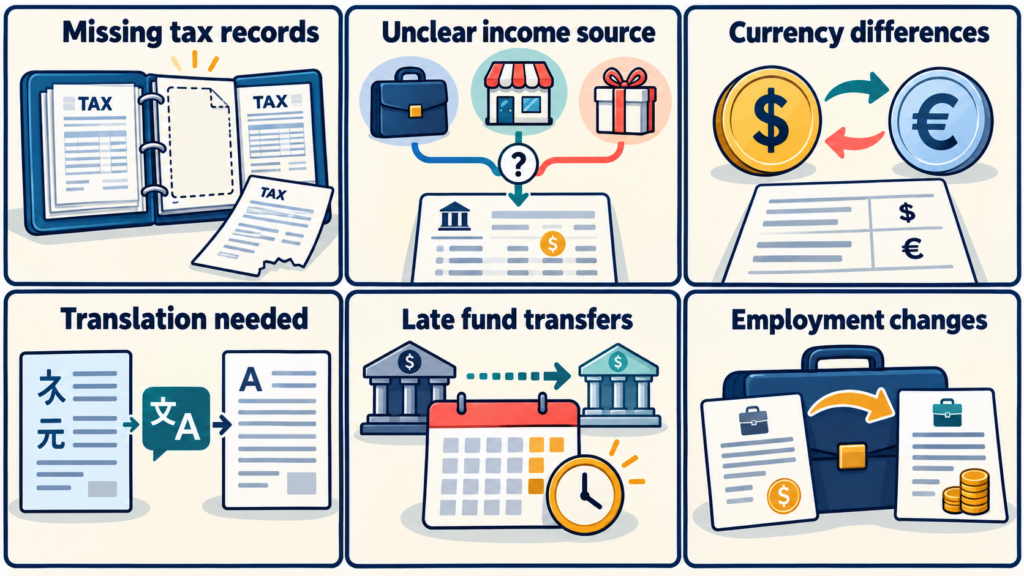
Incomplete tax records: If the lender needs tax returns that include foreign employment income, missing or inconsistent records may delay the review.
Unclear income source: A deposit into a bank account does not, by itself, prove that the money is eligible qualifying income. The lender may need to establish whether it represents salary, business income, a transfer between accounts, a gift, or another source.
Currency differences: Foreign-currency amounts must be evaluated under the applicable rules. Exchange rates and transfer amounts should be documented rather than assumed.
Documents that are not in English: Translation can take time. Ask the lender what it accepts before ordering translations.
Overseas funds transferred late in the process: Moving funds shortly before closing can create extra verification work. Confirm the timing and documentation requirements early.
Changes in employment or income: A change in employer, contract, compensation, or payment currency may affect the lender’s assessment. Tell your Loan Officer about material changes rather than waiting for the lender to discover them during verification.
These challenges do not automatically mean the mortgage will be denied. They mean the borrower should establish the documentation requirements early and allow enough time to resolve questions.
Section 09
A practical preparation checklist
Before beginning a mortgage application involving foreign income or assets, organize your records and clarify the following:
- Identify each income source and the country where it originates.
- Confirm whether income is paid in U.S. dollars or a foreign currency.
- Gather the applicable tax returns and employment records.
- Ask which foreign documents need English translations.
- List overseas bank accounts or assets that may be used for the transaction.
- Keep records showing the source of funds and any international transfers.
- Ask how foreign assets must be converted, transferred, and verified before closing.
- Disclose any recent large deposits or significant changes in income.
- Confirm which loan program’s rules will apply to your application.
- Leave time for additional documentation requests.
This preparation can make the process more organized, but it does not replace a lender’s review. The final documentation requirements depend on the loan program and the details of the file.
Section 10
Estimate your homebuying budget before you apply
Foreign income documentation is only one part of mortgage qualification. You also need to consider the proposed monthly payment, down payment, closing costs, recurring debts, and funds you want to keep available after closing.
Use the Wonder Rates Mortgage Payment Calculator to estimate principal, interest, property taxes, homeowners insurance, PMI when applicable, and HOA costs. This can help you compare potential home prices and monthly budgets.
The calculator is a planning tool, not an underwriting decision. It does not determine whether foreign income will be accepted, calculate the qualifying income that a lender will use, or confirm your eligibility for a loan program.
If you are beginning to explore homeownership, you can also review Wonder Rates’ home loan options. Once you have a clearer picture of your income sources, assets, and target budget, a mortgage professional can help identify which details need closer review.
Section 11
Final thoughts
Having income or assets outside the United States does not automatically prevent you from buying a home. It can, however, make documentation and verification more involved.
The most important steps are to identify the source of your income, understand how the applicable loan program treats it, prepare the required tax and employment records, and keep a clear paper trail for overseas funds. If your documents are in another language or your money needs to be transferred internationally, ask about those requirements before you begin moving funds or commit to a closing timeline.
If you want to discuss how your income sources and homebuying plans may fit into a mortgage application, contact Wonder Rates to get started. A Loan Officer can review the mortgage side of your situation and explain what information may be needed. For tax questions, consult a qualified tax professional.
Section 12
Disclaimer
This article is for general informational and educational purposes only. It does not constitute financial, legal, tax, immigration, or mortgage advice, and it does not guarantee loan approval. Mortgage eligibility, qualifying income, foreign asset documentation, translation requirements, currency conversion, and closing requirements vary by lender, loan program, investor guidelines, and individual circumstances. Fannie Mae guidance applies only to loans subject to its requirements. Speak with a licensed mortgage professional about your specific situation and consult a qualified tax or legal professional where appropriate.
Duc Pham, Mortgage Broker | NMLS# 844897, Wonder Rates, Inc. | NMLS# 1518655 | DRE# 02047445 | DFPI# 60DBO-59134 | Equal Housing Opportunity. Equal Housing Lender. | Licensed in: AL, AZ, CA, CO, FL, GA, LA, MI, NC, OH, OK, OR, PA, SC, TX, VA, WA.