
Section 01
Every time the Federal Reserve announces a rate decision, homebuyers ask the same question almost immediately: “So are mortgage rates going down now?” Or, on the other side: “The Fed just raised rates, does that mean my mortgage rate is about to jump too?”
It’s a fair question. But the answer isn’t as simple as Fed up equals mortgage up, Fed down equals mortgage down. In fact, mortgage rates can sometimes move before the Fed even makes its decision.
The Consumer Financial Protection Bureau (CFPB) has noted that mortgage rates can shift before the Federal Reserve actually changes the federal funds rate, since the mortgage market reacts to policy expectations and other longer-term factors well before an announcement happens.
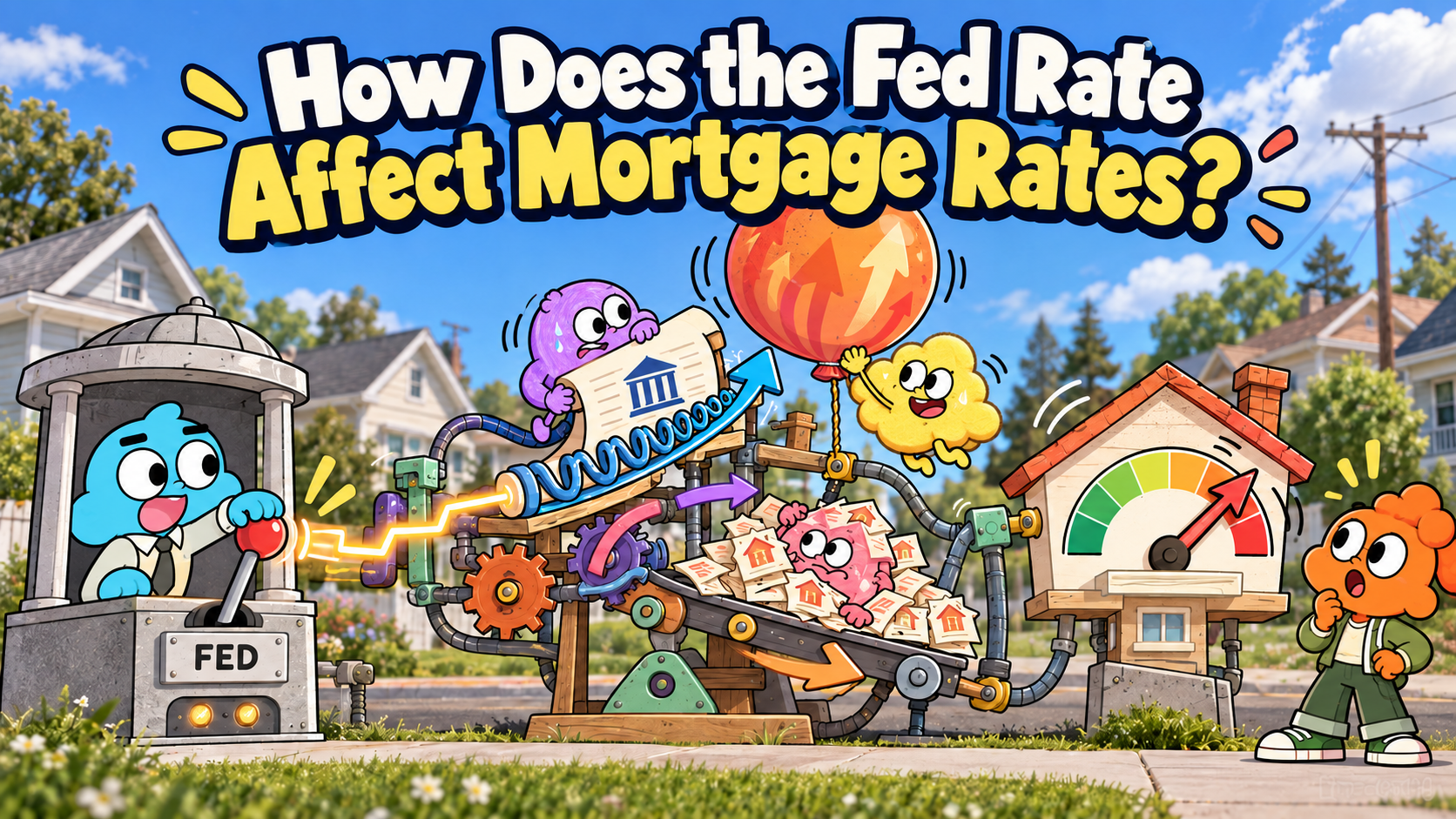
The thesis for this whole article is simple: the Fed matters, but the Fed does not directly set the 30-year mortgage rate. Understanding why takes a few layers of explanation, and that’s what this article walks through.
Section 02
First, What Is the Fed Rate?
“Fed Rate” Usually Means the Federal Funds Rate
The federal funds rate is the interest rate tied to overnight lending between banks. The Federal Open Market Committee (FOMC) sets a target range for this rate, and the Federal Reserve uses monetary policy tools to influence rates within that range.
This Is Not the Mortgage Rate
This point deserves its own emphasis: the federal funds rate is not the 30-year mortgage rate. You can’t simply look at the Fed rate, add a fixed number, and arrive at today’s mortgage rate.
So Why Does the Fed Still Matter to Mortgages?
Because the Fed rate is one piece of a much broader set of financial conditions. When the Fed changes policy, it can influence short-term borrowing costs, bond yields, market expectations, economic activity, and inflation expectations, all of which can, in turn, affect the mortgage market.
Section 03
The Most Important Thing to Understand: The Fed Does Not Directly Set Mortgage Rates
The Fed Sets Monetary Policy, Not Your Mortgage Quote
A borrower’s actual mortgage rate is priced by a lender based on a wide range of factors. It isn’t “the Fed says X, so your mortgage is Y.” It’s closer to an entire market pricing a product in real time.
Mortgage Rates Are Market-Driven
Lenders have to account for their own cost of funds, bond market conditions, mortgage-backed securities pricing, expected prepayment behavior, inflation, broader economic conditions, and the specific borrower’s and loan’s characteristics.
The CFPB explains that mortgage rates are influenced by Treasury rates and the mortgage securities market, and that the spread between Treasury yields and mortgage securities itself changes depending on market conditions.
This Is Why Mortgage Rates Can Move Ahead of the Fed
This is one of the more counterintuitive parts of how this works. If investors believe the Fed is likely to cut rates in the coming months, bond yields and mortgage rates can start reacting before that cut is ever announced. The Fed doesn’t need to actually make a move for the market to start pricing in the expectation of one.
Section 04
So What Actually Moves Mortgage Rates?

Treasury Yields
Longer-term Treasury yields, in particular, have a meaningful relationship with mortgage rates. It wouldn’t be accurate to say mortgage rates follow the 10-year Treasury exactly. A more accurate framing: 10-year Treasury yields are an important market reference for explaining longer-term mortgage rates, but mortgage rates don’t move one-for-one with them.
Inflation Expectations
If investors expect inflation to stay elevated for longer, longer-term interest rates can remain higher as a result, which can put upward pressure on mortgage rates.
Economic Growth
Strong economic activity can shift expectations around inflation, rates, and future Fed policy. Weaker economic conditions can shift those same expectations in the opposite direction. This isn’t a fixed formula; it’s a set of relationships that shift together.
Mortgage-Backed Securities
This is the piece that separates a genuinely useful explanation from a generic “Fed explained” article. Mortgage loans are often packaged into mortgage-backed securities, or MBS. Investors buy those securities, and their pricing and yields directly influence the rates lenders are able to offer borrowers. The CFPB specifically notes that mortgage rates are affected by the mortgage securities market and by the spread between mortgage securities and Treasury rates.
Section 05
What Are Mortgage-Backed Securities?
A Quick, Plain-Language Definition
Mortgage-backed securities are securities backed by pools of mortgages. In practice, this means a mortgage doesn’t necessarily just sit on a lender’s books from closing day until year 30. There’s an entire secondary market operating behind the scenes.
Why This Matters to Your Mortgage Rate
A lender isn’t only asking, “What’s the Fed rate today?” It’s also asking, “How is the market currently pricing mortgage risk and mortgage securities?”
This Is One Reason Mortgage Rates Don’t Track the Fed Day to Day
The Fed might change its policy rate once, at a scheduled meeting. The mortgage market, by contrast, can reprice continuously as conditions shift.
Section 06
Why Can Mortgage Rates Move Before the Fed Moves?
Markets Look Forward
Financial markets don’t only react to what the Fed has already done. They also react to what investors expect the Fed to do next.
Example: Investors Expect a Future Fed Cut
Suppose the market starts to believe inflation is cooling and that the Fed is likely to lower its policy rate at some point down the road. Investors may adjust their bond positions in anticipation. Longer-term yields can shift. Mortgage rates can start responding well before that expected cut is actually announced.
Illustrative example only. This example explains how market expectations can affect rates. It does not predict that a specific Fed decision will cause mortgage rates to move in a specific direction.
This Is Why a “Fed Cut” Isn’t Always the Day Mortgage Rates Drop
By the time the Fed actually announces a decision, part of that expectation may already be priced into the market. If the decision matches what the market expected, the reaction can be small. If it’s a surprise, the reaction can be much larger.
Section 07
What Happens to Mortgage Rates When the Fed Raises Rates?

Short Answer
A Fed hike can put upward pressure on borrowing costs and financial conditions generally. It does not guarantee that 30-year mortgage rates will rise by the same amount, or at all.
Why?
Mortgage rates depend far more on long-term market pricing than on the Fed’s short-term policy rate alone. If the Fed raises rates but the market had already expected the move, mortgage rates can react quite differently from the headline number.
What if the Fed Hikes Because Inflation Is High?
In that scenario, investors tend to focus on the broader outlook: future inflation, future Fed policy, Treasury yields, economic growth, and mortgage securities pricing. Mortgage rates respond to that whole outlook, not just to a single FOMC decision in isolation.
Section 08
What Happens to Mortgage Rates When the Fed Cuts Rates?

A Fed Cut Can Help Mortgage Rates, But It Does Not Guarantee a Drop
This is worth stating almost exactly this way, because it’s one of the most commonly misunderstood parts of this relationship.
Why?
If the Fed cuts because economic conditions are weakening, longer-term yields could move lower alongside that. But if inflation expectations remain elevated, longer-term rates can stay high regardless of what the Fed just did with its short-term policy rate.
A Fed Cut Can Even Happen While Mortgage Rates Stay Elevated
The Fed’s policy rate is a short-term rate. A 30-year mortgage is a long-term borrowing rate. The two markets are related, but they aren’t the same thing, and they don’t always move together.
Section 09
Why Can Mortgage Rates Rise Even After the Fed Cuts Rates?
The Market May Have Already Expected the Cut
If the cut was widely anticipated, mortgage rates may have already reacted to that expectation well before the announcement itself.
Inflation Expectations May Remain High
A Fed cut doesn’t automatically erase inflation concerns in the broader market.
Treasury Yields May Move Higher
If long-term yields rise for reasons unrelated to the Fed’s short-term move, mortgage rates can face upward pressure even in the same week as a cut.
Mortgage Spreads Can Change
Mortgage rates aren’t simply equal to Treasury yields. There’s a spread between mortgage securities and the Treasury market, and that spread can widen or narrow depending on conditions. The CFPB has noted that the spread between 10-year Treasuries and mortgage securities can shift meaningfully as market conditions change.
Section 10
The 10-Year Treasury and Mortgage Rates
Why Does Everyone Talk About the 10-Year Treasury?
A 30-year mortgage has long-term characteristics, which is why longer-term Treasury yields are commonly used as a reference point when explaining mortgage rate movements.
But a 30-Year Mortgage Is Not a 10-Year Treasury
This distinction matters. You can’t say “the 10-year Treasury is at 5%, so the mortgage rate must be 7%.” Mortgage pricing also depends on MBS pricing, lender costs, credit risk, loan characteristics, market liquidity, and borrower-specific characteristics.
The Spread Matters
If the Treasury yield stays flat but the mortgage spread widens, the mortgage rate can still rise. This is exactly why looking at the Treasury yield alone doesn’t tell the whole story.
Section 11
Why Your Mortgage Rate Is Not the Same as the Average Mortgage Rate
National Averages Are Not Personal Quotes
Freddie Mac’s Primary Mortgage Market Survey (PMMS) reports a weekly national average. For the week of September 17, 2026, Freddie Mac reported an average 30-year fixed mortgage rate of 6.95%, up from 6.76% the week before, and marking a fourth consecutive weekly increase to the highest level since January 2025.
The 6.95% figure is a national weekly average reported by Freddie Mac, based on conventional, conforming, fully amortizing home purchase loans for borrowers putting 20% down with excellent credit. It is not a personal mortgage quote. Actual rates can differ meaningfully based on borrower profile, loan type, property, location, points, lender and other factors.
Borrower Profile Matters
Lender pricing can vary based on credit profile, down payment, loan type, occupancy, property type, loan size, discount points, and current market conditions at the time of pricing.
This Is Why “What’s the Fed Rate Right Now?” Isn’t the Right Question to Ask
The Fed rate is only one input in a much broader financial system. It doesn’t translate directly into an individual mortgage quote.
Section 12
A Simple Example: Fed Rate vs. Mortgage Rate
Illustrative example: Suppose the Fed’s policy rate changes at a scheduled meeting. At the same time, several other things can be happening independently: Treasury yields shifting, inflation expectations changing, MBS pricing adjusting, and individual lenders repricing their offers. The end result is that the mortgage rate can move differently from the Fed rate, sometimes in the same direction but by a different amount, and sometimes not in the same direction at all.
Illustrative example only. The numbers and direction in this example are hypothetical and do not represent a forecast of future mortgage rates. Actual rate movements depend on market conditions, lender pricing and borrower-specific factors.
The Lesson From This Example
Don’t ask, “If the Fed cuts by X, how much will my mortgage rate drop?” A more useful question is, “What’s happening across the broader bond and mortgage market right now?”
Section 13
What Happened in September 2026?
The Fed’s September 2026 Decision
On September 16, 2026, the FOMC voted unanimously to raise the target range for the federal funds rate by 0.25 percentage point, to 3.75% to 4.00%. This was the Fed’s first rate hike since 2023, and it came as the Committee cited inflation remaining elevated relative to its 2% goal.
This is the Federal Reserve’s target range for the federal funds rate. It is not a mortgage rate and should not be used as a direct estimate of a borrower’s mortgage rate.
Mortgage Rates Were Already Moving Around the Decision
Freddie Mac reported the average 30-year fixed mortgage rate at 6.76% on September 10, 2026, and 6.95% on September 17, 2026, the fourth consecutive weekly increase and the highest level since January 2025.
These are national weekly averages, not individual mortgage offers. The two dates also reflect different market conditions and should not be interpreted as proof that the Fed’s September decision alone caused the move.
Why This Is a Useful Real-World Example
It illustrates the whole point of this article clearly. Mortgage rates had already been climbing for weeks before the Fed’s September meeting, not falling in anticipation of a cut. The Fed then delivered a rate hike, its first since 2023, and mortgage rates rose further the same week. The Fed rate and the mortgage rate are related, but they are not the same rate, and the mortgage market can move before, during, or after any given FOMC decision, in either direction.
Section 14
The Fed Has More Than One Way to Affect Mortgage Rates
The Federal Funds Rate
This influences short-term financial conditions across the economy.
Expectations
Markets are constantly forming a view on what the Fed is likely to do next, and that view can move rates well before any official action.
Balance Sheet and MBS Holdings
The Fed’s holdings of Treasury securities and agency mortgage-backed securities can affect broader financial conditions and the mortgage market. It wouldn’t be accurate to say the Fed “controls” MBS rates directly; a more accurate way to put it is that its policy and balance-sheet decisions can influence market conditions that feed into mortgage pricing.
Communication
Fed statements, economic projections, and press conferences can shift market expectations on their own, which is part of why markets can react strongly even to a relatively small actual rate change.
Section 15
Why Mortgage Rates Can Change Every Day
Mortgage Pricing Is Market-Based
Bond and MBS markets move continuously throughout the trading day, and lender pricing reflects that.
Economic Data Matters
Reports on inflation, employment, economic growth, and consumer spending can all shift market expectations, sometimes significantly, on days with no Fed meeting at all.
Fed Announcements Are Only One Source of Market Movement
Mortgage rates don’t just move on FOMC days. They can move on any day the broader market is digesting new information.
Section 16
Why a Fed Rate Cut Does Not Mean You Should Automatically Wait to Buy
Future Mortgage Rates Are Uncertain
It wouldn’t be accurate to say, “The Fed will cut, so mortgage rates will definitely fall.” Nobody can forecast that with certainty.
Waiting Has Its Own Trade-Offs
While a buyer waits, home prices can change, inventory can change, builder incentives can change, and personal financial circumstances can change. This isn’t an argument for buying immediately either; it’s simply a reminder that waiting isn’t a cost-free strategy.
The Right Question Is Personal Affordability
It’s worth evaluating the monthly payment, cash needed to close, emergency savings, income stability, existing debt, and how long you expect to stay in the home, rather than trying to time a single future rate move.
Refinancing Is Not Guaranteed
It wouldn’t be accurate to say, “Buy now and refinance later,” as if that’s a guaranteed strategy. A more accurate way to frame it: some borrowers may choose to refinance in the future if rates and their own circumstances make it worthwhile, but future rates and refinance eligibility are never guaranteed.
Section 17
What Should Homebuyers Watch Instead of the Fed Rate Alone?
Watch mortgage rate trends. Don’t fixate on a single day’s number; look at the broader trend over weeks.
Watch Treasury yields. These help explain the broader long-term rate environment mortgage rates sit within.
Watch inflation data. Inflation expectations directly affect longer-term rates.
Watch mortgage spreads. The gap between mortgage securities and Treasury yields is part of the full picture, not just the yields themselves.
Watch actual lender quotes. Ultimately, what matters most is a quote that reflects your own borrower profile. A national average is a reference point, not a personal offer.
Section 18
How Should a Homebuyer Read a Fed Announcement?
Don’t Immediately Ask “Did the Fed Cut?”
It’s more useful to look at what actually changed, why it changed, what the Fed said about inflation, what it said about employment, and what the market now expects to happen next.
Then Look at the Mortgage Market Reaction
Watch Treasury yields, mortgage rates, the MBS market, and actual lender pricing in the days that follow.
Give the Market Time to Digest the News
It’s a mistake to draw a conclusion about mortgage rates within minutes of a headline. The fuller reaction often plays out over days, not minutes.
Section 19
Common Myths About the Fed and Mortgage Rates
Myth 1: “The Fed sets mortgage rates.”
Reality: The Fed sets the federal funds target range. Mortgage rates are determined by the broader market.
Myth 2: “If the Fed cuts by 0.25%, mortgage rates drop 0.25%.”
Reality: There’s no fixed, one-to-one relationship between the two.
Myth 3: “Mortgage rates only change after Fed meetings.”
Reality: Mortgage rates can move daily as financial markets shift, with or without a Fed meeting.
Myth 4: “If the Fed cuts rates, mortgages must get cheaper immediately.”
Reality: Market expectations may already be priced in well before the announcement.
Myth 5: “The 10-year Treasury equals the mortgage rate.”
Reality: Treasury yields are an important reference point, but mortgage pricing includes additional spread and market-specific factors.
Myth 6: “The mortgage rate on the news is the rate I can get.”
Reality: National averages are not personal quotes.
Section 20
What Does the Fed Rate Mean for Someone Getting a Mortgage Today?
If You’re Shopping for a Home
Don’t only track Fed meeting dates. Track actual mortgage quotes from lenders, since that’s the number that will actually apply to your loan.
If You’re Already Under Contract
Rate lock timing can matter here. This article won’t offer specific advice on when to lock or float, since that decision depends on your own circumstances and risk tolerance, and is best discussed directly with your lender.
If You’re Considering Refinancing
It’s worth comparing your current loan, the new rate being offered, closing costs, how long you expect to keep the loan, and your break-even period. It wouldn’t be accurate to say refinancing will automatically be beneficial; that depends entirely on the specific numbers involved.
If You’re Simply Planning to Buy Later
This time can be used to improve credit, reduce debt, build savings, understand what payment you’re comfortable with, and monitor the market. This is general education, not a recommendation to buy now or to wait.
Section 21
The Simple Way to Remember It
The Fed controls monetary policy.
Markets price in expectations.
Bond yields help shape long-term borrowing costs.
Mortgage-backed securities affect mortgage pricing.
Lenders then price individual mortgage loans based on all of the above, plus the specific borrower and loan.
The Fed influences mortgage rates. It does not simply set them. That’s the one idea worth taking away from this entire article.
Section 22
Frequently Asked Questions
Does the Fed control mortgage rates?
Not directly. The FOMC sets the federal funds target range. Mortgage rates are determined through broader market pricing that includes Treasury yields, mortgage-backed securities, and lender-specific factors.
Does a Fed rate cut lower mortgage rates?
It can create downward pressure, but it doesn’t guarantee that mortgage rates will fall immediately or by the same amount as the Fed’s move.
Do mortgage rates go up when the Fed raises rates?
They can, but it isn’t an automatic, one-to-one relationship. Mortgage rates depend on a wider set of market factors beyond the Fed’s policy rate alone.
Why can mortgage rates rise when the Fed cuts rates?
Long-term yields, inflation expectations, mortgage spreads, and market expectations can all move independently of the Fed’s short-term policy rate.
What rate does the Fed control?
The federal funds rate target range, which is a short-term interbank lending rate, not a mortgage rate.
What is the 10-year Treasury’s relationship with mortgage rates?
It’s an important reference point for long-term interest rates, but mortgage rates also include mortgage-specific pricing factors, such as the spread between mortgage securities and Treasury yields.
What are mortgage-backed securities?
Securities backed by pools of mortgages. Their pricing is part of the broader mortgage market that helps determine the rates lenders can offer.
Why do mortgage rates change every day?
Because bond markets, mortgage-backed securities markets, economic data releases, and investor expectations are all shifting constantly, not just on days when the Fed meets.
When will mortgage rates go down?
This article won’t offer a forecast. Mortgage rates depend on future economic data, inflation trends, Fed policy expectations, Treasury yields, mortgage-backed securities pricing, and other market conditions that can’t be predicted with certainty.
Should I wait for the Fed to cut rates before buying?
There’s no universal answer. It generally makes more sense to evaluate your own affordability, financial situation, and housing needs, and to look at actual loan terms available to you, rather than basing a purchase decision on a single assumption about where rates might go next.
Section 23
Sources
- Federal Reserve, Economy at a Glance: Policy Rate
- Federal Reserve, FOMC Statement, September 16, 2026
- Consumer Financial Protection Bureau, Data Spotlight: The Impact of Changing Mortgage Interest Rates
- Freddie Mac, Primary Mortgage Market Survey (PMMS)
Disclaimer: This article is provided for general informational and educational purposes only. It is not financial, mortgage, real estate, tax, legal or investment advice. The Federal Reserve’s federal funds rate is different from the mortgage rate offered to an individual borrower. Mortgage rates are influenced by multiple market factors, including Treasury yields, mortgage-backed securities, inflation expectations, economic conditions, lender pricing and borrower-specific factors. Any rate examples or market figures in this article are provided for educational purposes only, reflect a specific point in time, and may have changed by the time you’re reading this. National mortgage rate averages are not personal loan offers or rate quotes. Actual mortgage rates, loan terms, costs and eligibility vary by borrower, property, loan program, lender, location and timing. Past rate movements do not guarantee future results.
Duc Pham, Mortgage Broker | NMLS# 844897 | 408-600-1900 | dp@wonderrates.com
Wonder Rates, Inc. | NMLS# 1518655 | DRE# 02047445 | DFPI# 60DBO-59134
Equal Housing Opportunity. Equal Housing Lender.
Licensed in: AL, AZ, CA, CO, FL, GA, LA, MI, NC, OH, OK, OR, PA, SC, TX, VA, WA