
Section 01
How much house can you afford? It is one of the first questions buyers ask before beginning their home search. While a lender can estimate the maximum loan amount you may qualify for, the number that matters most is the monthly payment that fits comfortably within your budget. In many cases, your personal affordability range may look very different from the amount you are approved to borrow.
Understanding how much house you can affo requires looking beyond just your income and considering your overall monthly budget.
For some buyers, the difference between a potential qualifying ceiling and a personal comfort target can exceed $1,400 a month. Many buyers focus on what they may qualify for without first calculating what payment fits comfortably within their monthly budget.
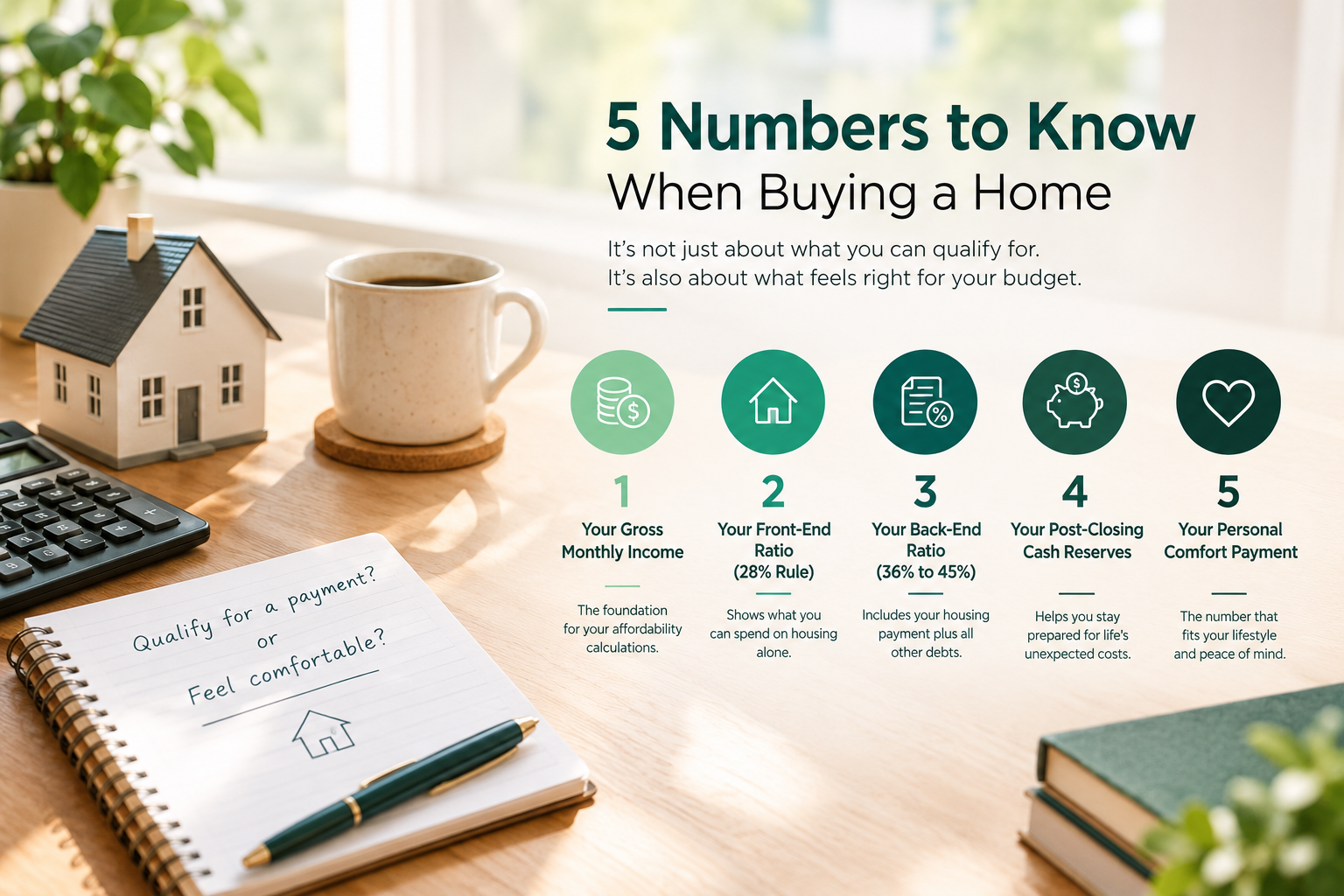
Qualifying for a payment and feeling comfortable with it are two separate questions. Here are five numbers that can help you look at both.
Section 02
Number 1: Your Gross Monthly Income
This is the foundation every other number in this article is built on, and it’s not the number that hits your bank account. Lenders calculate affordability using gross income, before taxes and deductions, not your take-home pay.
For this example, let’s assume you earn $7,000 in gross monthly income and take home $5,250 after taxes and deductions. Lenders generally use the $7,000 gross figure for DTI calculations, while your personal budget depends on the $5,250 you actually receive. Your real take-home pay may differ based on your tax situation, benefits, and other deductions.
Section 03
Number 2: Your Front-End Ratio (the 28% Rule)
Front-end ratio measures your housing payment alone against your gross income, not counting your other debts. One commonly used affordability guideline is 28% of gross monthly income.
On that same $7,000 gross income, 28% works out to a housing payment of $1,960.
This number ignores your car payment, credit cards, and everything else. It’s a useful first checkpoint, but it isn’t the full picture, which is where the next number comes in.
This is a commonly used guideline, not a universal requirement. Actual front-end ratio limits vary by lender and loan program, and do not constitute an offer of credit.
Section 04
Number 3: Your Back-End Ratio (36% to 45%, Including Everything)
Back-end ratio often plays a major role in determining how much you may qualify for. It includes your proposed housing payment plus every other monthly debt: student loans, car payments, credit cards, and anything else on your credit report.
Many lenders use DTI guidelines that fall somewhere in this range, but the maximum can vary by loan program, lender, credit profile, and other factors.
Say you have $380 in other monthly debt. Here’s how the ceiling changes at each ratio:
| Back-End Ratio | Ceiling on $7,000 Income | Existing Debt | Max Housing Payment |
|---|---|---|---|
| 36% | $2,520 | $380 | $2,140 |
| 45% | $3,150 | $380 | $2,770 |
Notice the gap: the same income and the same debt can produce different housing payment limits depending on the DTI guideline, loan program, lender, and other qualification factors. These figures are illustrative estimates only. Actual DTI limits vary by lender, loan program, and compensating factors, and do not constitute an offer of credit.
Section 05
Number 4: Your Post-Closing Cash Reserves
This is the number most affordability conversations skip entirely. After your down payment and closing costs are paid, how much money will you still have in savings?
A personal budgeting target is to keep 3 to 6 months of your total housing payment in reserve. The right amount depends on your income stability, expenses, and financial situation.
Using the $2,770 monthly housing payment from the 45% DTI example:
| Reserve Target | Total Cash Needed in Savings |
|---|---|
| 3 months | $8,310 |
| 6 months | $16,620 |
Qualifying for a mortgage and having a personal emergency cushion are two separate questions. Some borrowers may qualify without holding this full amount in reserves, while others may face specific reserve requirements depending on the loan program, property type, and financial profile.
Without a cash cushion, an unexpected job interruption or major home repair can put more pressure on your monthly budget.
Section 06
Number 5: Your Personal Comfort Payment
A lender may tell you that you qualify for a housing payment of up to $2,770 per month. But qualification is not the same as comfort.
For this illustration, let’s say your take-home income is $5,250 per month. If you choose to keep your housing payment at 25% of your take-home pay, your personal benchmark would be $1,312.50.
That creates a monthly difference of $1,457.50 between the payment you may qualify for and the payment you have chosen as your personal comfort target.
Neither number is automatically right or wrong.
The $2,770 figure represents an illustrative qualifying ceiling based on a specific DTI scenario. The $1,312.50 figure represents a personal budgeting choice. Your own comfort target may be higher or lower depending on your income, savings goals, lifestyle, and other financial commitments.
The point is to calculate both numbers before you start shopping for a home.
Section 07
Frequently Asked Questions
Should I always aim for the lower, more comfortable number instead of what I qualify for?
Not necessarily, but you should know both before you decide. Some buyers are fine stretching closer to their qualifying ceiling because they expect income growth or have few other financial goals competing for the same money. Others strongly prefer the cushion. There’s no universally correct answer, only an informed one.
Why do front-end and back-end ratios give such different answers?
Front-end only looks at housing costs. Back-end adds every other debt payment on top. If you have little to no other debt, the two numbers land close together. If you’re carrying student loans, a car payment, or credit card balances, back-end will usually be the tighter constraint, since those debts eat into the same ceiling your housing payment is competing for.
How much does existing debt actually shrink my max housing payment?
In a simple DTI calculation, existing monthly debt reduces the income available for your proposed housing payment. In the example above, $380 in monthly debt reduces the housing payment amount from $3,150 to $2,770 under a 45% DTI scenario. Removing that debt could free up the same amount of monthly DTI capacity, assuming other qualification factors remain unchanged.
Section 08
Conclusion
Knowing what you may qualify for is only half the answer. Knowing what actually fits your life is the other half.
Ready to find your real homebuying range? Send your numbers to Duc Pham or the Wonder Rates team. We’ll help you compare your potential qualifying range with a monthly payment that fits your broader budget.
The goal is not simply to find the largest payment you may qualify for. It is to understand what may work for your financial situation before you start touring homes or make an offer.
Disclaimer: All figures, calculations, and examples in this article are for illustrative and educational purposes only and do not constitute an offer of credit or financial advice. Income ratios, reserve targets, and comfort benchmarks vary by individual circumstances and lender guidelines and are subject to change. Consult your loan officer for guidance specific to your situation.
Duc Pham, Mortgage Broker | NMLS# 844897 | Wonder Rates, Inc. | NMLS# 1518655 | DRE# 02047445 | DFPI# 60DBO-59134 | Equal Housing Opportunity. Equal Housing Lender. | Licensed in: AL, AZ, CA, CO, FL, GA, LA, MI, NC, OH, OK, OR, PA, SC, TX, VA, WA.