
Section 01
Most people preparing to buy a home spend months focused on their credit score.
They pay down credit cards, dispute errors, and avoid opening new accounts. They walk into a conversation with a lender feeling ready, only to hear a number they were not expecting: their debt-to-income ratio is too high.
The loan does not work.Credit scores get the attention. Debt-to-Income Ratio (DTI) is often the factor that determines whether the numbers actually work.
A borrower might have great credit but still find it hard to qualify. This often happens because their income and debt don’t meet program guidelines.
This guide explains debt-to-income ratio (DTI). It covers how lenders calculate it, the numbers they usually want, and options if DTI is a problem.
Section 02
Debt-to-Income Ratio Formula: How to Calculate DTI
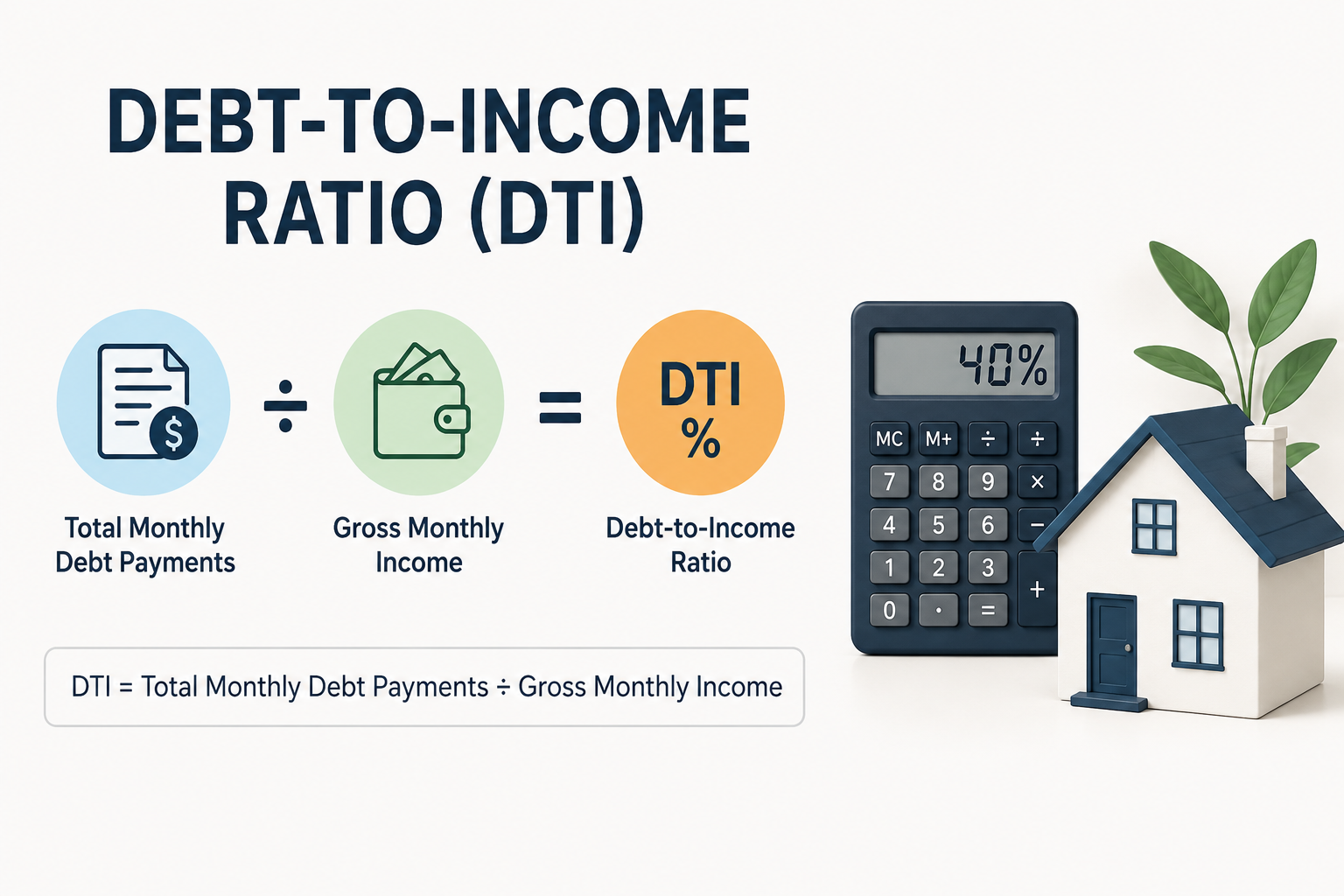
Debt-to-Income Ratio is calculated using a simple formula:
Total monthly debt payments ÷ Gross monthly income = DTI
For example:
- Monthly debt payments: $2,800
- Gross monthly income: $7,000
$2,800 ÷ $7,000 = 40% DTI
This means 40% of the borrower’s gross monthly income goes toward required monthly debt payments before other living expenses are considered.
Section 03
What Debt-to-Income Ratio Actually Means
DTI is the percentage of your gross monthly income that goes toward debt payments.
It is calculated two ways, and both matter.
Front-end DTI, also called the housing ratio, looks only at your proposed housing payment divided by your gross monthly income. This includes:
- Principal
- Interest
- Property taxes
- Homeowners insurance
- HOA dues, if applicable
Back-end DTI looks at your total monthly debt obligations divided by your gross monthly income. This includes:
- Housing payment
- Car loans
- Student loans
- Credit card minimum payments
- Personal loans
- Other recurring debt obligations
When lenders talk about your DTI, they are almost always referring to your back-end DTI.
| DTI Type | What It Includes | Formula |
| Front-end (housing ratio) | Proposed housing payment only | Housing payment ÷ gross monthly income |
| Back-end (total DTI) | Housing + all monthly debt payments | Total monthly debts ÷ gross monthly income |
Section 04
What Debts Count Toward DTI?
Most recurring monthly obligations count toward your DTI, including:
- Mortgage payments
- Car loans
- Student loans
- Credit cards
- Personal loans
- Child support and alimony
- Co-signed loans in many situations
Section 05
What Usually Does Not Count Toward DTI?
Certain expenses generally are not included, such as:
- Utilities
- Cell phone bills
- Auto insurance
- Health insurance deducted from payroll
- Groceries
- Retirement contributions
- Entertainment expenses
Even though these items may not affect qualifying, they still matter to your real-life budget and affordability.
Section 06
Debt-to-Income Ratio Limits for Mortgage Loans
DTI requirements vary by loan program. Here is where many programs generally draw the line:
| Loan Program | Max Front-End DTI | Max Back-End DTI | Notes |
| Conventional (Fannie Mae) | 28% | 45% to 50% | Higher with strong compensating factors |
| FHA | 31% | 43% to 57% | Higher with AUS approval |
| VA | No official limit | 41% guideline | Residual income requirement applies |
| USDA | 29% | 41% | Can go higher with a strong file |
| DSCR | Not applicable | Not applicable | Property cash flow qualifies |
DTI ratios shown above are general guidelines for educational purposes only. Actual qualifying limits vary based on lender requirements, loan program guidelines, automated underwriting findings, and individual borrower circumstances.
These are guidelines, not hard ceilings.Automated underwriting systems can approve files over these limits. They do this if there are factors that help, like:
- Higher credit scores
- Larger reserves
- Significant equity
- Larger down payments
Section 07
How a Small Debt Changes the Picture
This is where many buyers get surprised.
A $450 car payment on a $7,000 gross monthly income adds 6.4 percentage points to your back-end DTI before the housing payment is even counted.
On a conventional loan with a 45% DTI guideline, that $450 payment reduces your maximum allowable housing payment by $450 every month.
Today’s mortgage rates show that losing $450 in monthly buying power can cut your budget by about $70,000 to $80,000. This depends on taxes, insurance, and your loan terms.
| Monthly Debt | Gross Income | DTI Impact | Reduction in Housing Budget |
| $0 | $7,000 | 0% | None |
| $300 car payment | $7,000 | 4.3% | $300/month less available |
| $450 car payment | $7,000 | 6.4% | $450/month less available |
| $700 car payment | $7,000 | 10% | $700/month less available |
| $1,000 car + $300 student loan | $7,000 | 18.6% | $1,300/month less available |
The examples above are hypothetical and for illustrative purposes only. Actual purchasing power and loan eligibility depend on interest rates, property taxes, insurance costs, loan terms, and individual borrower qualifications and are not guaranteed.
The last example shows a buyer who can afford a smaller house. This isn’t due to credit or down payment. Instead, it’s because two monthly obligations limit their options when added together.
Section 08
How to Lower Your Debt-to-Income Ratio Before Applying
There are only two ways to improve DTI:
- Reduce debt.
- Increase income.
Reduce Debt
You may be able to improve your DTI by:
- Paying off small installment loans
- Paying down revolving balances
- Avoiding a new car purchase before applying
- Waiting to finance furniture or large purchases
- Eliminating monthly minimum payments
A key point: meaningful DTI improvement often happens when a full monthly payment goes away. It’s not just about a smaller balance.
Paying off a car loan with under 10 months left might let you exclude that payment from DTI calculations. This depends on your loan program and lender’s rules.
Increase Documented Income
Additional income may be usable if properly documented, including:
- Rental income
- Part-time employment with a sufficient history
- Self-employment income
- Overtime or bonus income that meets program requirements
- Recent raises reflected in pay documentation
Self-employed borrowers often show less cash flow on their tax returns. This is due to valid business deductions.
In these cases, bank statement loans can be useful. They qualify based on deposits, not taxable income.
Section 09
A Real-World Example
I recently helped a borrower with a credit score over 760 and good savings. However, they couldn’t qualify for a new property. Their multiple mortgages had pushed the DTI above the usual limits.
The issue was not credit.
The issue was math.
The borrower explored a loan option that looked at the property’s cash flow, not just their DTI. This allowed them to proceed with the purchase.
Results vary. Each case is unique. Still, these examples show why DTI often limits choices before credit does.
Section 10
When DTI Is the Wall: DSCR as an Alternative Path
For investors specifically, DTI often becomes the limiting factor long before credit or assets do.
Each financed property adds another mortgage payment to personal liabilities, which can push DTI higher even when the properties themselves are generating positive cash flow.
DSCR loans generally do not rely on the borrower’s personal DTI in the same way that traditional mortgages do.
The property qualifies based on its own ability to cover the debt service.
Personal income and tax returns don’t affect the property decision. Current debts also don’t matter.
DSCR loans have different rules for qualifying. They often have higher interest rates than regular loans. They are not the right solution for every investor.
For borrowers who have reached conventional DTI limits, though, they can provide another path forward.
Section 11
Debt-to-Income Ratio FAQs
Does student loan debt always count against my DTI?
Yes, but how it counts depends on the loan program and repayment status.
If you are on an income-driven repayment plan with a low monthly payment, that actual payment may sometimes be used, which can significantly improve qualifying.
Can I use rental income to offset my DTI?
Yes.
Most lenders apply a vacancy factor and generally count approximately 75% of gross rents as qualifying income, assuming the income can be properly documented.
What if my DTI is too high right now?
It depends on how high it is and what is causing it.
Potential solutions may include:
- Paying down debt
- Increasing documented income
- Adjusting the target purchase price
- Exploring loan programs with higher DTI tolerance
- Considering alternative financing options when appropriate
A review of your full financial picture can often reveal options that are not immediately obvious.
Section 12
Final Thought
Before you start making offers, take a few minutes to understand what your current income and debts actually support.
A conversation with a loan officer can help you identify potential obstacles, explore loan options, and develop a strategy that fits your goals.
Before you start making offers, consider reviewing your DTI with a licensed loan officer. A quick conversation today may help you understand your buying power, avoid surprises during underwriting, and identify options that fit your goals.
All figures, DTI thresholds, and program details in this article are for illustrative purposes only and do not constitute an offer of credit or financial advice. Loan program requirements vary by lender and are subject to change. Consult your loan officer for guidance specific to your situation.
Duc Pham, Mortgage Broker | NMLS# 844897,
Wonder Rates, Inc. | NMLS# 1518655 | DRE# 02047445 | DFPI# 60DBO-59134 |
Equal Housing Opportunity. Equal Housing Lender. |
Licensed in: AL, AZ, CA, CO, FL, GA, LA, MI, NC, OH, OK, OR, PA, SC, TX, VA, WA.