
Section 01
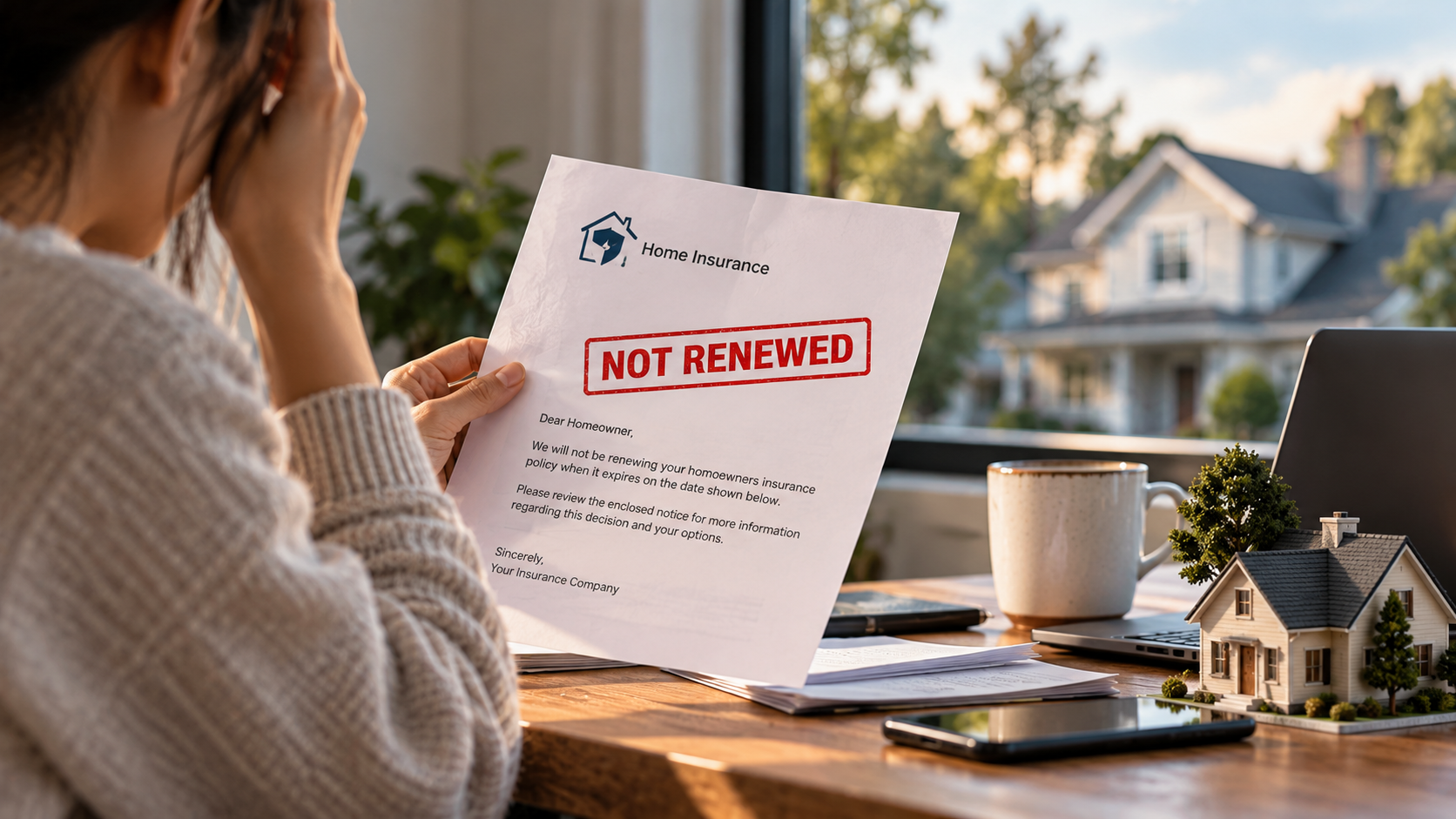
If your home insurance is not renewed, act before the current policy expires. Contact the insurer for the reason, notify your insurance agent and mortgage servicer when appropriate, begin comparing replacement coverage, and preserve proof of continuous insurance.
A nonrenewal does not remove the mortgage or insurance requirement. The homeowner may need replacement coverage, property repairs, an eligible state-supported option, or a response to a force-placed insurance notice. Options and rights depend on the state, policy, property, insurer, and mortgage documents.
Section 02
What Does Home Insurance Nonrenewal Mean?
Nonrenewal means the insurer does not intend to continue the policy after its current expiration date. It is different from cancellation during the policy term. State laws and policy rules can treat cancellation and nonrenewal differently, including permitted reasons, notice timing, and appeal or review options.
Confirm the policy number, property address, expiration date, stated reason, and contact instructions. Do not assume another party will solve the problem automatically.
If the notice is unclear or appears incorrect, contact the insurer using verified information from the policy or official website. Ask for a written explanation and the process for submitting updated information. Homeowners can also contact their state department of insurance for information about state-specific rights and complaint procedures.
Section 03
Why Home Insurance May Not Be Renewed
An insurer’s reason may relate to the property, claims history, underwriting changes, geographic risk, or the insurer’s business decisions. Possible reasons include:
- Roof age or condition.
- Electrical, plumbing, heating, or structural concerns.
- Vegetation, wildfire exposure, wind exposure, or another location risk.
- Multiple or significant prior claims.
- A property inspection that identified unresolved conditions.
- A change in occupancy or use.
- Missing information or an underwriting discrepancy.
- The insurer reducing or ending new or renewal business in an area.
These are examples, not a universal list of lawful reasons. Insurance regulation is state based, and the facts of the policy matter. The written notice should be the starting point for understanding the specific decision.
Before making an expensive repair, ask what documentation is required, whether review remains available, and whether the work could change the decision.
Section 04
Home Insurance Not Renewed? Take These 7 Steps
1. Confirm the expiration date and reason
Create a simple timeline. Record the date the notice was received, the policy expiration date, the reason given, and the last day to request review if one is available. Save the envelope, email, notice, inspection photographs, and every response.
Call the insurer or agent and ask:
- Is this a final nonrenewal decision?
- What policy provision or underwriting concern applies?
- Can updated documents, repairs, or a new inspection be considered?
- What proof is needed?
- Will the insurer confirm the answer in writing?
2. Contact an insurance professional early
Begin shopping early. Replacement coverage may take time when the home has unusual features, an older roof, prior claims, vacancy, renovation, or elevated catastrophe exposure.
Provide accurate information. A lower quote based on incomplete property details may create another problem when the insurer verifies the application. Compare the coverage, exclusions, deductibles, settlement basis, liability limits, endorsements, insurer information, and effective date, not only the premium.
3. Review the mortgage insurance requirements
The mortgage documents generally require the borrower to maintain acceptable hazard insurance on the property securing the loan. Review recent statements, escrow information, and any servicer correspondence. Ask the servicer how and where evidence of replacement coverage must be sent.
The servicer verifies whether coverage meets the loan contract’s requirements. Confirm the required documentation rather than guessing.
Homeowners who recently closed can use the broader post-closing homeowner checklist to organize insurance, escrow, payment, and account records.
4. Investigate whether the stated condition can be corrected
If the notice identifies a repair or property condition, obtain a clear description before spending money. Ask whether photographs, permits, paid invoices, inspection reports, or contractor statements are required.
Get qualified advice about safety and repair scope. Insurance eligibility and repair quality are separate questions.
Keep before-and-after photographs, contracts, proof of payment, permits, and completion documents. These records may help an insurer evaluate the property, but they do not guarantee renewal or acceptance by another carrier.
5. Contact the state insurance department
A state insurance department can explain complaint channels, identify licensed companies or agents, and describe state-specific residual-market or FAIR Plan options where applicable.
State-supported programs are not identical. Eligibility, coverage, pricing, deductibles, inspections, and companion-policy requirements vary.
The National Association of Insurance Commissioners provides a directory for finding the appropriate state insurance department.
6. Prevent a coverage gap
The replacement policy should become effective no later than the expiration of the old coverage unless qualified professionals advise otherwise. Confirm the exact effective date and time, named insureds, property address, mortgagee information, and proof sent to the servicer.
Do not cancel existing coverage because a quote looks acceptable. Obtain written confirmation, policy documents, and proof of insurance.
If insurance is paid through escrow, verify how the old premium, refund, and new premium will be handled. A coverage change can affect the escrow account and later payment calculations. Wonder Rates explains why a fixed-rate mortgage payment can increase when taxes or insurance change.
7. Check the first documents after replacement
After securing a policy, confirm that every party has the correct information. Review:
- Policy effective and expiration dates.
- Property address and occupancy.
- Named insureds.
- Mortgagee clause and loan number.
- Coverage limits and deductibles.
- Exclusions and endorsements.
- Premium payment or escrow status.
- Servicer confirmation that evidence was received.
Save everything and review statements until any refund, escrow adjustment, or force-placed insurance issue is resolved.
Section 05
How Insurance Nonrenewal Can Affect Your Mortgage
The property secures the mortgage debt, so the loan agreement normally requires insurance that protects against specified hazards. If the servicer does not have evidence of acceptable coverage, it may begin a process to obtain insurance on behalf of the loan owner and charge the borrower, subject to applicable rules.
Nonrenewal is not the same as a missed mortgage payment. However, a coverage lapse can create charges, escrow changes, servicing correspondence, and transaction difficulties.
For example, a refinance generally requires acceptable property insurance before closing. A prospective buyer may also face insurance questions when purchasing the home. Homeowners comparing ways to change a loan should first understand the difference between a mortgage recast and refinance, since a recast does not replace the mortgage or solve an insurance eligibility problem.
Section 06
What Is Force-Placed Insurance?
Force-placed insurance is hazard insurance obtained by a mortgage servicer on behalf of the loan owner or assignee when the servicer has a reasonable basis to believe the borrower has not maintained the coverage required by the mortgage contract.
Under 12 CFR 1024.37, a servicer generally must send specified notices before assessing a premium charge or fee for force-placed insurance. The initial written notice generally must be sent at least 45 days before the charge, followed by a reminder notice meeting the regulation’s timing requirements.
The required notice warns that force-placed coverage may cost significantly more and may provide less coverage than insurance purchased by the borrower. It should also explain what evidence the servicer needs.
Force-placed insurance primarily protects the loan owner’s interest. It may not include the personal-property, liability, loss-of-use, or other protection found in a homeowner-selected policy.
If the borrower provides evidence of compliant coverage, federal rules generally require the servicer to cancel force-placed insurance within the specified period and address charges for overlapping coverage. Submit proof through the servicer’s designated channel and keep delivery confirmation.
Do not ignore a force-placed insurance notice. Respond with the requested evidence and follow the servicer’s written error-resolution process when necessary.
Section 07
Home Insurance Nonrenewal Checklist
- Read and save the complete notice.
- Record the expiration date and review deadlines.
- Request the specific reason in writing.
- Ask whether updated evidence can be considered.
- Start shopping for replacement coverage immediately.
- Compare coverage, exclusions, deductibles, and insurer terms.
- Review mortgage and escrow requirements.
- Provide proof of new coverage to the servicer.
- Confirm that the mortgagee information is correct.
- Monitor statements for escrow or force-placed insurance charges.
- Contact the state insurance department when appropriate.
- Keep a complete record of calls, notices, policies, and receipts.
Avoid waiting until the final week, comparing premium alone, or assuming escrow will find a replacement policy. Repairs may be necessary, but consider the complete scope and remaining reserves. The article on whether to pay down a mortgage or preserve money for other goals provides a broader liquidity framework, although insurance deadlines require separate attention.
Homeowners preparing questions for a mortgage professional can also review 10 questions to ask a loan officer. Insurance agents, state regulators, attorneys, and tax professionals should answer matters within their own expertise.
Section 08
Frequently Asked Questions
Can a mortgage company cancel my loan because insurance was not renewed?
Insurance nonrenewal does not automatically cancel the mortgage. Maintaining required hazard insurance is generally an obligation under the loan documents. A lapse can lead to force-placed insurance, charges, notices, and other permitted servicing action.
How much notice must an insurer give before nonrenewal?
There is no single nationwide answer for insurer nonrenewal notices. State law, policy type, reason, and circumstances matter. Read the notice and contact the state insurance department for the rule applicable to the property.
Is force-placed insurance the same as homeowners insurance?
No. Force-placed insurance is arranged by the servicer to protect the secured property interest and may cost more while offering less protection than a homeowner-selected policy.
Can I refinance after an insurance nonrenewal?
Possibly, but the new lender generally needs acceptable coverage before closing. The borrower must also meet other underwriting and property requirements. Unavailable or unaffordable coverage can delay or prevent closing.
What if the servicer says it never received my policy?
Resubmit the evidence through the designated channel, keep proof of delivery, and ask for confirmation. If charges or errors remain, follow the written notice-of-error or information-request instructions shown by the servicer.
Section 09
Protect the Home Before Coverage Expires
When home insurance is not renewed, time matters. Confirm why the policy is ending, search for replacement coverage, review mortgage requirements, address property concerns, and document each step.
Do not assume that an agent, insurer, or servicer has shared information with every other party. Verify the new policy, effective date, mortgagee information, escrow treatment, and proof of delivery yourself. A coordinated response can reduce the chance of an avoidable lapse or force-placed insurance charge.
Duc Pham, Mortgage Broker | NMLS# 844897
****Wonder Rates, Inc. | NMLS# 1518655
Equal Housing Lender.
AZ, CA, CO, FL, GA, LA, MI, OK, PA, SC, TX, VA, WA, OH, AL, OR, NC
This article is for educational purposes only and is not insurance, legal, tax, or financial advice and is not a commitment to lend. Insurance availability, underwriting, coverage, pricing, and nonrenewal rules vary by state, carrier, property, and policy. Loan approval is subject to creditworthiness, income verification, property eligibility, insurance requirements, and current underwriting guidelines. Consult licensed professionals and review official policy and loan documents before making a decision.