
Section 01
You have a job. You pay your bills. You may even have a little money left over at the end of the month.
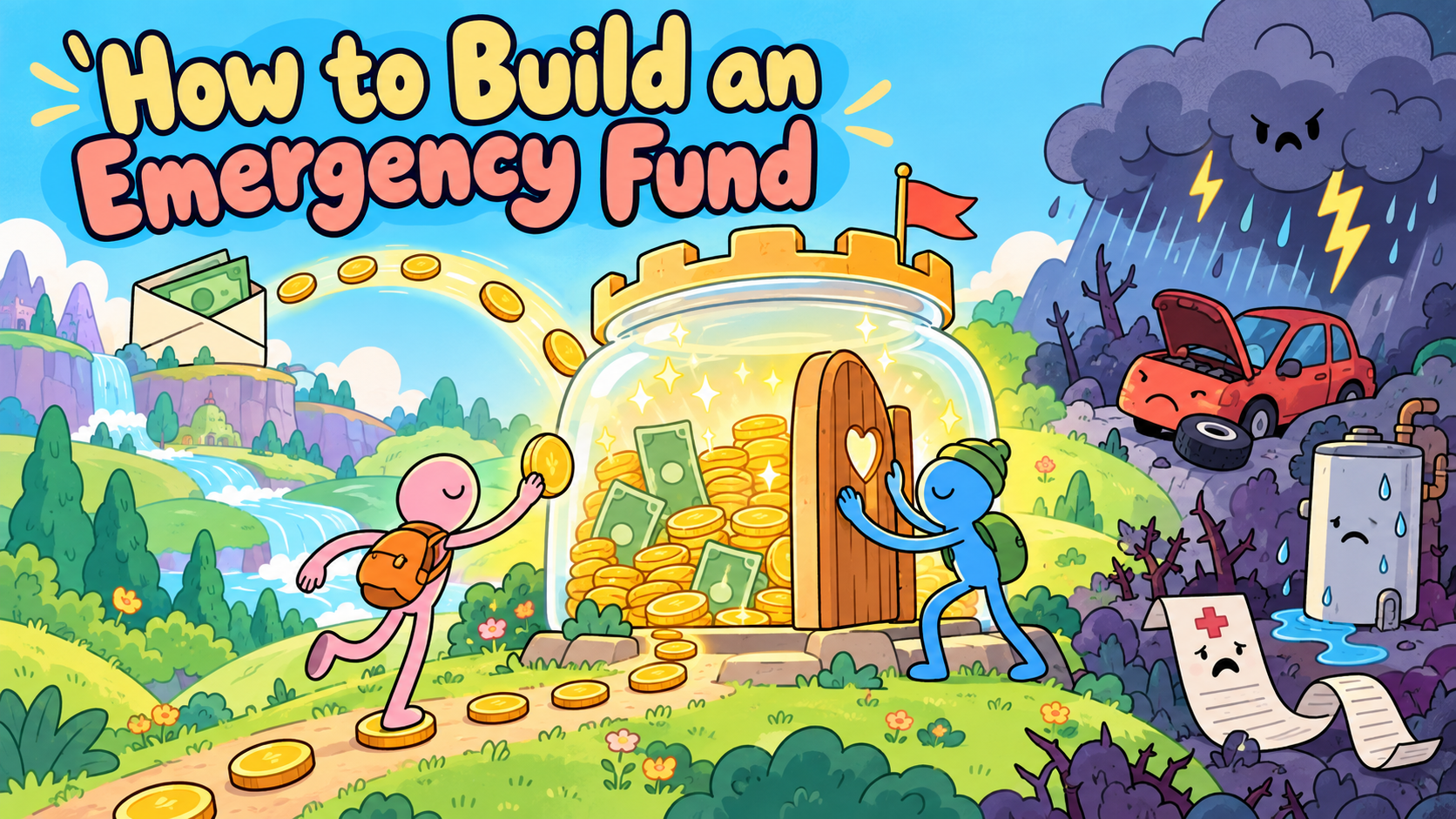
Then your car needs a $900 repair. Your water heater breaks. A medical bill shows up out of nowhere. Or your hours at work get cut without warning.
This does not always mean a household is bad with money. Sometimes it just means there is no financial cushion to absorb a surprise expense.
An emergency fund is money set aside specifically for unplanned expenses or financial emergencies. According to the Consumer Financial Protection Bureau (CFPB), common examples include car repairs, home repairs, medical bills, and a sudden loss of income. Without savings, an unexpected expense often ends up on a credit card or a loan, which can make the original cost even higher once interest and fees are added.
The goal of this guide is not to help you build a huge savings account overnight. It is to help you build a financial cushion that can grow along with your life.
Before deciding how much to save each month, the first question is simpler: how much do you actually need?
Section 02
How Much Should You Have in an Emergency Fund?
There is no single emergency fund number that works for everyone. The right target generally depends on your income, your expenses, and the type of unexpected costs you are most likely to face.
Start With Your Essential Monthly Expenses
Instead of guessing a target, start by listing what you truly must pay every month, such as:
- Housing
- Utilities
- Groceries
- Transportation
- Insurance
- Minimum debt payments
- Essential healthcare costs
You typically do not need to include restaurants, shopping, subscriptions, vacations, or other discretionary spending in this list. The goal is to answer one question: if your income were disrupted, how much would you actually need each month to keep your household running?
Think in Levels, Not One Giant Number
Rather than aiming for one large figure right away, it can help to think in stages.
Level 1: A starter emergency fund. A smaller amount set aside first, meant to cover common unexpected expenses.
Level 2: Several months of essential expenses. As your financial situation becomes more stable, you may build this up further so you have more room if your income is interrupted.
Level 3: A larger reserve for higher-risk situations. This may apply if you have irregular income, rely on a single income, carry ongoing medical costs, or have significant property responsibilities.
This is a planning framework, not a universal rule. Your own target may look different.
If your savings account is close to $0 right now, that is fine. You do not need to wait until money feels “extra” to begin.
Section 03
How to Start an Emergency Fund From $0

Set Your First Savings Goal
Avoid starting with a goal like “I need $20,000 saved.” A number that large can feel out of reach and may cause you to give up before you begin.
Instead, set a smaller first goal, a starter cushion you can realistically reach. Once you hit it, raise the target and keep going.
Automate Your Savings
A recurring transfer set up right after payday, moving money into a separate savings account, generally makes saving more consistent than trying to remember to do it manually. The CFPB notes that automatic, recurring transfers are one way to help savings happen more reliably.
Save Unexpected Money
When money arrives that you were not counting on, such as a tax refund, a work bonus, a cash gift, side income, or overtime pay, consider directing at least part of it into your emergency fund. You do not need to save all of it. The point is turning one-time money into a longer-term financial buffer.
Keep the Fund Separate From Everyday Spending
If your emergency money sits in the same account you use for daily spending, it is easy to see the balance and think, “I still have $2,000 in there,” and then slowly spend it on non-emergencies. A dedicated emergency savings account, kept apart from your checking account, generally makes this less likely to happen.
Once you have a system in place, the next practical question is how much to contribute each month.
Section 04
How Much Should You Save Each Month?
Start With a Number You Can Actually Maintain
It is generally more effective to save an amount you can keep up every single month than to set an ambitious number you frequently have to skip. Saving $100 every month consistently tends to build more progress over time than planning to save $500 a month and repeatedly falling short.
Work Backward From Your Goal
A simple way to estimate your timeline:
Emergency fund goal ÷ monthly savings amount = approximate number of months to reach your goal
Example: Building a $3,000 Emergency Fund
Suppose your goal is $3,000, and you are able to save $250 per month. At that pace, it would take roughly 12 months to reach the goal. In a month where you have extra income, contributing more could shorten that timeline.
Example disclaimer: This example is for illustration only. Your appropriate emergency fund target and monthly savings amount will depend on your income, expenses, debts, household situation, and other individual financial circumstances.
Increase the Amount as Your Income Changes
If you receive a raise, pay off a car loan, reduce a recurring monthly payment, or pick up additional income, you may be able to redirect part of that change toward your emergency savings.
Once you have money set aside, the next question is where it should actually live.
Section 05
Where Should You Keep Your Emergency Fund?

Prioritize Safety and Accessibility
Emergency savings generally work best when they are relatively safe, accessible when you need them, and kept separate enough that you are not tempted to spend them casually. The CFPB emphasizes that emergency funds should generally be kept somewhere safe and accessible, in a way that fits your personal circumstances.
Consider a Dedicated Savings Account
A standard savings account, a high-yield savings account, or an account at a bank or credit union can all work as a home for emergency savings. The purpose of this guide is not to recommend a specific product, but rather to explain the trade-offs involved.
An emergency fund is generally not primarily about maximizing returns. Its first job is being there when you actually need it.
Avoid Places You Cannot Easily Access
Long-term investments, assets that may lose value if you need to sell quickly, or accounts with withdrawal restrictions or penalties are typically not a good fit for emergency savings, since the money may not be available exactly when you need it.
But what if you are already carrying credit card debt or other high-interest debt? Should all extra money go toward paying that down first?
Section 06
Should You Pay Off Debt or Build Savings First?
Why Paying Off Debt Matters
High-interest debt can cause interest to accumulate, put pressure on your monthly cash flow, and reduce your overall financial flexibility.
Why Having No Savings Can Also Be Risky
Without an emergency fund, unexpected costs tend to follow a familiar pattern. The car breaks down, so it goes on a credit card. A medical bill arrives, so it goes on a credit card. An appliance fails, so it goes on a credit card. The CFPB notes that without emergency savings, consumers often end up relying on credit cards or loans to absorb financial shocks, which can add to existing debt.
A Practical Middle Ground
This does not have to be an either-or decision between savings and debt. A common approach is to build a starter emergency fund first, continue paying down high-interest debt at the same time, and increase your savings gradually as your financial situation improves.
The goal is avoiding a cycle where every emergency sends you back to borrowing.
This is also where emergency funds start to take on a different meaning once you become a homeowner.
Section 07
How Much Emergency Savings Do Homeowners Need?
Owning a home changes the type of unexpected expenses you may need to plan for.
When you rent, a broken appliance is generally a call to your landlord. When you own, a broken water heater is your responsibility.
Homeownership Comes With Unexpected Costs
Common examples of unexpected homeownership costs include:
- HVAC repair
- Water heater replacement
- Plumbing issues
- Roof repairs
- Appliance replacement
- Electrical issues
- Landscaping or tree removal
- An insurance deductible after a covered event
Not all of these happen often, but homeowners generally benefit from having the financial capacity to handle them when they do. The CFPB includes home repairs among the common unexpected expenses that an emergency fund can help cover.
Your Mortgage Payment Is Not Your Entire Housing Cost
This is an important distinction for anyone budgeting for a home. Homeownership costs are typically not limited to principal and interest. They can also include:
- Property taxes
- Homeowners insurance
- HOA dues, if applicable
- Ongoing maintenance
- Repairs
- Utilities
When estimating what you can afford, it generally helps to look beyond the monthly mortgage payment alone.
Emergency Fund vs. Home Maintenance Fund
It can help to think of these as two related but slightly different goals. An emergency fund is meant for broader financial emergencies, while a home maintenance or repair reserve is set aside specifically for property-related expenses. Depending on your situation, you may combine these or keep them separate.
Section 08
Building an Emergency Fund Before and After Buying a Home
Before Buying
Before purchasing a home, it generally helps to look beyond the question of whether you have enough for a down payment. Other costs to plan for typically include closing costs, moving expenses, initial expenses for setting up the new home, and emergency savings kept aside for after closing.
After Closing
After you close on a home, it is generally worth avoiding the habit of treating every dollar left in your account as money available to spend. Keeping a reasonable amount set aside for repairs, maintenance, insurance deductibles, and other unexpected household expenses can help.
Why Cash Reserves Matter
In a mortgage context, cash reserves generally refer to funds you have available after accounting for the costs of buying and owning a home. Reserve requirements can vary depending on the loan program, the property type, your borrower profile, and lender or investor requirements, so there is no single number that applies to every mortgage. A licensed Mortgage Broker can walk you through what may apply to your specific situation.
Section 09
A Simple Emergency Fund Plan You Can Start Today

Step 1: Calculate your essential monthly expenses. List the must-pay costs that keep your household running.
Step 2: Pick your first savings goal. Start small rather than aiming for a large number right away.
Step 3: Automate the contribution. Set up a recurring transfer right after payday.
Step 4: Keep it separate. Use a dedicated savings account apart from everyday spending.
Step 5: Revisit the goal as life changes. Reassess when your income, debt, or household situation changes, or when you move or buy a home.
Step 6: Rebuild after using it. Using your emergency fund is not a failure. It is the fund doing exactly what it was built for. The CFPB recommends continuing to rebuild your savings after you use it. The goal is simply to start the process again.
Section 10
The Goal Is Not to Never Have a Financial Emergency
You cannot control whether your car breaks down, your water heater stops working, or an unexpected bill arrives. What you can control is whether that expense derails your finances.
An emergency fund does not make unexpected expenses disappear. It gives you more room to handle them without immediately turning to expensive debt.
Once you own a home, that financial cushion becomes even more relevant, since you are responsible for the property and for the unexpected costs that come with it.
Start small. Build consistently. Increase the cushion as your income and responsibilities grow.
Section 11
Disclaimer
This article is for educational and informational purposes only and is not intended to provide financial, investment, tax, legal, or mortgage advice. Emergency fund needs vary based on individual income, expenses, debt obligations, household circumstances, homeownership costs, and other factors. Examples and calculations throughout this article are for illustrative purposes only and do not represent a recommendation or guarantee of financial outcomes, loan approval, mortgage terms, or required cash reserves. Mortgage qualification, cash reserve requirements, and other lending criteria vary by loan program, lender, property, and borrower circumstances. Readers should consult with a qualified financial professional, tax professional, legal professional, or licensed mortgage professional regarding their individual situation.
Duc Pham, Mortgage Broker | NMLS# 844897,
Wonder Rates, Inc. | NMLS# 1518655 | DRE# 02047445 | DFPI# 60DBO-59134 |
Equal Housing Opportunity. Equal Housing Lender. |
Licensed in: AL, AZ, CA, CO, FL, GA, LA, MI, NC, OH, OK, OR, PA, SC, TX, VA, WA.