Section 01
A lot of people who hear about ITIN mortgages jump straight to one question: “I have an ITIN. Can I buy a home?”
That’s not quite the most useful question to start with. A better one is: “If I want to buy a home, what does the process actually look like?”
This article isn’t a promise that every ITIN holder automatically qualifies for a mortgage. Mortgage approval is a process. A lender needs to look at the borrower, the income, the credit, the assets, the property, and the specific loan program involved, and eligibility is determined by that combination, not by the ITIN alone.
What Is an ITIN?
An ITIN, or Individual Taxpayer Identification Number, is a nine-digit number the IRS issues to people who need a U.S. taxpayer identification number for federal tax purposes but aren’t eligible for a Social Security number (SSN).
An ITIN Is Not an SSN
This is a factual distinction worth being very clear about. According to the IRS, an ITIN doesn’t qualify you for Social Security benefits or the Earned Income Tax Credit, doesn’t provide or change immigration status, doesn’t authorize you to work legally in the U.S., and doesn’t serve as identification outside the federal tax system.
So How Does an ITIN Relate to a Mortgage?
Here’s where the wording needs to be precise: some mortgage programs and lenders may have products designed for borrowers who use an ITIN, or other forms of documentation, in place of an SSN. Terms and eligibility are not the same across every lender and loan program.
It would not be accurate to say ITIN holders automatically qualify for mortgages, or that an ITIN guarantees financing. What it does mean is that certain financing paths exist, and understanding them is the actual starting point.
Section 02
The ITIN Home Buying Journey Starts Before You Look at a House
Don’t Start by Touring Homes
It’s tempting to open Zillow or Realtor.com, or start attending open houses, right away. But without a clear picture of financing first, a buyer can end up spending time on homes that don’t actually fit their budget or the loan structure available to them.
Step One Is Understanding Your Financing Options
Not every lender offers the same programs for ITIN borrowers. Before shopping for a home, it helps to understand which lenders have relevant programs, which specific loan program applies, what documentation is accepted, how income gets calculated, how credit gets evaluated, and whether there are specific down payment or reserve requirements.
This Is the Step Where You Learn “Possible” Is Different From “Approved”
A lender confirming that a program exists is not the same as confirming that a specific borrower qualifies for it. Actual approval only comes after a full file has been reviewed against that program’s and that lender’s guidelines.
Section 03
Step 1: Understand Your ITIN Mortgage Options
Not All ITIN Mortgages Are the Same
ITIN lending characteristics can vary considerably from one lender to the next. Depending on the lender, a program might require tax returns, bank statements, proof of income, a credit history review, cash reserves, a larger down payment, or specific eligible property types. There is no single fixed down payment percentage or requirement that applies universally across all ITIN loan programs.
The Loan Program Determines Most of the Documentation Process
It’s a mistake to take the requirements of one ITIN program and assume they apply to every ITIN loan. Documentation needs, down payment ranges, and eligibility rules are set at the program level, not at the ITIN level.
Questions Worth Asking a Lender From the Start
- Do you offer ITIN mortgage programs?
- What documents do you use to verify income?
- How do you review credit history?
- What asset documentation is required?
- What property types are eligible?
- What are the down payment requirements?
- Are reserves required?
- Can self-employed income be considered?
- What happens if my credit history is limited?
The goal here isn’t to answer these questions in advance. It’s to know what to ask.
Section 04
Step 2: Review Your Income
The Lender Needs to Understand Where Your Income Comes From
The question isn’t just “how much do you earn?” It’s also whether that income can be documented and used under the specific rules of the loan program being applied for.
W-2 Income
If a borrower has W-2 income, a lender may request documentation related to employment and earnings. Fannie Mae’s own guidance on mortgage documentation lists pay stubs, W-2s, and tax returns among the common categories of income documentation, with the exact requirement depending on income type.
Self-Employed Income
This matters a great deal for many ITIN borrowers. If a borrower runs a business or is self-employed, a lender may need to review tax returns, business records, profit and loss statements, bank statements, and business history. The precise requirements still depend on the loan program involved.
Income Isn’t Just “Gross Income”
A lender needs to determine qualifying income, meaning income that can actually be used in underwriting under the applicable guidelines. Not every dollar that moves through a bank account automatically counts as qualifying income.
This Is Why Tax Returns Can Matter So Much
This is especially true for self-employed borrowers. Tax returns can help a lender understand reported income and a business’s financial history. That said, a tax return by itself doesn’t guarantee approval.
Section 05
Step 3: Review Your Credit
An ITIN and a Credit History Are Two Separate Things
One ITIN holder might have an established credit history. Another might have a limited one. These two situations shouldn’t be treated as the same, and they aren’t evaluated the same way.
The Lender Needs to Understand How You’ve Managed Credit
This typically involves reviewing payment history, existing debts, credit accounts, balances, and the length and depth of credit history available.
A Credit Score Is Not the Whole Picture
This is an important point. It would be inaccurate to say a high credit score guarantees approval, or that a low credit score automatically disqualifies a borrower. Underwriting weighs multiple factors, and specific requirements vary by loan program.
What If Credit History Is Limited?
It wouldn’t be accurate to promise that alternative credit will always be accepted. A more accurate statement: some loan programs have different processes for borrowers with limited traditional credit history, and it’s worth asking a specific lender how their specific program handles that situation.
Section 06
Step 4: Review Your Assets
The Lender Needs to Know Where the Money for Your Purchase Is Coming From
This isn’t only “how much money do you have?” It’s also “where did that money come from?”. If you want to understand more about how lenders document where mortgage funds come from, see our guide to source of funds for a mortgage.
What Role Do Bank Statements Play?
Bank statements can help a lender verify available funds, deposit history, the source of funds, and any required reserves. Fannie Mae’s mortgage documentation guidance lists checking, savings, retirement, investment, and business accounts among the categories of asset documentation that may be requested, depending on the situation.
Large Deposits May Need Explanation
If a large sum shows up in an account, a lender may need documentation to establish where it came from.
Gift Funds
If part of the down payment comes from a gift, gift documentation may be required, depending on the loan program. Not every ITIN program allows gift funds, so this should be confirmed directly with the lender.
Section 07
Step 5: Pre-Approval
What Is Pre-Approval?
Pre-approval is when a lender reviews a borrower’s financial information to assess the likelihood of qualifying for a mortgage under the program being considered. If you want a closer look at what lenders review during pre-approval and what documents you may need to prepare, see our guide to mortgage pre-approval.
Pre-Approval Is Not Final Approval
This point is worth stating plainly: pre-approval is not a guarantee that the loan will close. Once a specific property is identified, the lender still has to review that property and complete full underwriting.
Pre-Approval Helps a Buyer Understand a More Realistic Budget
It’s still worth separating two ideas: lender qualification is not the same as personal affordability. A borrower might qualify for a certain payment and still decide, on their own terms, that it doesn’t comfortably fit their household budget.
What Should an ITIN Borrower Ask Before Accepting a Pre-Approval?
- What’s the loan amount?
- What’s the estimated rate?
- What’s the estimated payment?
- What’s the down payment?
- What are the closing costs?
- Are reserves required?
- What documentation is still needed?
- Are there conditions attached?
- Are there property requirements to keep in mind?
Section 08
Step 6: Find the Home
Not Every Home Fits Every Loan Program
This point matters more than buyers often expect. A property may need to satisfy occupancy rules, property type rules, condition requirements, appraisal requirements, insurance requirements, and, where applicable, HOA requirements, all of which vary by loan program.
Don’t Look Only at the Purchase Price
It’s worth also considering the monthly mortgage payment, property taxes, homeowners insurance, HOA dues if applicable, mortgage insurance if applicable, ongoing maintenance, utilities, and the cash needed at closing. If you’re trying to estimate how much cash you may need upfront for a home purchase, you can use the Wonder Rates Down Payment Calculator to compare down payment and estimated closing costs as a starting point.
Home Price and Monthly Payment Are Two Different Stories
A lower purchase price doesn’t automatically translate into a lower monthly cost, since taxes, insurance, HOA dues, and loan terms can all differ significantly between properties.
Section 09
Step 7: Make an Offer
An Offer Is More Than Just a Number
A buyer needs to think through the purchase price, earnest money if applicable, contingencies, the closing timeline, and the financing terms attached to the offer.
The Financing Contingency Can Matter
A financing contingency can, in some transactions, offer the buyer protection if financing doesn’t come together. The exact wording and legal effect depend on the contract and the state involved, so this is a point worth discussing with a real estate professional rather than treating as generic legal advice.
Don’t Change Your Finances Between Offer and Closing
This is worth flagging clearly. Avoid opening new credit accounts, taking out an auto loan, moving large sums of money without a clear paper trail, changing employment, or spending down savings that are earmarked for closing. If a significant financial change is unavoidable, it’s worth telling the lender before it happens.
Section 10
Step 8: Underwriting
Underwriting Is When the File Gets a Closer Look
Pre-approval is based on the information and documentation available at that point in time. Once a specific property is under contract, the lender needs to verify a much wider range of details.
The Underwriter May Revisit Income
This can involve updated pay stubs, bank statements, tax documents, business documents, explanation letters, or updated employment information, depending on the file.
The Underwriter May Revisit Assets
The goal is confirming that the buyer has sufficient eligible funds under the requirements of the specific loan program.
The Underwriter Reviews Credit and Liabilities
Existing debt can affect qualification. This is often where debt-to-income ratio comes into the conversation, though it doesn’t need to be its own deep dive here.
Property Appraisal
The lender needs to establish the property’s value and confirm it meets the requirements attached to the loan program.
Conditions
An underwriter may issue conditions, such as a request for documentation on a specific deposit, or updated income documentation. It wouldn’t be accurate to present this as a fixed, universal list that applies to every ITIN loan; conditions are specific to the individual file.
Conditions Don’t Mean the File Has Been Denied
This is worth emphasizing. A file with conditions can still move forward in the process. What matters is providing the requested documentation clearly and promptly.
Section 11
Step 9: Closing
What Is Closing?
Closing is when the buyer signs the final documents for the transaction and completes the mortgage according to the process set by the lender, title company, or closing agent involved.
Cash to Close
Buyers may need funds available to cover the down payment, closing costs, prepaid items, and other transaction-related costs. The actual figure is based on the Loan Estimate and Closing Disclosure, where applicable, not on a generic estimate.
Don’t Spend Down Your Cash Before Closing
Buyers should keep enough funds available to satisfy both the loan program’s requirements and their own financial plan. There isn’t a single dollar figure that applies universally to every ITIN borrower.
After Closing, You’re a Homeowner, But the Responsibility Is Just Starting
That includes the monthly payment, property taxes, insurance, HOA dues if applicable, ongoing maintenance, and future repairs.
Section 12
What Documents Might an ITIN Borrower Need?

Identity and ITIN Documents
An ITIN is a tax identification number, not proof of identity outside the tax system, according to the IRS. A lender may require additional identity documentation beyond the ITIN itself.
Income Documents
Depending on income type and the specific loan program, this can include pay stubs, W-2s, 1099s, tax returns, profit and loss statements, and other business documents. Fannie Mae’s own mortgage documentation guidance lists a number of these categories.
Asset Documents
This can include bank statements, investment account statements, retirement account statements, and business account records.
Credit Documents
Specific requirements here vary by lender and program.
Property Documents
Once a property is identified, the file typically expands to include the purchase contract, appraisal, insurance documentation, title-related paperwork, and HOA documents if applicable.
Section 13
What Can Make an ITIN Mortgage File More Complicated?
This section matters because it keeps expectations realistic rather than oversimplified.
Self-employed income. Business income often requires more extensive documentation than straightforward W-2 income.
Multiple income sources. If a borrower has income from several sources, a lender may need to review each one individually against the applicable guidelines.
Large or unexplained deposits. The source of funds needs to be clearly documented.
Limited credit history. Not every lender handles this the same way.
Inconsistent documentation. This can include income reported on a tax return that doesn’t match other documentation, bank deposits that are hard to explain, or incomplete business records. None of this automatically means denial; it’s more accurate to say these issues can create additional conditions or require additional documentation.
Section 14
Common Mistakes ITIN Borrowers Should Avoid
Choosing a home before understanding financing. This can lead to unrealistic budget expectations.
Only asking “what’s the interest rate?” It’s worth asking about the full loan structure and total costs, not just the rate.
Assuming ITIN automatically means mortgage eligibility. This isn’t accurate. An ITIN is a tax identification number; actual eligibility depends on the specific loan program and lender.
Not keeping income documentation organized. This matters especially for self-employed borrowers.
Not being able to explain the source of funds. Large deposits without documentation can slow the process down.
Changing finances during underwriting. Avoid opening new debt or moving large sums without first discussing it with the lender.
Assuming pre-approval is final approval. As covered earlier, pre-approval doesn’t mean the loan is clear to close.
Section 15
ITIN Mortgage Does Not Mean "No Documentation"
An ITIN Is Not a Shortcut
It’s worth setting the expectation clearly: a lender still needs to verify financial information thoroughly, regardless of whether a borrower is using an SSN or an ITIN.
Documentation Is How a Lender Understands the File
The lender needs to establish income, assets, credit, debts, the property, and overall loan eligibility, and documentation is the mechanism for doing that.
A Clear File Usually Helps the Process Move More Smoothly
This isn’t a promise that complete documentation guarantees approval. It’s simply that clear, organized documentation helps a lender review the file against the requirements of the applicable program.
Section 16
How Long Does an ITIN Mortgage Take?
There’s No Single Timeline That Applies to Every ITIN Borrower
Timing depends on the lender, the loan program, the documentation involved, the complexity of the borrower’s file, the property, the appraisal, title work, and any underwriting conditions that come up.
What a Borrower Can Control
Preparing documentation early, responding to lender requests quickly, explaining large deposits proactively, and keeping the financial profile stable throughout the process.
What a Borrower Doesn’t Fully Control
The appraisal timeline, title work, third-party documentation turnaround, and the underwriting review itself.
Section 17
A Simple Hypothetical ITIN Buyer Journey
Illustrative example: Consider a borrower who has an ITIN, earns self-employment income, has savings in a bank account, and wants to buy a primary residence. A possible journey might look like this: researching lenders that offer ITIN programs, reviewing income, gathering tax returns, reviewing bank statements, reviewing credit, receiving a pre-approval if the file qualifies, finding a suitable property, submitting an offer, going through underwriting review, satisfying any conditions that come up, and finally closing.
Illustrative example only. This scenario is hypothetical and does not represent a guaranteed qualification path or approval outcome. Actual documentation, eligibility, loan terms, underwriting requirements and closing process vary by borrower, lender, loan program, property and location.

Section 18
Can an ITIN Borrower Buy a Home Without an SSN?
An ITIN and an SSN Are Not the Same Type of Number
As covered earlier, the IRS is explicit that an ITIN is issued for federal tax purposes and does not serve as identification outside the federal tax system.
Mortgage Eligibility Depends on the Specific Program
This is the core answer here, and it isn’t a simple yes or no that applies to the entire market. Eligibility is determined at the level of the individual loan program and lender.
FHA Is a Useful Example of How Programs Set Their Own Rules
FHA loans have their own specific eligibility framework, and it has become more restrictive in this area. Under Mortgagee Letter 2025-09, issued March 26, 2025, HUD updated FHA’s residency requirements and removed the Non-Permanent Resident Alien eligibility category entirely. Under that update, FHA-insured mortgage eligibility is generally limited to U.S. citizens, lawful permanent residents who can document their status, and citizens of the Federated States of Micronesia, the Republic of the Marshall Islands, or the Republic of Palau.
This is a good example of why ITIN mortgage content shouldn’t imply that an ITIN can simply substitute for an SSN across every mortgage program. FHA is one clear case where eligibility is governed by specific residency and documentation rules that go beyond the SSN question alone, and those rules can change over time.
Section 19
ITIN Mortgage vs. "Any Mortgage With an ITIN"
An ITIN Is a Borrower Identifier, Not a Loan Program
“ITIN mortgage” is generally an industry shorthand for mortgage products designed for borrowers who use an ITIN as part of their file. Actual eligibility still has to be determined under the requirements of a specific program.
Ask “Which Program?” Instead of Just “Do You Do ITIN Loans?”
It’s more useful for a borrower to know the actual name of the loan program, its documentation requirements, down payment expectations, reserve requirements, eligible property types, credit requirements, and income requirements, rather than a simple yes-or-no answer about whether ITIN loans exist at that lender.
Section 20
What Should an ITIN Borrower Prepare Before Talking to a Lender?
Income. Gather documentation related to your income sources.
Tax history. Keep tax returns and related records organized and consistent with your reported income.
Bank accounts. Keep statements and documentation available for your funds.
Credit. Understand your own credit profile before starting conversations with lenders.
Debt. List your current monthly obligations.
Savings. Plan for more than just the down payment; factor in closing costs and any required cash reserves.
Homeownership budget. Know what monthly housing cost genuinely fits your household’s budget.
Section 21
The ITIN Home Buying Journey, From First Conversation to Closing
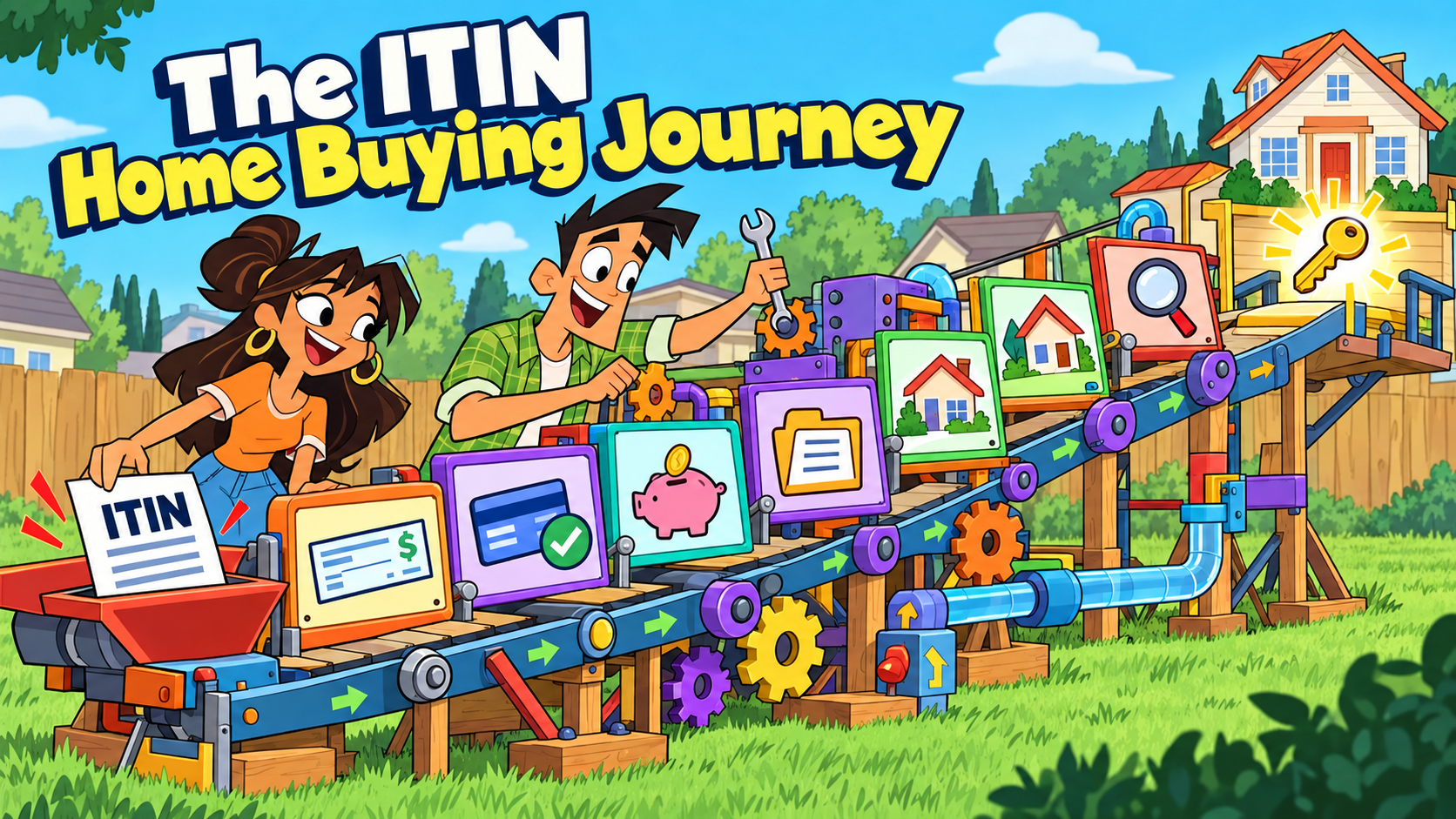
It can help to see the whole process laid out as a sequence: understanding financing options comes first, so you know which loan program might fit your situation. Reviewing income comes next, since the lender needs to understand where it comes from and how it can be documented under that program. Reviewing credit follows, since credit history and existing debt are part of underwriting. Reviewing assets comes next, as the lender needs to verify available funds and their source. Pre-approval follows, based on the information and documentation available at that point. Finding the home comes after that, since the specific property has to meet the requirements of the loan program. Making an offer moves the transaction forward. Underwriting is where the lender reviews the borrower, the property, and the documentation in full. Closing is the final step, once all requirements have been satisfied.
An ITIN mortgage isn’t a single step. It’s an entire journey.
Section 22
Final Takeaway: Start With the Loan, Not the House
If you have an ITIN and want to buy a home, don’t start by asking, “Can I buy a house?”
Start by asking, “Which financing options actually fit my situation?”
From there, the path runs through income, credit, assets, pre-approval, finding a property, making an offer, underwriting, and closing. That order matters, because it keeps the process grounded in what’s actually true for your file rather than a general promise, and it avoids treating an ITIN as some kind of shortcut through the mortgage process.
Section 23
Frequently Asked Questions
Can I buy a house with an ITIN?
It depends on the lender and the specific loan program. An ITIN by itself doesn’t automatically create eligibility; it’s one piece of a larger financial picture a lender reviews.
Can I get a mortgage with an ITIN?
Some lenders offer mortgage programs designed for ITIN borrowers, but terms and eligibility vary significantly. It’s worth asking a specific lender about their specific program requirements rather than assuming a general answer applies everywhere.
What is an ITIN mortgage?
It’s industry shorthand for a mortgage product available to borrowers who use an ITIN, rather than an SSN, as part of their loan file, subject to that lender’s and program’s specific requirements.
What documents are needed for an ITIN mortgage?
This typically includes income, asset, credit, identity, and property documentation, though the exact list depends on the loan program.
Does an ITIN replace an SSN for a mortgage?
Not in a general sense. The IRS defines an ITIN as a tax identification number, not a general form of identification, and some loan programs, such as FHA, have their own specific SSN and residency requirements that an ITIN doesn’t satisfy.
Can a self-employed ITIN borrower get a mortgage?
Potentially, depending on the lender and program, though self-employed income typically requires more extensive documentation for underwriting to evaluate it.
Do ITIN borrowers need credit history?
This depends on the loan program. Credit review is a meaningful part of most mortgage processes, though some programs handle limited or alternative credit history differently.
How much down payment does an ITIN borrower need?
There’s no single figure that applies across the board. It depends on the lender, the loan program, the borrower’s overall profile, and the property itself.
How long does an ITIN mortgage take?
There’s no fixed timeline. Documentation, underwriting, the appraisal, and the specific property can all affect how long the process takes.
Is an ITIN mortgage the same as an FHA loan?
No. FHA is a government-insured loan program with its own eligibility requirements. Under current HUD guidance, FHA eligibility is generally limited to U.S. citizens, lawful permanent residents, and citizens of certain Compact of Free Association nations, which is a separate question from whether a borrower uses an SSN or an ITIN.
Section 24
Sources
- IRS, Individual Taxpayer Identification Number (ITIN)
- IRS, ITIN Application Frequently Asked Questions
- Fannie Mae, Documents You Need to Apply for a Mortgage
- HUD, Mortgagee Letter 2025-09: Updates to FHA Residency Requirements
- HUD, FHA Single Family Housing Policy Handbook 4000.1
Disclaimer: This article is provided for general informational and educational purposes only. It is not financial, mortgage, real estate, tax, legal, immigration or investment advice. An ITIN is issued by the IRS for federal tax purposes and does not by itself establish mortgage eligibility, work authorization or immigration status. Mortgage availability, eligibility, underwriting requirements, documentation, rates, fees and loan terms vary by lender, loan program, borrower, property, location and timing, and program rules can change over time. A pre-approval is not a guarantee that a mortgage will close. Any examples in this article are hypothetical and are provided for educational purposes only. Readers should review their individual circumstances and obtain current information from the applicable lender and other qualified professionals before making a homebuying or financing decision.
Duc Pham, Mortgage Broker | NMLS# 844897 | 408-600-1900 | dp@wonderrates.com
Wonder Rates, Inc. | NMLS# 1518655 | DRE# 02047445 | DFPI# 60DBO-59134
Equal Housing Opportunity. Equal Housing Lender.
Licensed in: AL, AZ, CA, CO, FL, GA, LA, MI, NC, OH, OK, OR, PA, SC, TX, VA, WA