
Section 01
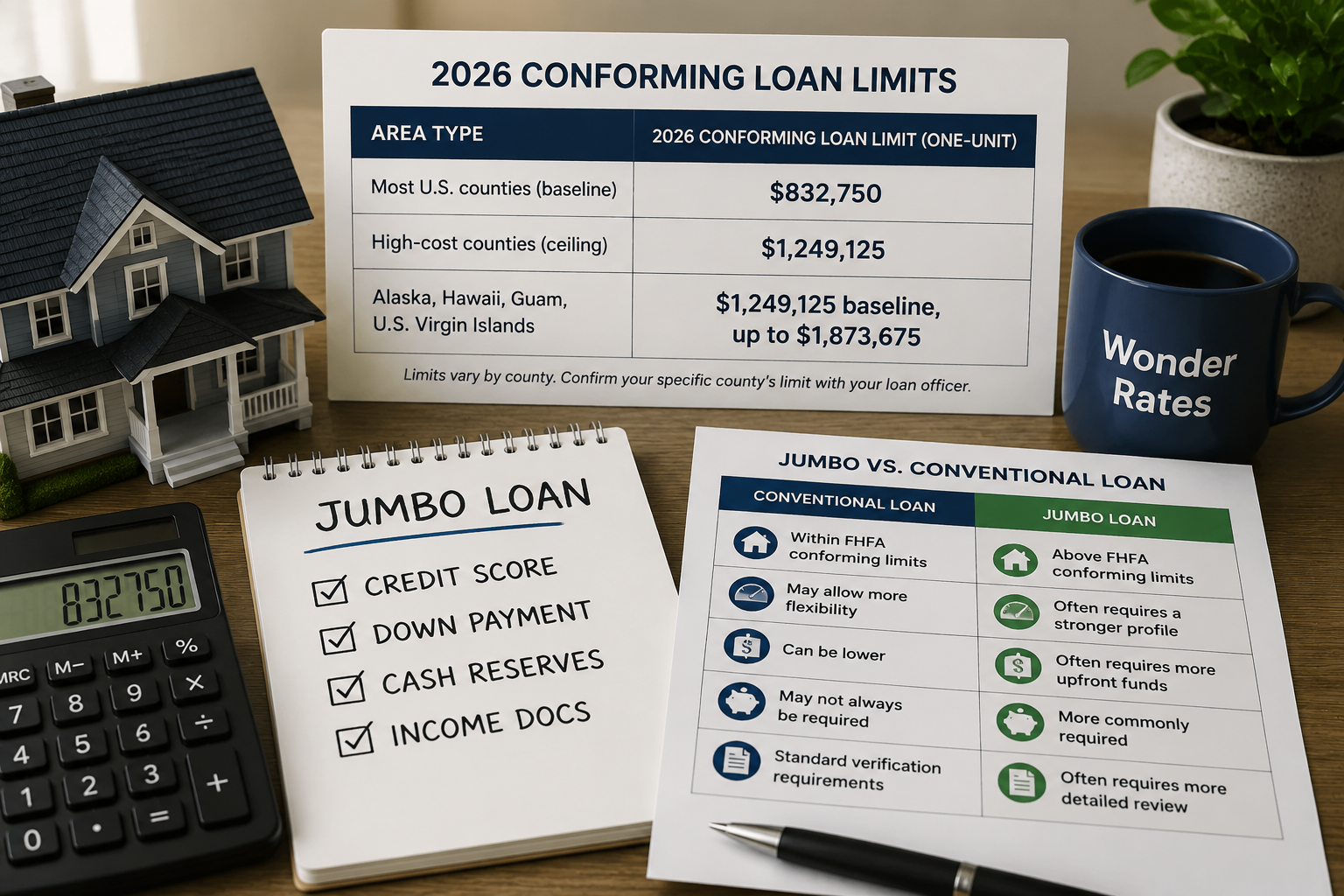
Jumbo Loan Requirements 2026 can vary by lender, but borrowers typically need to meet stricter standards for credit, down payments, cash reserves, and income documentation. A jumbo loan exceeds the conforming loan limit set by the FHFA, which means it falls outside Fannie Mae and Freddie Mac’s standard limits. The exact requirements depend on the lender and your financial profile.
What makes a loan jumbo isn’t the size of the home. It’s whether your loan amount exceeds the conforming limit for your county. Once you cross that line, the requirements can change.
Section 02
What Is Considered a Jumbo Loan in 2026?
A jumbo loan is any loan amount above the conforming loan limit set annually by the Federal Housing Finance Agency, or FHFA. Loans at or below that limit can generally be sold to Fannie Mae or Freddie Mac, while jumbo loans remain outside their standard conforming loan limits. . Loans above that limit cannot be purchased by Fannie Mae or Freddie Mac, which means jumbo lenders generally take on more risk themselves.
For 2026, the baseline and high-cost limits are:
| Area Type | 2026 Conforming Loan Limit (One-Unit) |
|---|---|
| Most U.S. counties (baseline) | $832,750 |
| High-cost counties (ceiling) | $1,249,125 |
| Alaska, Hawaii, Guam, U.S. Virgin Islands | $1,249,125 baseline, up to $1,873,675 |
The baseline limit went up from last year. This change reflects the annual adjustments by FHFA due to home price changes.
Here’s why location matters as much as loan amount: say you need a $900,000 loan. In a baseline-limit county, that’s $67,250 over the conforming limit, making it a jumbo loan. In a high-cost county, that same $900,000 loan is $349,125 under the ceiling, so it’s still conforming.
These figures reflect published 2026 FHFA conforming loan limits and are provided for general information. Confirm your specific county’s limit with your loan officer, since it varies by location and can differ from both figures shown here.
Section 03
Credit Score Requirements
Jumbo lenders generally look for stronger credit profiles than many conforming loan programs. Some lenders may look for scores in the 700s or higher, but the exact requirements depend on factors such as the loan amount, property type, down payment, and overall financial profile.
Your credit score is only one part of the evaluation. Lenders may also review factors such as your loan amount, debt profile, down payment, and asset strength when determining the overall risk of the loan.
| Credit Profile | What It May Mean for a Jumbo Loan |
|---|---|
| 700+ credit score | Stronger credit profile often considered by many jumbo lenders |
| Below 700 credit score | May require additional strengths, such as lower debt, larger reserves, or stronger income |
| Higher loan amounts | Larger jumbo loans may come with stricter credit and financial requirements |
This is why the same credit score can lead to different outcomes. A borrower with a 680 score may find more options near the conforming limit. In contrast, someone borrowing $1.5 million might face stricter requirements. This is because the lender takes on more risk.
Section 04
Down Payment Requirements
While conforming loans may allow lower down payments, many jumbo programs commonly require 10% to 20% down. Some lenders may offer lower options depending on the borrower’s credit profile, assets, and overall financial situation.
The examples below show how the same home price can lead to different loan classifications. This depends on the down payment and the county limit.
Here’s what that looks like on a $1,100,000 home in a baseline-limit county:
| Down Payment | Loan Amount | Jumbo in Baseline Counties? | Jumbo in High-Cost Counties? |
|---|---|---|---|
| 10% ($110,000) | $990,000 | Yes, $157,250 over the limit | No, $259,125 under the ceiling |
| 20% ($220,000) | $880,000 | Yes, $47,250 over the limit | No, $369,125 under the ceiling |
These figures are illustrative estimates only. Actual down payment requirements vary by lender, loan amount, and location, and do not constitute an offer of credit.
Section 05
DTI and Cash Reserve Requirements
Debt-to-income limits for jumbo loans are usually close to those for conforming loans. But some jumbo lenders set stricter caps. This depends on the file.
The bigger difference is usually reserve requirements. Jumbo lenders commonly want borrowers to have several months of mortgage payments available in eligible assets after closing, although the exact amount varies by lender, loan size, property type, and borrower profile.
Reserve requirements are usually measured by the number of months of housing expenses a borrower can cover after closing. A lender might require six months of reserves. They may ask you to show enough eligible assets to cover these housing expenses for that time.
The exact amount depends on factors such as your loan amount, property type, credit profile, income stability, and lender guidelines. Borrowers with big loans may need extra reserves. Those with complicated finances might also be asked for more.
Section 06
Income Documentation Is More Detailed
Jumbo lenders typically require more detailed documentation than conforming loans. Borrowers may need additional tax returns, asset verification, and in some cases, multiple appraisals for higher-value or unique properties.
Self-employed and 1099 borrowers should expect the most scrutiny here, since jumbo underwriters have less standardized guidance to lean on than conforming loans do.
Lenders may also review business income, profit-and-loss statements, and additional asset documentation depending on the borrower’s situation.
Section 07
Jumbo Loan vs Conventional Loan: What's the Difference?
The main difference between a jumbo loan and a conventional loan is the loan amount. Conventional loans must stay within the conforming loan limits set by the Federal Housing Finance Agency (FHFA), while jumbo loans exceed those limits.
Because jumbo loans fall outside Fannie Mae and Freddie Mac’s conforming limits, lenders often apply their own guidelines. This can lead to differences in credit, down payment, reserves, and documentation requirements.
| Conventional Loan | Jumbo Loan | |
|---|---|---|
| Loan amount | Within FHFA conforming limits | Above FHFA conforming limits |
| Credit requirements | May allow more flexibility depending on the program | Often requires a stronger credit profile |
| Down payment | Can be lower depending on borrower qualifications | Often requires more upfront funds |
| Cash reserves | May not always be required | More commonly required, especially for larger loans |
| Income documentation | Standard verification requirements | Often requires more detailed income and asset review |
A borrower buying an expensive home does not always need a jumbo loan. The deciding factor is the size of the mortgage compared with the conforming loan limit in the property’s county.
Section 08
Frequently Asked Questions
Can I get a jumbo loan with less than 20% down?
Yes, some jumbo programs allow 10% down or less, depending on the lender and borrower profile. However, lower down payments may come with stricter credit, income, or reserve requirements. A 20% down payment is common, but it is not a universal requirement.
Do jumbo loans always have higher interest rates than conforming loans?
Not always. Because jumbo loans don’t get sold to Fannie Mae or Freddie Mac, they aren’t priced against the same government-sponsored enterprise rules that shape conforming rates. Depending on market conditions, jumbo rates can run higher, lower, or close to conforming rates. It’s worth comparing actual quotes rather than assuming one is always cheaper.
How much cash do I actually need in reserves for a jumbo loan?
It depends on your lender’s requirements, loan amount, property type, credit profile, and overall financial situation. Many jumbo lenders may require several months of housing expenses in eligible assets after closing. Reserve requirements are separate from your down payment and closing costs.
Section 09
Conclusion
Whether your loan falls into jumbo or conforming territory depends on both your loan amount and your location.
Send a message to Duc Pham or the Wonder Rates team to check your county’s current loan limit and understand which loan option may fit your situation.
All figures, calculations, and examples in this article are for illustrative and educational purposes only and do not constitute an offer of credit or financial advice. Conforming loan limits are current as of the 2026 FHFA announcement and may vary by county. Credit score, down payment, DTI, and reserve requirements vary significantly by lender and are subject to change. Consult your loan officer for guidance specific to your situation.
Duc Pham, Mortgage Broker | NMLS# 844897 | Wonder Rates, Inc. | NMLS# 1518655 | DRE# 02047445 | DFPI# 60DBO-59134 | Equal Housing Opportunity. Equal Housing Lender. | Licensed in: AL, AZ, CA, CO, FL, GA, LA, MI, NC, OH, OK, OR, PA, SC, TX, VA, WA.