
Section 01
Two buyers are purchasing the same $500,000 home. One puts down $50,000. The other puts down $100,000. They are buying the exact same property, but their mortgage risk profile may look quite different, because their loan-to-value ratios are not the same.
Loan-to-value ratio, commonly shortened to LTV, compares the mortgage amount to the value of the property. It is one of the core numbers used in mortgage underwriting and pricing, and it can affect your loan options, your pricing, whether private mortgage insurance applies to you, your refinance eligibility down the road, and your overall equity position in the home. Understanding LTV helps you see that a down payment is really more than just the amount of cash you bring to the closing table. It is also the number that shapes a great deal of what happens inside the loan itself.
Disclaimer: This article is for general educational purposes only and does not constitute financial, mortgage, legal, tax, or investment advice. Mortgage requirements, LTV limits, pricing, mortgage insurance requirements, and eligibility vary by loan program, lender, investor, property type, occupancy, and borrower circumstances. Examples in this article are hypothetical and are provided for illustration only. Borrowers should discuss their specific situation with a qualified mortgage professional.
Section 02
What Is Loan-to-Value Ratio?
LTV Compares the Loan Amount to the Property Value
The core formula is simple. LTV equals the loan amount divided by the property value, multiplied by one hundred to express it as a percentage. The loan amount is the portion of the purchase being financed, while the property value is the applicable value used for the mortgage calculation, which may come from the purchase price, an appraisal, or both depending on the transaction.
As a quick example:
- Loan amount: $400,000
- Property value: $500,000
- $400,000 ÷ $500,000 = 80% LTV
Disclaimer: This is a hypothetical calculation for educational purposes only. Actual mortgage calculations can vary depending on the loan structure and applicable underwriting rules.
A Higher LTV Means You Are Financing a Larger Portion of the Property
A 90% LTV means the borrower is financing roughly 90% of the property’s value, while a 70% LTV means they are financing closer to 70%. Generally speaking, a lower LTV means more borrower equity relative to the property’s overall value.
LTV Is Not the Same Thing as Your Down Payment Percentage
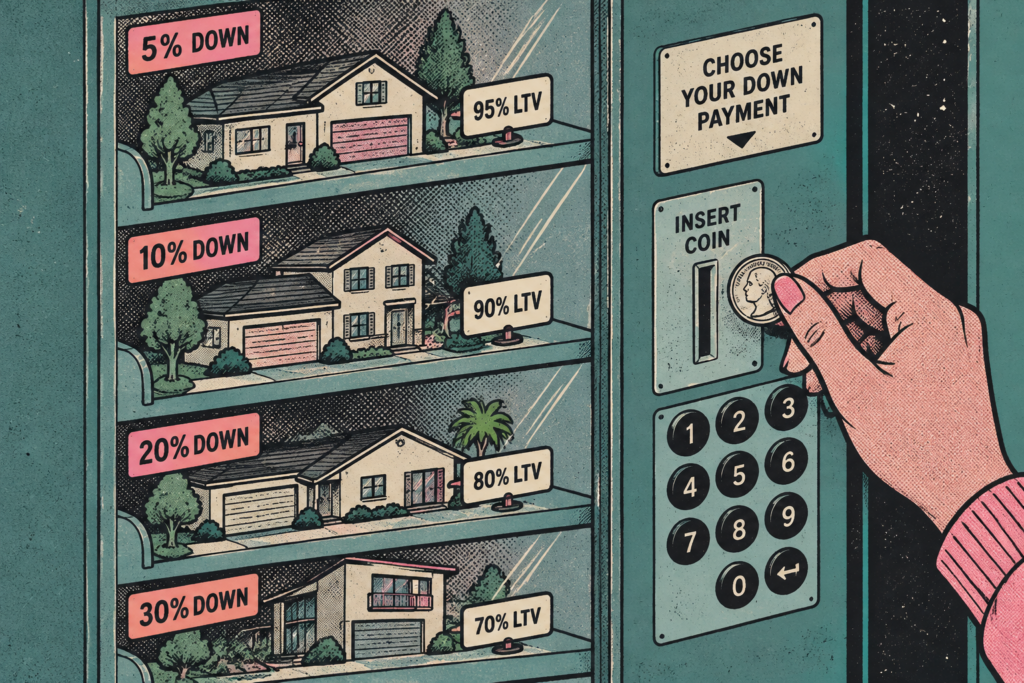
This distinction trips up a lot of first-time buyers. In a simple purchase scenario, putting 20% down works out to approximately 80% LTV, putting 10% down works out to approximately 90% LTV, and putting 5% down works out to approximately 95% LTV. That said, LTV calculations can become more complicated depending on the overall loan structure, any subordinate financing involved, how the property is valued, and other specific details of the transaction.
Section 03
How to Calculate Loan-to-Value Ratio
The Formula
LTV = Mortgage Loan Amount divided by Property Value, multiplied by 100
To find your own number, you just need three steps. First, figure out your loan amount. Second, figure out your property value. Third, divide the loan amount by the property value and multiply by 100.
LTV Example for a Home Purchase
Illustrative example: Home price is $500,000. Down payment is $100,000. That leaves a mortgage of $400,000. Divide $400,000 by $500,000, and you get 0.80. Multiply by 100, and the LTV is 80 percent.
This example is for educational purposes only. Actual loan amounts, property values, down payment requirements, mortgage pricing, and underwriting requirements vary by lender, loan program, property, and borrower circumstances.
How Down Payment Changes Your LTV
| Down Payment | Loan Amount | LTV |
|---|---|---|
| 5% | 95% | 95% |
| 10% | 90% | 90% |
| 20% | 80% | 80% |
| 25% | 75% | 75% |
A higher down payment means a lower LTV. A lower down payment means a higher LTV. That part is simple math. But down payment size is not the only thing that decides whether you get approved for a mortgage. If you’re comparing different down payment amounts, our Down Payment guide can help you look at how much cash you may need beyond the down payment itself.
Section 04
Why Does LTV Matter in a Mortgage?
LTV Helps Lenders Evaluate Collateral Risk
A mortgage is secured by the property itself, which means the home serves as collateral for the loan. If a borrower were to default, the property becomes part of what the lender looks to for recovery. A borrower with more equity generally holds a larger ownership stake in the property relative to the loan, and LTV is essentially how lenders quantify that relationship between debt and property value.
LTV Can Affect Mortgage Pricing
LTV can be one factor among several that influence mortgage pricing. A lower LTV may qualify for different pricing or terms in certain scenarios, but this does not mean every borrower with a lower LTV automatically receives a lower rate. Other factors typically come into play too, including credit profile, loan type, occupancy, property type, loan amount, and broader market conditions at the time of pricing.
LTV Can Affect Mortgage Insurance
Certain higher-LTV conventional loans may require private mortgage insurance, commonly called PMI. PMI protects the lender, not the borrower, and its requirements vary by loan program. Some government-backed loans use an entirely different mortgage insurance structure altogether, which is why it would be a mistake to treat 80% LTV as some kind of universal magic number that applies the same way to every type of mortgage.
Section 05
What Is a Good Loan-to-Value Ratio?
Is 80% LTV Considered Good?
An 80 percent LTV comes up constantly in mortgage conversations, mostly because it lines up with having roughly 20 percent equity in the home at the time of the calculation. That said, 80 percent is not a magic number that applies the same way to every mortgage. It is simply a common benchmark.
What About 90%, 95%, or Higher LTV?
Higher-LTV financing is common and available through many loan programs. A higher LTV means less equity on day one. It also means the specific loan program’s requirements matter more, mortgage insurance may come into play, and pricing or underwriting can look different than it would at a lower LTV.
Does a Lower LTV Always Mean a Better Mortgage?
Not necessarily. A buyer might have enough cash for a large down payment but still need to keep money in reserve for closing costs, an emergency fund, or other near-term expenses. Chasing the lowest possible LTV is not automatically the smartest financial move for every buyer. Sometimes keeping cash on hand matters more than shaving a few points off your LTV. If you’re deciding how much cash to put toward your down payment, it is also worth considering how much you should keep available after closing. See our guide to Cash Reserves for a Mortgage for more on that part of the planning process.
Section 06
How LTV Affects Your Down Payment
Down Payment and LTV Move in Opposite Directions
The relationship here is simple once it clicks. More down payment leads to a smaller loan, which leads to a lower LTV. Less down payment leads to a larger loan, which leads to a higher LTV.
Compare the Trade-Off, Not Just the Percentage
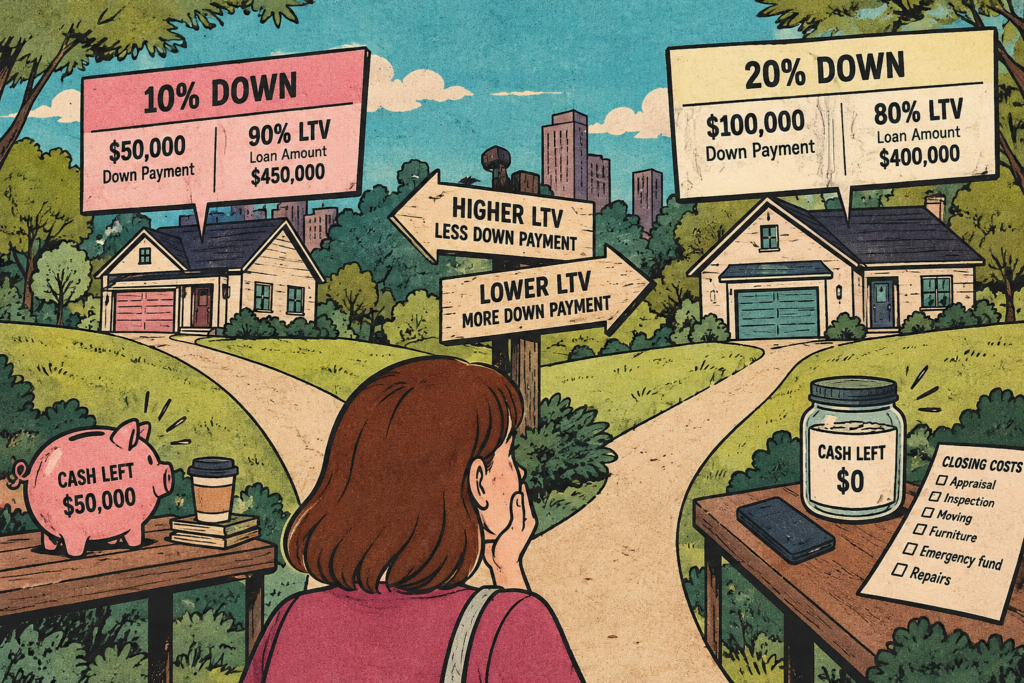
Imagine a borrower with $100,000 available. In one scenario, they put $80,000 down and keep $20,000 in reserve. In another, they put the full $100,000 down and have nothing left before even considering closing costs. The second scenario produces a lower LTV, but it may leave the borrower with far less liquidity to handle whatever comes next.
Disclaimer: This is a hypothetical illustration only. The appropriate down payment depends on the borrower’s complete financial situation and applicable loan requirements.
Cash After Closing Matters Too
A lower LTV is only part of the picture. It is worth connecting that number back to emergency funds, reserves, potential repairs, moving expenses, and the unexpected costs that tend to show up in the first year of owning a home.
Section 07
How LTV Can Affect PMI
What Is PMI?
Private mortgage insurance is generally associated with certain conventional mortgages and exists to protect the lender against borrower default, not the borrower themselves.
Why Higher LTV Can Mean PMI
A higher LTV means less equity in the home. Some conventional loan structures require PMI once LTV rises above a certain level, and this added insurance cost can increase the overall monthly housing payment beyond just principal and interest.
PMI Rules Depend on the Loan
It helps to avoid blanket statements here, since the rules differ meaningfully between conventional and government-backed loans, and even within conventional loans depending on the specific program. According to the Consumer Financial Protection Bureau, PMI on many conventional loans can generally be requested for cancellation once the loan balance reaches 80% of the home’s original value, and is generally required to automatically terminate once the balance reaches 78% of that original value, assuming the borrower is current on payments. FHA loans and VA loans follow their own separate mortgage insurance and guarantee structures that work quite differently from conventional PMI.
The key point worth remembering is that putting 20% down is not universally required for every mortgage, and putting 20% down does not automatically eliminate every type of mortgage insurance across every loan program. The actual loan program you choose matters a great deal here.
Section 08
How LTV Can Affect Your Mortgage Interest Rate
LTV Is One Factor, Not the Entire Rate Equation
Mortgage pricing typically considers LTV alongside credit score and profile, loan type, property type, occupancy, loan amount, broader market conditions, and other pricing adjustments that apply at the time.
Why Two Borrowers Can Receive Different Rates
Picture two borrowers purchasing identical $500,000 homes, where Borrower A puts 10% down and Borrower B puts 25% down. Even if every other factor between them were identical, their LTVs would differ, which can influence their pricing. It would not be accurate, though, to promise that Borrower B will definitely receive some specific lower rate just because their LTV is lower.
Disclaimer: This example is hypothetical and does not represent a rate quote or guarantee. Actual pricing depends on the complete loan scenario and current lender and investor pricing.
Do Not Compare Mortgage Rates Without Comparing LTV and Loan Structure
Two rate quotes that look different on the surface often reflect two entirely different LTV and loan structure scenarios underneath, which is exactly why rate alone rarely tells the full story when comparing offers from different lenders.
Section 09
How LTV Affects Mortgage Refinancing
Your LTV Can Change After You Buy the Home
Two separate things can shift your LTV over time after your original purchase. Your mortgage balance can decrease as you make payments, and your property’s value can change based on the market. Either movement changes where your LTV actually sits today.
Example: Your Loan Balance Decreases
Original scenario:
- Property value: $500,000
- Loan amount: $400,000
- $400,000 ÷ $500,000 = 80% LTV
Later, after paying down the balance:
- Loan balance: $360,000
- Property value: $500,000 (unchanged)
- $360,000 ÷ $500,000 = 72% LTV
Disclaimer: This is a hypothetical example. Actual refinance LTV calculations depend on the valuation and loan requirements applicable to the refinance.
Home Appreciation Can Also Lower LTV
- Loan balance: $400,000 (unchanged)
- Property value: $500,000 → $600,000
- $400,000 ÷ $500,000 = 80% LTV
- $400,000 ÷ $600,000 = 66.7% LTV
It is worth being clear that an increase in home value does not automatically put cash in your bank account. The equity exists on paper within the home, not as cash sitting in an account ready to spend.
Lower LTV May Help a Refinance Scenario, but It Does Not Guarantee Approval
A lower LTV is a helpful piece of the puzzle, but refinancing still depends on income, credit, debt-to-income ratio, payment history, loan type, occupancy, and the actual purpose behind the refinance request.
Section 10
LTV and Home Equity: What Is the Difference?
LTV and Equity Are Closely Related
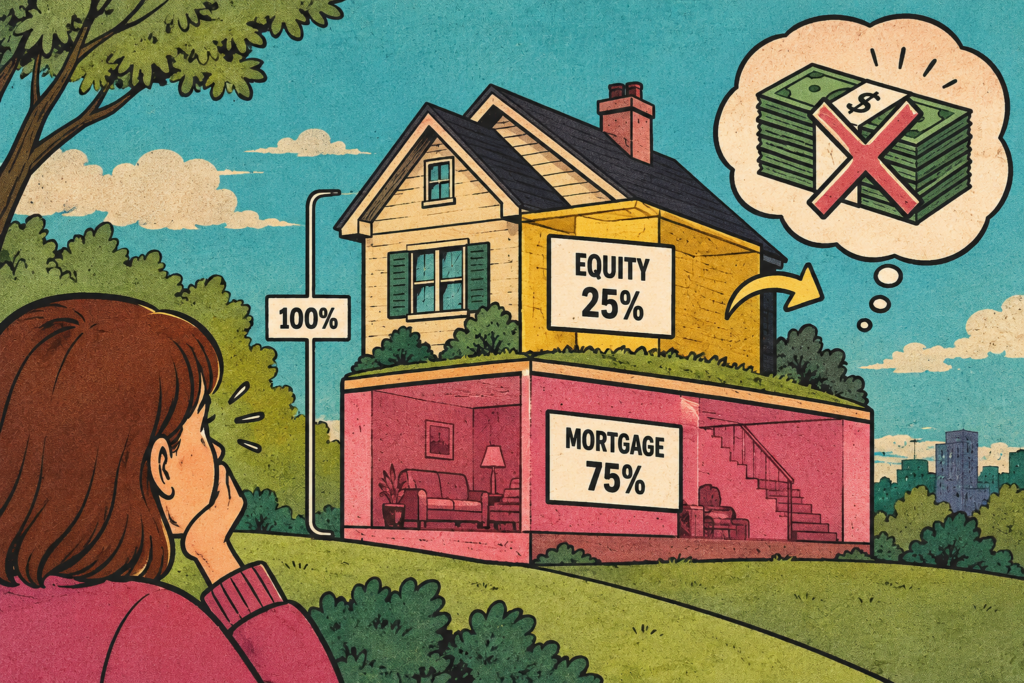
In a simple first-lien scenario, equity percentage is roughly equal to 100% minus LTV. A 75% LTV corresponds to approximately 25% equity, for example.
Equity Is Not the Same as Cash
- Home value: $700,000
- Mortgage: $400,000
- $700,000 − $400,000 = $300,000 in equity
But the homeowner does not automatically have $300,000 sitting in a bank account ready to use. That equity exists within the property itself, not as liquid cash.
Why This Matters for Cash-Out Refinance
A cash-out refinance uses available equity to replace the existing mortgage and potentially provide cash to the borrower, but it comes with its own LTV limits and eligibility requirements. A borrower should not assume that having $300,000 in equity automatically means they can take $300,000 in cash out, since lenders generally cap how much of that equity can actually be converted this way.
Section 11
LTV for Different Types of Mortgage Loans
Conventional Mortgages
LTV plays a major role in conventional mortgages, and PMI may apply at higher LTV levels, though exact requirements depend on the specific loan scenario involved.
FHA Mortgages
FHA loans carry their own down payment and mortgage insurance structure, which is quite different from conventional financing. Borrowers should not simply apply conventional 20% down logic directly to an FHA loan, since the rules genuinely work differently.
VA Mortgages
VA loans involve different eligibility requirements and financing structures altogether, with LTV rules and funding considerations that differ meaningfully from conventional loans.
Investment Properties and Other Scenarios
LTV requirements can shift based on occupancy, property type, the number of units involved, the purpose of the loan, and the borrower’s overall profile. There is simply no single LTV rule that applies the same way across every mortgage scenario.
Section 12
What Happens to LTV When Home Values Change?
If Your Home Value Increases
Assuming the loan balance stays the same, a rising home value lowers LTV:
- $400,000 ÷ $500,000 = 80% LTV
- $400,000 ÷ $600,000 = 66.7% LTV
If Your Home Value Decreases
The same logic works in reverse:
- $400,000 ÷ $500,000 = 80% LTV
- $400,000 ÷ $450,000 = 88.9% LTV
Why Falling Property Values Can Create Challenges
A declining property value generally means less equity, potentially a higher LTV than before, more difficult refinance scenarios, and possible limitations on certain loan options that depend on equity thresholds.
Disclaimer: This is a hypothetical calculation only. Actual property value for mortgage purposes may depend on the applicable valuation method and underwriting requirements.
Section 13
Can You Lower Your Loan-to-Value Ratio?
Make Additional Principal Payments
If the property value stays the same, paying down additional principal lowers your loan balance, which in turn lowers your LTV over time.
Increase Your Down Payment When Purchasing
This is the most straightforward path of all. A larger down payment creates more upfront equity and a lower initial LTV right from the start.
Property Appreciation Can Lower LTV
Rising property values can lower your LTV too, though this is market-driven and not something a borrower directly controls.
Do Not Spend All Your Cash Just to Lower LTV
A lower LTV can genuinely be valuable, but not if achieving it leaves you financially unprepared for everything else that comes along with owning a home, from routine maintenance to the unexpected repair that always seems to show up at the worst time.
Section 14
A Detailed Example: Comparing 5%, 10%, and 20% Down
Same $600,000 Home, Different Down Payments
| Down Payment | Loan Amount | Approximate LTV |
|---|---|---|
| 5% ($30,000) | $570,000 | 95% |
| 10% ($60,000) | $540,000 | 90% |
| 20% ($120,000) | $480,000 | 80% |
What Changes as LTV Changes
As the down payment grows and LTV drops, the loan amount shrinks, equity grows, potential PMI requirements may change, the monthly principal and interest payment shifts, pricing may differ, and the amount of cash remaining after closing varies significantly between these three paths.
What Does Not Change
The property price remains $600,000 throughout all three scenarios, the property itself is exactly the same home, and the borrower still needs to budget for taxes, insurance, HOA dues if applicable, and other ongoing ownership costs regardless of which down payment they choose.
Disclaimer: This comparison is hypothetical and excludes interest, taxes, insurance, PMI, closing costs, HOA fees, and other loan-specific factors. It is intended only to demonstrate how down payment and LTV relate to each other.
Section 15
Common Mistakes Borrowers Make When Thinking About LTV
One common mistake is thinking LTV is the same thing as down payment. Down payment is the cash contributed toward the purchase, while LTV is the loan amount measured against the property value, and the two are related but not identical.
Another mistake is assuming a lower LTV automatically means a better mortgage, without weighing the trade-off between equity, liquidity, monthly payment, and the opportunity cost of tying up more cash in the home.
A third mistake is assuming 80% LTV is some kind of universal target that applies to every loan program, when in reality different programs carry very different thresholds and structures.
A fourth mistake, especially relevant for refinancing, is ignoring the property’s current value and calculating LTV based only on what was originally paid for the home, since refinance LTV depends on both the current loan balance and the current property value together.
And a fifth mistake is confusing equity with available cash, treating the number on paper as though it were money sitting in a bank account ready to spend.
Section 16
How to Think About LTV Before Choosing a Mortgage
Start With Your Available Cash
It helps to start by asking how much cash you can comfortably put toward a down payment, how much you will need for closing costs, and how much you want to have remaining after closing for peace of mind.
Compare the Monthly Payment
Look well beyond principal and interest alone, factoring in property taxes, homeowners insurance, HOA dues if applicable, mortgage insurance, and any other recurring housing costs tied to the property.
Compare the Total Cost and Trade-Offs
Rather than only asking which LTV gives you the lowest monthly payment, it helps to also ask what happens to your cash reserves if you choose a particular down payment, since the lowest payment and the healthiest financial position are not always the same choice.
Match the LTV to Your Financial Situation
A simple way to frame the whole decision is to follow the chain from cash, to down payment, to loan amount, to LTV, to mortgage insurance and pricing, to monthly payment, and finally to the cash you have left over once everything closes.
Section 17
Loan-to-Value Ratio Explained in One Simple Formula
The Formula
LTV equals the loan amount divided by the property value, multiplied by one hundred.
Quick Examples
- $450,000 ÷ $500,000 = 90% LTV
- $400,000 ÷ $500,000 = 80% LTV
- $350,000 ÷ $500,000 = 70% LTV
The Lower the LTV, the More Equity You Have
That said, a lower LTV is not automatically a better mortgage for every borrower. The right decision still depends on your complete financial picture rather than chasing the smallest possible percentage.
Section 18
Loan-to-Value Ratio Is One Number That Can Change the Mortgage Conversation
LTV tells you how much of the property’s value is actually being financed through the mortgage. A higher LTV generally means less initial equity and may affect mortgage insurance or pricing depending on the specific loan involved. A lower LTV can create more equity, but it may require considerably more cash upfront than some borrowers are prepared to part with. And ultimately, the right LTV depends on your entire financial picture, not some single magic percentage that works the same for everyone.
Understanding your LTV helps you understand what your down payment is actually doing inside the mortgage. It is not just a percentage sitting on a worksheet. It can affect your loan amount, your equity, your mortgage insurance, your pricing, and the amount of cash you have left once closing is behind you.
Section 19
Disclaimer
This article is for general educational purposes only and does not constitute financial, mortgage, legal, tax, or investment advice. Mortgage requirements, LTV limits, pricing, mortgage insurance requirements, and eligibility vary by loan program, lender, investor, property type, occupancy, and borrower circumstances. Examples in this article are hypothetical and are provided for illustration only and do not represent an offer, quote, approval, or guarantee of any specific outcome. Borrowers should discuss their specific situation with a qualified mortgage professional.
Duc Pham, Mortgage Broker | NMLS# 844897, Wonder Rates, Inc. | NMLS# 1518655 | DRE# 02047445 | DFPI# 60DBO-59134 | Equal Housing Opportunity. Equal Housing Lender. | Licensed in: AL, AZ, CA, CO, FL, GA, LA, MI, NC, OH, OK, OR, PA, SC, TX, VA, WA.