
Section 01
You are almost at the finish line. Your offer was accepted, your mortgage is moving through underwriting, and closing day is on the calendar. Then something changes.
A new credit account appears. Your lender asks for another bank statement. The appraisal raises an issue. Suddenly, the closing date may need to move.
Mortgage closing delays can happen even late in the process because your lender still needs to confirm that your finances, the property, and the final loan documents meet the requirements for your mortgage.
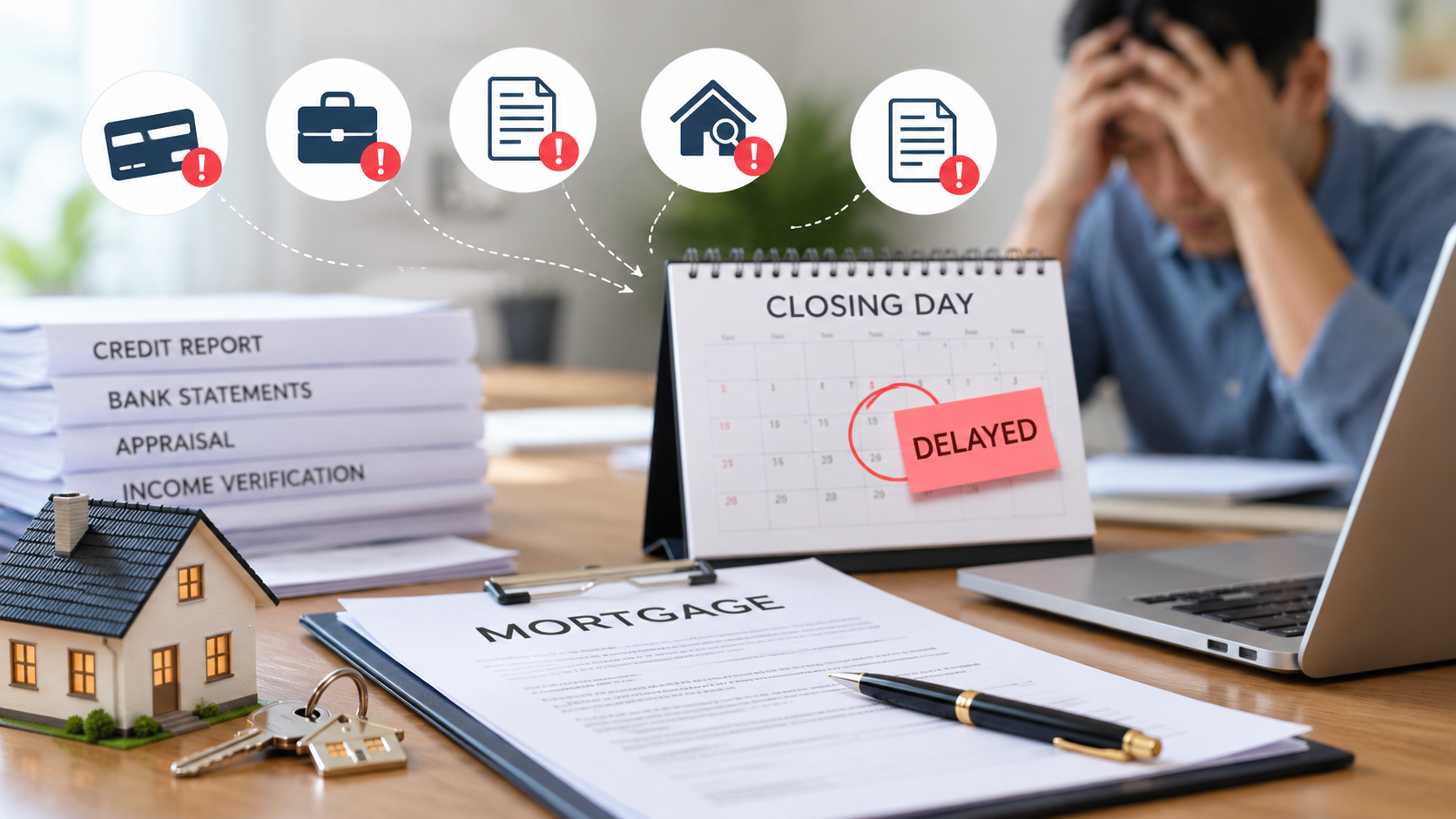
Here are five common things that can delay your mortgage closing and what homebuyers should know about each one.
Section 02
What Can Delay a Mortgage Closing?
A mortgage closing may be delayed when your financial situation changes, documents are missing, the property has an issue, or the final paperwork needs to be corrected. Some problems can be resolved quickly, while others may require another underwriting review, additional documents, repairs, or changes to the closing timeline.
Here is a quick overview:
| Potential Closing Delay | Why It Can Cause a Delay | What May Happen Next |
|---|---|---|
| New debt or credit | Your credit profile or monthly debt changes | The lender may need to review the new account or payment |
| Job or income changes | The income used for the mortgage may have changed | Updated income or employment documents may be required |
| Missing documents or unexplained deposits | Underwriting cannot verify part of the application | The lender may request additional records or explanations |
| Appraisal or property issues | The home’s value or condition may affect the loan | Additional review, repairs, or transaction changes may be needed |
| Closing document problems | Information must be accurate before closing | Documents may need to be corrected, and some changes can affect timing |
Section 03
1. Taking On New Debt or Opening New Credit
A new credit card, auto loan, personal loan, or other debt can affect a mortgage that is already in progress. Your mortgage application is reviewed partly based on your credit profile and existing financial obligations, so a new monthly payment may require the lender to evaluate the change before closing.
This can matter even when you are already close to getting the keys. According to the Consumer Financial Protection Bureau’s guidance on mortgage credit checks, a lender may obtain your credit report just before you close on a loan.
The CFPB also explains that applying for another credit card, car loan, or other type of credit during the mortgage process creates an additional inquiry and may affect your credit score. Its mortgage credit guidance recommends being careful about applying for other credit while getting a mortgage.
For example, imagine you are two weeks from closing and decide to finance new furniture for the house. That financing could create a new account, inquiry, and monthly payment. Your lender may then need to determine whether the new obligation changes your mortgage file.
The same can happen with a new auto loan, personal loan, store credit card, or financing for appliances. A new account does not automatically mean your mortgage will be denied, but it can create another item that needs to be reviewed.
Simple takeaway: A financial decision that seems unrelated to your home purchase may still affect the mortgage process before closing.

Section 04
2. Changing Jobs or Income Before Closing
A change in your employment or income can also slow down the mortgage process. The lender reviewed your application using information about how much you earn and where that income comes from. If that information changes before closing, updated documents or another review may be needed.
Examples include starting a new job, leaving your current job, having your hours reduced, moving from salary to commission, taking unpaid leave, becoming self-employed, or experiencing a significant change in income.
Not every employment change creates the same issue. Moving from one salaried position to another may be very different from leaving a salaried job to become self-employed. The impact depends on your loan program, income structure, documentation, and the rest of your application.
The CFPB explains that during the closing process, lenders may ask for additional financial information and documents to verify information previously reported on your application. That is why an income or employment change can lead to another round of documentation or underwriting review.
Simple takeaway: If information used to evaluate your mortgage changes before closing, the lender may need time to review the new information.
Section 05
3. Missing Documents or Unexplained Money in Your Accounts
One missing document can hold up an otherwise strong mortgage file. During underwriting, your lender may request records to verify your income, assets, debts, or source of funds.
Common requests may include recent pay stubs, bank statements, tax documents, proof of homeowners insurance, gift fund documentation, records showing the source of a deposit, or updated financial information.
The CFPB tells homebuyers to respond quickly to lender requests for additional documents because the lender needs to review financial information before completing the mortgage.
Large deposits can also create extra questions. For example, if $15,000 suddenly appears in the bank account you plan to use for closing, the money may have a perfectly acceptable source. You may have transferred it from another account, sold an asset, or received funds from an eligible source. The key issue is whether the lender can document where the money came from.
The CFPB notes that lenders may ask borrowers to document the source of recent large bank deposits when verifying income and funds for the transaction. If the source is unclear, underwriting may need additional records before moving forward.
This is one reason a simple document request can turn into several steps. The lender may ask for a bank statement, then notice a deposit that needs explanation, and then request supporting records for that deposit. Each step can add time if documents are incomplete or slow to arrive.
The CFPB specifically warns that delaying documents needed to process a mortgage application may delay closing.
Simple takeaway: Keep your financial records organized and provide complete documentation when your lender asks for it.
Section 06
4. Appraisal, Repair, or Property Issues
Sometimes your finances are not the reason for the delay. The property itself can create an issue.
An appraisal provides an independent opinion of the home’s value. If the appraised value comes in below the purchase price, the lender may not be able to evaluate the transaction exactly as originally expected.
The CFPB explains what a low home appraisal can mean for a buyer, including the possibility that the buyer and seller may need to revisit the purchase price or other parts of the transaction.
For example, imagine you agree to buy a home for $500,000, but the appraisal supports a lower value. That difference may need to be addressed before the transaction can continue as planned.
Property condition can also matter. Depending on the loan and the property, certain issues may require more information, repairs, or additional review. An appraisal is not the same as a home inspection, but property-related concerns can still affect whether the mortgage and transaction are ready to close.
A borrower can have a well-documented financial file and still experience a closing delay because of the property.
Simple takeaway: Mortgage approval involves more than your income and credit. The home itself also plays a role in the transaction.
Section 07
5. Problems or Major Changes in Your Closing Documents
Closing documents need to be accurate before you sign them, and even a small mistake can create a delay. According to the CFPB, errors in mortgage closing documents can delay closing by a few hours or even a few days.
Common problems may include a misspelled name, an incorrect property address, the wrong loan amount, missing pages, or information that does not match earlier documents.
One of the most important documents to review is your Closing Disclosure. It shows key information about the mortgage, including the loan terms, projected payments, closing costs, and other transaction details.
For most mortgages covered by the rule, federal law requires the borrower to receive the Closing Disclosure at least three business days before closing. The CFPB explains the three-business-day Closing Disclosure requirement in its consumer guidance.
That review period gives you time to compare the final information with your Loan Estimate and raise questions before signing.
Section 08
Does Every Change Restart the Three-Day Waiting Period?
No. Most corrected Closing Disclosures do not require a completely new three-business-day waiting period.
Under the CFPB’s official TILA-RESPA Integrated Disclosure guidance, a new three-business-day waiting period is generally required when the APR becomes inaccurate under Regulation Z, the disclosed loan product changes, or a prepayment penalty is added.
For many other corrections, the lender may provide an updated Closing Disclosure without restarting the full three-business-day period.
Simple takeaway: Review your Closing Disclosure as soon as you receive it. Finding an error earlier gives the lender or settlement agent more time to correct it.
Section 09
How to Reduce the Risk of a Mortgage Closing Delay
You cannot control every part of the closing process. An appraisal issue, property problem, documentation question, or closing error can still happen. But staying organized can make it easier to resolve questions when they come up.
During the mortgage process, watch for lender emails and document requests, submit complete documents rather than partial pages, and keep records showing where large deposits or transfers came from. You should also understand that new credit or debt may affect your file and that changes to your income or employment may require additional review.
Once you receive your Closing Disclosure, review it carefully and raise questions if something does not match what you expected. The CFPB provides a useful step-by-step mortgage closing resource for homebuyers that covers document submission, closing services, and the final paperwork.
The goal is not to assume something will go wrong. It is to understand that underwriting and closing are still active processes until the transaction is complete.
Section 10
What Happens If Your Mortgage Closing Is Delayed?
A delayed closing does not automatically mean the mortgage is falling apart. Sometimes the lender simply needs another document. An appraisal question may need to be addressed, or a closing document may need correction.
The next step depends on the reason for the delay. A delay can also affect other parts of the transaction, including contract deadlines or a mortgage rate lock, so the parties involved may need to coordinate a new timeline.
If you are unsure what caused the delay, one useful question to ask is: What condition still needs to be resolved before the loan can close?
That helps identify whether the issue is a routine documentation request or something that may require more time to resolve.
Section 11
Frequently Asked Questions About Mortgage Closing Delays
Can opening a credit card delay mortgage closing?
It can. A lender may check your credit again before closing, and a new credit card can create an inquiry, a new account, or additional debt that may need to be reviewed. The CFPB confirms that credit reports may be obtained shortly before a loan closes.
Can changing jobs before closing delay a mortgage?
It can, especially if the income used to evaluate your mortgage changes. Your lender may need updated employment or income documentation before completing underwriting.
Can a large bank deposit delay closing?
It may if the lender cannot verify where the funds came from. The CFPB explains that borrowers may need to document the source of large deposits during the mortgage process.
Can a low appraisal delay closing?
Yes. When an appraisal is lower than the purchase price, the transaction may need additional review or changes before closing. The CFPB provides more information on what buyers can expect when an appraisal comes in below the sale price.
Can an error on the Closing Disclosure delay closing?
Yes. Some mistakes can be corrected quickly, while others may take longer. The CFPB says closing document errors can sometimes delay closing for hours or days. Certain major changes to the Closing Disclosure can also trigger a new three-business-day waiting period.
How long can a mortgage closing be delayed?
There is no standard timeline. A simple document correction may be resolved quickly, while an appraisal, underwriting, title, or property issue may take longer.
The timeline depends on what caused the delay and what needs to happen before the lender and other parties are ready to close.
Section 12
Final Thoughts
Getting close to closing does not mean every part of your mortgage is finished. Your lender may still need to verify information, clear underwriting conditions, review changes, and prepare accurate closing documents. The property also needs to be ready for the transaction.
Understanding what can delay a mortgage closing can make the final stage less confusing. If something changes, ask what still needs to be completed and whether it could affect your expected closing date.
If you are still comparing loan options or preparing for your next home purchase, Wonder Rates can help you review mortgage programs from 50+ lending organizations and connect with a licensed loan officer who can walk you through the next steps.
For additional consumer information, the Consumer Financial Protection Bureau’s home closing guide provides official resources on underwriting documents, closing paperwork, and the final steps of buying a home.
Disclaimer: This article is for educational and informational purposes only. It is not individualized financial or mortgage advice. Loan eligibility, documentation requirements, underwriting decisions, and closing timelines depend on the borrower, property, loan program, and lender requirements.
Duc Pham, Mortgage Broker | NMLS# 844897 | 408-600-1900 | dp@wonderrates.com
Wonder Rates, Inc. | NMLS# 1518655 | DRE# 02047445 | DFPI# 60DBO-59134
Equal Housing Opportunity. Equal Housing Lender.
Licensed in: AL, AZ, CA, CO, FL, GA, LA, MI, NC, OH, OK, OR, PA, SC, TX, VA, WA