Section 01
What Is a Mortgage Rate Lock?
You’ve found the home. Purchase price: $500,000. You’re moving through your mortgage application, and your lender has given you a specific interest rate. But mortgage rates don’t stay still. They can shift between the day you apply and the day you actually close, sometimes by a little, sometimes by more than you’d expect.
This is where a mortgage rate lock comes in.
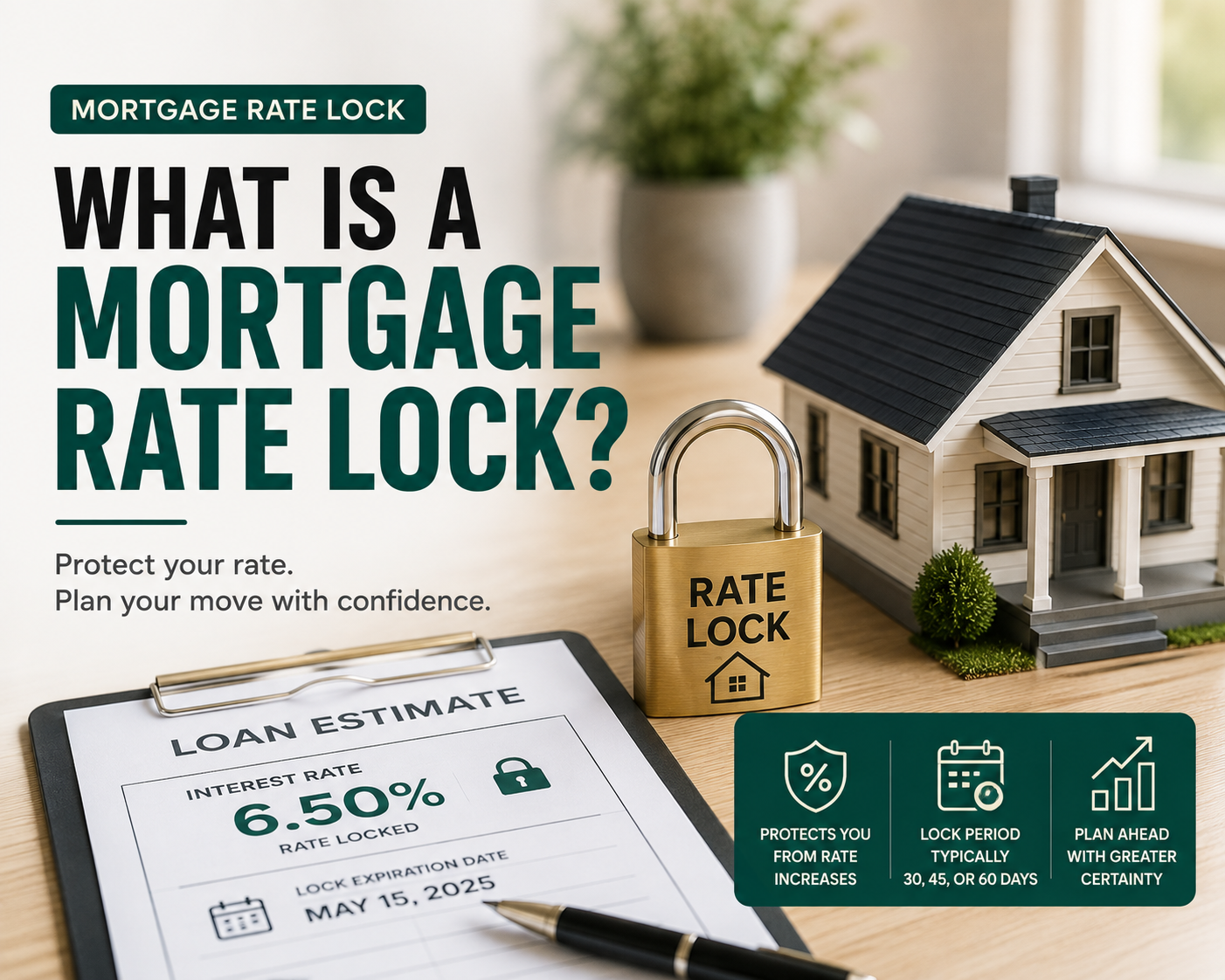
A rate lock is an agreement between you and your lender to hold a specific interest rate for a set period of time, subject to the terms of the rate lock agreement. The Consumer Financial Protection Bureau (CFPB) explains that once your rate is locked, it generally won’t change during the lock period as long as you close within that timeframe and your application information doesn’t change in a way that affects pricing.
Section 02
What a rate lock actually protects you from
Here’s a simple scenario. On Day 1, you’re quoted a rate of 6.50% and you decide to lock it. By Day 15, market rates have climbed to 6.75%. If the conditions of your lock are still being met and you close within the lock period, you typically keep the 6.50% rate you originally locked, even though the broader market moved higher.
That’s the core benefit. A rate lock protects you from some of the interest rate movement that can happen during the time between application and closing. What it is not, however, is a guarantee that every term of your mortgage will remain frozen no matter what happens in your file. That distinction matters, and we’ll come back to it throughout this guide.
Section 03
How Does a Mortgage Rate Lock Work?
Rather than thinking of a rate lock as a single event, it helps to see it as one step in a broader timeline.
Step 1: You apply for a mortgage
During the application process, you provide information about your income, assets, employment, credit, the property you’re purchasing, your desired loan amount, and your down payment. This information forms the basis for the pricing your lender will offer.
Step 2: The lender provides pricing
Based on your file, the loan program you’re using, current market conditions, and other pricing factors, your lender provides you with an interest rate and a set of loan terms.
Step 3: You decide whether to lock
Depending on the lender and the specifics of your transaction, you may be able to lock your rate at different points in the process. The CFPB recommends checking the first page of your Loan Estimate to see whether your rate has been locked, and if so, until when.
Step 4: The lock has an expiration date
This is the part that’s easy to overlook until it becomes a problem. A rate lock does not last indefinitely. The CFPB notes that rate locks are typically available for 30, 45, or 60 days, and sometimes longer, depending on the lender and the loan.
Section 04
What Does a Rate Lock Actually Lock?
This is one of the more misunderstood parts of the process, so it’s worth being precise here.
The interest rate
If the conditions of your lock agreement are met, your interest rate is held steady for the duration of the lock period.
Points and lender credits
A rate lock can also involve other pricing elements, such as discount points or lender credits. The CFPB requires that your Loan Estimate reflect the status of your rate lock, and if your rate is locked, the disclosure must show when that lock expires.
What it does not necessarily freeze
It would be inaccurate to say that once your rate is locked, every closing cost in your transaction is permanently fixed. A rate lock doesn’t mean every number in the transaction is frozen in place. Certain changes can still affect your loan, including:
- Changes to your application information
- Changes to your loan amount
- Changes to your down payment
- Changes to your credit profile
- Issues verifying your income
- An appraisal that affects the transaction
- A change in loan program
The CFPB specifically cites these kinds of situations when explaining how a rate can still change even after a borrower has locked it in.
Section 05
Why Do Mortgage Rates Move After You Lock?
Mortgage rates are not static
Mortgage rates can move throughout the day, and sometimes even within the same hour. The CFPB notes that rates can change daily, and occasionally hourly, which is exactly why the rate lock tool exists in the first place.
The market can move in either direction
Say you lock at 6.50%. If the market rate later rises to 6.75%, your lock generally works in your favor, assuming the conditions of the agreement are still being met. But if the market rate instead drops to 6.25%, you don’t automatically get shifted down to that lower number. This two-sided reality is the core trade-off of locking a rate: protection if rates rise, but no automatic benefit if they fall.
Section 06
What Happens If Mortgage Rates Go Up After You Lock?
This is the scenario most buyers are hoping a rate lock will protect them from, and generally speaking, it does its job here.
Illustrative scenario: You’re purchasing a home for $500,000 with 20% down, resulting in a loan amount of $400,000. You lock your rate at 6.50%. Sometime later, market rates rise to 6.75%. If you close within your lock period and nothing in your application changes in a way that would affect pricing, you typically keep your locked 6.50% rate rather than being repriced at the higher market rate.
Why this matters financially
To put this in concrete terms, consider the monthly principal and interest payment on a $400,000, 30-year fixed loan at each rate. At 6.50%, the payment is roughly $2,528 per month. At 6.75%, it’s roughly $2,594 per month. That’s a difference of about $66 per month, or roughly $792 per year, in principal and interest alone, not counting property taxes, homeowners insurance, HOA dues, or mortgage insurance if applicable.
This calculation is for illustration only and does not include taxes, insurance, HOA dues, or mortgage insurance. It is not a rate quote or payment quote and does not represent a guaranteed outcome for any specific loan.
Section 07
What Happens If Mortgage Rates Drop After You Lock?
This is the flip side, and it catches some buyers off guard.
Illustrative scenario: You lock your rate at 6.50%. A week later, market pricing has moved to 6.25%. It’s natural to wonder whether your lender now has to give you that lower rate. In most cases, the answer is no. A rate lock generally means you’ve chosen to secure a specific rate for a defined window of time, regardless of which direction the market moves afterward. The CFPB points out that one downside of locking is the possibility of missing out on a lower rate if rates fall after you’ve locked.
This scenario is illustrative only and uses hypothetical rates for explanation purposes. It does not represent an actual loan, a rate quote, or a guaranteed outcome. Whether a locked rate can be adjusted downward depends entirely on whether your specific loan includes a float-down feature.
What about a float-down option?
Some lenders or loan products offer what’s called a float-down option, which can allow your locked rate to be adjusted downward if market conditions meet certain specified criteria. This isn’t universal. Not every loan includes a float-down feature, and where it is available, the conditions, cost, and the amount of potential rate reduction vary by lender and by product. It would be inaccurate to say every borrower automatically has the right to float down, since this is an optional feature that depends entirely on what your specific lender and loan program offer.
Section 08
When Should You Lock Your Mortgage Rate?
There isn’t a single formula that works for every borrower here, and it would be misleading to suggest otherwise. Timing generally depends on market conditions, how far out your closing is, and how much risk you’re personally comfortable carrying.
Consider how close you are to closing
If your closing date is coming up soon, it often makes sense to think about a lock period long enough to comfortably cover the remaining transaction timeline.
Consider how certain your transaction is
If your purchase contract, appraisal, underwriting, or documentation still involves meaningful uncertainty, it’s worth discussing timing directly with your lender before committing to a lock.
Consider your risk tolerance
Some borrowers strongly prefer the certainty of locking early. Others are more comfortable accepting some rate movement in exchange for flexibility. Neither approach is universally right. It depends on your own comfort level and financial situation.
Section 09
How Long Does a Mortgage Rate Lock Last?
Common lock periods include 30 days, 45 days, 60 days, and sometimes 90 days. The CFPB confirms that 30, 45, and 60 days are typical lock periods, and other industry sources note that 90-day locks are also a common option, particularly for transactions with longer expected timelines, such as new construction.
Example: choosing a 30-day lock
If your expected closing is 25 days away, a 30-day lock can provide a reasonable buffer. But if the transaction gets delayed by another 15 days, that lock could expire before you actually close.
Example: choosing a 60-day lock
If your closing is expected in roughly 50 days, a 60-day lock may give you more breathing room. That said, it’s worth asking your lender directly about the cost of the longer lock, how the pricing compares to a shorter option, and what the extension policy looks like if you need it. A longer lock period isn’t automatically the better choice for every borrower, since longer locks can sometimes come with a slightly higher rate or fee to account for the additional risk the lender is taking on.
Section 10
What Happens If Your Rate Lock Expires Before Closing?
This is one of the more stressful situations a borrower can run into, and it’s worth understanding ahead of time rather than in the middle of it.
Illustrative scenario: You lock your rate at 6.50% for 30 days, with an expected closing on Day 28. Then the appraisal or underwriting process runs into a delay, and closing shifts to Day 40. Your rate lock has now expired before you were able to close.
This scenario is illustrative only and uses a hypothetical timeline for explanation purposes. It does not represent an actual loan or a guaranteed outcome. Actual timelines, lock periods, and what happens after expiration vary by lender and transaction.
Possible outcomes
Depending on your lender and the specific terms of your agreement, you may need to extend the lock, re-lock at current pricing, accept whatever pricing is available at that point, pay an extension fee, or follow whatever specific policy your lender has in place for expired locks. The CFPB warns that extending a rate lock can come with a cost if your transaction ends up needing more time than originally planned.
Example of an extension
Suppose your lender tells you your 30-day lock needs to be extended by 10 days because of a closing delay. If, purely as an illustration, the extension cost were quoted at 0.125% of the loan amount, that would work out to $400,000 multiplied by 0.125%, or $500.
This is a hypothetical example only, meant to illustrate how an extension fee might be calculated. It does not represent a standard market fee, and actual extension costs vary significantly by lender, loan program, and the length of the extension needed.
Section 11
Can Your Rate Change Even After You Lock?
The honest answer is yes, in certain circumstances. The CFPB identifies several situations where a locked rate can still be affected, including changes to your application, changes to your loan amount or down payment, an appraisal that comes in differently than expected, a change in your credit score, or a lender being unable to document overtime, bonus, or other variable income as originally expected.
You change your loan amount
For example, say your initial loan amount was $400,000, but you later adjust your down payment, which changes the loan amount itself. Depending on the circumstances, your pricing may need to be re-evaluated to reflect that change.
Your credit changes
If you open a new line of credit or miss a payment after locking, your credit profile has changed. That shift can potentially affect your pricing or your eligibility for the loan terms you originally locked.
Your income cannot be documented as expected
This is particularly relevant for self-employed borrowers, and for those relying on commission, bonus, or overtime income. If your lender is unable to document that income according to the applicable requirements, your rate or loan terms may need to be adjusted.
Section 12
Rate Lock vs. Floating Rate: Which Is Better?
Neither option is universally correct. Each comes with its own trade-offs.
Rate lock
Advantages: Certainty, protection if rates rise, and generally easier budgeting since your payment estimate is more stable.
Trade-offs: You could miss out on a lower rate if the market improves, and extending a lock can come with added cost.
Floating
Advantages: The potential to benefit if rates fall before you close.
Trade-offs: Rates could rise instead, your monthly payment could end up higher than expected, and it can be harder to plan your budget with confidence until pricing is finalized.
The right choice depends on the buyer
Consider two different borrowers. Buyer A is closing in 20 days and strongly values certainty over the possibility of a slightly better rate. Buyer B has a closing date further out and is more comfortable accepting some market risk in exchange for the possibility of a lower rate later. Both of these are reasonable decisions. What matters is which trade-off fits your own situation and comfort level.
Section 13
Rate Lock and the Loan Estimate
This is where the education side of rate locks connects directly to compliance and paperwork.
The CFPB advises borrowers to check the first page of their Loan Estimate to confirm whether their rate has been locked, and if so, the exact date the lock expires.
Questions to ask your lender
- Is my rate locked right now?
- What is the lock expiration date and time?
- How much does this lock period cost?
- What happens if my closing is delayed?
- How much would an extension cost if I needed one?
- Is there a float-down option available on my loan?
- Under what circumstances could my locked rate still change?
The CFPB recommends asking your lender these exact kinds of questions early, so you aren’t caught off guard later in the process.
Section 14
A Realistic Rate Lock Timeline
Following a single scenario from start to finish can make these concepts easier to picture.
Day 1: Loan application. Purchase price of $500,000, 20% down payment, resulting in a $400,000 loan.
Day 7: Rate lock. The borrower locks a rate of 6.50% for a 45-day period.
Day 20: Market rates rise. Market pricing has moved up to 6.75%. The borrower still holds the locked 6.50% rate, since the conditions of the lock continue to be met.
Day 35: Appraisal completed. The appraisal supports the transaction as expected.
Day 40: Closing. The borrower closes within the 45-day lock period. The locked rate remains applicable, subject to the agreement and assuming no changes to the qualifying conditions along the way.
Alternative scenario: closing delayed
Now imagine closing instead gets pushed to Day 55. At that point, the 45-day lock has already expired. The borrower would need to contact the lender promptly to understand the available extension or re-lock options, along with any associated cost, rather than assuming the original rate will simply carry forward.
This entire timeline, including both the on-time and delayed closing scenarios, is illustrative only. It does not represent an actual loan file, a specific borrower, or a guaranteed timeline. Actual processing times, rate movement, and outcomes vary by lender, loan program, and transaction.
Section 15
Common Mortgage Rate Lock Mistakes Buyers Make
Assuming a quote is automatically a lock
A rate quote and a locked rate are not the same thing. Until your lender confirms the rate is actually locked, and until that’s reflected on your Loan Estimate, the quoted rate can still move with the market.
Waiting until the last minute to ask about the expiration date
It’s worth knowing your lock expiration date well before your transaction gets close to closing, not after a delay has already put you at risk of missing it.
Making major financial changes after locking
Opening new credit, taking on additional debt, or otherwise changing your financial profile after locking, without first talking to your lender, can put your locked pricing at risk.
Assuming a locked rate means nothing can ever change
As covered earlier in this guide, a rate lock comes with conditions. Understanding those conditions upfront helps you avoid surprises later.
Looking only at the interest rate
A loan offer is generally best evaluated based on the broader loan terms and total costs involved, not the interest rate in isolation.
Section 16
How to Protect Yourself During a Rate Lock
Keep your financial profile stable
Once you’ve locked, it generally helps to avoid opening new credit accounts, avoid changing your loan structure without discussing it first, avoid transferring large sums of money you can’t easily explain or document, and continue promptly providing any documents your lender requests.
Track your lock expiration date
Don’t wait until the final days before closing to check where things stand relative to your expiration date.
Ask about extension options before you actually need one
If your transaction shows any early signs of delay, it’s worth raising the topic with your lender sooner rather than later.
Read the lock agreement itself
Pay particular attention to the expiration date, extension terms, the specific conditions attached to the lock, any float-down provisions, the pricing structure, and any associated fees.
Section 17
Is a Mortgage Rate Lock Worth It?
Rather than answering with a simple yes, it’s more useful to reframe the question.
A rate lock can be genuinely valuable for a borrower who wants to protect their expected monthly payment from potential rate increases while their loan moves through processing. At the same time, borrowers need to accept the trade-off that if rates fall after locking, they generally won’t automatically benefit from that lower rate.
The more useful question isn’t “Is a rate lock good?” It’s closer to: “Is this level of certainty worth the trade-off, given where I am in my specific transaction right now?”
Section 18
Final Takeaway: A Rate Lock Is Protection, Not a Crystal Ball
A rate lock isn’t a tool for predicting where the market is headed. It’s a tool for managing a portion of your interest rate risk during the window of time between locking and closing.
Three things are worth keeping in mind throughout the process: the rate you’re actually locking in, the timeframe your lock covers, and the specific conditions that could still cause your rate or pricing to change. Understanding these three pieces tends to help borrowers walk into closing with more realistic expectations and fewer surprises along the way.
If you’re weighing when to lock, whether a longer lock period makes sense for your timeline, or how a float-down option might fit your situation, a licensed loan officer can walk through the specifics with you based on your actual transaction.
Section 19
Sources
- Consumer Financial Protection Bureau (CFPB), What’s a lock-in or a rate lock on a mortgage?
- Consumer Financial Protection Bureau (CFPB), Your Home Loan Toolkit
- Freddie Mac, My Home
- Fannie Mae Selling Guide
This article is provided for general educational and informational purposes only and does not constitute financial, mortgage, legal, tax, or investment advice, nor does it constitute a commitment to lend. Mortgage rates, pricing, fees, rate-lock periods, extension policies, float-down options, and eligibility requirements vary by lender, loan program, borrower qualifications, property, market conditions, and transaction details. A rate lock generally protects a borrower from changes in the locked interest rate during the specified lock period, subject to the terms and conditions of the applicable rate-lock agreement. A locked rate may still change in certain circumstances, including changes to the borrower’s application or loan terms, or if the lock expires before closing. Examples and calculations in this article are for illustration only and are not rate quotes, payment quotes, or guarantees. Consult a licensed mortgage professional regarding your specific situation.
Duc Pham, Mortgage Broker | NMLS# 844897 | 408-600-1900 | dp@wonderrates.com Wonder Rates, Inc. | NMLS# 1518655 | DRE# 02047445 | DFPI# 60DBO-59134 Equal Housing Opportunity. Equal Housing Lender. Licensed in: AL, AZ, CA, CO, FL, GA, LA, MI, NC, OH, OK, OR, PA, SC, TX, VA, WA