
Section 01
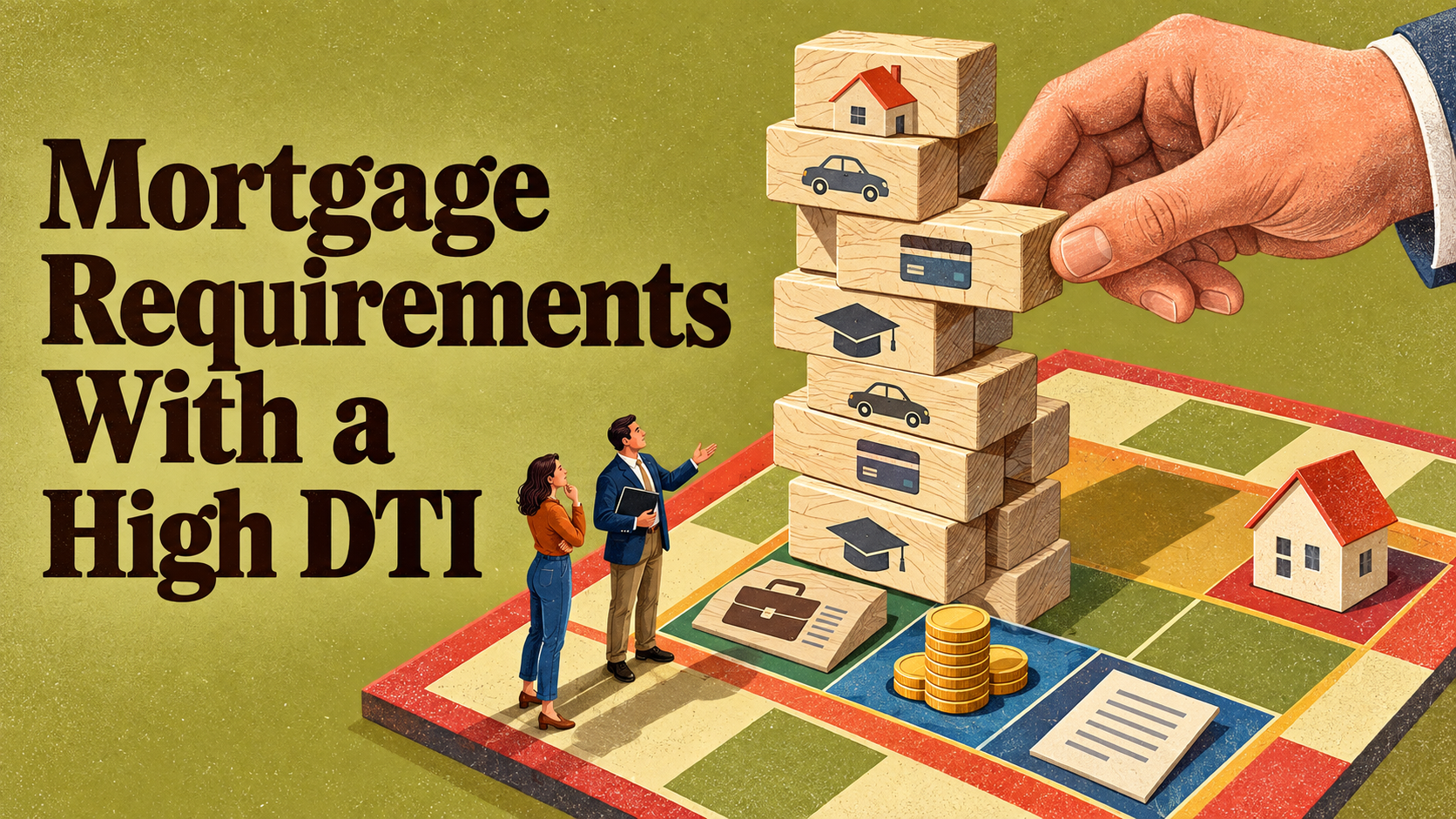
A high Debt-to-Income ratio, commonly shortened to DTI, can make mortgage approval more challenging, but it does not automatically mean a borrower cannot qualify.
DTI compares your monthly debt obligations with your qualifying gross monthly income. The higher the ratio, the more of your income is already committed to debt payments before a mortgage payment even enters the picture. A high DTI is genuinely one part of the mortgage qualification picture, not the entire picture. Credit history, credit score, income stability, assets and reserves, down payment, loan type, property type, payment history, and overall risk profile all matter alongside it, often referred to together as compensating factors. Different mortgage programs also treat DTI differently, which is exactly why there is no single universal maximum DTI that applies to everyone.
Disclaimer: This article is for general educational purposes only and is not a commitment to lend, financial advice, or a guarantee of mortgage approval. Mortgage requirements, DTI limits, underwriting standards, loan program guidelines, and qualifying methods can vary by loan type, lender, borrower circumstances, property, and applicable regulations. Examples in this article are hypothetical and are provided for educational purposes only. Always consult a licensed mortgage professional for guidance based on your specific situation.
Section 02
What Is DTI and Why Does It Matter for a Mortgage?
How DTI Is Calculated
The basic formula looks like this:
- DTI = Total Monthly Debt Payments ÷ Gross Monthly Income × 100
As an example:
- Gross monthly income: $10,000
- Monthly debt obligations: $4,500
- $4,500 ÷ $10,000 = 45% DTI
The income and debt figures used for mortgage qualification come from the lender’s own underwriting rules, which are not necessarily the same numbers you might use for your own personal budget.
If you want a broader breakdown of how DTI works, including what lenders may count as monthly debt and how the ratio can affect mortgage qualification, see our guide to Debt-to-Income Ratio (DTI).
Disclaimer: This is a hypothetical example for educational purposes only. Actual qualifying income, debts, and DTI calculations may differ based on loan program and lender guidelines.

Front-End DTI vs. Back-End DTI
Front-end DTI generally looks at housing-related obligations alone, while back-end DTI looks at your total monthly debt obligations combined. When people discuss a high DTI in the context of mortgage qualification, they are usually referring to the total, or back-end, DTI figure.
Why Lenders Care About DTI
If a large percentage of your qualifying income is already committed to debt, there may be less room left to absorb unexpected expenses or a change in income down the road. That said, a high DTI does not equal automatic denial. It simply means the rest of your application, and how well it holds together, may become more important to the overall decision.
Section 03
What Is Considered a High DTI for a Mortgage?
There Is No Single Universal High-DTI Threshold
What counts as high genuinely depends on the loan program, the lender, your borrower profile, the underwriting method used, your credit profile, your income characteristics, your reserves, the property itself, and other risk factors at play. It would not be responsible to present one number as a universal mortgage rule that applies the same way across every scenario.
Why a 43%, 45%, or 50% DTI Does Not Tell the Whole Story
It helps to think about different DTI levels as representing increasing underwriting complexity rather than hard pass-or-fail categories. A lower DTI generally means less of your monthly income is already committed to debt. A higher DTI generally means less room in your monthly budget. A very high DTI may require stronger overall qualification elsewhere, or it may simply not fit certain loan programs at all. No particular percentage can be said to guarantee approval or guarantee denial on its own.
High DTI Does Not Mean the Same Thing for Every Borrower
Picture two hypothetical borrowers with a similar DTI, but one has strong credit, a sizable down payment, healthy reserves, and stable income, while the other has thinner credit, a smaller down payment, limited reserves, and less predictable income. The DTI number alone cannot tell you which borrower is in a stronger position. It genuinely needs to be evaluated in context alongside everything else in the file.
Disclaimer: This is a hypothetical comparison for educational purposes only. Actual underwriting decisions depend on the complete borrower and loan profile.
Section 04
Mortgage Requirements With a High DTI
Borrowers with a high DTI generally need to pay closer attention to the complete qualification picture, since the other pieces of the file tend to carry more weight when the DTI itself is elevated.

Credit Score and Credit History
Credit score, payment history, recent late payments, collections, and bankruptcies or other major credit events where applicable all factor into the overall credit profile. A stronger credit profile can genuinely help when DTI is already high, though it does not automatically compensate for every other underwriting concern in the file.
Stable and Documentable Income
Income matters even more when DTI is elevated. W-2 income, salaried income, hourly income, bonus, commission, self-employment income, and multiple income sources combined can each require different documentation, and it is worth knowing that not every dollar of income automatically counts as qualifying income under a lender’s guidelines.
Down Payment and Available Assets
This covers your down payment, closing costs, reserves, documented assets, and the source of those funds. Having additional funds remaining after closing can be relevant to your overall financial picture, depending on the specific loan program involved.
Loan Program Eligibility
Not every mortgage program treats DTI exactly the same way. Conventional, FHA, VA, USDA, and other lender-specific or portfolio options each carry their own approach, which is covered in more detail further below.
Property and Occupancy
Underwriting also considers whether the property will be a primary residence, a second home, or an investment property, along with the property type, occupancy, and the overall transaction structure. The same borrower may face different qualification considerations depending entirely on which property and loan scenario is involved.
Section 05
Can You Get a Mortgage With a High DTI?
Yes, potentially. But that answer needs an immediate qualifier. A high DTI does not automatically make a mortgage impossible, but you still need to satisfy the applicable loan program and lender requirements that apply to your specific situation.
When a High DTI May Still Be Manageable
A high DTI tends to be more manageable within an overall profile that includes strong credit, stable qualifying income, substantial documented assets, healthy reserves, a clean payment history, a lower-risk property profile, and a loan program that genuinely fits the borrower’s situation.
When High DTI Becomes More Difficult
A high DTI combined with weak credit, unstable income, recent late payments, limited reserves, unexplained deposits, a high new housing payment, or several of these risk factors stacked together tends to make qualification considerably more difficult. Risk factors can compound rather than simply add up one at a time.
Section 06
How Lenders Evaluate a Borrower With High DTI
Income
Lenders determine your qualifying income through their own underwriting rules, which is not necessarily identical to simply taking your stated salary at face value.
Monthly Debt Obligations
Debts included in DTI calculations commonly include installment loans, revolving debt, student loans, auto loans, housing obligations, and other qualifying liabilities, though not every financial obligation is necessarily treated the same way across every program.
Credit Profile
Payment history and overall credit quality can meaningfully influence how a lender views your broader risk picture.
Assets and Reserves
Lenders may care about the funds remaining in your accounts after closing, since this can reflect how much of a cushion you have if something unexpected happens.
Loan-to-Value Ratio
A larger down payment generally leads to a lower loan-to-value ratio, which means more borrower equity in the property. It would be inaccurate, though, to suggest a lower LTV automatically overrides a high DTI on its own. For a deeper explanation of how LTV works and how your down payment affects this ratio, see our guide to Loan-to-Value Ratio.
Compensating Factors
Compensating factors are elements of your file that can strengthen your overall application, such as strong reserves, strong credit, stable income, a lower LTV, or a long and consistent payment history. These factors can meaningfully help, but they should not be thought of as something that simply cancels out a high DTI altogether.
Section 07
How Different Mortgage Programs May Treat High DTI
Conventional Mortgages
For standard Fannie Mae loans, the maximum total DTI is generally 36% for manual underwriting, or up to 45% when the required credit score and reserves are met. For loans underwritten through DU, the maximum is 50%. Approval still depends on the complete file and applicable lender requirements. For the current Fannie Mae requirements, you can also review the official Debt-to-Income Ratios guidance.
FHA Loans
FHA qualification runs on its own underwriting framework with its own DTI considerations, weighing credit, income, housing payment, total debt, and compensating factors where applicable, along with differences between automated and manual underwriting paths.
VA Loans
VA underwriting does not work like a simple DTI cutoff model. It places real weight on residual income, alongside credit, income stability, and your overall financial profile, making it meaningfully different from a straightforward DTI-based approach.
USDA Loans
USDA loans carry their own eligibility and underwriting requirements, including both income limits and property eligibility rules that sit alongside DTI considerations.
Non-QM and Portfolio Options
Some borrowers with more complex financial profiles may encounter lender-specific or alternative loan products. These alternatives can come with different rates, fees, documentation requirements, down payment requirements, and risk considerations, so they should not be viewed as some kind of automatic solution for a high DTI without understanding the full trade-offs involved.
Section 08
High DTI vs. Low DTI: What Changes in Mortgage Qualification?
| Factor | Lower DTI | Higher DTI |
|---|---|---|
| Income committed to debt | Lower | Higher |
| Monthly flexibility | Generally greater | Generally lower |
| Underwriting concern | Lower debt burden | Higher debt burden |
| Importance of overall profile | Important | Often even more important |
| Need to review loan options | Yes | Especially important |

The goal here is not simply to win by reaching some specific DTI number. The goal is to find a mortgage structure that genuinely fits your overall financial situation, whatever your DTI happens to be.
Section 09
Example: Buying a $500,000 Home With a High DTI
Borrower Profile
- Home price: $500,000
- Down payment: $50,000
- Gross qualifying income: $10,000 per month
- Existing monthly debt: $3,500
- New estimated housing obligation: $2,000
- Total monthly obligations: $5,500
- $5,500 ÷ $10,000 = 55% DTI
Why the DTI Alone Does Not Decide the Outcome
At 55% DTI, this purchase scenario exceeds Fannie Mae’s 50% DU limit. Strong credit or reserves do not override that limit. The borrower would need to reduce the qualifying DTI or be evaluated under a different eligible program with its own requirements.
What Could Change the Scenario
In one version, the borrower lowers their monthly debt before applying. In another, they bring a larger down payment to the table. In a third, their qualifying income looks different once documentation is reviewed. And in a fourth, a different loan structure entirely is used. Each of these changes can affect the overall qualification picture in its own distinct way, rather than simply moving one number up or down in isolation.
Disclaimer: This example is hypothetical and for educational purposes only. The payment, qualifying income, debt amounts, DTI, loan terms, and underwriting outcome are illustrative and do not represent an actual mortgage offer or guarantee of approval.
Section 10
How to Qualify for a Mortgage With a High DTI
Review Your Existing Debts Before Applying
List every monthly debt payment you currently have, along with the remaining balance, the monthly payment amount, the interest rate, when it matures, and whether it could realistically be paid off or reduced before you apply. Before speaking with a lender, you can use the Wonder Rates DTI Calculator to estimate your front-end and back-end DTI based on your income, housing payment, and monthly debts.
Avoid Taking on New Debt Before Closing
A new auto loan, a personal loan, a growing credit card balance, or a newly financed purchase can all shift your qualification picture in ways that are hard to undo once they happen.
Pay Down Debt Strategically
This does not mean emptying your savings just to lower your DTI. It is worth weighing the trade-off between lower monthly debt on one hand and your cash reserves, down payment, closing costs, and post-closing liquidity on the other.
Keep Documentation Clean
This connects directly back to your bank accounts, including large deposits, transfers, gift funds, business funds, foreign funds, and documentation for any side income you may have.
Discuss the Scenario With a Loan Officer Early
A Loan Officer can help you understand which debts actually matter, what income may qualify, what documentation will be needed, which loan programs may genuinely fit your profile, and what changes could meaningfully improve your application before you commit to anything.
Section 11
Can Paying Off Debt Lower Your DTI Before a Mortgage?
How Paying Off a Monthly Payment Can Change DTI
Consider a borrower with $10,000 in gross monthly income and $4,500 in monthly debt:
- $4,500 ÷ $10,000 = 45% DTI
If a $500 monthly debt payment is eliminated entirely:
- New monthly debt: $4,000
- $4,000 ÷ $10,000 = 40% DTI
Disclaimer: This is a hypothetical calculation for educational purposes only. Actual DTI calculations may differ based on which liabilities are included and how the lender calculates qualifying income and debt.
Paying Off Debt Is Not Always the Best Move
It is worth weighing cash reserves, closing costs, your down payment, your emergency fund, and the opportunity cost of using cash this way before deciding to pay something off purely to improve a ratio. Paying off everything you can before applying is not automatically the right advice for every borrower.
Section 12
Does a Larger Down Payment Help With High DTI?
What a Larger Down Payment Can Change
A larger down payment can lower your loan amount, lower your principal and interest payment, lower your LTV, and potentially lower mortgage insurance costs depending on the loan structure involved.
What a Larger Down Payment Does Not Automatically Fix
A larger down payment does not automatically erase your existing debts, eliminate a high DTI, guarantee approval, solve unstable income, or fix poor credit. It is one helpful lever among several, not a cure-all on its own.
Do Not Use All Your Cash Just to Lower DTI
Liquidity after closing matters just as much as the ratio itself. Spending every available dollar to push your DTI down can leave you financially exposed right at the moment you most need a cushion.
Disclaimer: This is a hypothetical example only. The appropriate down payment depends on the borrower’s loan program, financial position, cash reserves, and individual circumstances.
Section 13
Does High DTI Affect Mortgage Interest Rates?
DTI Is Not the Only Factor Behind Mortgage Pricing
Credit, LTV, loan type, occupancy, property, loan amount, market conditions, and lender-specific pricing all play a role in mortgage pricing alongside DTI.
Why High DTI Can Still Matter
Even if DTI does not function as a simple, direct rate penalty, it can still affect whether you qualify for a particular loan structure or pricing scenario in the first place, which indirectly shapes what rate options end up on the table.
Compare Mortgage Offers Using the Full Picture
It helps to compare interest rate, APR, points, lender credits, closing costs, monthly payment, and loan terms together, rather than fixating on a single rate number in isolation.
Section 14
Common Mistakes Borrowers With High DTI Make
Assuming a high DTI means automatic denial is too simplistic, since so much depends on the rest of the file. Assuming one DTI number applies to every loan overlooks how differently various programs and underwriting systems actually treat this ratio. Paying off debt without considering cash reserves forgets that a lower DTI is not the only financial goal worth protecting. Hiding debt or financial information from your lender only creates bigger problems later, since accurate disclosure is simply part of how the process works. Opening new credit before closing can change your qualification picture at the worst possible time. Waiting until underwriting to explain unusual deposits creates avoidable delays that earlier preparation could have prevented. And shopping only by interest rate, without understanding the loan structure behind it, can be genuinely misleading.
Section 15
How to Prepare for a Mortgage Application With a High DTI
In the thirty to sixty days before applying, it helps to review your credit, list out your monthly debts, review your bank accounts, gather your income documentation, identify any large deposits, estimate your available cash, and avoid taking on unnecessary new debt.
Before talking to a Loan Officer, it helps to have your recent pay information, bank statements, tax documents when applicable, debt information, asset information, and any details about additional income ready to go.
A few questions worth asking your Loan Officer directly include how your DTI is being calculated, which debts are included, which income sources can actually be used, what documentation will be needed, which loan programs may fit your profile, whether paying off a particular debt would materially change your qualification, and how much cash you should realistically keep on hand after closing.
Section 16
High DTI Does Not Mean You Should Automatically Wait to Buy
There are really two separate questions worth sitting with here. Can I qualify? And can I comfortably afford this payment? A borrower might technically qualify for a mortgage while still needing to think carefully about whether that payment genuinely fits their broader financial life, including emergency savings, maintenance costs, property taxes, homeowners insurance, HOA dues where applicable, future income changes, and other financial goals sitting alongside homeownership.
Section 17
Mortgage Requirements With a High DTI: What Borrowers Should Remember
A high DTI does not automatically mean mortgage denial. There is no single DTI number that applies to every borrower and every loan. The loan program you choose genuinely matters. Credit, income, assets, reserves, LTV, and property all play a role together. Paying down debt may help, but your cash reserves matter just as much. A larger down payment can change the loan structure without solving every qualification issue on its own. Accurate documentation is critical throughout. And speaking with a Loan Officer early can help identify the strongest realistic path forward.
If your DTI is higher than you expected, the first step does not have to be giving up on buying altogether. Start by understanding how your numbers are actually being calculated and which parts of your financial profile may genuinely be improved before you apply.
If you want to understand how your actual income, debts, credit, and loan options may work together, you can get started with Wonder Rates and speak with a licensed mortgage professional about your scenario.
Section 18
Disclaimer
This article is for general educational purposes only and is not a commitment to lend, financial advice, or a guarantee of mortgage approval. Mortgage requirements, DTI limits, underwriting standards, loan program guidelines, and qualifying methods can vary by loan type, lender, borrower circumstances, property, and applicable regulations. Examples in this article are hypothetical and are provided for educational purposes only and do not represent an actual mortgage offer or guarantee of approval. Always consult a licensed mortgage professional for guidance based on your specific situation.
Duc Pham, Mortgage Broker | NMLS# 844897, Wonder Rates, Inc. | NMLS# 1518655 | DRE# 02047445 | DFPI# 60DBO-59134 | Equal Housing Opportunity. Equal Housing Lender. | Licensed in: AL, AZ, CA, CO, FL, GA, LA, MI, NC, OH, OK, OR, PA, SC, TX, VA, WA.