
Section 01
A self-employed mortgage after a bad tax year may still be possible, but the lender must understand whether the decline was temporary, stabilized, or continuing. Qualification depends on usable income, business viability, debts, assets, credit, documentation, and the selected loan program rather than gross business revenue alone.
One difficult year does not tell the entire story. A business may have absorbed expansion costs, lost a temporary contract, changed locations, purchased equipment, or experienced an industry slowdown. At the same time, a borrower should not expect a lender to ignore a meaningful downward trend simply because current sales feel stronger.
Section 02
What Counts as Self-Employment for Mortgage Review?
Mortgage programs may treat a borrower as self-employed when the person owns a significant interest in a business or earns income that requires self-employment analysis. The exact definition and documentation depend on the program and ownership structure.
Common examples include sole proprietors, partners, S corporation or corporation owners, independent contractors, and owners of multiple businesses. A borrower can also have both W-2 employment and self-employment income.
The lender evaluates each income source under the applicable method. A successful business does not automatically mean all cash flowing through its account is personal qualifying income.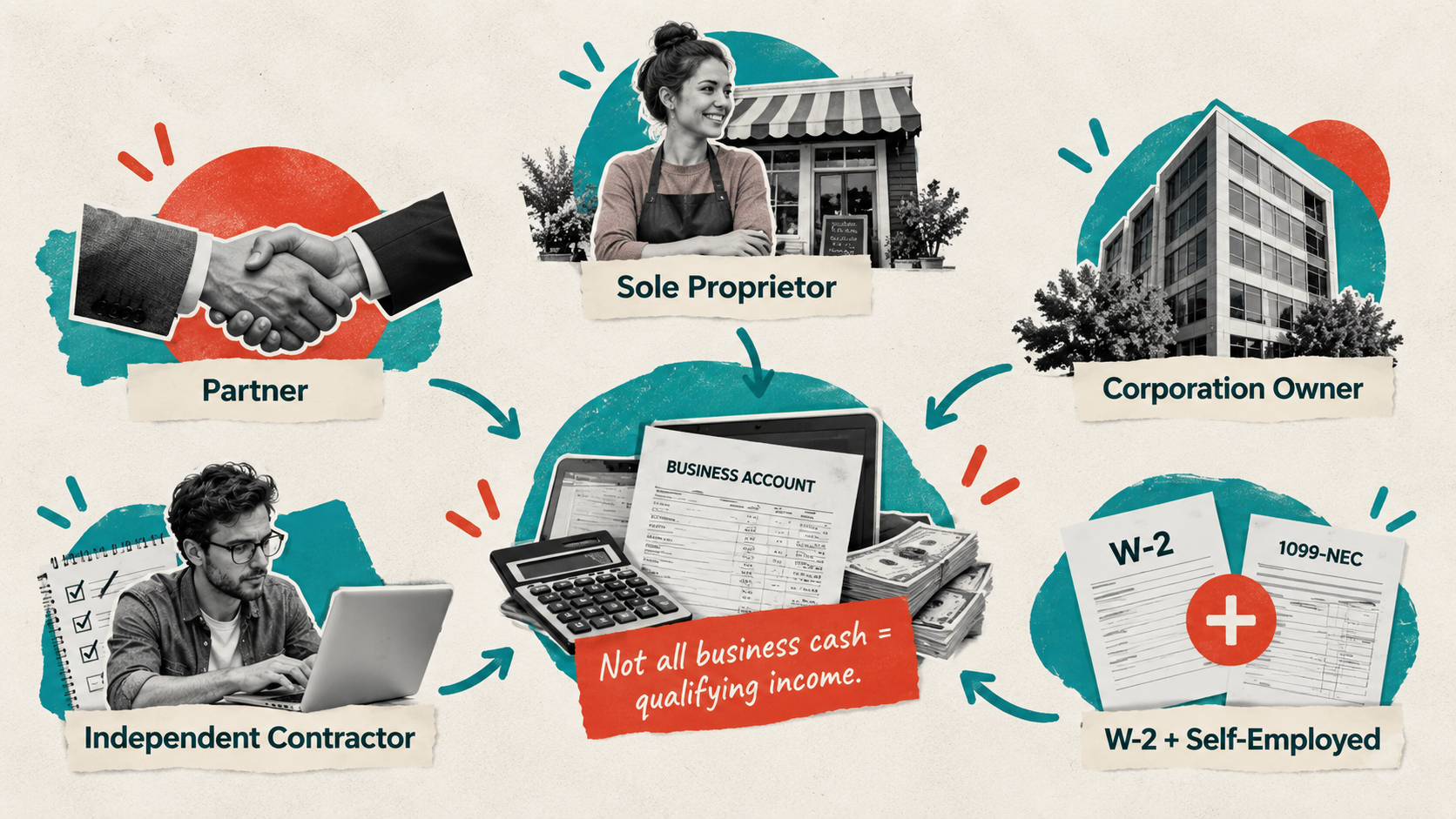
Section 03
Why a Bad Tax Year Can Affect a Self-Employed Mortgage
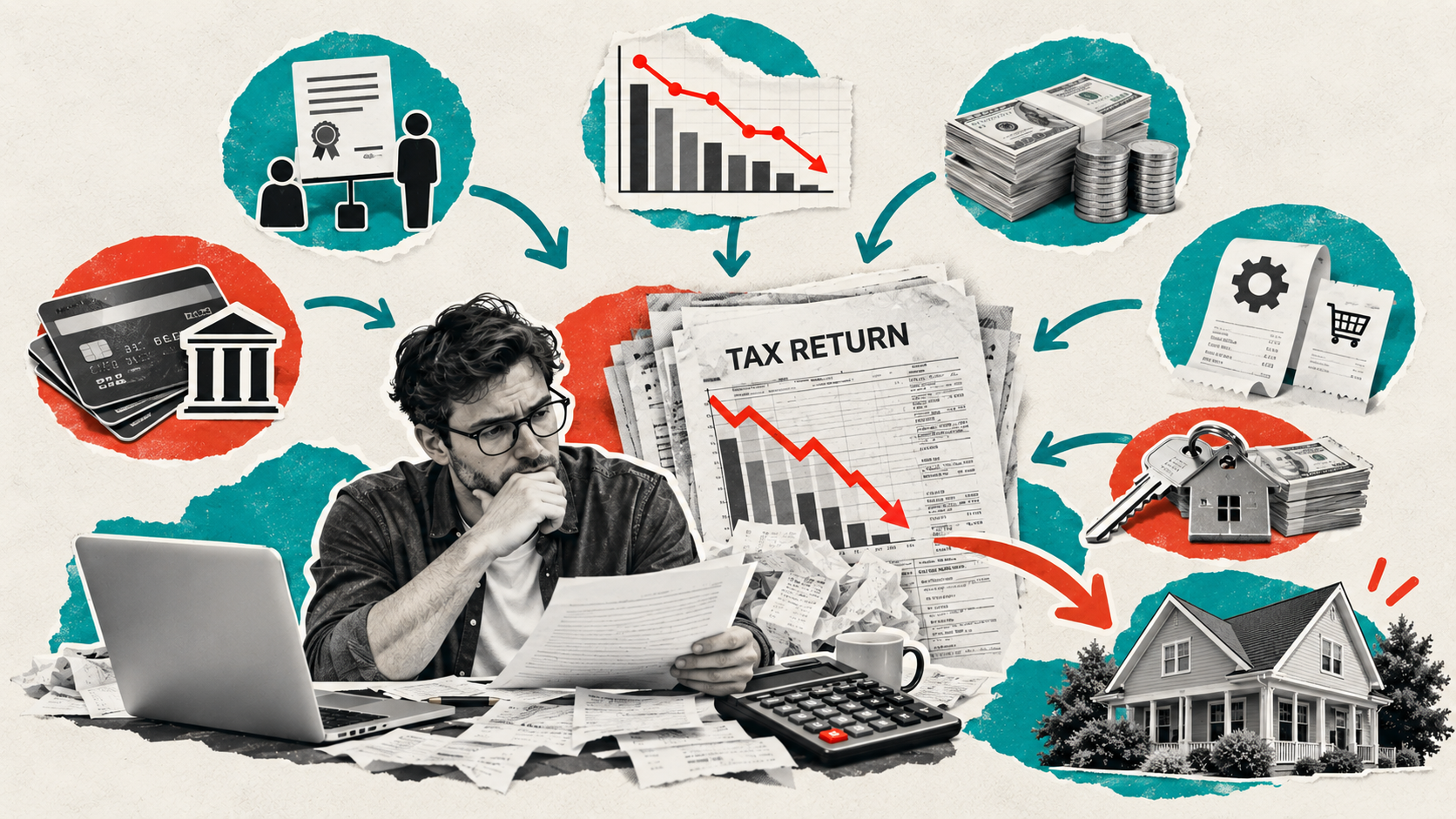
Tax returns help the lender analyze earnings, expenses, ownership, and trends. Business deductions may legally reduce taxable income, but they can also reduce the income available for mortgage qualification unless an expense is eligible for a permitted adjustment.
Fannie Mae’s self-employed borrower guidance explains that lenders analyze business viability and income trends using tax returns and other documentation as applicable.
The analysis may consider:
- Length of self-employment
- Ownership percentage and business structure
- Historical and current earnings
- Whether income is stable, increasing, or decreasing
- Business liquidity and obligations
- Recurring versus one-time expenses
- The effect of business debt paid personally
- Whether business funds are needed for closing
Section 04
Temporary Setback or Continuing Decline?
The story must be supported by evidence. A temporary disruption followed by documented recovery can look different from several periods of declining revenue and shrinking liquidity.
Possible supporting documents may include year-to-date profit-and-loss statements, balance sheets, recent business bank statements, signed contracts, evidence of insurance proceeds, proof of a completed relocation, or documentation showing that a one-time expense will not recur.
These documents do not guarantee that prior losses will be disregarded. They help the underwriter evaluate the current picture under the loan program’s rules.
Section 05
Gross Revenue Is Not Qualifying Income
A salon may collect substantial customer payments while also paying rent, employees, supplies, insurance, equipment, and taxes. A restaurant may have strong sales but thin net income. A real estate professional may have high commissions and equally significant business expenses.
Qualifying income is calculated from acceptable documentation, not from deposits alone. Avoid comparing annual revenue with a salaried employee’s wages as if they were equivalent.
Section 06
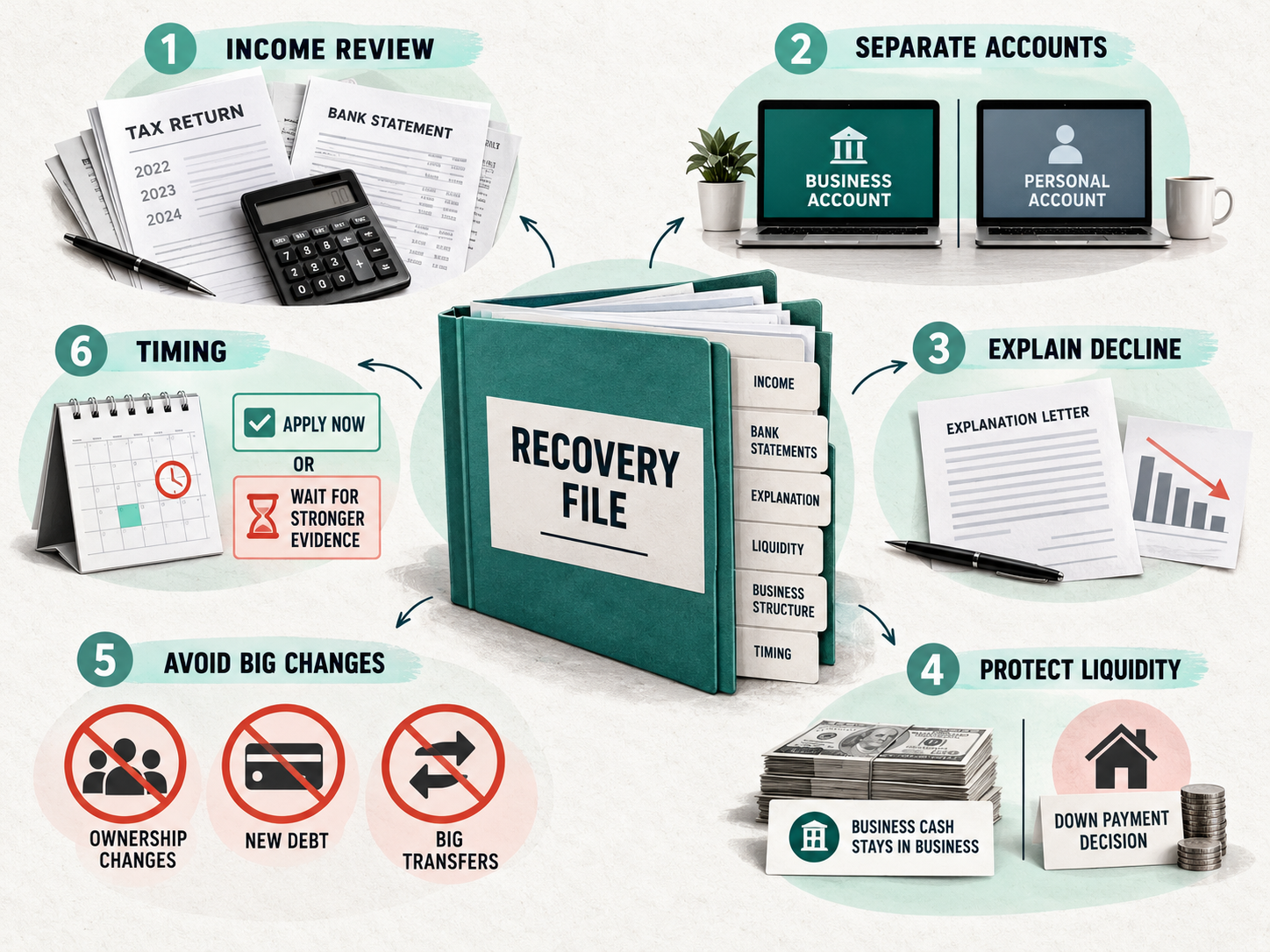
Build a Credible Recovery File Before Applying
Start with an honest income review
Gather filed personal and business returns, current financial statements, bank statements, debt schedules, and ownership documents. Identify where the decline occurred and whether it continues.
Separate business and personal activity
Mixed accounts can make analysis harder and create unexplained transfers. Maintain clear records showing business revenue, expenses, owner distributions, and personal funds.
Explain the decline with documents
A concise letter can provide context, but it should match the records. State what happened, when it happened, what changed, and why current performance may be more stable. Avoid exaggerated claims.
Protect business liquidity
Using business funds for a down payment can require analysis of whether the withdrawal harms operations. Before moving funds, ask what documentation will be required.
Avoid major undocumented changes
Opening a new entity, changing ownership, taking on business debt, or moving large sums during underwriting may create new questions. Discuss planned changes with the lender.
Choose timing based on evidence
Sometimes the best next step is applying now. In other cases, additional filed history or a longer period of stable earnings may produce a clearer file. A responsible review should distinguish between those situations.
Section 07
What Not to Do Solely to Qualify
Do not amend a tax return, omit a debt, create a false contract, inflate a profit-and-loss statement, or temporarily deposit borrowed money while describing it as business revenue. Mortgage documents must be accurate.
Do not assume that a bank-statement or alternative-documentation program eliminates verification. Programs have different requirements, costs, and risk standards. The lender still evaluates ability to repay and the complete transaction.
Section 08
Using Business Funds for Closing
Business funds may be acceptable in some transactions, but the lender may need to confirm ownership, access, and the effect of the withdrawal on the business. A large withdrawal that leaves the company unable to pay ordinary obligations can create concern.
If a homeowner is considering equity for business liquidity, Cathryn’s comparison of a refinance with a HELOC explains structural differences. Access to equity is not guaranteed, and using a home to support a business adds risk that should be evaluated carefully.
Section 09
Documents That May Be Requested
Depending on the program and file, documentation may include:
- Personal and business federal tax returns
- IRS transcripts or transcript authorization
- Year-to-date profit-and-loss statement
- Business balance sheet
- Business bank statements
- Evidence of ownership and business existence
- K-1 forms and business schedules
- Documentation of one-time expenses
- Letters explaining material changes
- Verification of current business activity
Requirements vary. Do not treat this list as universal or complete.
Section 10
Three Examples of How the Same Decline Can Look Different
Consider three business owners who each reported lower income last year. The first expanded into a second location, paid one-time opening expenses, and now has documented contracts and stable current deposits. The second lost a major client and has not replaced the revenue. The third reduced work temporarily for a medical or family reason and has since resumed normal operations.
The tax-return decline may appear similar, but the current risk is not identical. The lender needs documents that separate a temporary event from a continuing problem. A letter alone cannot establish recovery, and strong current deposits do not automatically replace the required income calculation.
Borrowers should also distinguish business cash from personal income. Money retained for payroll, inventory, taxes, or operating expenses may not be freely available for a home purchase. Withdrawing it could weaken the business that produces the qualifying income.
Section 11
Pre-Approval Questions for a Business Owner
- Which tax years and business returns will be reviewed?
- Is year-to-date financial reporting required?
- How will the decline be analyzed?
- Are any expenses potentially eligible for an adjustment?
- Will using business funds require a liquidity analysis?
- Does the business pay debts appearing on personal credit?
- Are distributions consistent with ownership and earnings?
- Would waiting for another reporting period materially change the review?
An early conversation should produce a document plan, not a promise. It also gives the borrower time to involve the tax preparer or bookkeeper without asking those professionals to alter accurate records.
Section 12
Frequently Asked Questions
Can current revenue replace a weak tax return?
Current results can provide important context, but whether and how they are used depends on the program, documentation, and income trend.
Do tax write-offs always hurt qualification?
Business expenses generally reduce taxable income. Certain noncash or permitted items may receive specific treatment, but not every deduction can be added back.
Can I qualify with one year of self-employment?
Some scenarios may allow a shorter history when applicable requirements are met, while others require more history. Prior experience and the overall file may matter.
What if I own several businesses?
The lender may need to analyze each business and determine how income, losses, debts, and cash transfers affect the borrower.
Should I wait until next year’s return is filed?
It depends on whether current acceptable documentation supports stable income and whether a new filing would materially clarify the trend. Review both timelines before deciding.
Section 13
Final Takeaway
A self-employed mortgage after a bad tax year requires more than a good explanation. The lender needs consistent documents showing what caused the decline, whether income has stabilized, and whether the business can continue supporting the borrower. Early review gives the borrower time to correct recordkeeping, protect liquidity, and choose a realistic application date.
Duc Pham, Mortgage Broker | NMLS# 844897
Wonder Rates, Inc. | NMLS# 1518655
Equal Housing Lender.
AZ, CA, CO, FL, GA, LA, MI, OK, PA, SC, TX, VA, WA, OH, AL, OR, NC
This article is for educational purposes only and is not a commitment to lend, tax advice, or business advice. Loan approval is subject to creditworthiness, acceptable income verification, assets, property eligibility, and current underwriting guidelines. Documentation requirements, loan programs, interest rates, and lender fees may change without notice. Consult qualified tax and financial professionals about your circumstances.