

Section 01
Already own a home and thinking about using your VA loan benefit to buy another one? The question that actually matters here usually isn’t “does VA allow no down payment.” It’s something more specific: if you keep your current home and rent it out, how does a lender actually treat that existing mortgage, the rental income, your remaining entitlement, and the occupancy requirement on the new property, all at the same time?
This article walks through that exact scenario, from remaining entitlement, to how rental income and rental offset work differently than most people expect, to occupancy rules, to a California-specific program worth knowing about if you’re shopping in this state.
Section 02
Can You Get a VA Loan If You Already Own a Home?
Yes. VA loans are not limited to first-time homebuyers, and already owning a home does not automatically disqualify you from using your VA home loan benefit again. The VA allows eligible borrowers to use this benefit multiple times, depending on your remaining entitlement and the specifics of the transaction.
That said, there’s an important distinction worth understanding upfront. Buying a new home with a VA loan still requires you to meet the occupancy requirement. For a VA purchase loan, the Veteran must intend to personally occupy the new property as their primary residence. VA guidance generally treats occupancy within 60 days after closing as reasonable, though a documented future event can support a longer timeline in specific circumstances.
So the scenario of keeping your current home as a rental while buying a new home to move into isn’t automatically disqualifying. It’s a situation that needs to be properly analyzed by your lender rather than something you should assume will work or won’t work without asking.
Example: An active-duty service member currently owns a home. The family plans to keep that home and rent it out after moving into a new home, which they intend to use as their primary residence. This is a hypothetical example for educational purposes only. Whether a specific borrower can use a VA loan in this situation depends on remaining entitlement, occupancy, underwriting, income, liabilities, and other applicable VA and lender requirements.
Section 03
The First Question Is Not "Can I Get 0% Down?"
VA home loans are widely known for allowing no down payment in many cases. The VA confirms that a VA-backed purchase loan can allow no down payment when applicable requirements are met.
But if you’ve already used your VA loan benefit before, or currently have a VA loan, the first question worth asking yourself isn’t whether VA offers 0% down. It’s how much VA entitlement you actually have left.
If you have full entitlement, the VA states there is no county loan limit on the guaranty itself. That does not mean approval is automatic, though. The lender still has to approve the loan based on your finances, and the appraisal still has to support the purchase price. If your entitlement isn’t fully restored, your remaining entitlement becomes a genuinely important factor in determining your next loan amount and whether a down payment might be required.
Example: Suppose a borrower wants to purchase a new home around $780,000. It would be a mistake to jump straight to the conclusion that $780,000 times 0% simply equals $0 down. Before reaching that conclusion, you’d need to know whether the borrower currently has a VA loan, how much entitlement has already been used, how much remains, and how the lender will underwrite the loan overall. This example is hypothetical and does not represent a VA loan limit or an approval amount. Actual financing depends on entitlement, credit, income, liabilities, appraisal, and lender underwriting.
Section 04
What Happens to Your Current Mortgage If You Keep Your Old Home?
If you keep your current home, the existing mortgage payment on it doesn’t disappear just because you intend to rent the property out. This is a genuinely important point in how a lender approaches your qualification.
Example: A borrower’s current home carries a mortgage payment of $2,800 per month, while the projected payment on the new home is $5,000 per month. Without accounting for rental income in some way, the lender has to factor in the obligation from the old home alongside every other monthly debt when evaluating the borrower’s overall ability to repay. This example uses simplified, hypothetical numbers for illustration only and does not represent an actual underwriting calculation.
This is exactly why rental income, and specifically how it’s treated, becomes such an important part of this kind of scenario. VA’s Lender’s Handbook includes specific guidance on rental offset for a property the Veteran currently occupies before purchasing the new home, which is covered in detail in the next section.
Section 05
How Does VA Rental Income Offset Work?
This is really the core concept of the entire article, and it’s also the part most people misunderstand.
It’s worth drawing a clear line between two things that sound similar but are treated very differently in VA underwriting: rental income used as qualifying income, and rental income used as a rental offset.
VA’s current Lender’s Handbook specifically addresses the situation where a borrower rents out the property they occupied before moving into a new home. Under the applicable rental-offset analysis, prospective rental income may be used to offset the mortgage payment on that existing property, rather than simply being added to the borrower’s income without limits.
What Does “Offset” Actually Mean?
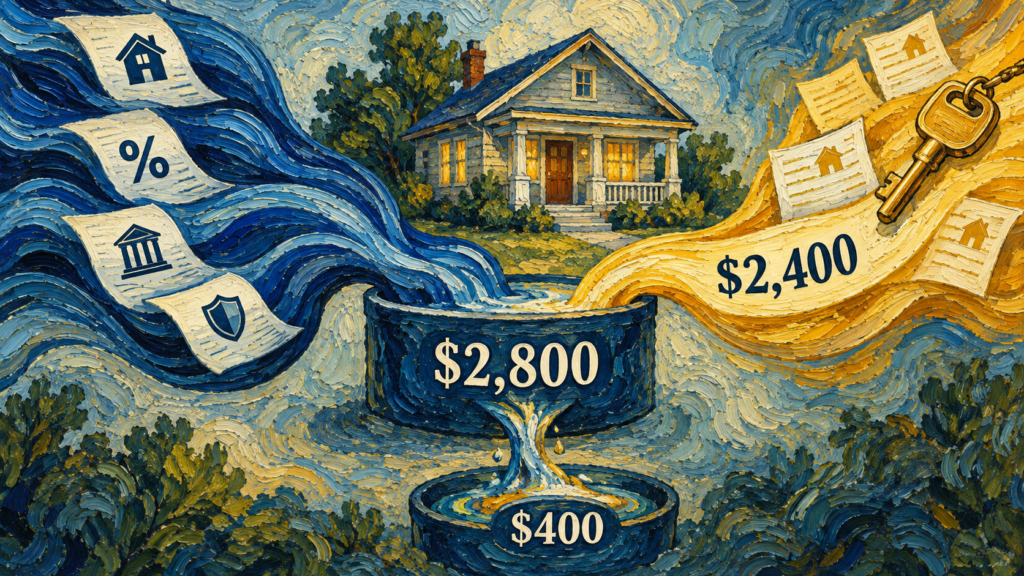
Example: A borrower’s current home has a mortgage payment, including principal, interest, taxes, and insurance, of $2,800 per month. The property has the potential to rent for $2,400 per month. Under the applicable offset treatment, if the scenario meets the required conditions, that rental income may be used to offset the mortgage payment on the old property in the underwriting analysis, rather than being added on top of the borrower’s income as a separate stream. This is meaningfully different from what many borrowers assume, which is that the full $2,400 simply gets added to their income. VA’s handbook specifically distinguishes rental offset from effective income, and in this departing-residence example, rent above the mortgage payment generally is not counted as effective income under that offset treatment. If you’re also trying to understand when rental income can be counted toward mortgage qualification, see our guide to how rental income is treated when applying for a mortgage. This example simplifies the underwriting concept for illustration. It does not predict how a particular lender will calculate any specific borrower’s qualifying income or liabilities.
Section 06
What Does the Lender Need to Document the Rental Income?
After understanding how offset works, the natural next question is whether simply telling your lender you plan to rent out the home is enough. It isn’t.
VA guidance requires documentation and verification to determine the likelihood that rental income will actually continue. For a departing residence specifically, the handbook calls for a rental agreement where one exists, and allows prospective rental income to be used for offset purposes under specified conditions, including consideration of the local rental market rather than just the borrower’s own estimate.
If rental income from the property is instead being used under different income rules, documentation requirements can include tax returns or tax transcripts and reserves, depending on the specific situation. The current VA handbook identifies documentation that can include three months of PITI reserves and two years of tax returns or tax transcripts for rental-property income verification in the applicable context.
The point worth remembering here: believing your home can rent for $3,000 is not documentation on its own.
Example: A borrower tells their loan officer their home will definitely rent for $3,200 because a neighboring property is currently renting at that price. This might be useful context for the conversation, but it shouldn’t be assumed that $3,200 will automatically be the figure the lender uses to qualify the borrower. Documentation requirements vary by the specific underwriting scenario and lender overlays. This example is illustrative and should not be treated as a complete document checklist.
Section 07
Why the Current Home's Mortgage Payment Still Matters
This connects the rental offset discussion directly to your broader debt-to-income picture.
A lender isn’t only asking how much income you have. They’re also asking how much you owe every month, across everything. If you’re carrying a current mortgage, a car payment, credit card debt, a student loan, other recurring obligations, and your proposed new housing payment, all of that together forms the complete picture a lender uses to evaluate your ability to repay. Understanding how your debt-to-income ratio works, and how each of these pieces factors into it, is worth exploring further if this is new territory for you. If you’re not familiar with how lenders calculate DTI or which monthly obligations may count toward it, see our guide to Debt-to-Income Ratio (DTI). If you want to get a quick estimate of how your existing debts and proposed housing payment affect your DTI, you can also try the Wonder Rates DTI Calculator.
Section 08
VA Loan Occupancy Matters When You Keep Your Current Home
This section matters because a lot of borrowers assume that already owning a home automatically turns the new purchase into an investment property in VA’s eyes. That’s not necessarily the case.
A VA purchase loan requires the Veteran to certify their intent to personally occupy the new property as their home. VA guidance generally treats occupancy within 60 days after closing as reasonable, though specific circumstances, such as a documented future event, can support a longer period under the applicable rules.
So the situation where your old home becomes a rental and your new home becomes your primary residence is genuinely different from a situation where your old home stays your primary residence and the new home is purchased purely as an investment property. That distinction matters quite a bit for how the transaction is structured and underwritten.
Example: A military family is transferring to a new duty station and wants to keep their current home as a rental property, then purchase a new home near the new duty station and move into it as their primary residence. This scenario is meaningfully different from purchasing a new home solely as an investment. This is an illustrative scenario only. Occupancy requirements are fact-specific and should be reviewed directly with the lender handling the VA transaction.
Section 09
Buying a $750K to $800K Home With a VA Loan
Rather than simply asking whether an $800,000 purchase price is allowed under VA guidelines, it’s more useful to understand that purchase price does not automatically equal loan approval.
If a borrower has full entitlement, the VA states there is no county loan limit on the guaranty. That doesn’t mean the borrower automatically qualifies for any purchase price they’d like. The lender still has to approve the loan, and the property still has to support the purchase price through the appraisal process, just as it would for any other loan.
For a purchase in the $750,000 to $800,000 range specifically, a lender will still be looking at income, credit, existing debts, how the current mortgage and rental situation is treated, remaining entitlement, residual income, available assets, the appraisal, and the proposed new housing payment, all together.
Example: A borrower is purchasing a home for $780,000 with a potential $0 down payment, while keeping their existing home as a rental. This is not simply a formula where VA equals zero down equals automatic approval. It’s a scenario that requires full underwriting of the borrower’s complete financial picture. The $780,000 purchase price is hypothetical. Zero down is not a guarantee of approval, and actual eligibility and loan terms depend on the borrower’s individual circumstances and lender requirements.
Section 10
What Is Residual Income and Why Does It Matter for VA Loans?
This concept is worth understanding on its own, since it’s part of what makes VA underwriting genuinely different from a typical conventional mortgage conversation, and it keeps this article from becoming purely a DTI discussion.
VA underwriting doesn’t rely on debt-to-income ratio alone. Residual income is also a meaningful part of VA credit underwriting. The basic idea: after paying debts and housing expenses, how much money does the household actually have left to cover everyday living costs, things like food, transportation, and other essentials that don’t show up as a line-item debt?
This is one of the reasons VA loan analysis can look different from what borrowers are used to seeing with a conventional mortgage, where DTI often takes center stage.
Example: Two households both have $12,000 in gross monthly income and roughly similar DTI ratios on paper. But different household sizes and different other financial obligations can leave one household with meaningfully more or less residual income than the other, even though their top-line numbers look similar. This is a simplified conceptual example, not a VA underwriting calculation or an approval threshold.

Section 11
What About CalHFA VA?
This is worth knowing about if you’re purchasing in California specifically, though it’s a distinct program rather than the main focus of most VA loan scenarios.
CalHFA currently offers a CalHFA VA Program, a VA-insured 30-year fixed-rate first mortgage offered through CalHFA-approved lenders. CalHFA states that borrowers must occupy the property as their primary residence, meet applicable CalHFA income limits, and present a valid VA Certificate of Eligibility.
It’s worth being clear about one thing: CalHFA VA is not simply “a VA loan plus an extra perk.” It’s a program with its own requirements layered on top of VA guidelines. CalHFA itself notes that where its guidelines conflict with VA’s, the lender has to follow whichever requirement is more restrictive.
Why Should Borrowers Ask About CalHFA Early?
Eligibility can depend on income limits, program-specific requirements, property requirements, whether your lender actually participates in the program, your VA eligibility, and occupancy. CalHFA maintains a list of approved lenders, and only those approved lenders can originate CalHFA programs, so it’s worth confirming this early rather than assuming any VA lender can offer it.
Example: An active-duty borrower in California hears about CalHFA VA and wants to know more. Instead of only asking what the rate is, it’s worth asking whether their household income falls within the program’s limits, whether the property meets the program’s requirements, and whether their loan officer actually offers CalHFA VA at all. CalHFA program eligibility, income limits, and program requirements can change over time. This example is for educational purposes and does not determine eligibility for any specific borrower.
Section 12
What Should You Ask a VA Loan Officer Before Applying?
A handful of specific questions can save you real time and frustration later in the process.
Do You Regularly Handle VA Loans?
Rather than simply asking whether a loan officer does VA loans at all, it’s worth asking how many VA files they typically handle in a given month. Volume tends to correlate with familiarity with the nuances covered throughout this article.
How Would You Analyze My Current Home?
This is arguably the most important question for this exact scenario. Ask directly: “I want to keep my current home and rent it out. How will you handle the current mortgage and the rental income in my qualification?”
Will You Use Rental Income or Rental Offset?
Don’t assume these two concepts are interchangeable, since they clearly aren’t, as covered earlier. Ask how rental income will specifically be treated in your particular scenario.
How Will My VA Entitlement Be Calculated?
This matters especially if you’ve used your VA loan benefit before, since your remaining entitlement can meaningfully affect your next transaction.
Do You Handle CalHFA VA?
Worth asking directly if you’re purchasing in California and think this program might apply to your situation.
What Documents Should I Prepare Before Preapproval?
Getting ahead of documentation requirements early helps you avoid the frustrating experience of being asked for something new every few days as your file moves through underwriting.
Section 13
A VA Loan Scenario Can Be More Complicated Than "0% Down"
It can help to see the whole picture laid out as a sequence. You already own a home. You want to keep it. You plan to rent it out. That requires a rental income or rental offset analysis. You need to check your remaining VA entitlement. You need to think through occupancy for your new primary residence. Your income, debts, and residual income all need to be underwritten together. And finally, the appraisal and loan terms need to be reviewed against everything else.
Taken together, this shows why VA loans can open up genuine possibilities for buying a home with little or no down payment in qualifying situations, but “0% down” is really only one piece of a considerably larger picture.
Section 14
Final Takeaway
If you’re active duty, already own a home, and are considering keeping that home as a rental while buying a new one with a VA loan, don’t stop at asking whether VA allows 0% down.
Ask how much entitlement you actually have remaining, how your old home will be treated in underwriting, how rental income can be used in your specific scenario, what occupancy will look like for your new home, and how your complete monthly obligations will ultimately be underwritten together.
A loan officer who regularly works with VA scenarios like this one can help you see the whole picture from the very start of preapproval, rather than leaving you to discover a documentation requirement or an overlooked constraint only after you’ve already found the new home you want to buy.
Section 15
Sources
- U.S. Department of Veterans Affairs, VA Home Loans, Purchase & Cash-Out Refinance Home Loans
- U.S. Department of Veterans Affairs, VA Home Loan Entitlement and Loan Limits
- U.S. Department of Veterans Affairs, VA Pamphlet 26-7, Lender’s Handbook
- U.S. Department of Veterans Affairs, VA Pamphlet 26-7, Chapter 3: The VA Loan and Guaranty
- CalHFA, CalHFA VA Program
- CalHFA, Approved Lenders
This article is for general educational and informational purposes only and does not constitute mortgage, financial, legal, tax, or investment advice. VA home loan eligibility, entitlement, occupancy requirements, rental income treatment, residual income analysis, documentation requirements, and lender underwriting standards may vary based on the borrower’s circumstances and applicable VA and lender guidelines. CalHFA programs have additional eligibility requirements that may change over time. All examples, purchase prices, rental amounts, mortgage payments, and scenarios in this article are hypothetical and are provided solely to explain general concepts. They are not guarantees of loan approval, loan amount, interest rate, rental-income treatment, or eligibility. Borrowers should verify current VA and CalHFA requirements with the applicable program and a qualified mortgage professional before making financial decisions.
Duc Pham, Mortgage Broker | NMLS# 844897, Wonder Rates, Inc. | NMLS# 1518655 | DRE# 02047445 | DFPI# 60DBO-59134 | Equal Housing Opportunity. Equal Housing Lender. | Licensed in: AL, AZ, CA, CO, FL, GA, LA, MI, NC, OH, OK, OR, PA, SC, TX, VA, WA.