

Section 01
When people go house hunting in the U.S., they usually focus on the obvious things: how many bedrooms, how large the kitchen is, whether there is a garage, and how much the house costs.
But sometimes one of the most useful features is sitting behind the main house.
An Accessory Dwelling Unit, commonly called an ADU, is a separate living space located on the same property as a primary home. Depending on the property and local rules, an ADU can provide space for an aging parent, an adult child, guests, a home office, or a tenant.
ADUs have also become increasingly relevant to mortgage planning because some loan programs allow qualifying rental income from an ADU to be considered in certain situations. That does not mean every dollar of expected rent automatically counts toward mortgage qualification. The property’s legal status, appraisal, documentation, transaction type, and loan program all matter.
If you are considering buying a home with an ADU, the first step is understanding what actually qualifies as an ADU and what that feature means for the property, your financing, and your future plans.
Section 02
What is an ADU?
An ADU, or Accessory Dwelling Unit, is an additional living unit located on the same property as a primary residence.
The exact legal definition varies by jurisdiction, but mortgage guidelines provide a useful framework. Fannie Mae describes an ADU as an additional living area that is independent from the primary dwelling and provides living, sleeping, cooking, and bathroom facilities. It must be located on the same parcel as the primary one-unit dwelling.
An ADU may be:
- Detached from the main house
- Attached to the main house
- Located inside the primary residence, such as a basement apartment
- Built over or within a garage
- Created from another part of the existing structure
The important distinction is that an ADU is an additional dwelling unit, not simply an extra bedroom or finished room.
A finished basement with a bedroom and bathroom is not automatically an ADU. Whether it qualifies depends on the property’s layout, applicable building and zoning requirements, and the standards used by the relevant lender and appraisal process.
An ADU is also not a separate parcel of real estate. The main home and ADU remain on the same lot unless the property has been legally subdivided into separate parcels under applicable local rules.
Section 03
What Does an ADU Usually Include?
A qualifying ADU is generally designed to function as an independent living space.
Depending on the property and local requirements, it may include:
- A living or sleeping area
- A kitchen or cooking facilities
- A bathroom
- A separate entrance
- Its own utilities or utility connections
- A layout that provides reasonable privacy from the primary residence
Not every ADU has exactly the same layout. Some are small detached structures in the backyard, while others are located above a garage or inside the main home.
Fannie Mae’s current ADU guidance specifically notes that the unit must be accessible without going through the primary residence and that there must be some expectation of privacy from the main home.
That distinction can matter when you are evaluating a property for both real estate and mortgage purposes.
Section 04
Common Types of ADUs
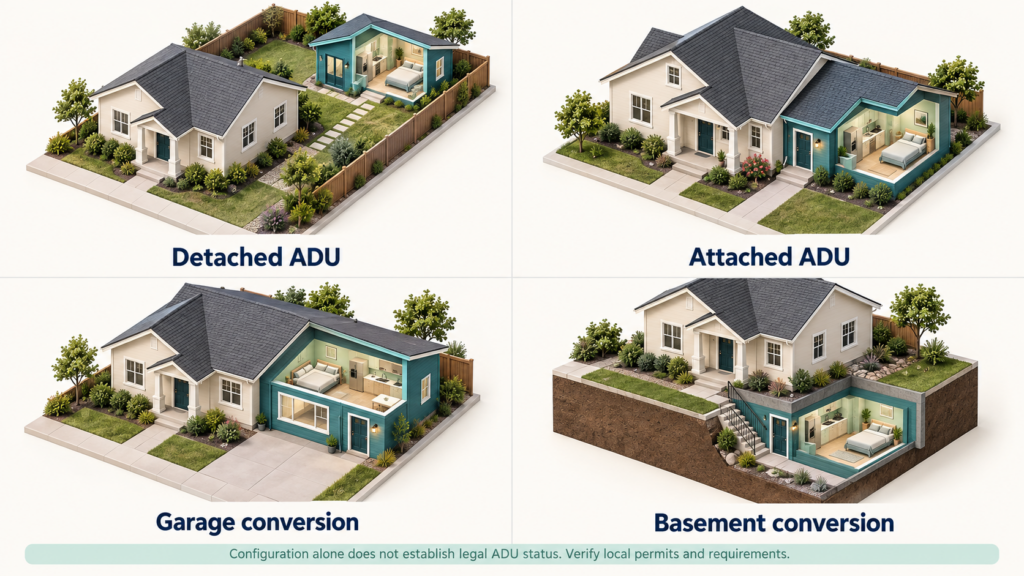
Detached ADU
A detached ADU is physically separate from the primary residence. It may sit in the backyard, beside the main house, or in another permitted area of the lot.
Because the two living spaces are physically separated, detached ADUs can offer a higher degree of privacy. This can make them useful for multigenerational households or long-term rental arrangements.
However, detached does not automatically mean legally rentable or mortgage-eligible. Local zoning, permits, building requirements, and the property’s actual use still need to be evaluated.
Attached ADU
An attached ADU is connected to the primary residence while functioning as a separate living area.
For example, an ADU could be built as an addition to the side of the house or incorporated into part of the existing structure. An attached unit may be practical for families who want separate living areas without placing another structure at the back of the property.
The construction and utility arrangement can vary significantly from one property to another, so buyers should not assume that an attached ADU has the same requirements as a detached unit.
Garage or Basement Conversion
Some ADUs are created by converting an existing garage, basement, or other portion of a home.
This can be an efficient way to create additional living space because part of the existing structure is already there. But the fact that a space has been converted does not automatically make it a legal ADU.
A garage conversion may need to meet local requirements for permits, occupancy, fire safety, access, utilities, and other building standards. A basement conversion can raise similar questions.
If you are buying a home with a converted space, verify its legal status rather than relying solely on the seller’s description in the listing.
Section 05
Why Are ADUs Becoming More Popular?
ADUs can solve several housing needs without requiring a homeowner to purchase a second property.
For a multigenerational family, an ADU can allow an aging parent or adult child to live nearby while maintaining a degree of privacy and independence. For another homeowner, the same space might function as a home office, guest accommodation, or long-term rental.
Freddie Mac identifies several common uses for ADUs, including housing for family members, aging in place, home offices, and generating additional rental income.
That flexibility is one of the main reasons an ADU can be attractive to a homebuyer. The value is not necessarily one specific use. The same space may serve a different purpose as the homeowner’s needs change.
For example, a buyer might initially use an ADU as a home office, later convert it into living space for a parent, and eventually rent it to a tenant. Whether each use is permitted depends on local rules and the property’s legal status.
Section 06
Can You Rent Out an ADU?
Potentially, but rental income should not be treated as automatic.
Before assuming an ADU can generate rental income, you need to determine whether the unit is legally permitted for residential use and whether local regulations allow the type of rental you have in mind.
The relevant questions can include:
- Is the ADU properly permitted?
- Is residential occupancy allowed?
- Are there local rental restrictions?
- Does the city require a rental registration or permit?
- Does an HOA restrict ADU use or rentals?
- Is long-term rental permitted?
- Are short-term rentals subject to additional rules?
These questions are particularly important because a property can physically contain a second living space without that space necessarily being legally usable as a rental.
Local zoning and building rules are determined by the jurisdiction. Freddie Mac recommends checking the applicable zoning code and contacting the local zoning, building, or planning department before proceeding with an ADU project.
Section 07
Can ADU Rental Income Help You Qualify for a Mortgage?
In some situations, yes.
But this is one area where buyers should be especially careful because expected ADU rent is not automatically treated as qualifying income.
Fannie Mae’s current rental income policy allows rental income from an existing ADU to be considered for certain one-unit principal residence transactions. The property must be a one-unit principal residence, the transaction must be a purchase or limited cash-out refinance, and rental income can be used from only one ADU. The amount of ADU rental income used for qualifying purposes is limited to 30% of the borrower’s total qualifying income.
Documentation also matters. Depending on the circumstances, the lender may need an appraisal-based market rent analysis, lease documentation, tax return information, or other documentation required under the applicable rental income guidelines.
This means a buyer should not calculate their mortgage budget by simply taking the advertised monthly rent and assuming the lender will count all of it.
For example, suppose an ADU could theoretically rent for $2,000 per month. That does not mean a lender will automatically add $2,000 to your qualifying monthly income. The lender has to determine whether the property and income meet the applicable guidelines and how much, if any, can be used.
Freddie Mac also has specific requirements for ADU rental income, including a 30% limit on qualifying ADU rental income relative to total stable monthly income in the applicable transaction framework.
The exact treatment therefore depends on the loan program and lender.
Section 08
What About Short-Term Rental Income?
Short-term rental income is a separate issue from traditional ADU rental income.
For example, renting an ADU through a short-term rental platform may be subject to different local licensing and zoning requirements than renting the unit to a tenant under a long-term lease.
Fannie Mae’s current policy for short-term rental income states that short-term rental income cannot be derived from an ADU under that specific policy. The applicable short-term rental requirements also include legal compliance with local registration and licensing requirements.
So if your plan is to buy a home with an ADU and use it as a short-term rental, do not assume that the expected income will be treated the same way as long-term ADU rental income.
Check both sides of the question separately:
- Does the local jurisdiction permit the intended short-term rental use?
- Does the loan program allow that income to be used for qualification?
Those are two different questions.
Section 09
Does an ADU Increase a Home's Value?
An ADU can add value and appeal to a property, but there is no universal dollar amount that can be assigned to every ADU.
The market value contribution depends on factors such as:
- Location
- Local buyer demand
- Size and quality of the ADU
- Legal and permitted status
- Layout and functionality
- Privacy and access
- Available comparable properties
- Local rental demand
- Overall condition of the property
Freddie Mac notes that adding an ADU can increase a home’s value while also providing benefits such as additional income, multigenerational living space, and flexible use.
At the same time, buyers should not assume that every dollar spent building an ADU will return one dollar of additional market value.
A $150,000 ADU project, for example, does not automatically mean the property will be worth $150,000 more after construction. Appraisers and buyers evaluate the property based on market evidence, functionality, quality, location, and other factors.
Legal status can also matter. An attractive but unpermitted conversion may create problems during a transaction instead of adding the value a buyer expects.
Section 10
Why Permits Matter When Buying a Home With an ADU
One of the first things to investigate is whether the ADU was legally constructed and permitted.
A listing might describe a property as having an “ADU,” “guest house,” “in-law suite,” or “rental unit.” Those descriptions do not by themselves establish the property’s legal status.
Before making an offer, ask the seller or agent for documentation and verify the information with the appropriate local authority.
Depending on the jurisdiction, you may need to confirm:
- Building permits
- Zoning compliance
- Certificate of occupancy or equivalent documentation
- Final inspections
- Utility approvals
- Rental permits, if applicable
- Any restrictions attached to the property
An unpermitted structure can affect more than your ability to rent it. It may also create appraisal, insurance, resale, or financing complications.
The exact consequences depend on the jurisdiction and property, so buyers should not assume that an unpermitted ADU is automatically acceptable or automatically disqualifying.
Section 11
What Should You Check Before Buying a Home With an ADU?
An ADU should be evaluated as part of the entire property, not simply as an extra feature in the listing.
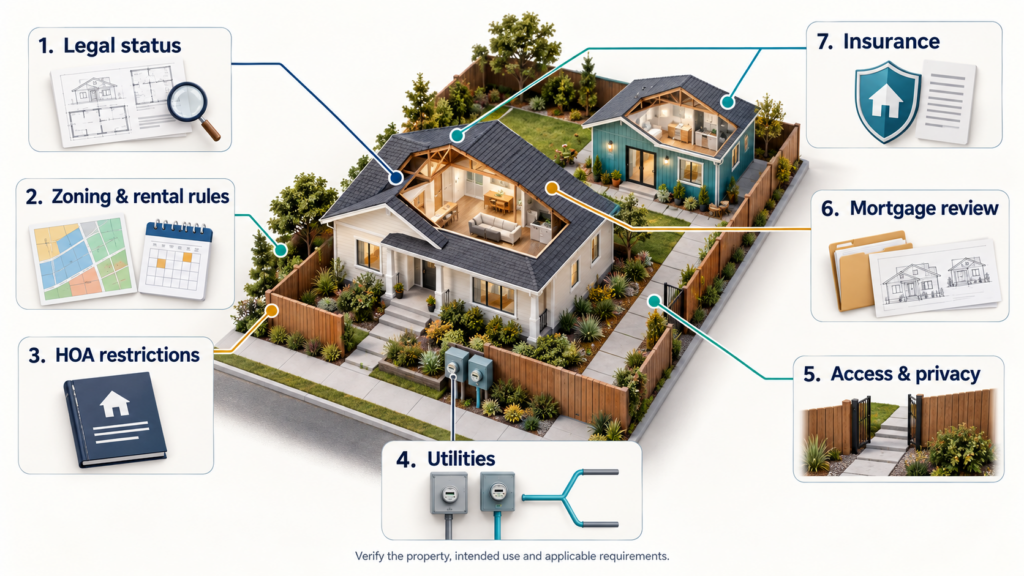
1. Verify the Legal Status
Ask whether the ADU is permitted and whether the current configuration matches the approved plans.
If the seller says the unit is permitted, verify the information with the relevant local building or planning authority.
2. Check Zoning and Rental Rules
A permitted ADU is not necessarily permitted for every type of rental use.
Check whether local regulations allow long-term rentals, short-term rentals, owner occupancy, or other intended uses.
3. Review HOA Restrictions
If the property belongs to an HOA, review the governing documents and applicable rules.
An HOA may have restrictions affecting rentals, additions, parking, exterior changes, or other aspects of how the property can be used.
4. Understand the Utility Setup
Find out whether the ADU shares utilities with the main house or has separate meters.
Shared utilities are not inherently a problem, but they can affect how expenses are divided between occupants and how you manage a rental arrangement.
5. Check Access and Privacy
Consider how the ADU is accessed.
Does the occupant have a separate entrance? Does the tenant need to pass through the primary residence? Is there enough separation between the two living spaces?
These details can have a major practical impact even if the ADU is legally permitted.
6. Understand How the ADU Will Be Treated in the Mortgage
Tell your Loan Officer about the ADU before you make assumptions about qualifying income.
The lender may need to review the property’s appraisal, legal status, rental documentation, transaction type, and applicable program guidelines.
7. Check Insurance
Ask the insurance provider how the ADU will be covered and whether the intended use affects the policy.
An ADU used by a family member may have different considerations from one rented to a tenant, and short-term rental use can introduce additional questions.
Section 12
Buying a Home With an ADU vs. Adding One Later
There are two different situations that often get grouped together.
The first is buying a property that already has an ADU.
The second is buying a home and building or converting an ADU after you purchase it.
The financing considerations can be different.
If you are buying an existing property with an ADU, the lender can evaluate the property as part of the purchase transaction. If you are planning to build an ADU later, you may need a separate financing strategy for the construction or renovation.
Financing options for an ADU project can include renovation financing, construction financing, home equity products, or other options depending on the homeowner’s circumstances and lender availability. Wonder Rates has a separate guide covering ADU financing options.
The key is to determine the financing structure before starting the project rather than assuming that the future rental income will automatically pay for the construction.
Section 13
How Much Can an ADU Affect Your Monthly Housing Budget?
If you are buying a property partly because of its ADU, it is useful to look at the full monthly housing cost rather than focusing only on the potential rental income.
Your total housing expense may include:
- Principal and interest
- Property taxes
- Homeowners insurance
- Mortgage insurance, if applicable
- HOA dues
- Utilities
- Maintenance
- Repairs
- Property management costs, if applicable
If you expect to rent the ADU, also consider vacancy and the possibility that actual rent may be lower than your initial estimate.
You can use the Wonder Rates Mortgage Payment Calculator to estimate principal, interest, taxes, insurance, PMI, and HOA costs for a purchase scenario.
If you are specifically trying to understand how rental income could affect your debt-to-income ratio, the Wonder Rates DTI Calculator can help you model the numbers. The calculator is an estimate, not a determination of qualifying income under a specific mortgage program.
Section 14
Can an ADU Help You Buy a More Expensive Home?
Potentially, but this depends on whether the applicable lender can use ADU rental income for qualifying purposes.
This distinction is important because a buyer may see a property advertised with a rentable ADU and assume the additional income will increase their purchasing power.
The lender still has to determine whether the income is eligible, how it must be documented, and how much can actually be included.
For example, if a home has an existing ADU advertised at $2,500 per month, that does not mean the buyer can simply add $30,000 to annual qualifying income.
The lender may need an appraisal-based market rent analysis, lease documentation, tax information, or other documentation. Program-specific limits may also apply.
That is why buyers interested in an ADU for its potential rental income should discuss the property with their Loan Officer before relying on that income when setting their home search budget.
Section 15
Is an ADU a Good Investment?
An ADU can be useful, but whether it is a good financial decision depends on the property and the homeowner’s goals.
For an owner-occupant, the benefit may not come entirely from rental income. The ADU could provide housing for a parent, reduce the need for another household member to pay rent elsewhere, create a home office, or provide flexibility for future living arrangements.
For an owner planning to rent the ADU, the financial calculation is more direct. You would compare expected rent against the additional costs associated with the property, including financing, utilities, maintenance, insurance, taxes, vacancy, and management.
The same ADU can therefore be a good fit for one buyer and a poor fit for another.
The important question is not simply whether an ADU is valuable. It is whether the specific property, legal structure, financing, and intended use make sense for your situation.
Section 16
Quick Comparison: Is an ADU Right for You?
| If you… | An ADU may be worth considering |
|---|---|
| Want to live near aging parents or family members | It can provide separate living space while keeping households close |
| Have an adult child who needs independent housing | It can provide privacy without requiring a second property |
| Want a dedicated home office or workspace | An ADU can separate work from the main living area |
| Need space for guests | It can provide more privacy than a traditional guest bedroom |
| Want potential rental income | It may provide rental income if local rules and loan guidelines allow |
| Want to build a second living space later | Financing and zoning should be researched before construction |
| Want the simplest possible home purchase | A property without an ADU may involve fewer additional questions |
Section 17
Common Mistakes Buyers Make With ADUs
Assuming Every Backyard Unit Is a Legal ADU
A structure can look like an apartment and still have an unclear legal status.
Always verify permits and zoning instead of relying on the listing description.
Assuming All ADU Rent Counts Toward Mortgage Qualification
This is one of the most important mistakes to avoid.
Mortgage programs have specific rules for using ADU rental income. Fannie Mae’s current policy, for example, limits qualifying ADU rental income to 30% of total qualifying income and restricts the eligible property and transaction types.
Assuming Short-Term Rental Income Works the Same Way
It does not.
Short-term rental income has separate underwriting treatment, and Fannie Mae’s current short-term rental policy does not permit short-term rental income from an ADU under that policy.
Assuming an ADU Automatically Adds Its Construction Cost to the Home’s Value
Market value depends on the property and local market.
The cost of construction and the amount of value recognized by buyers or an appraisal are not necessarily the same.
Waiting Until After the Offer to Tell the Loan Officer
If the ADU is an important reason you are interested in the property, tell your Loan Officer early.
The ADU can affect appraisal, rental income analysis, property eligibility, documentation, and the way you evaluate the property’s financial potential.
Section 18
What About FHA Loans and ADUs?
FHA financing can be used for properties with ADUs under applicable FHA requirements.
HUD has specifically stated that FHA allows homebuyers to purchase properties with ADUs and may allow certain actual or projected ADU rental income to be considered for FHA qualification. FHA also updated its policies to address properties with existing ADUs, rehabilitation of existing structures to add ADUs, and construction of new homes with ADUs.
That does not mean every property with an ADU automatically qualifies for FHA financing.
The property still has to meet applicable FHA property and underwriting requirements, and the treatment of rental income depends on the specific circumstances.
If you are comparing FHA with conventional financing for a home with an ADU, have the lender evaluate the actual property rather than assuming one program will be better based only on the existence of the ADU.
Section 19
What About Conventional Loans and ADUs?
Conventional financing can also accommodate homes with ADUs.
Fannie Mae allows eligible properties with ADUs under its Selling Guide, and its current rental income policy permits qualifying rental income from an existing ADU under specific conditions. The property must be a one-unit principal residence, the transaction must be a purchase or limited cash-out refinance, only one ADU can generate qualifying rental income, and the income used for qualification is limited to 30% of total qualifying income.
Freddie Mac likewise has specific ADU requirements, including rules for documenting and calculating rental income.
The takeaway is not that one conventional program always works better than another. It is that ADU financing is possible, but the details of the property and loan scenario determine how the ADU is treated.
Section 20
Before You Make an Offer on a Home With an ADU
If an ADU is one of the reasons you like a property, use this checklist before moving forward:
- Verify that the ADU is legally permitted.
- Confirm that its current layout matches the approved use.
- Check local zoning and rental regulations.
- Review HOA rules, if applicable.
- Determine whether utilities are shared or separately metered.
- Check whether the ADU has independent access and reasonable privacy.
- Ask how the property will be appraised.
- Ask whether projected or existing rental income can be used for mortgage qualification.
- Confirm what documentation the lender will need.
- Review insurance requirements.
- Estimate realistic rent rather than relying only on the listing.
- Include maintenance, utilities, vacancy, and other ownership costs in your budget.
- Do not assume short-term rental income will receive the same treatment as long-term ADU rental income.
The earlier you address these questions, the less likely you are to discover an ADU-related issue late in the transaction.
Section 21
Frequently Asked Questions
What does ADU stand for?
ADU stands for Accessory Dwelling Unit. It is an additional residential living unit located on the same property as a primary dwelling.
Is an ADU the same as a guest house?
Not necessarily. “Guest house” is often used informally in real estate listings, while an ADU is a specific type of additional dwelling unit. Whether a structure legally qualifies as an ADU depends on applicable local requirements and, for mortgage purposes, the relevant loan program’s property guidelines.
Can an ADU be detached from the house?
Yes. An ADU can be detached, attached, or located within the primary residence. Fannie Mae’s current guidance allows ADUs in several configurations as long as applicable requirements are met.
Can I rent out an ADU?
Potentially. Local zoning and rental regulations determine whether the ADU can be rented, while mortgage guidelines determine how rental income may be treated for loan qualification.
Can ADU rental income help me qualify for a mortgage?
It can in certain situations. Fannie Mae currently allows qualifying rental income from an existing ADU under specific conditions, including a one-unit principal residence, an eligible purchase or limited cash-out refinance transaction, one ADU, and a 30% limit on the amount of ADU rental income used relative to total qualifying income.
Does an ADU automatically increase home value?
No. An ADU can make a property more attractive and may contribute to higher value, but the impact depends on location, legal status, quality, functionality, comparable properties, and buyer demand.
Does an ADU need to be permitted?
Whether a structure requires permits and what constitutes a legal ADU depends on local rules. From a buyer’s perspective, verifying the structure’s legal and permitted status is important because unpermitted work can create zoning, appraisal, insurance, resale, and financing issues.
Can I use an ADU as an Airbnb or other short-term rental?
That depends first on local laws and then on the applicable mortgage and underwriting rules. Fannie Mae’s current short-term rental policy does not allow short-term rental income from an ADU to be used under that policy.
Can FHA loans be used to buy a home with an ADU?
Yes, FHA permits eligible properties with ADUs and has policies addressing certain ADU rental income and ADU-related financing. The property and borrower still have to satisfy applicable FHA requirements.
Should I tell my Loan Officer about the ADU before making an offer?
Yes. If the ADU affects your decision to buy the property, tell your Loan Officer early. The lender may need to evaluate the ADU’s legal status, appraisal, rental income, property eligibility, and applicable loan program requirements.
Section 22
Final Thoughts
An ADU can be much more than an extra room behind a house. Depending on the property and local rules, it can provide housing for family, create flexible living space, support aging in place, or provide a potential source of rental income.
But an ADU also adds another layer to the homebuying decision. Buyers need to look beyond the physical structure and understand whether the unit is legal, how it can be used, how it will be appraised, and whether any rental income can actually be used for mortgage qualification.
If you are shopping for a home with an ADU, start by verifying the property itself. Then work with your Loan Officer to understand how the ADU affects the financing scenario.
You can use the Wonder Rates Mortgage Payment Calculator to estimate the property’s potential monthly payment, and the Wonder Rates DTI Calculator to explore how income and monthly obligations affect your overall scenario.
When you have a specific property in mind, get started with Wonder Rates so a licensed Loan Officer can review the actual property and your financial profile before you rely on projected ADU income or other assumptions.
Section 23
Sources
- Fannie Mae: Accessory Dwelling Units
- Fannie Mae Selling Guide: Rental Income From the Subject Property
- Fannie Mae: Appraiser Update on ADU Rental Income
- Fannie Mae: 2025 ADU Rental Income Policy Update
- Freddie Mac: Accessory Dwelling Units Fact Sheet
- Freddie Mac: Should I Add an ADU to My Home?
- HUD: National Homeownership Month and ADU Guidance
- HUD: FHA ADU Loan Processing Updates
This article is provided for educational and informational purposes only and should not be considered financial, legal, tax, or mortgage advice. ADU definitions, zoning rules, permitting requirements, rental restrictions, mortgage guidelines, and loan program requirements vary by jurisdiction and lender and may change over time. Rental income is not automatically counted for mortgage qualification. Every borrower’s financial situation and property are different, and no specific approval, rental income amount, rate, or loan term is guaranteed. Consult qualified local, legal, real estate, insurance, and mortgage professionals regarding your specific circumstances before making a purchase or financing decision.
Duc Pham, Mortgage Broker | NMLS# 844897
Wonder Rates, Inc. | NMLS# 1518655 | DRE# 02047445 | DFPI# 60DBO-59134
Equal Housing Opportunity. Equal Housing Lender.
Licensed in: AL, AZ, CA, CO, FL, GA, LA, MI, NC, OH, OK, OR, PA, SC, TX, VA, WA.