

Section 01
Americans are not necessarily waiting to buy homes because they do not want one. Many are waiting because the math has become genuinely harder to make work.
Mortgage rates remain elevated. Home prices remain high. Inventory has improved in some areas, but the supply of homes for sale is still not fully back to pre-pandemic levels. At the same time, many existing homeowners are reluctant to give up older, lower-rate mortgages they locked in years ago. That combination creates an unusual market where buyers hesitate to buy and sellers hesitate to sell, at roughly the same time.
That tension is really the central thread running through this entire article.
Section 02
Why Are Americans Waiting to Buy Homes?
A handful of forces are driving this hesitation at once. Mortgage rates are still high relative to recent years. Home prices remain expensive relative to typical household incomes. Many homeowners are effectively locked into older mortgages that carry much lower rates than what’s available today. And both buyers and sellers appear to be waiting for conditions to improve before acting.
Put together, this creates a cycle worth understanding: high rates reduce affordability, which causes buyers to wait, which causes sellers to hesitate as well, which keeps inventory constrained, which keeps prices from falling enough to restore affordability on its own, which brings buyers right back to waiting. It’s worth being clear that this cycle does not apply equally in every city. Housing is highly local, and some metro areas are seeing meaningfully different conditions than the national picture described here.
Section 03
Mortgage Rates Are Still Making Homeownership Expensive
As of September 3, 2026, Freddie Mac reported the average U.S. 30-year fixed mortgage rate at 6.71%, up from 6.66% the prior week and 6.50% a year earlier. The 15-year fixed rate averaged 6.04% over the same period.
The 6.71% figure is Freddie Mac’s national weekly average for the 30-year fixed-rate mortgage as of September 3, 2026. It is not a guaranteed rate for any individual borrower. Actual mortgage rates can vary based on credit, loan type, down payment, property, lender, and other factors.
A higher mortgage rate affects affordability in a fairly direct way, because the same home price can produce a meaningfully higher principal-and-interest payment at a higher rate. That means some buyers who could have comfortably afforded a particular home price at a lower rate may no longer qualify for that same purchase price today.
Higher Rates Change the Monthly Payment, Not Just the Headline Rate
It’s worth being precise here rather than sweeping. It would be inaccurate to say rates are too high so nobody can afford homes, since plenty of buyers are still purchasing homes even in this rate environment. A more accurate statement is that higher rates can reduce purchasing power for borrowers who need to stay within a specific monthly budget, which is exactly the situation many prospective buyers find themselves in right now.
If you want to see how different home prices and interest rates could affect the monthly payment, the Wonder Rates Mortgage Payment Calculator can help you run a few scenarios based on your own budget.
Section 04
Home Prices Have Not Fallen Enough to Offset Higher Rates
This section matters because it challenges a common assumption, namely that if rates are high, home prices should simply crash to compensate.
In August 2026, the national median listing price was $424,500, down 1.3% from a year earlier, marking the tenth consecutive month of annual list-price declines. At the same time, active listings reached roughly 1,140,035, up 3.6% year over year.
The $424,500 figure is Realtor.com‘s national median listing price for August 2026. It is a listing-price measure, meaning what sellers are asking, not the median closed-sale price for every home actually sold in the United States. Sale prices and list prices are not the same thing, and the gap between them varies by market.
Prices have softened somewhat, but not nearly enough to fully offset the affordability problem created by higher borrowing costs. This is where the more interesting part of the story begins.
Section 05
Why Aren't Home Prices Falling Much More?
Because There Are Still Not Enough Sellers
This is where a concept called mortgage rate lock-in becomes relevant. A homeowner who secured a much lower mortgage rate during the pandemic years may face a dramatically different monthly payment if they sell their current home and purchase another one today.
That homeowner may reasonably think they’d like a bigger house, but wonder whether they really want to give up their current mortgage rate to get it. This is not the same thing as saying every homeowner is trapped in place. For some homeowners specifically, the difference between their existing mortgage rate and today’s market rates can make moving considerably less attractive than it would otherwise be. Realtor.com has similarly noted that elevated mortgage rates can leave homeowners feeling locked in, keeping some potential sellers on the sidelines rather than listing their homes.
Section 06
The Mortgage Rate Lock-In Effect
This concept deserves its own explanation, since it’s one of the more important and less intuitive dynamics shaping today’s market.
What Is Mortgage Rate Lock-In?
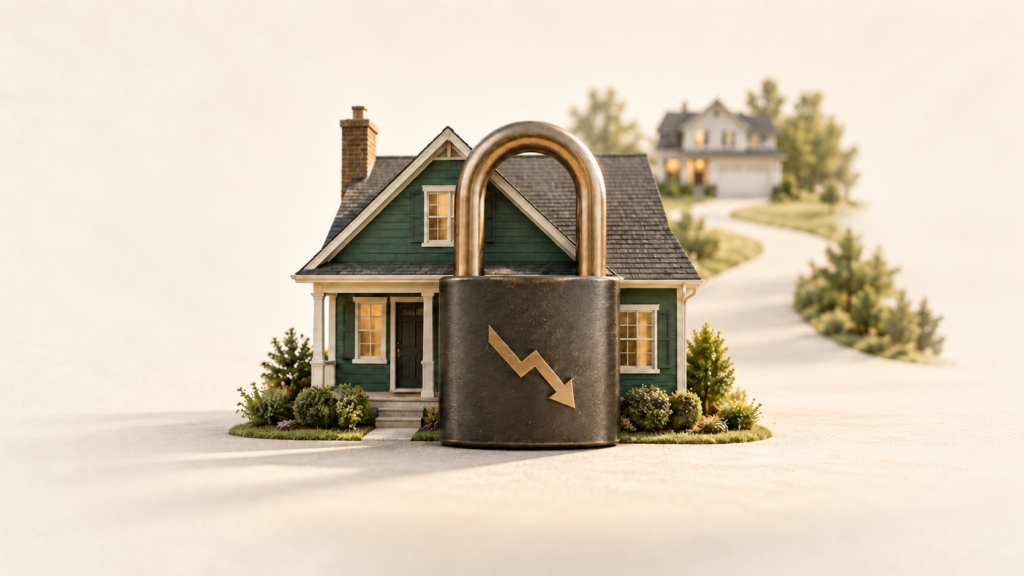
Mortgage rate lock-in describes the situation where homeowners with older, lower mortgage rates have less financial incentive to sell, because buying another home would mean taking out a brand new mortgage at today’s considerably higher rates.
The market impact follows a fairly simple chain. A homeowner with a low existing rate tends to stay put rather than sell. That means fewer homes get listed overall. And fewer listings mean fewer choices for the buyers who are actively searching.
That said, it’s worth adding an important caveat here. Mortgage rate lock-in is one factor affecting housing supply, not the only reason any given homeowner decides whether or not to move. Job changes, family needs, retirement, and countless other personal circumstances still drive plenty of sales regardless of what a homeowner’s current rate happens to be.
Section 07
Buyers Are Waiting, But Sellers Are Waiting Too
This dynamic, more than any single statistic, may be the strongest way to understand today’s market.
Buyers Are Saying, “Maybe Next Year”
Some buyers are holding off in hopes of lower mortgage rates, lower home prices, more inventory to choose from, or simply more economic certainty before making what is, for most people, the largest financial commitment of their lives.
But waiting carries its own trade-off worth naming directly. If rates do fall meaningfully, more buyers are likely to return to the market at once, which could increase competition for the homes that are actually available. It would be inaccurate to say that if rates fall, home prices will definitely rise as a result. A more accurate way to frame it is that a drop in mortgage rates could improve affordability on the payment side, but the actual effect on prices and competition would depend on inventory levels, demand, local conditions, and the size of the rate move itself.
Example: A survey conducted by Neighbors Bank and reported by Realtor.com found that 72% of potential homebuyers said they had delayed or paused their home search until mortgage rates improve. This is the result of one specific survey of a defined group of respondents. It is not a scientifically representative measure of every prospective homebuyer in the United States, and results from a different survey population could look meaningfully different.
Sellers Are Saying, “Maybe I Should Stay”
Existing homeowners are running a version of the same calculation. Many may genuinely want to move, but their current mortgage looks considerably more attractive than anything available to them today, which is enough to keep them from listing. That creates a market where both sides of a typical transaction are hesitating at the same time, rather than just one side.
Section 08
The U.S. Housing Market Is Becoming a Waiting Game
Bringing these pieces together produces a fairly clear sequence. High mortgage rates lead to lower purchasing power for buyers. Lower purchasing power leads buyers to wait rather than commit. Meanwhile, homeowners sitting on low legacy rates hesitate to sell. That hesitation keeps inventory more constrained than it would otherwise be. Constrained inventory, combined with softer demand, keeps prices from falling enough to fully restore affordability on their own. And that lack of affordability sends buyers right back to waiting again.
This helps explain why the housing market can feel unusually slow without resembling a traditional housing crash in the way many people remember from 2008. Realtor.com has similarly described the market as experiencing a major contraction in sales activity and household mobility, without a broad national price correction accompanying it.
Section 09
Is the U.S. Housing Market Actually Frozen?

Commentary describing the market as effectively “frozen” has become fairly common, pointing to high mortgage rates, high home prices, and homeowners holding onto lower-rate mortgages as the core drivers. Reporting citing Apollo’s chief economist, for instance, has noted that the share of households planning to move over the next 12 months has fallen to a record low of roughly 7%.
It’s worth qualifying that language carefully, though. “Frozen” is a useful shorthand for describing unusually weak housing activity. It is not a literal statement that nobody anywhere is buying or selling homes, since millions of transactions are still happening across the country every year, just at a notably slower pace than in more typical years.
Section 10
Why This Is Different from a 2008-Style Housing Crash
This section matters because it’s easy to slide from “the market feels slow” to assuming a crash must be coming, and those are two very different things.
Today’s Problem Is Mainly Affordability and Mobility
The current market genuinely has significant affordability problems. But that alone does not mean the same underlying conditions that caused the 2008 financial crisis, namely widespread subprime lending, weak underwriting standards, and excessive leverage across the financial system, are present in today’s market.
Falling Sales Do Not Automatically Mean Falling Prices
If demand falls while supply also stays constrained by lock-in and other factors, prices can remain relatively sticky rather than dropping in tandem with sales volume. That’s a meaningful part of why today’s housing market can show weak transaction volume without producing a dramatic national price collapse alongside it.
None of this means the housing market is inherently safe or incapable of a downturn under different conditions. It simply means the specific dynamics driving today’s slowdown are not the same dynamics that drove the last major housing crash.
Section 11
What Could Finally Bring Buyers Back?
A few developments, individually or together, could shift today’s standoff between buyers and sellers.
Lower mortgage rates would directly improve monthly affordability for a given home price, which tends to be the single most discussed lever. More housing inventory could give buyers more choices and ease the intense competition that can build up around individual, well-priced listings. Slower home-price growth, even without sharp declines, would give household incomes more time to catch up to home values over time. And stronger household finances broadly, meaning income growth, stable employment, healthy savings, and favorable credit conditions, can also affect whether buyers feel genuinely ready to enter the market, independent of what rates happen to be doing.
It’s worth resisting the temptation to forecast a specific future rate here, since even major institutions with access to extensive data regularly revise their own forecasts as conditions change.
Section 12
Should You Wait to Buy a House in 2026?
There is no single answer that applies to every buyer, and it would be a mistake to pretend otherwise.
A buyer should weigh their own monthly payment comfort, their available down payment, their credit profile, their income stability, how long they realistically expect to stay in the home, local property taxes, homeowners insurance costs, any applicable HOA costs, their available cash reserves, and the specific home prices and inventory conditions in their local market. A lower future mortgage rate would obviously be helpful if it materializes, but nobody, including major forecasters, knows exactly when or by how much rates will move next.
If you’re trying to translate those factors into a realistic home price range, see our guide to How Much House Can You Afford?
Section 13
The Better Question May Not Be "When Will Rates Drop?"
A more useful question for most buyers is simply what they can comfortably afford today, based on their actual finances rather than a prediction about where the market might be a year from now.
A mortgage decision works best when it’s grounded in a buyer’s real financial situation, not primarily in guesses about next year’s rates, next year’s prices, or next year’s inventory. Those broader market conditions matter, but they’re only part of the picture, and they’re the part any individual buyer has the least control over. When you’re evaluating what you can comfortably afford today, it’s also important to account for the costs beyond the mortgage payment. Our Home Buying Costs Checklist walks through the other expenses buyers may need to plan for.
Section 14
Final Takeaway
Americans are waiting to buy homes for several connected reasons rather than any single one. Mortgage rates are still elevated. Home prices remain high relative to recent history. Some homeowners are reluctant to give up older, lower-rate mortgages, which keeps inventory tighter than it might otherwise be.
The result is a market where buyers wait for better affordability while sellers wait for better conditions of their own. That does not mean every local market is frozen in the same way, and it does not mean prices are incapable of falling further. It means the U.S. housing market in 2026 is being shaped by a genuinely difficult balance between affordability, mortgage rates, inventory, and homeowner mobility, all pulling in different directions at once.
If you’re thinking about buying or refinancing, Đức can help you look at the mortgage options based on your specific situation, rather than trying to guess where the broader market will be six months from now.
Section 15
Frequently Asked Questions
Why are Americans waiting to buy homes?
Because high mortgage rates and high home prices have reduced affordability, while limited inventory and mortgage rate lock-in continue to shape the broader market.
Will mortgage rates go down in 2026?
Mortgage rates can move in either direction, and no one can guarantee where rates will be at any specific future date. Forecasts from major institutions vary and are regularly revised as conditions change.
Are home prices falling in the U.S.?
National listing prices have softened somewhat. Realtor.com reported a $424,500 median listing price in August 2026, down 1.3% year over year. Local markets can behave very differently from this national figure, so it’s worth looking at conditions specific to your area.
What is mortgage rate lock-in?
It’s the reluctance some homeowners feel toward selling a home with a low-rate mortgage and replacing it with a new mortgage at a higher current rate, which can reduce the number of homes that come up for sale.
Is 2026 a good time to buy a house?
There is no universal answer. The right timing depends on a buyer’s personal finances, their affordability at current rates, their local market conditions, and how long they expect to own the property.
Section 16
Sources
- Freddie Mac, Primary Mortgage Market Survey (PMMS)
- Realtor.com, August 2026 Housing Trends
- Realtor.com, August 2026 Housing Report: Delistings Trend Below Last Year’s Pace
- Realtor.com, Homebuyers Say Mortgage Rates Need To Hit a “Magic Number” Before They’ll Buy
This article is provided for general informational and educational purposes only. It is not financial, mortgage, tax, legal, or investment advice, and it is not a recommendation to buy, sell, refinance, or wait. Mortgage rates, home prices, inventory, and other housing data change over time and can vary significantly by location and borrower. Any rates, prices, percentages, examples, forecasts, or other figures mentioned are based on the cited sources and the date of publication. Actual mortgage terms, payments, eligibility, and costs depend on the borrower’s financial profile, property, loan program, lender, and other factors. Readers should review their own circumstances and consult qualified professionals before making financial decisions.
Duc Pham, Mortgage Broker | NMLS# 844897 | 408-600-1900 | dp@wonderrates.com Wonder Rates, Inc. | NMLS# 1518655 | DRE# 02047445 | DFPI# 60DBO-59134 Equal Housing Opportunity. Equal Housing Lender. Licensed in: AL, AZ, CA, CO, FL, GA, LA, MI, NC, OH, OK, OR, PA, SC, TX, VA, WA