
Section 01
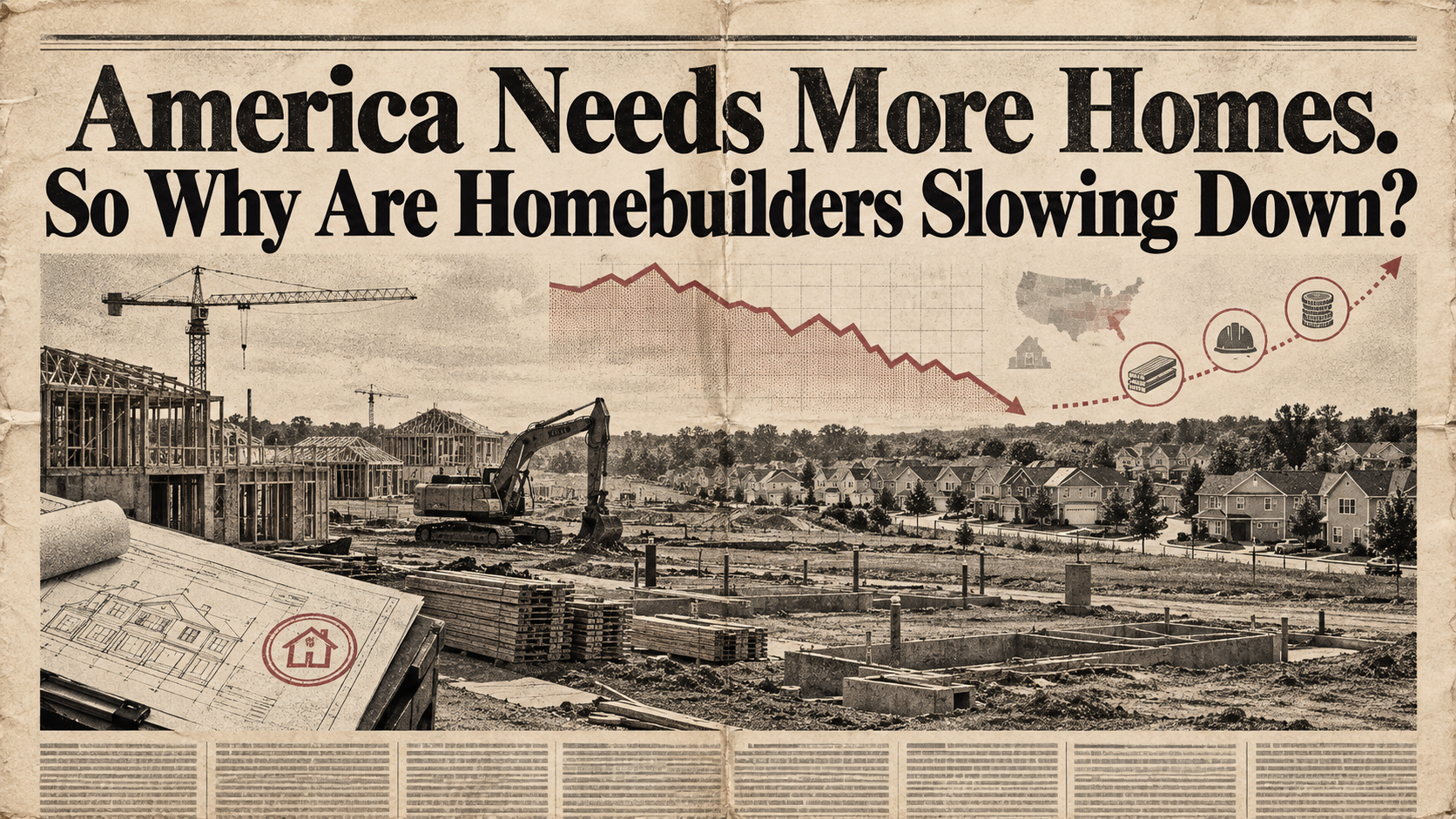
According to the U.S. Census Bureau, single-family housing starts fell 9.9% in July 2026 compared to June, dropping to a seasonally adjusted annual rate of 808,000 units. That’s the lowest pace since November 2022. Compared to July 2025, single-family starts were down 15.7%.
The 808,000 figure is a seasonally adjusted annual rate, or SAAR. It is not the number of single-family homes actually started during July. It represents the pace of construction if that monthly rate continued for a full year, and Census notes a margin of error of plus or minus 10.4 percentage points on the monthly change.
On the surface, that looks contradictory. If the country is short on housing, shouldn’t builders be racing to build more of it?
It’s not that builders don’t know the market needs more homes. The real issue is that knowing the market needs housing and being able to build that housing at a price buyers can actually afford are two very different things. That gap is the thesis of this entire article.
Section 02
The U.S. Needs More Housing. But More Demand Does Not Automatically Mean More Construction
Before getting into costs, it helps to understand why a housing shortage doesn’t automatically translate into more construction.
A Housing Shortage Doesn’t Mean Builders Will Build Without Limit
If a market is short on housing, a builder has, in theory, a strong incentive to build more of it. But a builder still has to pay for land, labor, materials, financing, insurance, permits, other development costs, and marketing and sales expenses. If those combined costs run too high, a builder may not be able to sell the finished home at a price the local buyer pool can actually afford.
A Builder Isn’t Only Asking “Does Anyone Need a Home?”
The more relevant question for a builder is closer to: “Are there enough people who can actually afford this home at the price we need to charge for the project to make financial sense?”
That distinction matters. Demand existing in the abstract isn’t the same as effective demand, meaning demand that’s backed by the financial ability to actually complete a purchase.
This Is Why Housing Affordability Matters Here
A market can be short on homes, have plenty of people who want to buy, and still see relatively few transactions, if home prices and monthly mortgage payments run higher than what a meaningful share of buyers can support. That’s the bridge into the next section: mortgage rates.
Section 03
The First Problem: Mortgage Rates Are Affecting Both Buyers and Builders
Mortgage Rates Don’t Just Affect Buyers
Buyers feel higher mortgage rates directly, through a higher monthly payment. Builders feel the effect indirectly, but it still runs through their business: higher mortgage rates mean fewer qualified or willing buyers, which means weaker demand, which makes new homes harder to sell, which makes builders more cautious about starting new projects.
NAHB has noted that elevated mortgage rates are keeping many prospective buyers on the sidelines, while rising construction costs continue to add to what it costs to build.
A Home Can Be “Affordable” for the Builder but Not for the Buyer
A builder is running project economics: what it costs to build, and what price is needed to make the project profitable. A buyer is looking at a very different number: the monthly payment. If construction costs push the required sale price up, and the mortgage rate pushes the monthly payment up on top of that, the deal can become harder to close even though both sides are, in their own way, doing the math correctly.
This Creates a Difficult Loop
Higher mortgage rates can weaken demand. Weaker demand makes builders more cautious. Caution slows the construction pipeline. But a slower construction pipeline doesn’t do anything to fix the underlying housing shortage. That loop is one of the more frustrating parts of the current market.
Section 04
The Second Problem: Building a Home Has Become More Expensive
Labor Costs
Residential construction depends on more than a single general contractor. It requires plumbers, electricians, framers, roofers, HVAC technicians, and a range of other skilled trades. When labor costs rise across those trades, the total cost basis of a home rises with them.
Materials
Lumber, steel, copper, concrete, electrical components, and appliances all factor into total construction cost. According to an analysis by the Associated General Contractors of America (AGC) of government producer price index data, input prices for new nonresidential construction rose 7.1% from July 2025 to July 2026, with steep increases in metals and fuel-related costs contributing to the rise.
This 7.1% figure is a national construction-input measure covering nonresidential construction materials and services. It is not specific to residential building, and it does not mean every builder or every home experienced the same cost increase. Material and labor costs vary by project, region, and timing.
Land Costs
It’s easy to assume that building a home is mostly a function of materials plus labor, but land is often a significant piece of a project’s overall economics, and in areas where land is scarce, that cost alone can make it harder to build homes at an entry-level price point.
Financing Costs
Builders typically need financing to develop a project, whether that’s holding land, building out infrastructure, or constructing homes to sell as inventory. When borrowing costs are higher, all of that becomes more expensive to carry. That’s one reason mortgage rates, and interest rates more broadly, can affect construction long before any individual buyer ever submits a mortgage application.
Section 05
The Third Problem: Buyers Are There, But Many Are Waiting
High Home Prices and High Mortgage Rates Create an Affordability Problem
It isn’t accurate to say Americans don’t want to buy homes. A more accurate way to put it: many potential buyers may want to buy, but affordability can keep them from actually entering the market.
Buyer Traffic Matters to Builders
Builders don’t just track how many people say they want to buy a home. They watch buyer traffic, signed contracts, cancellations, sales pace, inventory levels, and pricing power. When buyer traffic runs weak, builders have a concrete reason to be cautious about starting new construction.
Reuters reported in September 2026 that builder sentiment fell to its lowest level in a year, against a backdrop of rising mortgage rates, high material costs, and weak buyer traffic.
The Existing-Home Market Also Affects New Construction
Buyers choosing between a new-construction home and an existing resale home are, in effect, shopping the same budget across two different markets. When existing-home inventory rises, builders face more competition for that same pool of buyers. New construction doesn’t exist in a vacuum separate from the resale market; the two are directly connected.
Section 06
The Fourth Problem: Builders Already Have Homes to Sell
More Construction Isn’t Always the Immediate Answer
If a builder already has completed homes, or homes under construction, that haven’t sold yet, starting even more new construction isn’t automatically the logical next move. NAHB reported that roughly 579,000 single-family homes were under construction nationally in July 2026.
This is a national estimate and does not describe inventory conditions in every local housing market. Local conditions can differ significantly from the national figure.
Inventory Changes the Builder’s Decision
When inventory runs high, a builder has several available responses: slowing new starts, lowering prices, offering incentives, adjusting floor plans, or targeting different price points to move existing inventory faster.
This Is Why a “Housing Shortage” and “New-Home Inventory” Can Both Exist at Once
A market can be short on housing in the long run while a specific builder still has more completed homes on hand than the current sales pace can absorb. Those two statements aren’t actually in conflict with each other; they’re describing different timeframes and different levels of the market.
Section 07
So Builders Are Offering Incentives Instead of Simply Cutting Prices
What Are Builder Incentives?
Common forms include closing cost assistance, temporary mortgage rate buydowns, other rate-related incentives, upgrade credits, and outright price reductions. Not every builder offers all of these, and the specific mix varies by builder and community. If you want a closer look at how these offers work and what buyers should compare, see our guide to Builder Incentives on New Homes.
Why Do Builders Prefer Incentives Over Price Cuts?
Cutting a home’s listed price outright can affect the perceived value, and appraised value, of every other home in the same community. An incentive, by contrast, can be structured to help a specific transaction close without resetting the baseline price for the whole community.
An Incentive Doesn’t Automatically Mean a Home Is “Cheaper” in Every Sense
A builder might offer a credit to help offset a buyer’s upfront costs, for example. But the buyer still needs to look at the full picture: purchase price, mortgage rate, monthly payment, property taxes, homeowners insurance, HOA dues, closing costs, and total cash needed to close.
Any incentive example in this article is illustrative only. Actual builder incentives, eligibility rules, loan terms and costs vary by property, market, lender and promotion.
Incentive Use Has Been Rising
According to Reuters, the NAHB/Wells Fargo Housing Market Index survey found that 66% of builders reported using sales incentives in September 2026, up from 63% in August. Separately, 38% of builders reported cutting prices, up from 35% the prior month, with the average price reduction holding steady at 6% for a sixth straight month.
These percentages come from the NAHB/Wells Fargo Housing Market Index survey and describe the builders who responded to that specific survey. They are not a count of all U.S. builders.
Section 08
The Interesting Part: Permits Are Rising While Starts Are Falling
Permits and Starts Are Not the Same Thing
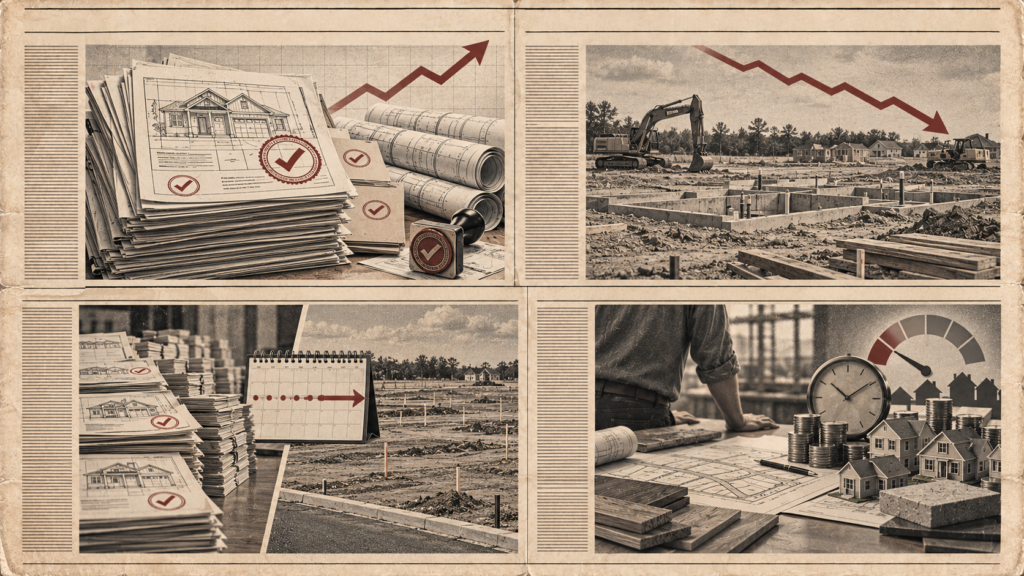
A permit shows that construction has been authorized. A start means construction has actually begun. A home can have an active permit without construction having started yet.
July 2026 Shows This Clearly
Single-family permits rose 2.5% in July to an annualized rate of 894,000, while single-family starts fell 9.9% over the same month to 808,000.
Both figures are seasonally adjusted annual rates. They describe the pace of activity rather than the literal number of homes permitted or started during July.
What Might This Suggest?
It would be an overreach to say builders will definitely build all of these permitted homes soon. A more accurate read: permits suggest that some future construction has been authorized, but a permit is not a guarantee that construction will begin immediately.
Builders May Be Waiting
Builders holding permits without starting construction could be waiting on any number of things: stronger demand, lower financing costs, clearer material pricing, a stronger sales pace, or better inventory conditions in their specific market. There’s no way to say which of these applies to any single builder without knowing their specific circumstances.
Section 09
Why Would a Builder Slow Down When America Still Needs More Homes?
The Cost of Building May Be Too High
A housing shortage doesn’t automatically make construction economics work out for the builder.
Buyers May Not Be Able to Support the Required Price
Demand can exist while affordability still limits how many buyers can actually act on it.
Existing Inventory Can Reduce the Need for Immediate New Starts
Builders generally need to sell down current inventory before ramping up production.
Financing Makes Waiting Expensive Too
Builders have to weigh the cost of capital tied up in land and unsold inventory against the cost of starting new projects.
Builders Are Businesses, Not Public Housing Agencies
Builders respond to market conditions and project economics. Their decision to start a project depends on whether they expect that project to make financial sense, not on the size of the national housing shortage by itself.
Section 10
What Does Slower Homebuilding Mean for Homebuyers?
It Does Not Automatically Mean Home Prices Will Rise
Prices depend on a combination of factors: local supply, local demand, mortgage rates, income levels, inventory, resale activity, land availability, and local economic conditions. A single national housing starts number isn’t enough on its own to predict where local prices are headed.
It Does Mean Future Supply May Be Affected
If starts stay lower for an extended period, the number of homes completed in the future could be affected. It’s worth keeping one distinction clear: starts today are not the same thing as homes available to buy today.
Buyers May See Fewer Choices in Some Markets
Less construction activity can affect new-home selection, available floor plans, and the number of active communities, particularly at the entry-level price point. This effect is market-specific rather than uniform nationwide.
Buyers May Also See More Incentives in Some Markets
Here’s the interesting tension: builders can be slowing construction while still offering incentives on the inventory they already have. Buyers may see fewer choices looking forward, alongside different negotiating opportunities in the present. It wouldn’t be accurate to say buyers have more negotiating power everywhere in the country; that varies significantly by local market.
Section 11
New Construction and Existing Homes Are Connected
New Homes Compete With Existing Homes
Buyers usually aren’t only asking, “Is there a new-construction option available?” They’re asking, “Given my budget, which option makes the most sense?” That question pulls new construction and resale homes into direct competition with each other.
Builder Incentives Can Shift That Competition
When a new-construction home comes with a strong incentive, it can become more competitive against a comparable resale home, even at a similar list price.
Existing-Home Inventory Also Shapes Builder Strategy
When resale inventory rises, builders may need to adjust their own pricing or incentive strategy to stay competitive with what’s already on the market.
Section 12
Why Entry-Level Buyers May Feel This Problem More
Building Cheaper Homes Is Difficult
Construction costs don’t scale down proportionally with a smaller home. A smaller home still requires land, a foundation, plumbing, electrical work, HVAC, labor, and permits, many of which carry costs that don’t shrink much just because the home itself is smaller.
This Is Why Affordability Isn’t Only a Mortgage-Rate Problem
Mortgage rates are one part of affordability. The underlying cost of producing housing is another, and that cost affects home prices regardless of where mortgage rates sit at any given moment.
If Builders Struggle to Produce Homes at Lower Price Points
Entry-level housing supply can be slower to grow as a result. That said, this doesn’t mean supply is guaranteed to shrink everywhere; conditions vary significantly by local market.
Section 13
Does Slower Homebuilding Mean the Housing Market Is About to Crash?
A Construction Slowdown Is Not the Same as a Housing Crash
A housing crash typically involves several factors moving at once, not a single month of weaker housing starts data.
July Data Shows Weakness, But One Month Is Not the Whole Market
Monthly Census data carries real volatility and statistical margins of error. Census itself reported that the 9.9% monthly decline in single-family starts carries a margin of error of plus or minus 10.4 percentage points.
Monthly housing construction data can be volatile and is subject to revision. A single monthly reading should not be treated as a forecast for the entire housing market.
Look at Multiple Indicators Together
A more complete picture comes from looking at several indicators at once: starts, permits, completions, new-home sales, existing-home sales, inventory levels, mortgage rates, and builder sentiment, rather than relying on any single monthly data point.
Section 14
What Buyers Should Watch Next
Watch Mortgage Rates
Not to try to predict exactly where rates are headed, but to understand how affordability is shifting in real time.
Watch New-Home Inventory
If completed inventory keeps rising in a given market, builders in that market may continue to rely on incentives to move it.
Watch Permits Versus Starts
The gap between permits and starts can offer a signal about how the construction pipeline is behaving, though it shouldn’t be used alone to forecast future supply.
Watch Builder Incentives
Worth asking directly: What exactly is the incentive? What conditions come attached to it? Does it require using a builder-affiliated lender? Does it affect the purchase price? How long does a rate buydown actually last? How does it change the cash needed to close?
Watch the Local Market, Not Just National Headlines
A buyer in Texas can be facing very different conditions than a buyer in California. National data is useful for spotting broader trends, but an actual home purchase decision depends heavily on local market conditions and individual borrower circumstances.
Section 15
What This Means for Someone Buying a New Construction Home
Don’t Look Only at the Advertised Rate
If a builder advertises a low rate, it’s worth understanding whether that rate is fixed or a temporary buydown, how long it lasts, which lender is offering it, what the eligibility requirements are, and whether any trade-offs come with it.
Compare the Full Loan Terms
Rather than asking only “what’s the rate,” it helps to look at the complete picture: loan amount, rate, APR, monthly principal and interest, property taxes, insurance, HOA dues, mortgage insurance if applicable, closing costs, and total cash needed to close. For a broader breakdown of the costs that can affect your budget beyond the mortgage payment itself, see our Home Buying Costs Checklist.
A Builder Incentive Isn’t Automatically the Cheapest Financing Option
If a builder requires using its affiliated lender to receive an incentive, it can still be worth comparing the total loan cost against other lenders. Neither an outside lender nor a builder-affiliated lender is automatically the better choice; it depends on the full terms offered in each case. If you’re comparing a builder’s financing offer with other loan options, you can talk with a licensed mortgage professionalabout how the different terms may affect your overall costs.
Section 16
A Simple Example: Why a Builder Incentive Can Change the Math
Illustrative example: Consider a new-construction home listed at a hypothetical purchase price. The builder offers an incentive intended to help with either closing costs or a temporary mortgage rate buydown. A buyer evaluating this offer needs to compare two full scenarios based on total loan cost and total monthly housing cost, rather than reacting to the advertised rate or incentive amount alone.
Illustrative example only. The figures are hypothetical and are not a quote, forecast or representation of current builder pricing, mortgage rates or loan terms. Actual costs depend on the property, borrower, lender, loan program, taxes, insurance, HOA and builder promotion.
What matters isn’t whether an incentive sounds big or small on its own. What matters is how it actually changes the total cost of the loan and the resulting monthly payment. If you’re comparing a builder incentive or rate buydown, the Wonder Rates Mortgage Payment Calculator can help you estimate how different rates, home prices, down payments, taxes, and insurance may change the monthly payment.
Section 17
The Bigger Housing Problem Is Not Just "We Need More Homes"
America Needs More Housing
But “more housing” has to come paired with housing people can actually afford, housing built in places people actually want to live, and housing that builders can produce and still turn a reasonable profit on.
Supply and Affordability Are Connected
If construction costs run too high, new supply can struggle to reach the market at entry-level price points, regardless of how badly that supply is needed.
That’s Why the Housing Shortage Is Complicated
There isn’t one single variable driving this. Mortgage rates matter. Construction costs matter. Land matters. Labor matters. Buyer income matters. Inventory matters. Financing costs matter. Local regulations and development conditions can matter too. All of these move together, which is part of why there’s no single fix.
Section 18
The Real Question Is Not "Why Aren't Builders Building?"
A more useful question to ask is: What is stopping builders from building homes that buyers can actually afford?
America may need more homes. But builders still have to work within the economics of actually producing those homes. When mortgage rates are high, buyers become more price-sensitive. When construction costs rise, builders face higher costs to bring a project to market. When inventory grows, builders may slow new starts to sell down what they already have. When demand weakens, incentives become more common as a way to keep transactions moving.
And every one of those dynamics ultimately loops back and affects the buyer on the other side of the transaction.
Section 19
What Should Homebuyers Take Away From This?
Don’t Assume Fewer Starts Automatically Mean Higher Prices
The data available doesn’t support that conclusion on its own.
Don’t Assume Builder Incentives Automatically Mean a Great Deal
The full transaction, not just the incentive headline, determines whether it’s actually a good deal.
Don’t Assume a National Number Describes Your City
Housing markets are fundamentally local.
Don’t Make a Mortgage Decision From One Headline
Rate, price, taxes, insurance, HOA dues, loan structure, and personal budget all need to be weighed together, not evaluated one at a time.
Section 20
Frequently Asked Questions About the U.S. Homebuilding Slowdown
Why are homebuilders slowing down in 2026?
A combination of factors is involved, including elevated mortgage rates, rising construction costs, softer buyer demand and traffic, and existing unsold inventory that builders need to work through before ramping up new construction.
Why did single-family housing starts fall in July 2026?
Census data showed single-family starts fell 9.9% from June to a seasonally adjusted annual rate of 808,000, the lowest pace since November 2022, and down 15.7% from July 2025. The decline reflects a mix of higher mortgage rates, elevated construction costs, and softer buyer demand.
What are housing starts?
Housing starts refer to homes where construction has actually begun. This is different from building permits, which only authorize construction, and completions, which track homes that are finished.
What is the difference between housing starts and building permits?
A permit authorizes construction to begin; a start means construction has actually begun on the ground. A home can have an active permit without construction having started yet, which is part of what happened in July 2026, when permits rose while starts fell.
How do mortgage rates affect homebuilders?
Higher mortgage rates raise the monthly payment for buyers, which can reduce the pool of qualified or willing buyers. That weaker demand can make builders more cautious about starting new construction projects.
Why are builders offering incentives?
Incentives, such as closing cost assistance or temporary rate buydowns, can help move sales along in a softer demand environment or when a builder has more completed inventory than the current sales pace can absorb, without resetting the listed price for an entire community.
Does a housing construction slowdown mean home prices will increase?
Not necessarily, and it can’t be concluded from housing starts data alone. Local supply, demand, inventory levels, mortgage rates, and other local market conditions all play a role in where prices actually go.
Are new construction homes becoming more affordable?
This varies significantly by market and can’t be answered with a single national yes or no. It depends on purchase price, available incentives, mortgage terms, and local market conditions.
Is the U.S. still short of homes?
Various organizations have published housing shortage estimates using different methodologies, which can produce different figures. It’s worth checking the specific source and methodology behind any shortage estimate rather than treating the number as universally agreed upon.
What should buyers watch if builders slow construction?
Housing starts, permits, new-home inventory, builder incentives, mortgage rates, and local new-home sales data all provide useful, complementary signals.
Section 21
Sources and Data
- U.S. Census Bureau, New Residential Construction
- NAHB, Housing Starts Retreat on Market Headwinds
- Reuters, US Homebuilder Sentiment Drops to 12-Month Low in September
- Associated General Contractors of America, Construction Input Costs Data (July 2026)
Disclaimer: This article is for general informational and educational purposes only. It is not financial, mortgage, real estate, tax, legal or investment advice. Housing market data, mortgage rates, construction costs, builder incentives and inventory can vary significantly by location, property, borrower, lender and timing. National statistics are not a substitute for evaluating an individual home purchase or mortgage. Any examples in this article are hypothetical and are provided only to explain general concepts. Actual loan terms, costs, eligibility, rates and builder incentives may differ. Readers should review their own circumstances and obtain current information from qualified professionals before making financial or homebuying decisions.
Duc Pham, Mortgage Broker | NMLS# 844897 | 408-600-1900 | dp@wonderrates.com
Wonder Rates, Inc. | NMLS# 1518655 | DRE# 02047445 | DFPI# 60DBO-59134
Equal Housing Opportunity. Equal Housing Lender.
Licensed in: AL, AZ, CA, CO, FL, GA, LA, MI, NC, OH, OK, OR, PA, SC, TX, VA, WA