
Section 01
Why CPI Days Matter More Than Fed Meetings for Mortgage Rates
Many homebuyers wait for every Federal Reserve meeting, hoping mortgage rates will finally move lower.
In reality, some of the biggest mortgage rate changes happen on days when the Fed is not meeting at all.
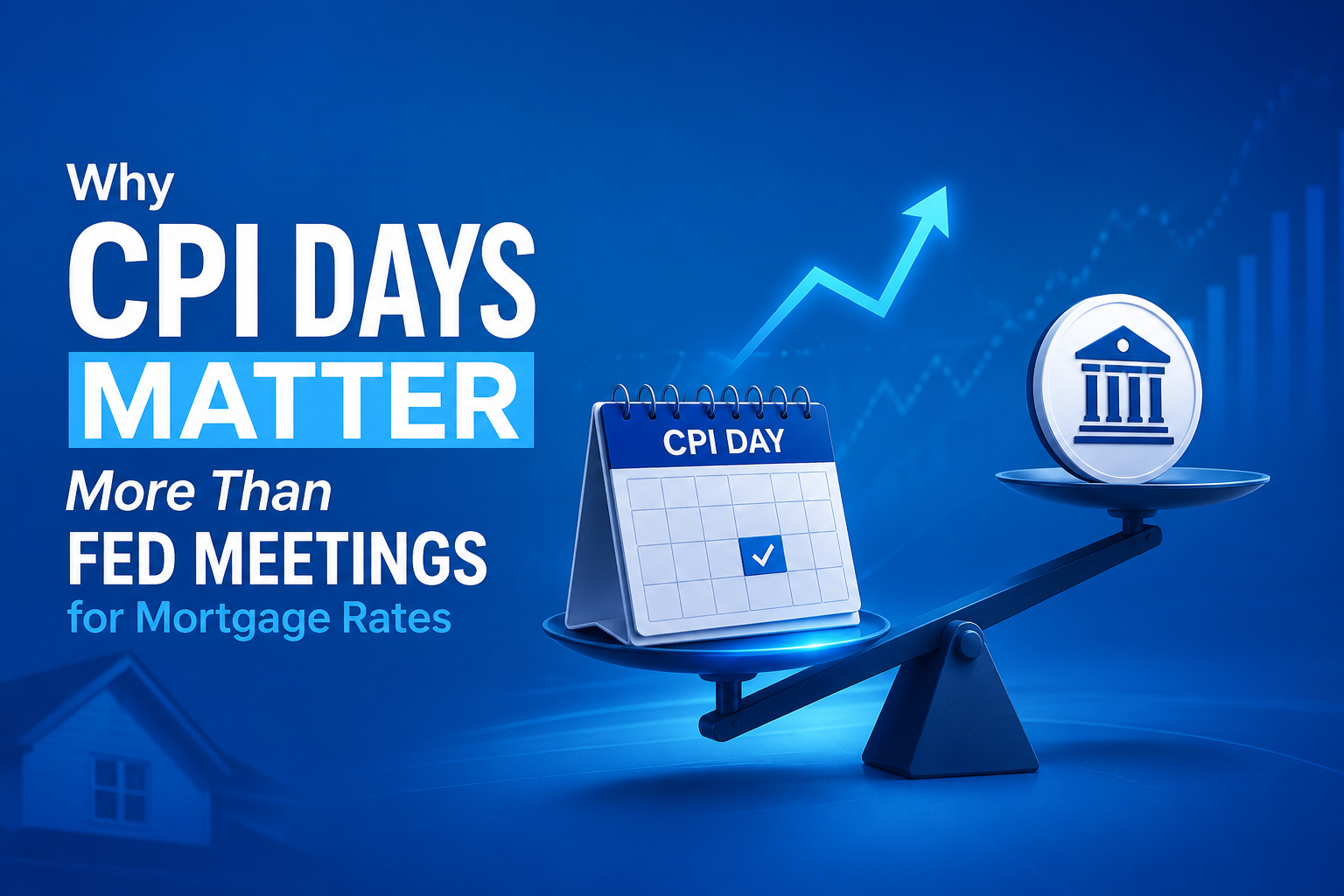
One of the most important dates on the economic calendar is Consumer Price Index (CPI) release day. For mortgage professionals, CPI often carries more weight than a Fed announcement because it changes how investors expect interest rates to behave in the future.
Section 02
Mortgage Rates Follow the Bond Market, Not the Fed Funds Rate
Many people assume the Federal Reserve directly sets mortgage rates.
It does not.

Thirty-year fixed mortgage rates are driven primarily by Mortgage-Backed Securities (MBS) and the 10-Year Treasury yield. Both markets react to inflation expectations much faster than the Federal Reserve can respond.
The Fed usually adjusts monetary policy only after reviewing months of economic data. Bond investors, however, begin pricing future expectations as soon as new information becomes available.
That is why mortgage rates often move before the Fed takes action.
Section 03
Why CPI Has Such a Strong Impact
CPI measures inflation
The Consumer Price Index measures how prices change across a wide range of goods and services.
Higher inflation reduces the future purchasing power of fixed-income investments such as Treasury bonds and mortgage-backed securities.
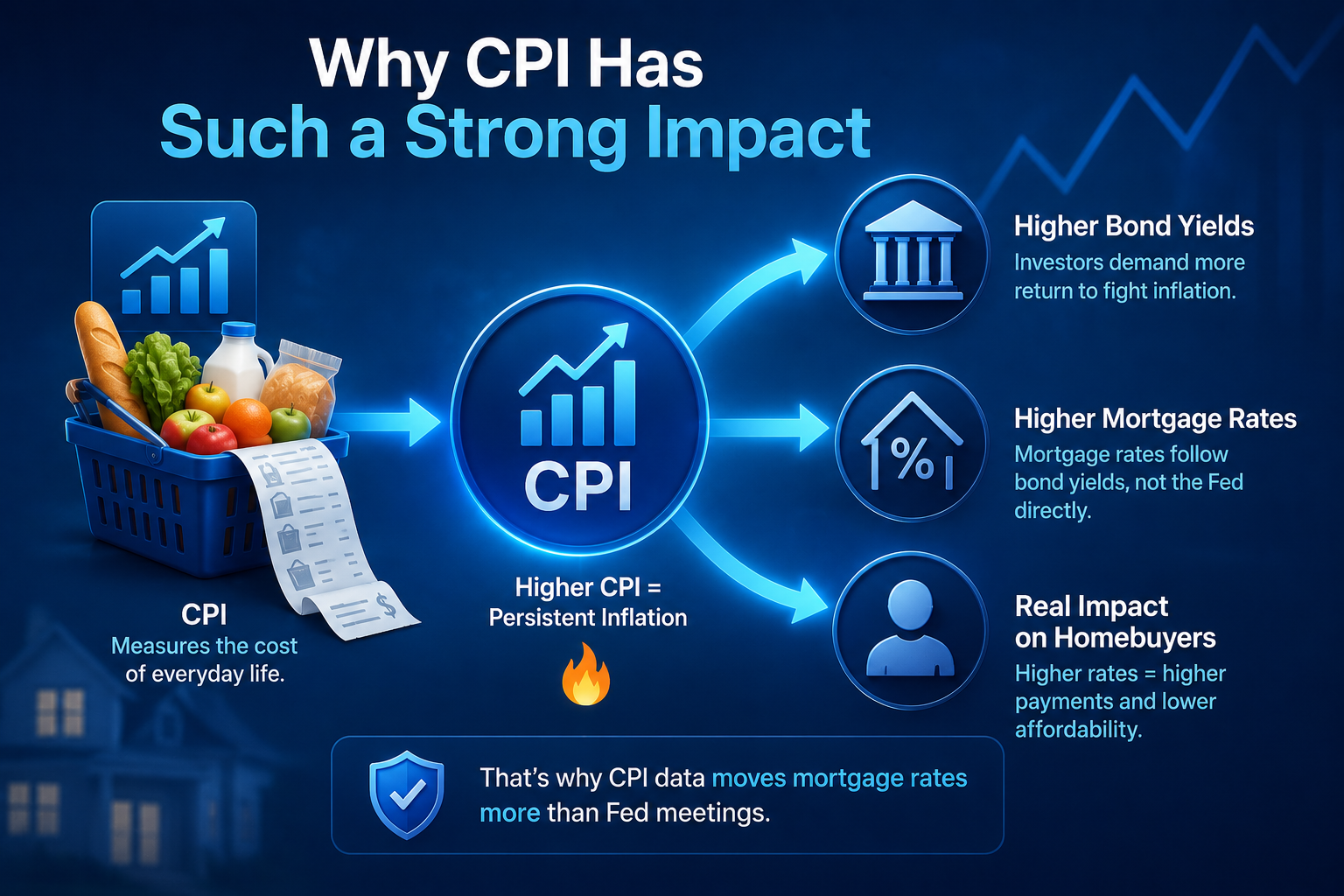
As a result, investors usually demand higher yields to compensate for inflation risk.
Higher bond yields generally lead to higher mortgage rates.
Markets react to surprises, not headlines
The market already knows when the CPI report will be released.
What investors do not know is whether inflation will come in above or below expectations.
Suppose economists expect annual CPI to increase by 2.8%, but the actual report shows 3.2%.
That difference may cause Treasury yields to rise immediately because investors expect inflation to remain elevated. Mortgage-backed securities may decline in value, causing mortgage rates to move higher on the same day.
If CPI comes in below expectations, the opposite may happen.
Note: The figures above are hypothetical examples for educational purposes only.
Why Fed Meetings Sometimes Have Little Impact
By the time the Federal Reserve announces a rate decision, financial markets have often priced in the expected outcome.
Imagine the market is almost certain the Fed will leave rates unchanged.
When the announcement confirms that expectation, Treasury yields may barely move because investors already anticipated the decision.
Instead, the biggest market reaction often comes from the Fed Chair’s comments about future inflation, employment, and monetary policy.
Even then, markets continue to focus on incoming economic data because future CPI reports may change those expectations again.
Section 04
A Simple Example
Consider two different weeks.
| Event | Market Expectation | Possible Mortgage Rate Reaction |
|---|---|---|
| Fed meeting with expected decision | Fully priced in | Small movement |
| CPI report above expectations | Unexpected inflation | Rates may rise noticeably |
This is why mortgage professionals often pay closer attention to CPI release days than to routine Fed meetings.
The inflation report has the potential to change the market’s outlook within minutes.
Section 05
Mortgage Professionals Watch More Than One Inflation Report
Although CPI receives the most attention, it is not the only inflation measure.
Many analysts also monitor:
- Consumer Price Index (CPI)
- Core CPI
- Personal Consumption Expenditures (PCE)
- Producer Price Index (PPI)
- Average Hourly Earnings
Each report provides another piece of the inflation picture.
Markets evaluate all of them when estimating future Federal Reserve policy and long-term interest rates.
Section 06
What Homebuyers Should Learn
Trying to predict mortgage rates based only on Fed meetings can be misleading.
A better approach is to understand the economic reports that influence bond investors.
If inflation continues to cool, mortgage rates may improve even before the Federal Reserve announces another rate cut.
If inflation remains stubbornly high, mortgage rates may stay elevated despite expectations for future easing.
That is why experienced loan officers often discuss inflation reports, Treasury yields, and mortgage-backed securities when explaining daily rate movements.
Section 07
Final Thoughts
Federal Reserve meetings remain important because they shape long-term monetary policy. However, mortgage rates respond to financial markets, and financial markets react quickly to new inflation data.
For that reason, CPI release days often have a greater short-term impact on mortgage rates than the Fed meeting itself. Understanding this relationship helps borrowers focus on the economic data that truly drives mortgage pricing instead of watching only the Fed’s calendar.
Disclaimer: Wonder Rates NMLS #1518655, Duc Pham NMLS #844897. Equal Housing Lender. Rates and terms are subject to change. This article is for educational purposes only and should not be considered financial, tax, or legal advice. Any market examples and figures in this article are hypothetical unless otherwise noted.