
Section 01
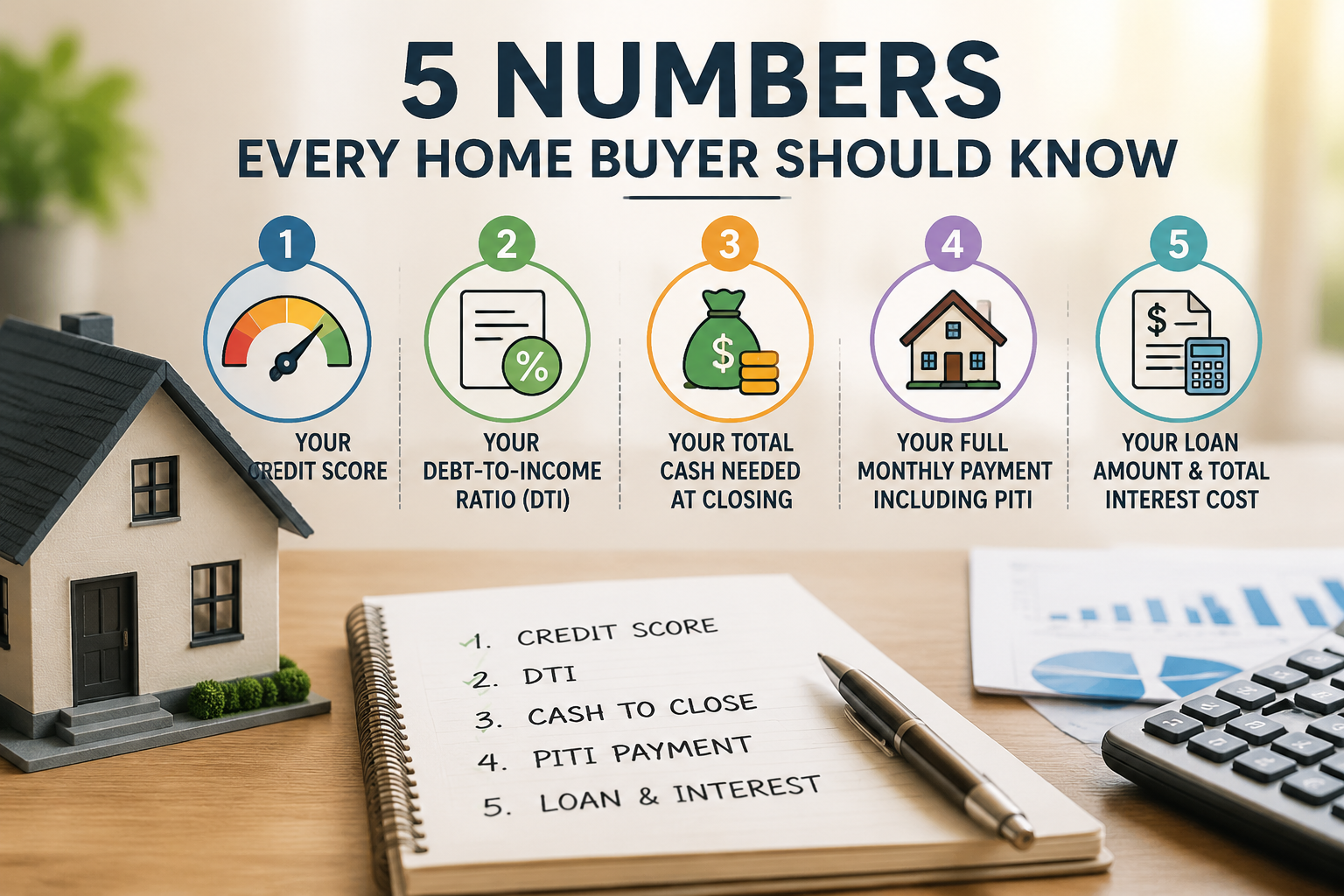
5 numbers every home buyer should know can completely change how you understand what you can actually afford when buying a home.
Most people start the homebuying process focused on one number: the purchase price.
It makes sense. The price of the home is the most visible figure in the whole transaction. It is what gets listed, what gets negotiated, and what everyone talks about at the dinner table.
But the purchase price is actually one of the least useful numbers for understanding whether you can buy a home and what it will cost you. There are five other numbers that matter more, and most first-time buyers do not know all of them before they start the process.
Here they are.
Reader checklist
Section 02
Number 1: Your Credit Score (One of the 5 Numbers Every Home Buyers Should Know)
Not an estimate. Your actual FICO score from all three bureaus.
Your credit score determines two things simultaneously: whether you qualify for a loan at all and what interest rate you are offered if you do. Both of those outcomes have enormous financial consequences, and neither one is negotiable once your application is submitted.
The difference between a 680 score and a 760 score on a $300,000 loan can be approximately 0.5% in rate, which translates to roughly $94 per month in payment and more than $33,800 over the life of a 30-year loan.
| Credit Score Range | Loan Options | Approximate Rate Impact vs 760+ |
|---|---|---|
| 760 and above | All programs, best pricing | Baseline |
| 720 to 759 | All programs | +0.25% approximately |
| 680 to 719 | All programs | +0.50% approximately |
| 640 to 679 | FHA, VA, limited conventional | +0.75% approximately |
| 620 to 639 | FHA, VA, some conventional | +1.00% or more |
| Below 580 | Very limited options | Significantly higher |
Rate impact estimates are illustrative and based on typical pricing tier differences. Actual differences vary by lender, loan program, and full borrower profile. These figures do not constitute an offer of credit.
You should know your score before you talk to any lender, not after. Pull your credit reports from annualcreditreport.com to review your credit history and check for errors. For your mortgage FICO score, you can purchase it through myFICO or ask your loan officer to pull it for you.
Section 03
Number 2: Your Debt-to-Income Ratio
If you’re unsure how DTI is calculated or why it matters so much, read what debt-to-income ratio means and how lenders use it. It is the number lenders use to determine how much you can borrow, and it is often the reason people qualify for less than they expected.
Back-end DTI, which is the one lenders focus on, includes the proposed housing payment plus every other recurring monthly debt obligation: car loans, student loans, credit card minimums, personal loans, and anything else that shows up on your credit report.
Most conventional loans allow a back-end DTI up to 45% to 50% with strong compensating factors. FHA can go somewhat higher in certain cases.
| Gross Monthly Income | 45% DTI Ceiling | Existing Monthly Debts | Maximum Housing Payment |
|---|---|---|---|
| $5,500 | $2,475 | $450 | $2,025 |
| $7,000 | $3,150 | $600 | $2,550 |
| $9,000 | $4,050 | $800 | $3,250 |
| $11,000 | $4,950 | $1,000 | $3,950 |
Illustrative examples based on 45% back-end DTI. Actual qualifying limits vary by loan program, lender, and compensating factors. These figures do not constitute an offer of credit.
Calculate your own DTI before you apply: add up all your current monthly minimum debt payments, divide by your gross monthly income, and multiply by 100. That percentage tells you how much of your DTI ceiling is already spoken for before the housing payment enters the picture.
Section 04
Number 3: Your Total Cash Needed at Closing
Most buyers know they need a down payment. Fewer know that closing costs are a separate, significant expense paid at the same time.
Closing costs typically run 2% to 5% of the purchase price and include lender fees, title insurance, appraisal, prepaid taxes and insurance, and other charges. They are not optional, and they are not included in your loan.
On a $300,000 home with 5% down, you need $15,000 for the down payment and an additional $6,000 to $15,000 for closing costs. Total cash needed: $21,000 to $30,000.
| Purchase Price | Down Payment (5%) | Closing Costs (2% to 5%) | Total Cash Needed |
|---|---|---|---|
| $250,000 | $12,500 | $5,000 to $12,500 | $17,500 to $25,000 |
| $300,000 | $15,000 | $6,000 to $15,000 | $21,000 to $30,000 |
| $400,000 | $20,000 | $8,000 to $20,000 | $28,000 to $40,000 |
| $500,000 | $25,000 | $10,000 to $25,000 | $35,000 to $50,000 |
Figures are illustrative estimates. Actual closing costs vary by location, lender, loan program, and transaction specifics. Seller concessions, down payment assistance, and gift funds may reduce out-of-pocket requirements. These figures do not constitute an offer of credit.
Knowing this number early prevents the most common budget surprise in the homebuying process, which is discovering two weeks before closing that you need significantly more cash than you planned for.
Section 05
Number 4: Your Full Monthly Payment Including PITI
The monthly payment your lender quotes you in early conversations is often just principal and interest. The full monthly housing cost includes three more components that add up quickly.
Property taxes are assessed as a percentage of your home’s value and vary significantly by location, ranging from under 0.3% annually in some states to over 2% in others. The national average is approximately 1.1% annually. On a $300,000 home, that is $3,300 per year, or $275 per month.
Homeowner’s insurance averages approximately $1,200 to $2,000 per year nationally depending on location and coverage, adding roughly $100 to $167 per month.
Private mortgage insurance applies if your down payment is below 20% on a conventional loan, typically costing 0.5% to 1.5% of the loan amount annually. On a $285,000 loan with 0.8% PMI, that is $2,280 per year, or $190 per month.
| Payment Component | Monthly Estimate on $300K Home, 5% Down, 6.0% Rate |
|---|---|
| Principal and interest ($285K loan at 6.0%) | $1,709 |
| Property taxes (1.1% annually) | $275 |
| Homeowner’s insurance | $133 |
| PMI (0.8% on $285K loan) | $190 |
| Total PITI | $2,307 |
All figures are illustrative estimates. Actual costs vary significantly by location, lender, credit score, and coverage choices. These figures do not constitute an offer of credit.
The gap between the P&I quote and the full PITI payment is often $400 to $600 per month. Knowing the full number before you set your budget prevents a significant planning error.
Section 06
Number 5: How Long You Plan to Stay
This one is not a financial ratio or a score. It is a timeline, and it matters more than most buyers realize.
Buying a home comes with significant upfront costs, primarily closing costs, that are not recouped immediately. The longer you stay in the home, the more those costs are spread out over time and the more equity you build through both principal paydown and appreciation.
A useful way to think about it: if you buy and sell within two to three years, the closing costs you paid to buy plus the selling costs you pay when you leave, typically 6% to 10% of the sale price, can consume most or all of the equity you built in that short window. In some cases you break even or come out slightly behind.
| Planned Stay | Buying Generally Makes Sense | Notes |
|---|---|---|
| Under 2 years | Rarely | Costs rarely recovered in time |
| 2 to 3 years | Sometimes | Depends heavily on market appreciation |
| 3 to 5 years | Often | Equity begins to outpace transaction costs |
| 5 years or more | Usually | Long-term equity building is most reliable |
This table provides general guidance only. Actual outcomes depend on market conditions, appreciation rates, loan terms, and individual circumstances. Real estate is not a guaranteed investment.
If you are uncertain how long you will stay in an area, that uncertainty is worth factoring into your decision before you buy, not after. A buyer who plans to move in 18 months might be better served by renting a little longer, not because buying is wrong but because the math of short-term ownership is harder to make work.
Section 07
Frequently Asked Questions
What is the difference between gross income and net income when lenders calculate DTI?
Lenders calculate DTI using gross income, your income before taxes and deductions, not your take-home pay. For example, if you earn $6,000 gross but take home $4,500, your DTI is based on the full $6,000. This often means you may qualify for more than your net income suggests.
If I put less than 20% down, is PMI permanent?
No. On conventional loans, PMI can usually be removed once you reach 20% equity, and lenders must automatically cancel it at 78% loan-to-value if you’re current on payments. For most FHA loans with less than 10% down, MIP typically lasts for the life of the loan unless you refinance into a conventional loan.
How do I know if a purchase price is actually affordable for my income before I talk to a lender?
A good starting point is to keep your total monthly housing payment (PITI) under 28% of your gross monthly income. For example, if you earn $7,000 per month, aim to keep PITI around $1,960 or less. This is only a planning guideline, but it provides a realistic estimate before applying for a mortgage.
Section 08
Final Thoughts
Before you start touring homes or browsing listings, know your five numbers first.
A 20-minute conversation can help you understand what you may qualify for, how much cash you’ll likely need, and what your monthly payment could look like, so you can shop with confidence instead of guessing.
Send a message to Duc or the Wonder Rates team. We’ll walk through your five numbers together and help you understand your options before you make one of the biggest financial decisions of your life.
All figures, calculations, and examples in this article are for illustrative and educational purposes only and do not constitute an offer of credit or financial advice. Credit score requirements, DTI limits, closing cost estimates, PMI rates, property tax rates, and insurance costs vary significantly by location, lender, loan program, and individual borrower profile and are subject to change. Consult your loan officer for guidance specific to your situation.
Duc Pham, Mortgage Broker | NMLS# 844897 | Wonder Rates, Inc. | NMLS# 1518655 | DRE# 02047445 | DFPI# 60DBO-59134 | Equal Housing Opportunity. Equal Housing Lender. | Licensed in: AL, AZ, CA, CO, FL, GA, LA, MI, NC, OH, OK, OR, PA, SC, TX, VA, WA.