
Section 01
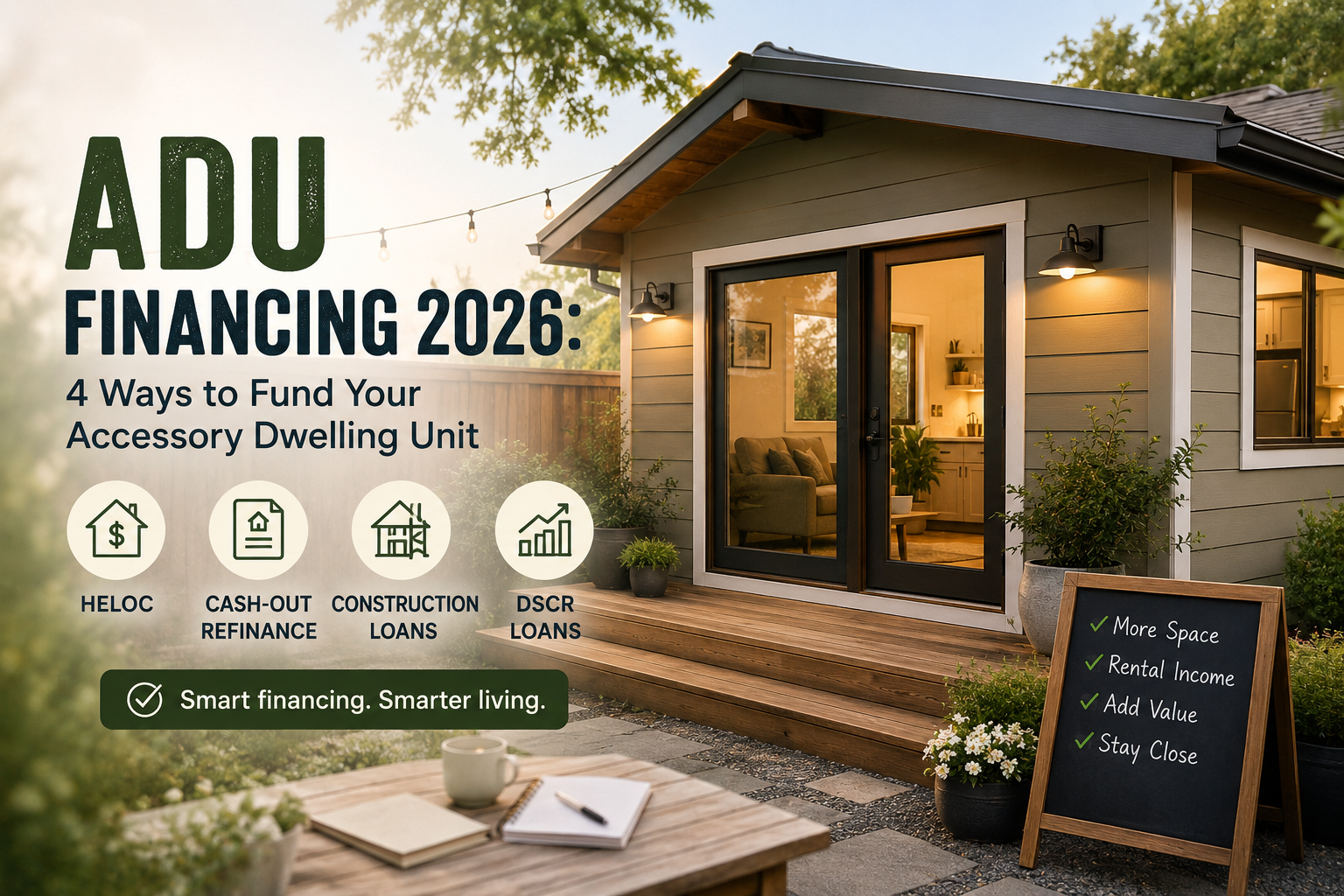
Many homeowners are sitting on an asset they have never used: the backyard. ADU financing is how that space turns into extra income or extra room for family, without buying a second property. An ADU, short for accessory dwelling unit, is a small second home built on the same lot as your main house. It might be a detached unit in the backyard, a unit attached to the garage, or converted space inside your existing home. This guide gets straight to the part that matters most: where the money comes from, and how to tell if an ADU is actually worth building.
Section 02
Why ADU Financing Is Getting More Attention
ADUs solve two very real needs at once.
The first is space for extended family. Aging parents want to stay close to their kids but still need privacy. Adult children want to move out but are not ready to buy in an expensive market. An ADU lets everyone stay close without crowding into one house.
The second is cash flow. A rented ADU can generate monthly income that offsets some, or all, of your mortgage payment. Many real estate professionals now treat ADU financing as a way to increase a property’s value. It does this without requiring you to buy an entirely separate rental.
Section 03
What Does an ADU Cost to Build?
Based on real data from ADU builders across the Bay Area, a quality ADU typically costs between $150,000 and $400,000 to complete. The exact cost depends on size, materials, and how complicated permitting is in a given city. A full project, from design through permitting to construction, usually takes 8 to 12 months.
These are general market figures, not a quote. Your actual cost depends on your builder, your city, and the design you choose.
Section 04
4 ADU Financing Options, and Who Each One Fits
1. HELOC (Home Equity Line of Credit)
This is one of the most common ADU financing options for homeowners who have built up equity. A HELOC gives you a credit line based on your home’s equity. You draw funds in stages as construction progresses, instead of borrowing everything up front. A HELOC gives you a credit line based on your home’s equity. You draw funds in stages as construction progresses, instead of borrowing everything up front.
The advantage is that you only pay interest on what you have actually drawn, not on your full credit limit. If your builder invoices in stages, say once the foundation is done and again once framing is complete, a HELOC lines up naturally with that payment schedule. The tradeoff is that HELOC rates are usually variable, so your payment can shift as the market moves. See the full breakdown of how HELOCs work, including fees and draw periods, in our guide to HELOC and home equity loans.
2. Cash-Out Refinance
This is the second most common option. Instead of adding a new line of credit on top of your mortgage, a cash-out refinance replaces your entire mortgage with a larger one. You receive the difference in cash to fund the ADU.
This route tends to make sense if your current mortgage rate is higher than today’s market rate, since you get to improve your rate on the whole loan at the same time. If your current rate is already low, a cash-out refinance can work against you. You would be giving up that low rate on your full balance, not just on the new amount you are borrowing.
3. ADU-Specific Construction Loans
Some lenders offer loans built specifically for ADU construction. These are usually structured as construction-to-permanent financing. Funds are released in stages during the build, then the loan automatically converts into a standard long-term loan once construction is finished.
This type of ADU financing can work well for homeowners without much built-up equity yet. It also suits anyone who wants to keep the ADU loan separate from their primary mortgage. The tradeoff is a more involved approval process than a HELOC or cash-out refinance, and not every lender offers this product.
4. DSCR Loans, If Rental Income Is the Goal
If the main purpose of the ADU is to generate rental income, some investors use a DSCR loan. This loan qualifies you based on the property’s expected rent rather than your personal income. It can be a strong fit for investors who already own other rental property. It also fits investors whose personal income does not reflect their real ability to repay.
To understand exactly how DSCR qualification works, see our full guide to DSCR loan requirements.
Quick Comparison
| ADU Financing Option | How Funds Are Released | Rate Type | Best Fit |
|---|---|---|---|
| HELOC | In stages, as construction progresses | Usually variable | Homeowners with equity who want flexibility |
| Cash-out refinance | One lump sum at closing | Usually fixed | Homeowners who can also improve their mortgage rate |
| ADU-specific construction loan | In stages, then converts to a permanent loan | Varies by lender | Homeowners without much equity yet |
| DSCR loan | Varies by lender structure | Usually higher than conventional | Investors building an ADU mainly to rent it out |
This is a general market comparison, not a quote or commitment from Wonder Rates. Actual terms depend on your lender and your specific financial profile.
Section 05
How to Tell If an ADU Is Worth Building
Before you build, the most important question is not “how much will this cost,” but “will the rent cover the monthly cost of financing it.”
Here is the simple version: take the ADU’s expected monthly rent, then subtract the monthly payment on whatever you used to finance it. If the number left over is positive, the ADU is paying for itself, and possibly generating extra cash flow every month. If the number is negative, you need to be clear about why you are building it. Is it for family housing, or for long-term property value, rather than monthly income? This is a similar distinction to cash flow versus appreciation when investing in a rental property.
Also budget for the costs that come with renting out an ADU. These include higher property taxes after the improvement is assessed, insurance, ongoing maintenance, and vacancy between tenants. Rental income from an ADU is generally taxable. Talk to a tax professional about how it affects your specific return before you commit.
Section 06
Frequently Asked Questions
Do I need a permit to build an ADU?
Yes. Every ADU in California requires a building permit from the city or county. State ADU law has simplified many of the rules in recent years, but each city still runs its own permitting process. Full detail is available in California’s official ADU Handbook.
How long does it take to build an ADU?
From design through permitting to completed construction, a typical Bay Area ADU project takes about 8 to 12 months. Timelines can run longer depending on the city and the complexity of the design.
Will building an ADU increase my property taxes?
Usually, yes. The added value from the new ADU is typically reassessed and added to your existing property tax bill. The exact increase depends on your county, so check with your local county assessor’s office for a specific number.
Should I use a HELOC or a cash-out refinance to fund an ADU?
If your current mortgage rate is already low, a HELOC is usually the better fit, since it leaves your existing rate untouched. If your current rate is higher than today’s market, a cash-out refinance can let you improve your rate on the whole loan while also funding the ADU. See our Home Equity Calculator to compare scenarios side by side.
Do I have to rent out my ADU?
No. Many homeowners build an ADU purely for family, such as housing for aging parents or adult children, with no plan to rent it out. Your intended use affects how you should evaluate whether the ADU is worth building, and can also affect which financing option fits best.
Do I have to live on the property to build an ADU?
Under current California ADU law, the owner-occupancy requirement has been removed in most cases. Local rules can still vary, so it is worth confirming with your specific city before you plan your project.
Next Steps
If you are considering ADU financing, the first step is getting clear on your goal: housing for family, rental income, or both. That decision shapes which financing option actually fits your situation.
Wonder Rates can help you review your available equity and compare HELOC and cash-out refinance scenarios side by side before you start working with a builder.
[Talk to a loan officer about ADU financing →]
Duc Pham, Mortgage Broker | NMLS# 844897
Wonder Rates, Inc. | NMLS# 1518655
Equal Housing Lender.
AZ, CA, CO, FL, GA, LA , MI, OK, PA, SC, TX, VA, WA, OH, AL, OR, NC
This article is for educational purposes only and is not a commitment to lend. Loan approval is subject to creditworthiness, income verification, property eligibility, and current underwriting guidelines. Loan programs, interest rates, and lender fees may change without notice. Always review your official Loan Estimate before making a financing decision.