
Section 01
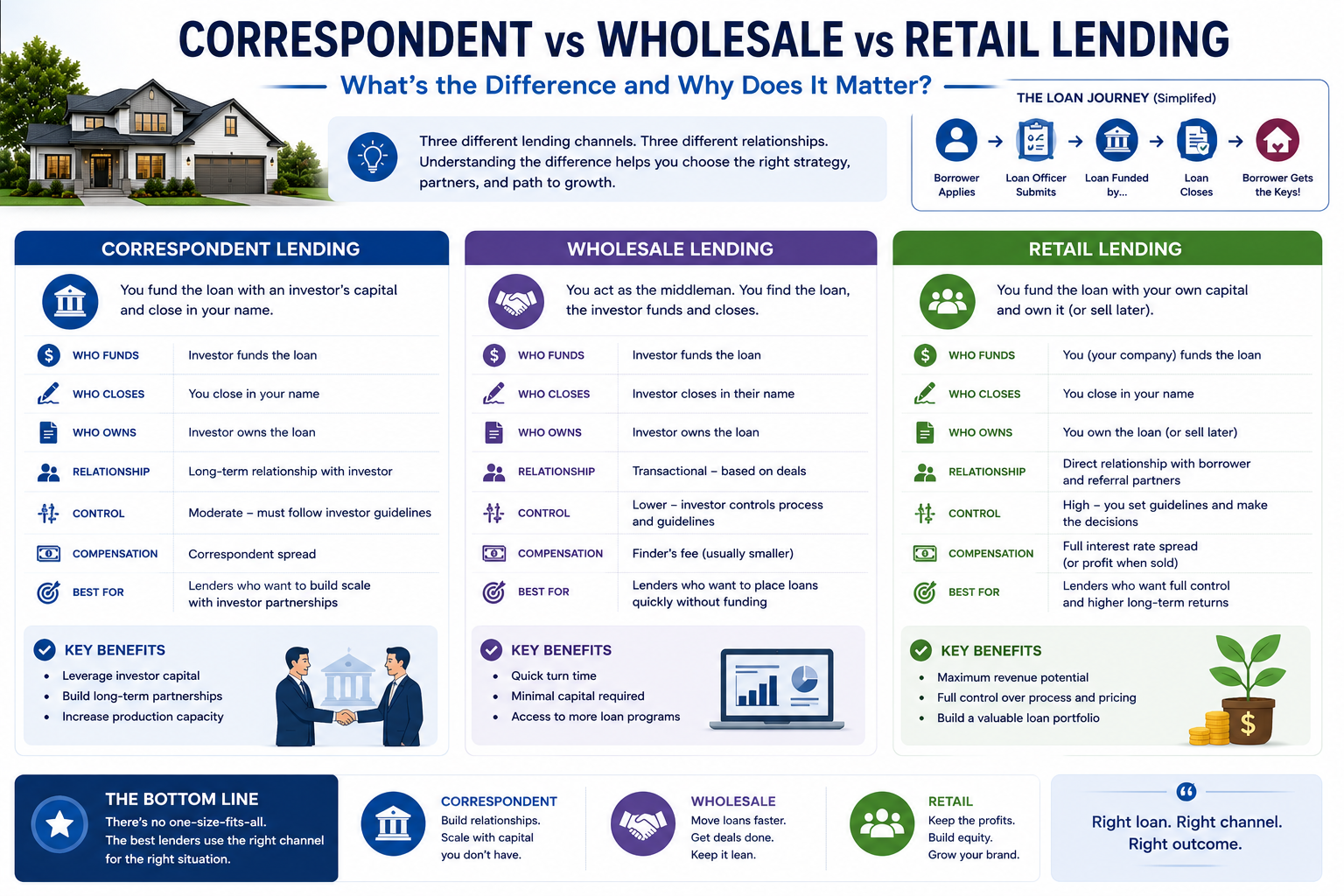
Correspondent vs Wholesale and Retail Lending: What's the Difference and Why Does It Matter?
When most people shop for a mortgage, they compare interest rates, monthly payments, and closing costs. Those numbers are important, but they don’t tell the whole story.
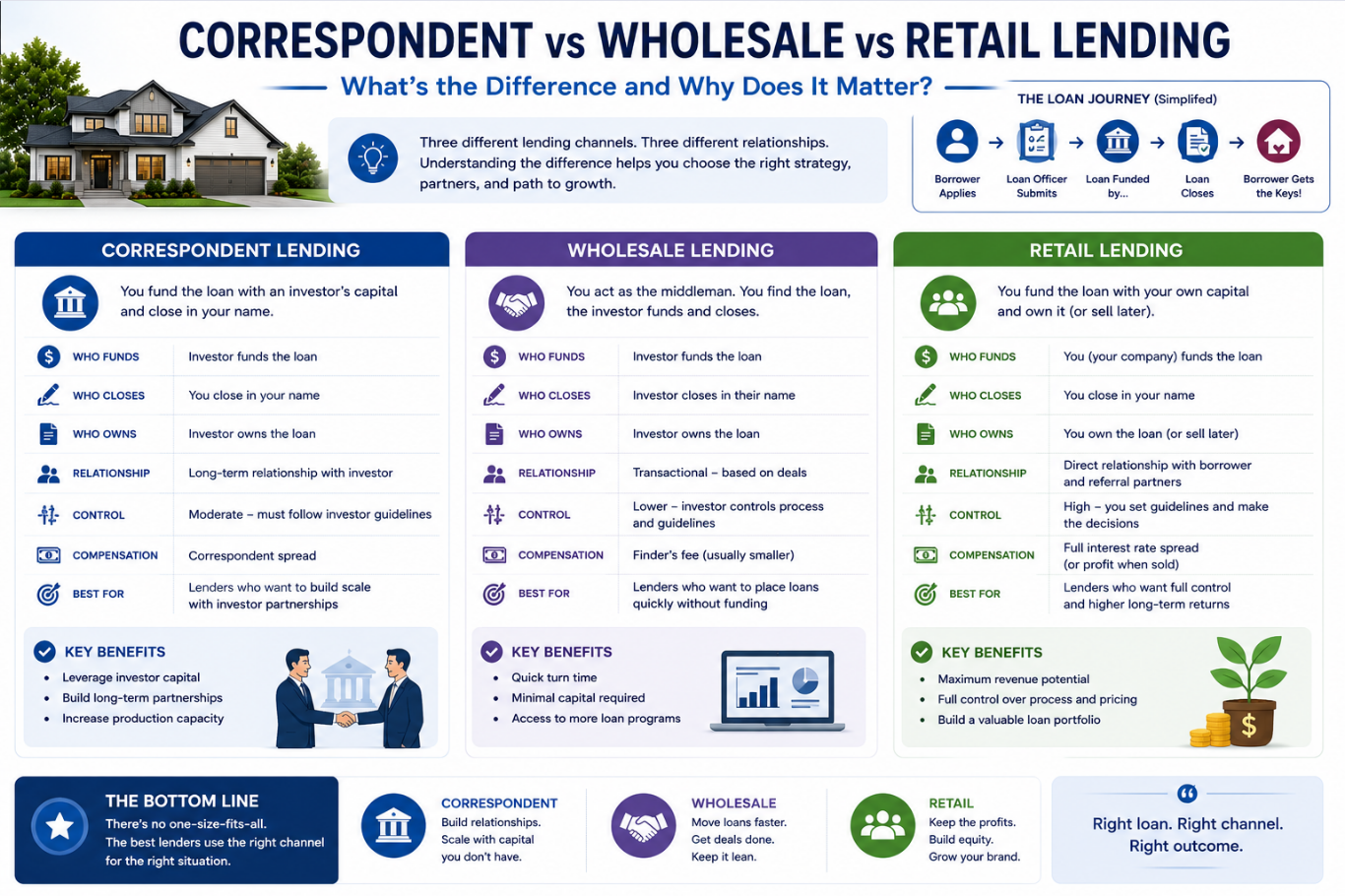
There’s another question that many borrowers never ask:
Who is actually making the loan?
The answer is often more complicated than it looks. The company you work with may not be the one providing the money. It may not be the company making the underwriting decision. In many cases, it won’t even own your mortgage a few weeks after closing.
That’s because home loans move through different lending channels. The three most common are retail lending, wholesale lending, and correspondent lending.
Understanding these channels won’t change your interest rate overnight. However, it will help you understand why lenders price loans differently, why underwriting experiences vary, and why two companies can offer different solutions for the same borrower.
Section 02
Understanding the Three Main Mortgage Lending Channels
Each lending channel follows the same goal—helping borrowers finance a home—but the process behind the scenes is very different.
Retail lending: You work directly with the lender
Retail lending is the model most borrowers recognize.
You apply directly with a bank, credit union, or mortgage lender. That company handles most of the process, including processing, underwriting, funding, and closing.
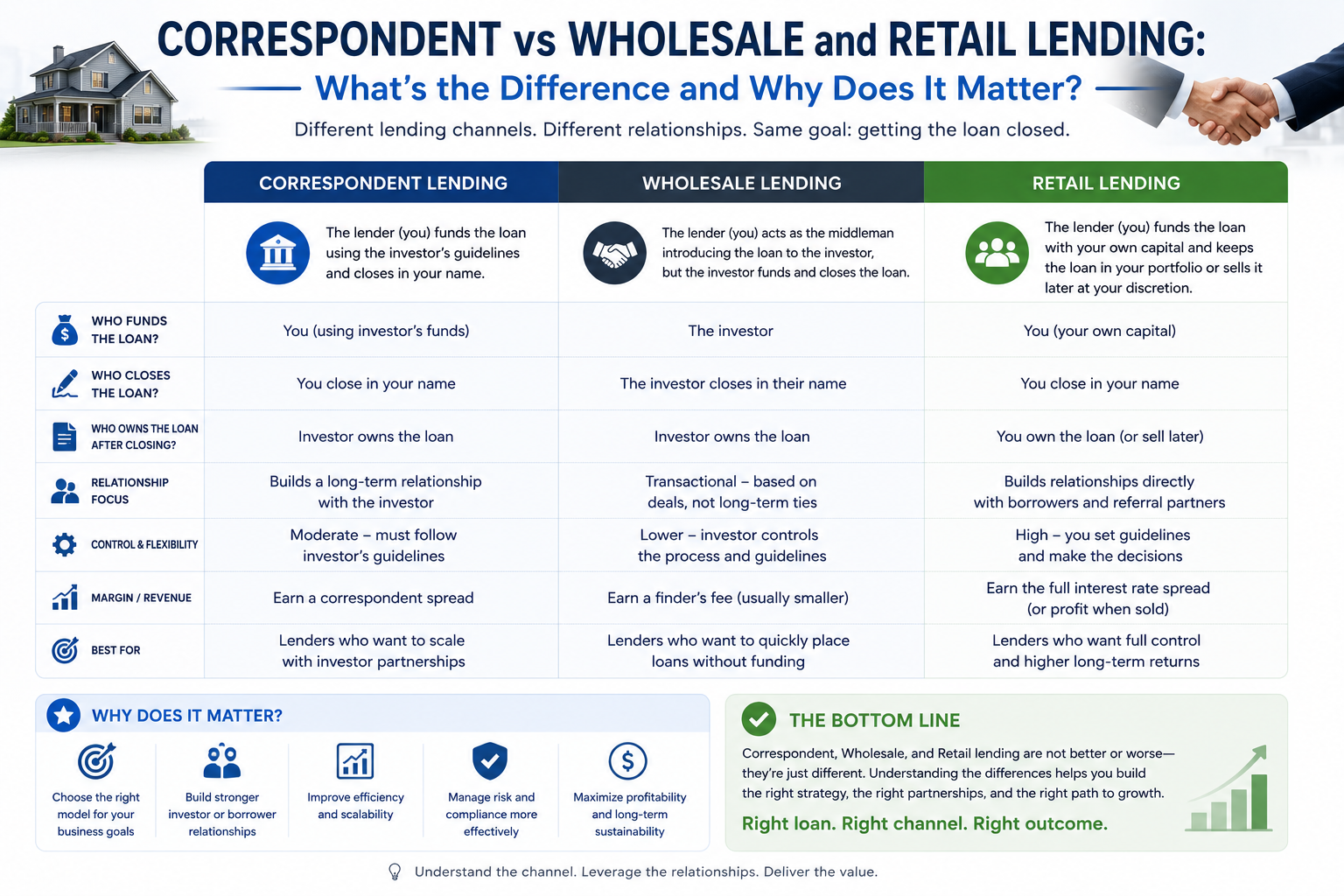
Because everything stays inside one organization, communication is often straightforward. The trade-off is that you’re usually limited to that lender’s products and pricing.
If the lender doesn’t offer a program that fits your situation, you may need to start over somewhere else.
Wholesale lending: A mortgage broker shops for you
Wholesale lending works differently.
Instead of applying directly with one lender, you work with a mortgage broker. The broker reviews your financial profile and compares loan options from multiple wholesale lenders.
Once the best option is selected, the wholesale lender underwrites and funds the loan, while the broker continues to guide you through the process.
Think of it this way.
A retail lender offers its own menu.
A mortgage broker can compare several menus before helping you choose the one that fits your needs.
Section 03
Correspondent Lending: The Channel Many Borrowers Never Notice
What is a correspondent lender?
A correspondent lender sits somewhere between a retail lender and a mortgage broker.
Like a retail lender, the company originates the loan in its own name and closes the transaction directly with the borrower.
Unlike many banks, however, it usually doesn’t plan to keep that loan for the next 30 years.
After closing, the loan is often sold to a larger investor.
From the borrower’s point of view, nothing changes during closing. Behind the scenes, though, the loan may already be preparing for its next owner.
Why do correspondent lenders sell loans?
The answer is simple: capital.
Mortgage lending requires a large amount of cash. If a lender keeps every 30-year mortgage on its balance sheet, it will eventually run out of money to make new loans.
By selling closed loans into the secondary mortgage market, correspondent lenders recover their capital and can continue lending to new borrowers.
This model keeps money flowing through the housing market instead of locking it into long-term loans.
Section 04
The Biggest Difference Isn't Who You Meet It's Who Takes the Risk
Retail lenders control most of the process
In retail lending, one company manages almost everything.
That usually includes:
- loan application;
- document collection;
- underwriting;
- funding;
- closing;
- post-closing support.
Even if the loan is sold later, the borrower experiences one consistent process from start to finish.
Wholesale lending separates customer service from underwriting
Wholesale lending divides responsibilities.
The mortgage broker works with the borrower, explains loan options, collects documents, and helps solve problems.
The wholesale lender focuses on reviewing risk, approving the loan, and providing the funds.
This allows each side to specialize in what they do best.
For borrowers, it often means access to more loan options without applying separately to several lenders.
Section 05
Why Can Two Lenders Offer Different Rates for the Same Loan?
Many borrowers assume every lender should offer the same interest rate if the loan program is identical.
In reality, mortgage pricing depends on much more than the loan itself.
Each lender has different:
- operating costs;
- investor relationships;
- risk management strategies;
- funding costs;
- servicing plans.
Those differences affect how loans are priced.
For example, imagine two borrowers with identical credit scores, income, and down payments applying for the same Conventional loan.
One lender may offer a slightly lower rate but charge higher lender fees.
Another may offer a slightly higher rate while reducing upfront closing costs.
Both loans could be financially competitive. They’re simply built using different pricing strategies
Section 06
Why the Secondary Mortgage Market Matters
Most mortgages don’t stay with the original lender
Many borrowers believe they’ll make payments to the same company that approved their loan.
Sometimes that’s true.
Often, it isn’t.
After closing, many mortgages are sold to larger investors or packaged into Mortgage-Backed Securities (MBS).
This process allows lenders to recover their money and make new loans to future borrowers.
Without a healthy secondary market, mortgage lending would slow dramatically because lenders would have far less capital available.
Better investor relationships can improve pricing
Not every lender has access to the same investors.
Some companies can sell loans more efficiently than others.
That may lower their overall costs and allow them to offer more competitive pricing.
This helps explain why two lenders reviewing nearly identical borrowers can still produce different Loan Estimates.
The difference isn’t always underwriting.
Sometimes it’s what happens after the loan closes.
Section 07
Which Lending Channel Offers More Flexible Underwriting?
There isn’t one simple answer.
Many borrowers assume mortgage brokers always have more flexibility or that banks always have stricter rules.
The reality is more nuanced.
Investor guidelines matter more than the lending channel
Most underwriting decisions follow investor guidelines rather than the business model itself.
For example, one retail lender may add extra internal requirements beyond standard agency guidelines.
Meanwhile, a wholesale lender working with a different investor may approve the exact same borrower.
The opposite can also happen.
That’s why two lenders can reach different decisions using the same credit report and financial documents.
Complex borrowers often benefit from more lending options
Suppose a self-employed business owner earns $250,000 per year, but much of that income is offset by tax deductions.
A retail bank with limited loan products may not have a program that works well for this situation.
A mortgage broker or correspondent lender may have access to Bank Statement Loans or other Non-QM programs (non-qualified mortgage) designed for borrowers with more complex income.
In cases like this, the lending channel doesn’t create flexibility on its own.
Access to the right investors does.
Section 08
Which Lending Channel Is Best?
There isn’t a single “best” lending channel.
Each one serves a different purpose.
| Borrower Situation | Lending Channel Worth Considering |
|---|---|
| Straightforward W-2 income | Retail lending may be a good fit. |
| Want to compare several lenders | Wholesale lending may provide more options. |
| Want direct closing but wider investor access | Correspondent lending may be worth exploring. |
| Self-employed or complex income | The available loan programs often matter more than the lending channel itself. |
The quality of your mortgage experience depends on much more than the type of lender.
Knowledge, communication, problem-solving, and access to the right loan products often make a much bigger difference.
Section 09
Final Thoughts
Retail, wholesale, and correspondent lending are not competing versions of the same business. They are three different ways mortgages move from borrowers to the financial markets that ultimately fund home loans.
Understanding these channels helps explain why lenders don’t always offer the same rates, why underwriting experiences vary, and why one company may be a better fit than another.
Instead of asking which lending channel is “best,” ask a better question:
Which lending channel gives me access to the right loan program, competitive pricing, and experienced professionals for my financial situation?
For most borrowers, that’s the question that leads to a better mortgage—not simply the lowest advertised interest rate.
Thinking about buying a home or refinancing? Try the Wonder Rates team’s mortgage calculator to estimate your monthly payment, then connect with Duc Pham and the Wonder Rates team for guidance on the loan options that fit your situation.
Sources
- Fannie Mae Selling Guide: sections on DTI and installment debt.
- HUD (hud.gov): Handbook 4000.1, sections on installment debt and collections for FHA loans.
Disclaimer: Rates and terms are subject to change. This article is for educational purposes only and should not be considered financial, tax, or legal advice.
Duc Pham, Mortgage Broker | NMLS# 844897,
Wonder Rates, Inc. | NMLS# 1518655 | DRE# 02047445 | DFPI# 60DBO-59134 |
Equal Housing Opportunity. Equal Housing Lender. |
Licensed in: AL, AZ, CA, CO, FL, GA, LA, MI, NC, OH, OK, OR, PA, SC, TX, VA, WA.