

Section 01
When you apply for a home loan, you may hear your loan officer say something like, “I’ll run your file through AUS.” It sounds technical, but the idea is simple. An automated underwriting system is a computer tool that helps a lender review your mortgage application. It looks at your credit, income, debts, savings, and the loan you want, and then it gives the lender a recommendation.
That recommendation matters a lot, but it isn’t the whole story. In this guide, you’ll learn what an AUS is, how it works, what its results mean, and why a lender still checks your papers after the computer weighs in.
Section 02
What Is an Automated Underwriting System (AUS)?
An automated underwriting system (AUS) is a software tool that mortgage lenders use to review a borrower’s information and the loan they want. It weighs the risk of the loan and checks whether the loan seems to fit the rules of a certain loan program or investor. Because a computer runs the same checks every time, it helps lenders review files in a more consistent and faster way.
The Consumer Financial Protection Bureau gives a formal definition in Regulation C. It describes an AUS as an electronic tool that gives a result about two things. The first is the borrower’s credit risk. The second is whether the loan is eligible to be made, bought, insured, or guaranteed by the group that built the tool.
That last part is key. Groups like Fannie Mae, Freddie Mac, and the Federal Housing Administration (FHA) set rules for loans they buy or insure. Their AUS tools check a loan against those rules.
What AUS Stands For in Mortgage Lending
AUS stands for Automated Underwriting System. Underwriting is the lender’s careful review of your loan file to decide whether it can lend to you. You may hear loan officers use phrases like “run the file through AUS,” “the AUS findings,” or “the loan got an approve finding.” All of these describe this step of the process.
AUS isn’t one single product. Different agencies have their own systems, and lenders may add their own tools and review steps on top.
What an AUS Is Designed to Do
An AUS helps a lender answer one basic question: does this loan, as entered, appear to meet the risk and eligibility rules? Along the way, it can flag risk factors, list conditions to meet, and point out the documents the lender needs to collect.
Here’s the catch. The system can only judge the information it’s given. If your income, debts, savings, or plans for the home are entered wrong, the results won’t match your real situation.
Why an AUS Result Is Not a Mortgage Approval
A good AUS result is great news, but it’s not a promise. It doesn’t guarantee you’ll get the loan, that the loan will close, or that you’ve met every paperwork rule.
The computer recommends. The lender decides.
After the AUS runs, your lender still has to check your papers, review the home, and make sure every condition is met before your loan can close.
Section 03
How Does an Automated Underwriting System Work?
An AUS doesn’t just glance at your credit score and say yes or no. It’s one step in a longer chain that starts when you apply and ends when your loan is ready to close. Here’s how that chain usually works.
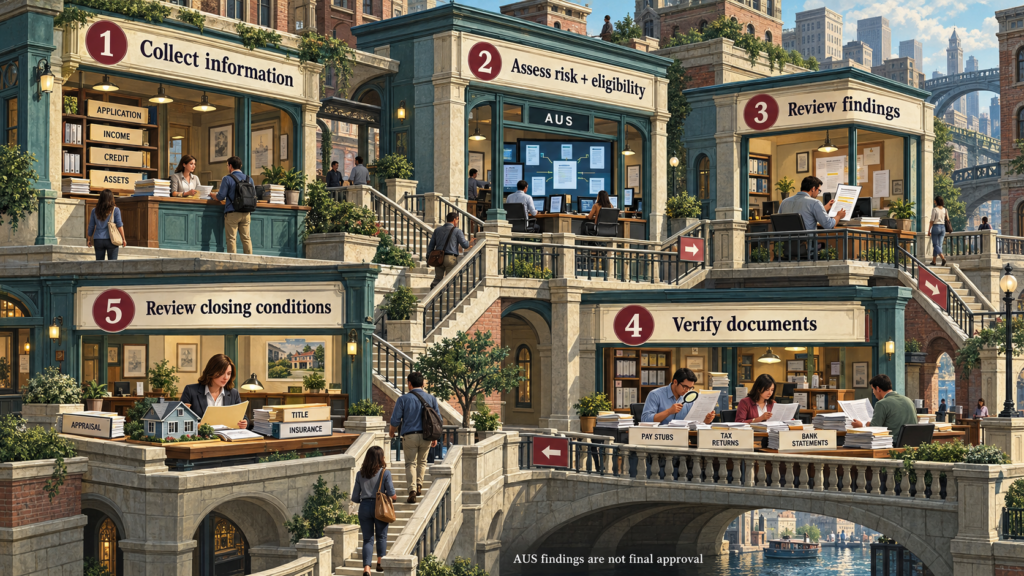
Step 1: The Lender Collects Your Information
First, your lender gathers details about you and the loan. Depending on the system and loan program, this can include:
- Your name, Social Security number, and other application details
- Your credit report and the debts on it
- Your job and income
- Your savings and the money you’ll use to buy the home
- The loan amount, your down payment, and your loan-to-value ratio
- The type of property, how you’ll use it, and the type of deal
- Any other details the system needs
Your lender or loan officer enters this data and sends it to the AUS. You won’t run the system yourself.
Step 2: The AUS Weighs Risk and Eligibility
Next, the system compares your information with its models and rules. It may point out strengths, risk factors, missing details, and conditions you’ll need to meet.
Fannie Mae says its Desktop Underwriter (DU) helps lenders assess credit risk and decide whether a loan is eligible for sale to Fannie Mae. Freddie Mac says its Loan Product Advisor (LPA) assesses risk and helps lenders check eligibility under Freddie Mac’s rules.
Step 3: The Lender Reviews the Findings
The AUS sends back a result plus a report, often called the “findings.” This report may list conditions, documents to collect, risk factors, or items that need a closer look. Your lender has to understand what those findings mean for your file, not just read the headline result.
Step 4: The Lender Checks Your Documents
Now the paperwork begins. You may need to send pay stubs, tax returns, bank statements, proof of your job, or notes about unusual deposits. The exact list depends on your loan program, your findings, and your lender’s review.
Step 5: The Lender Decides Whether the Loan Can Close
Finally, the lender works through any open conditions. It also handles the home’s appraisal, the title, insurance, and other closing tasks. Some items clear quickly, while others can change your loan’s timing or even whether it can move forward.
In short, an AUS can speed things up and keep reviews consistent. But the full mortgage decision always involves more than the computer’s result.
Section 04
Common Mortgage Automated Underwriting Systems
For most conventional loans, two systems come up again and again: Fannie Mae’s Desktop Underwriter and Freddie Mac’s Loan Product Advisor. They do similar jobs, but they’re separate tools with their own rules, results, and wording.
Fannie Mae Desktop Underwriter (DU)
Desktop Underwriter is Fannie Mae’s automated underwriting system. It helps lenders weigh credit risk and see whether a loan meets the rules for sale to Fannie Mae.
When a lender runs a loan through DU, it gets back a set of findings. These findings include a recommendation, plus the documents and conditions the lender needs to meet. Still, not every conventional loan has to go through DU. Lenders and loan programs can follow other approved paths.
Freddie Mac Loan Product Advisor (LPA)
Loan Product Advisor is Freddie Mac’s automated underwriting system. It gives lenders a read on the loan’s overall risk and checks it against Freddie Mac’s rules. Its feedback can also point out next steps for some files.
LPA also has features that can automate parts of the review of assets, income, jobs, and the home’s value when certain rules are met. These features don’t apply to every loan, though. Freddie Mac’s LPA FAQ explains that lenders must still follow its Seller/Servicer Guide.
DU vs. LPA: What Is the Difference?

| Feature | Fannie Mae DU | Freddie Mac LPA |
|---|---|---|
| Built by | Fannie Mae | Freddie Mac |
| Main job | Weighs loan risk and checks eligibility | Weighs loan risk and checks eligibility |
| Rulebook | Fannie Mae Selling Guide | Freddie Mac Seller/Servicer Guide |
| What it returns | DU findings report | LPA feedback certificate |
| Documents needed | Depends on the findings and the rules | Depends on the findings and the rules |
Neither system is “better” for everyone. Which one gets used depends on the lender, the loan program, and your file. Results from the two systems can also differ, so one system’s answer doesn’t carry over to the other.
Do All Mortgage Lenders Use the Same AUS?
No. Lenders may use different systems based on how they do business and what kind of loan you need. For example, FHA loans are scored with HUD’s TOTAL Mortgage Scorecard, which lenders reach through tools like DU or LPA. USDA loans use their own system, called GUS. Jumbo and non-QM loans (loans outside the standard agency rules) may rely on a lender’s own process or on manual underwriting, where a person reviews the file by hand.
So DU and LPA are the best known, but they’re far from the only tools in the mortgage world.
Section 05
What Information Does AUS Evaluate?
An AUS looks at many of the same things you share on your loan application. The exact mix depends on the system, the loan program, and your situation. Still, most reviews touch on the areas below, and none of them works alone. The system looks at how they fit together.
Credit History and Liabilities
Your credit report shows how you’ve handled debt in the past. The AUS may look at your payment history, the debts you owe now, and your monthly payments on things like car loans, student loans, and credit cards.
There’s no single magic credit score that guarantees a certain result. A score matters, but the loan rules and the rest of your file matter too.
Income and Employment
The system uses details about your job, the type of income you earn, and how much you make. Your lender then has to confirm that income with documents. It also checks that the income is steady and counts under the loan rules.
If you’re self-employed, earn commission, or have income that changes from month to month, expect a closer look. Your lender may need more than one simple yearly salary figure.
Assets, Down Payment, and Reserves
Assets are the money you have, like checking, savings, and investment accounts. The AUS looks at the cash you have for your down payment and closing costs. It may also look at reserves, which are savings you still have after closing. Your lender may need to confirm the accounts are yours, where the money came from, and whether you can use it for this purchase.
Debt-to-Income Ratio (DTI) and Loan-to-Value Ratio (LTV)
Two ratios get a lot of attention:
- Debt-to-income ratio (DTI) compares your monthly debt payments to your monthly income. If you earn $6,000 a month and owe $2,400 a month in debts, including your new mortgage, your DTI is 40%.
- Loan-to-value ratio (LTV) compares your loan amount to the home’s value. If you borrow $360,000 on a $400,000 home, your LTV is 90%.
Both ratios matter, but they’re not the only factors. How much each one counts depends on the system, the loan program, and the rest of your file. You can try different loan amounts and down payments with our mortgage calculator to see how your payment might change.
Property, Occupancy, and Loan Details
The home and the deal matter too. Your loan purpose, property type, how you’ll use the home, your loan amount, and your down payment can all affect eligibility. For example, a home you’ll live in, a vacation home, and a rental property often follow different rules.
The AUS findings don’t settle every property question, though. The home may still need an appraisal or another approved way to confirm its value. It will also need a title review and insurance before closing.
Section 06
Understanding AUS Findings and Recommendations
The headline result of an AUS is called a finding or recommendation. Each system uses its own words, so a term from one system doesn’t always mean the same thing in another. Here are the results you’re most likely to hear about.
Approve/Eligible
Approve/Eligible is a common result from Fannie Mae’s Desktop Underwriter. It generally means the loan got a positive recommendation and appears eligible, based on the data entered. That’s still subject to the conditions in the findings report. DU can also return this result for some FHA and VA loans it scores for those programs.
Approve/Eligible is not the same as “clear to close.” Your lender still has to verify your information, meet every listed condition, and confirm the whole deal fits the rules.
Accept Findings in Freddie Mac LPA
Freddie Mac’s Loan Product Advisor uses different words. A positive risk result is called “Accept,” while a weaker one is called “Caution.” LPA also reports whether the loan looks eligible for sale to Freddie Mac.
An Accept result is good news. Even so, your lender must still follow the feedback certificate, gather the listed documents, and meet Freddie Mac’s Guide rules. Approve/Eligible and Accept come from different systems, so they aren’t the exact same output.
Refer/Eligible
Refer/Eligible shows up most often with FHA loans, which are scored by HUD’s TOTAL Mortgage Scorecard. It means the loan may be eligible for the FHA program, but the scorecard didn’t give it an automatic approval. Under HUD’s handbook, a “Refer” loan must be reviewed by hand. This is called manual underwriting.
A Refer result is not a denial. What happens next depends on the program’s rules, what the findings show, and whether the loan can meet the stricter manual review standards.
Refer with Caution
Refer with Caution is a result from Fannie Mae’s DU. It means the loan didn’t pass DU’s risk assessment as entered. In some cases, a lender may be able to underwrite the loan by hand under Fannie Mae’s manual rules. Many loans don’t qualify for that path, though, and some lenders don’t offer it.
This result is not the same as an FHA “Refer” or an LPA “Caution.” Your lender will decide what’s allowed next based on the rules that apply to your loan.
When Findings Include Conditions or Extra Documents
Even a positive result usually comes with a to-do list. It may include conditions, documents to collect, or eligibility checks to complete.
A good finding opens the door. Your documents walk you through it.
Ask your loan officer which items are still open. It’s also smart to ask whether any of them could change your loan’s eligibility.
Section 07
AUS Approval vs. Preapproval vs. Final Mortgage Approval
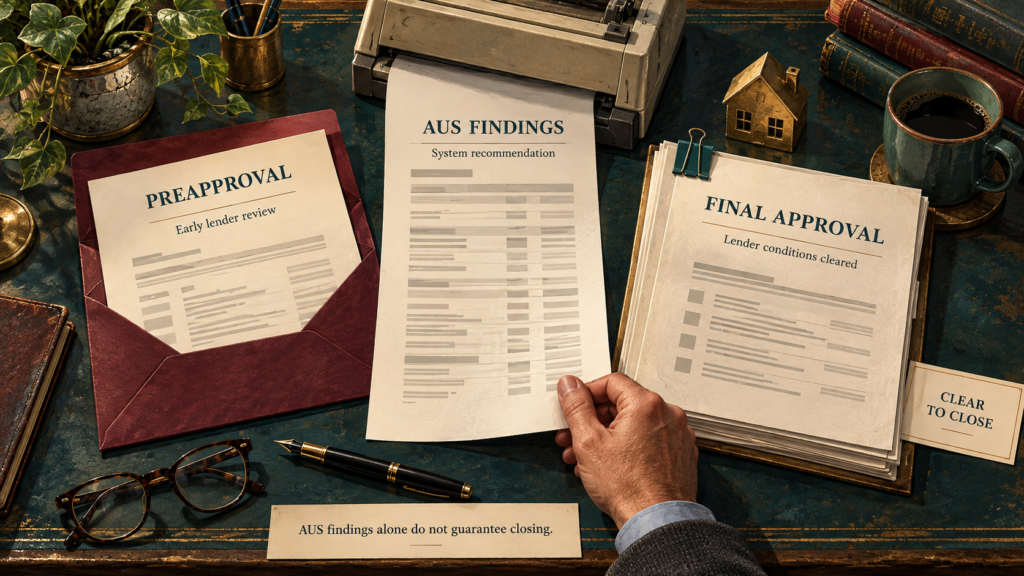
The word “approved” pops up at several points in the mortgage process, which can get confusing fast. These three terms describe different stages, so it helps to know what each one really means.
Mortgage Preapproval
A preapproval is a lender’s early look at whether you’re likely to qualify, based on what it knows so far. The CFPB explains that a preapproval letter says a lender is willing to lend you up to a certain amount, based on certain assumptions. How deep the review goes varies by lender. It may include a credit check, income papers, bank statements, and an AUS run.
A preapproval letter doesn’t guarantee your loan will close or that every detail has been fully checked.
AUS Recommendation
An AUS result is the system’s take on the loan data that was entered. It supports your lender’s review by pointing out risks, eligibility, and the papers needed.
The AUS can be run at different times. Some lenders run it during preapproval, while others run it later, after you have a signed purchase contract. Lenders often run it more than once as details change.
Final Approval and Clear to Close
Final approval means the lender has worked through the underwriting conditions and confirmed the loan meets the rules. “Clear to close” comes after that. It means the lender has signed off on your file and you can move toward your closing date, aside from a few last steps.
Even then, you’ll need to meet any closing requirements. You’ll also want to avoid big changes to your money or your job until the deal is done.
Why the Difference Matters
Don’t rely on the word “approved” alone. Instead, ask your loan officer what stage your loan is in. A good AUS finding is encouraging, but the more useful question is whether the lender has reviewed your documents and cleared all the major conditions.
Section 08
What Happens if AUS Does Not Approve the Loan?
A result that isn’t an approval doesn’t always mean you can never get a mortgage. It means the loan, as it was entered, didn’t get the result you hoped for under that system and those rules. The best first step is to understand why before you assume the door is closed.
Review the Findings With Your Loan Officer
Ask which factors or conditions affected your result. Depending on the system, the findings may point to risk factors, missing details, or eligibility issues.
Keep in mind that your lender can’t always explain every detail of how the system’s model works. And not every issue can be fixed. But a clear talk with your loan officer will show you where you stand.
Check the Information That Was Entered
Mistakes happen. A wrong income figure, a debt listed twice, a missing asset, or the wrong loan amount can change your result. If your lender finds a real error, it can correct it with accurate information and run the AUS again when that’s appropriate.
Never leave off a debt, inflate your income, or change how you plan to use the home just to get a better result. Giving false information on a mortgage application is a serious offense under federal law, and it can lead to a denied loan or worse.
See Whether the Loan Can Be Set Up Differently
Sometimes a change to the loan itself can help. Your lender may look at a smaller loan amount, a larger down payment, paying down some debt, or a different loan program. Any change has to match your real situation and stay within the program’s rules.
There’s no guarantee, though. A new setup won’t always produce a better result.
Ask About a Manual Underwriting Path
Manual underwriting means a person reviews your file by hand instead of relying on the AUS result. It’s available for some loan programs and situations, but it’s not a backup plan for every loan. The program’s rules, your lender’s policies, and your situation decide whether it’s an option.
FHA loans follow their own rules here. Your lender must use the HUD handbook and TOTAL Mortgage Scorecard requirements, not Fannie Mae or Freddie Mac terms.
Ask Whether Another Loan Program Fits Better
If your first loan setup doesn’t work, your lender may review other programs you could qualify for. Each one has its own rules, paperwork, costs, and review process.
A weak finding is a reason to look closer, not a reason to bend the truth.
Section 09
Can a Mortgage Be Denied After AUS Approval?
Yes. A mortgage can still be denied, or fail to close, after a good AUS result. That can happen if the lender later finds eligibility problems, wrong information, documents that don’t hold up, or other issues with the loan. Here are the most common reasons.
Income Can’t Be Verified as Entered
The AUS trusted the income figure it was given. Later, your pay stubs, W-2s, or tax returns might show a different number. Your lender may also find that some of your income doesn’t count under the program’s rules, or isn’t likely to continue.
Assets or the Source of Funds Can’t Be Documented
Your down payment has to be traced and confirmed. Problems can come up if your lender can’t verify that money, can’t explain a large deposit, or finds that some of your assets can’t be used for this purchase. Any of these can cause trouble even after a strong AUS result.
The Home or the Deal Doesn’t Meet the Rules
An AUS result doesn’t clear the property on its own. The appraisal, the title, insurance, the home’s condition, or how you plan to use the home can all raise issues later. Some of these need more review, and a few can stop the loan from closing.
Your Situation Changes in a Big Way
Life doesn’t pause during underwriting. Taking on a new car loan, losing your job, seeing a big drop in income, or spending the money you need for closing can all change the picture. Depending on what happened, your lender may need to review your file again.
How to Help Keep Your Loan on Track
You don’t have to freeze your whole financial life while you wait. You just need to keep your lender in the loop. A few habits go a long way:
- Send requested documents quickly.
- Tell your loan officer about any money or job changes right away.
- Keep clear, accurate records of your accounts.
- Check with your loan officer before opening new credit, making large purchases, or moving large sums of money.
Surprises slow loans down. Updates keep them moving.
Section 10
How AUS Affects Self-Employed and Other Nontraditional Borrowers
An AUS judges the information it receives, no matter how you earn your money. Still, some types of income need more paperwork or a deeper look from your lender. A good AUS result doesn’t remove the rules for proving that income.
Self-Employed Borrowers
If you own a business, you’ll likely need tax returns, business financial statements, and other records to show your income. Your lender may have to work out your income using the program’s rules. It won’t just count your total sales or the deposits in your business account. Our self-employed mortgage documents checklist walks through the papers to gather.
Commission-Based and Variable-Income Borrowers
Commission, bonuses, and overtime can change from month to month. That makes your past earnings and the odds that your income will continue extra important. Your lender decides which records it needs and whether that income counts under the program.
Borrowers With Multiple Income Sources
Maybe you earn a salary, run a side business, and own a rental. Each kind of income can have its own paperwork and math. Your lender has to figure out which sources can be used and how much of each one counts.
Borrowers With Limited Credit History
If you haven’t used credit much, your file may need a different kind of review, depending on the loan program. Some programs allow manual underwriting or other ways to show your bill-paying history, such as rent or utility records. Whether that’s available depends on the program’s guidelines and your lender.
None of these situations means you’ll get a bad AUS result. It simply means your documents carry more of the weight, so it pays to have them ready early.
Section 11
What Borrowers Should Do Before and After an AUS Submission
Whether you’re just getting preapproved or already in underwriting, a few simple steps can make the AUS process smoother.
Before the Lender Runs AUS
- Give accurate details about your income, job, savings, debts, and the home you want.
- Gather the documents your loan officer asks for.
- Explain any unusual income changes or money situations honestly.
- Know which accounts will cover your down payment, closing costs, and reserves.
- Ask whether your lender needs anything else before it runs your file.
After the Lender Receives the Findings
- Ask which result came back and what it means for your loan.
- Request a clear list of the documents and conditions still open.
- Confirm the deadlines for sending your records.
- Ask whether changing your loan amount, down payment, or debts would require a new AUS run.
- Keep your lender posted on any big changes to your income, job, savings, or debts.
Questions Worth Asking Your Loan Officer
- Which automated underwriting system did you use?
- What do the findings mean for my application?
- Are there open conditions that could affect my eligibility?
- Is this loan setup the right fit, or should we look at another option?
- What still needs to happen before my loan is clear to close?
You don’t need to understand every technical detail of AUS. You just need to know your result, what’s still open, and your next steps. Whether you’re buying a home or planning to refinance, a loan officer can walk you through it. If you’re getting ready to apply, you can start here to talk through your loan scenario and the documents you’ll need.
Section 12
Automated Underwriting System Examples
These three made-up stories show how different files can take different paths through underwriting. They don’t use real system scores or cutoffs, because no single factor decides an AUS result.
Example 1: A Borrower Receives a Favorable AUS Finding
Daniel earns a steady salary and applies for a conventional loan. His lender enters his income, debts, savings, credit, and loan details into the AUS. The system sends back a positive result, along with a list of conditions and documents.
Daniel still needs to send his pay stubs, W-2s, and bank statements, and his lender must clear every condition. The positive result guides the process, but it doesn’t guarantee final approval or closing on its own.
Example disclaimer: This scenario is hypothetical and provided for educational purposes only. Actual AUS findings depend on the complete application, the system used, applicable eligibility requirements, and lender review. No particular finding or approval outcome is guaranteed.
Example 2: A Borrower Receives a Non-Approval Finding
Priya applies for a mortgage, but her loan, as entered, doesn’t get the result she hoped for. Her loan officer reads the findings and spots a few details that need to be checked before deciding next steps.
The lender confirms that Priya’s application data is accurate. Then it looks at whether an honest change to the loan or another eligible program might work. Any new version of her application has to reflect her true situation and follow the program’s rules.
Example disclaimer: This is a hypothetical illustration, not a prediction of how any specific AUS will assess a loan. An unfavorable finding does not establish that every mortgage option is unavailable, and changing an application does not guarantee approval.
Example 3: AUS Approval Doesn’t Resolve an Income Documentation Issue
Marcus is self-employed and gets a positive AUS result based on the income he reported. During document review, though, his lender finds that his current business records don’t fully support that income figure.
The lender asks for more records and reviews his income under the program’s rules. If his verified income turns out to be quite different from what he first reported, the lender may need to run the AUS again.
Example disclaimer: This scenario is hypothetical. Income verification requirements and the treatment of self-employed income vary by loan program and individual circumstances. A favorable AUS finding does not guarantee that all reported income will be accepted for qualification.
Section 13
Key Takeaways About Automated Mortgage Underwriting
- An automated underwriting system reviews the information on your mortgage application and returns findings about risk and eligibility.
- Fannie Mae’s DU and Freddie Mac’s LPA are separate systems, each with its own terms and rules. FHA loans follow HUD’s TOTAL Mortgage Scorecard.
- An AUS finding is not the same as final approval or clear to close.
- A positive result can still require document checks, a property review, and open conditions to be cleared.
- A weaker result is worth reviewing with your lender, since there may still be other paths forward.
- Accurate information and complete documents matter from start to finish.
If you’re getting ready to apply, a qualified mortgage professional can help you understand which underwriting path may fit your situation and which documents to gather first.
Disclaimer: This article is for general educational and informational purposes only and is not financial, legal, tax, or mortgage underwriting advice. Automated underwriting systems, findings, eligibility requirements, and documentation standards vary by loan program, system, lender, and borrower circumstances. Examples in this article are hypothetical and do not represent actual underwriting results or guarantee mortgage approval. An automated underwriting recommendation does not guarantee final loan approval, a specific interest rate, or the ability to close a transaction. Lenders must independently review applicable documentation, eligibility requirements, and outstanding conditions. Consult a qualified mortgage professional regarding your individual circumstances. All mortgage eligibility and approval decisions are subject to applicable requirements and lender review.
Duc Pham, Mortgage Broker | NMLS# 844897
Wonder Rates, Inc. | NMLS# 1518655 | DRE# 02047445 | DFPI# 60DBO-59134
Equal Housing Opportunity. Equal Housing Lender.
Licensed in: AL, AZ, CA, CO, FL, GA, LA, MI, NC, OH, OK, OR, PA, SC, TX, VA, WA.



