

Section 01
A California supplemental property tax bill is a separate bill issued after a change in ownership or completed new construction changes a property’s assessed value. It is not necessarily a mistake, and it may arrive months after closing even when the homeowner has a mortgage escrow account.
The bill covers the difference between the property’s prior taxable value and its newly established value for the applicable portion of the fiscal year. Understanding that timing can help California buyers reserve enough cash and avoid an unexpected late payment.
Section 02
What Is a California Supplemental Property Tax Bill?
California counties use supplemental assessments to update taxable value after certain events, most commonly a change in ownership or the completion of taxable new construction. When the new value is higher than the value already on the regular assessment roll, the county generally issues a supplemental tax bill. If the new value is lower, the adjustment may produce a refund instead.
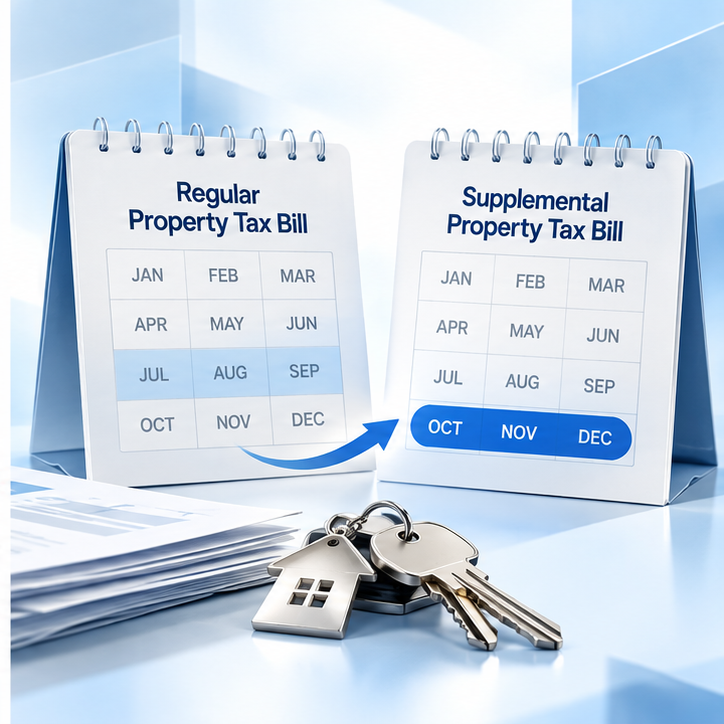
The supplemental bill is separate from the regular secured property tax bill. It does not replace the regular bill, and paying one does not automatically satisfy the other.
This distinction explains a common first-year surprise. A buyer may pay tax prorations at closing, fund an escrow account, and still receive another bill directly from the county. The closing proration settles certain amounts between buyer and seller. The supplemental assessment updates the county’s tax roll after the ownership change.
Section 03
Why California Issues the Supplemental Bill
Under California’s Proposition 13 system, a property generally receives a new base-year value when a reassessable change in ownership occurs. The county assessor determines the property’s fair market value as of the change-of-ownership date. In an open-market sale, the purchase price may be evidence of that value, but it is not correct to say that every property is automatically assessed at the contract price.
The regular property tax calendar creates a timing gap. California’s fiscal year runs from July 1 through June 30, while January 1 is the annual lien date. A regular bill already in process may still reflect the prior owner’s factored base-year value.
The supplemental assessment closes that gap. It applies the difference between the old taxable value and the new value to the portion of the fiscal year affected by the ownership change. Once the new value appears on the regular roll, later regular bills should reflect it, subject to applicable law, exemptions, exclusions, local assessments, and later changes.
The California State Board of Equalization provides an official explanation of supplemental assessments and the billing cycle.
Section 04
How a Supplemental Property Tax Bill Is Calculated
The basic planning formula is:
Supplemental assessment × applicable tax rate × proration factor = estimated supplemental tax
The supplemental assessment is generally the new assessed value minus the taxable value already on the roll. The tax rate includes California’s 1 percent base property tax plus applicable voter-approved debt and other charges. Because rates and assessments vary by location and property, use the rate shown for the parcel rather than a statewide estimate.
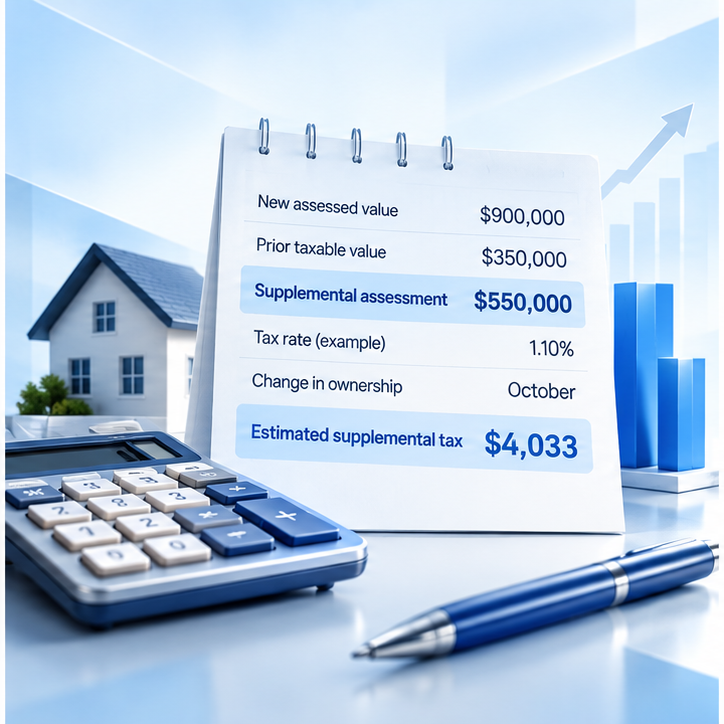
Here is an educational example:
- New assessed value: $900,000
- Prior taxable value: $350,000
- Supplemental assessment: $550,000
- Assumed combined tax rate for illustration: 1.10 percent
- Change in ownership: October
The full-year tax attributable to the increase would be:
$550,000 × 1.10 percent = $6,050
For an October ownership change, the proration period normally begins on the first day of November and continues through June 30. An eight-month planning estimate would be:
$6,050 × 8 ÷ 12 = $4,033.33
This is only an estimate. Counties use statutory proration factors, and the assessor’s value, parcel-specific tax rate, exemptions, exclusions, direct assessments, and processing details can change the actual amount.
| Input | Where to look |
|---|---|
| Prior taxable value | County assessor or prior tax bill |
| New assessed value | Supplemental assessment notice |
| Parcel tax rate | County tax collector or tax bill |
| Change-of-ownership date | Recorded closing documents |
| Due dates | Supplemental tax bill |
Do not use the seller’s current tax bill as the only estimate of your future ownership cost. To model taxes as part of the broader housing budget, use the Wonder Rates mortgage payment calculator and replace its default tax assumption with a parcel-specific estimate when available.
Section 05
Why Some Buyers Receive Two Supplemental Bills
The number of supplemental assessments depends partly on when the event occurs.
According to the California State Board of Equalization:
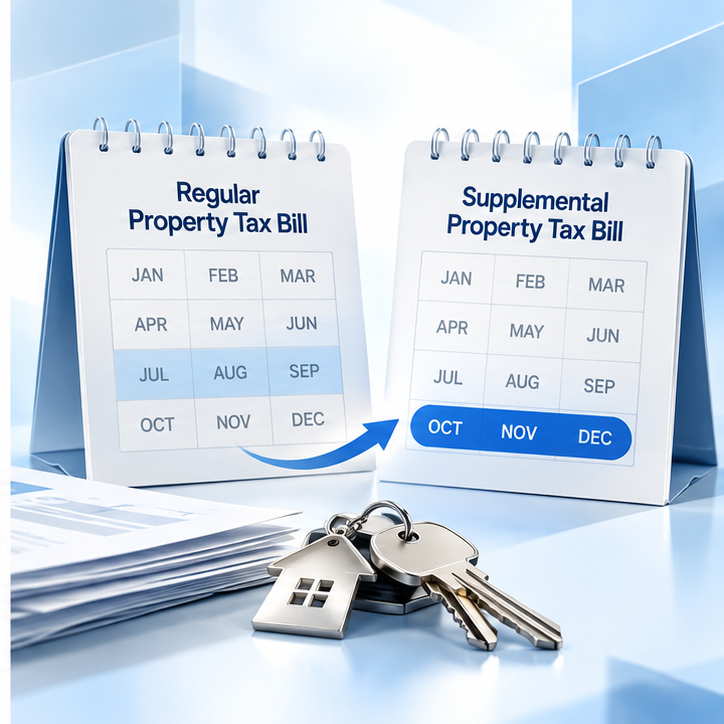
- A change in ownership from June 1 through December 31 generally produces one supplemental bill or refund for the remaining portion of the current fiscal year.
- A change in ownership from January 1 through May 31 generally produces two supplemental bills or refunds. One covers the remaining portion of the current fiscal year. The other covers the entire next fiscal year because that regular roll was already being prepared using the earlier value.
Receiving two bills does not necessarily mean the county charged the same period twice. Each notice should identify its fiscal year and assessment period. Compare those periods before assuming there is an error.
If the dates or values appear incorrect, contact the county assessor. The assessor determines value, while the tax collector generally handles billing and payment. An assessment appeal has filing deadlines, so do not wait until the bill is delinquent to ask questions. The Board of Equalization explains that certain supplemental-assessment appeals may need to be filed within 60 days of the relevant notice or bill.
Section 06
Does Mortgage Escrow Pay the Supplemental Bill?
Do not assume it does. Mortgage servicers commonly use escrow funds for regular property tax bills, but the handling of supplemental bills varies by servicer, loan documents, and local billing practices.
The safest approach is to contact the servicer when the bill arrives and ask these questions:
- Will the servicer pay this specific supplemental bill from escrow?
- If yes, what documents must the homeowner provide?
- If no, where and when should the homeowner pay it directly?
- Will the new assessed value change the next escrow analysis?
Keep the bill until you receive a clear answer. If the servicer says it will pay, monitor the county’s payment record and your escrow activity. If the servicer will not pay, follow the instructions and deadlines printed on the bill.
Late supplemental installments can trigger penalties and other charges. The amount and timing depend on the installment and county administration, so confirm the delinquency date with the county tax collector rather than relying on the date you received the mail. A misunderstanding between a borrower and servicer may not be sufficient grounds to waive a penalty.
Section 07
How the New Assessment Can Affect Your Monthly Payment
A fixed-rate mortgage keeps the loan’s principal-and-interest rate structure fixed, but it does not freeze taxes or homeowners insurance. When the servicer updates its estimate of regular property taxes, the required escrow deposit may change.
If the escrow account collected too little before the new tax amount was known, the next analysis may show both:
- a shortage based on amounts already paid or projected, and
- a higher ongoing escrow deposit for future bills.
That is why a homeowner can see a mortgage payment increase even with a fixed-rate loan. If the servicer reports a shortage, review how a mortgage escrow shortage works before choosing among any repayment options offered.
Section 08
How to Prepare Before and After Closing
Estimate taxes from the new value
Ask for the parcel number, current taxable value, and local tax rate. Base your first-year budget on a reasonable estimate of the new assessed value, not only on what the seller paid.
Keep a separate reserve
Set aside the estimated supplemental amount after closing. Do not treat an escrow balance as confirmation that the supplemental bill is covered. A separate reserve can also help with repairs, insurance adjustments, and other first-year costs after closing.
Review the Closing Disclosure
The Closing Disclosure shows estimated taxes, prepaid items, and initial escrow funding, but it is not the county’s supplemental tax bill. Review the figures with your loan officer and ask which assessed value was used. If you are still learning the form, see the comparison of the Loan Estimate and Closing Disclosure.
Watch notices and verify the mailing address
County processing may take months. Confirm that the assessor and tax collector have the correct mailing address, especially if the property is not your mailing address. A delayed or missing notice does not necessarily eliminate the tax obligation.
Verify unexpected requests independently
Use the official county assessor or tax collector website to confirm the parcel, bill number, payment instructions, and office contact details. Do not send money based only on an unsolicited email, text message, or phone call.
Section 09
Frequently Asked Questions
Is a supplemental property tax bill the same as my regular tax bill?
No. The regular bill covers the value on the regular assessment roll. A supplemental bill accounts for a qualifying value change, such as a reassessable ownership transfer, for the applicable period. Both may be payable during the same year.
How long after closing can the bill arrive?
Timing varies by county workload and processing. It may arrive months after closing. Buyers should reserve funds and monitor county records instead of assuming no bill will be issued because nothing arrived immediately.
Is the purchase price always the new assessed value?
Not always. The assessor establishes fair market value as of the change-of-ownership date. The sale price may be strong evidence in an open-market transaction, but unusual terms, partial transfers, exclusions, or other facts can affect the assessment.
Can a supplemental assessment result in a refund?
Yes. If the new assessed value is lower than the value already on the roll for the relevant period, the adjustment may result in a refund rather than an additional bill.
Can I appeal the assessed value?
Potentially. Start by contacting the county assessor to understand the valuation. If you still disagree, review the local assessment appeals process promptly because filing windows apply. The California Board of Equalization publishes assessment appeal guidance, but the filing itself is handled locally.
Section 10
Plan the Full First-Year Cost Before You Buy
A supplemental bill is easier to manage when it is part of the purchase budget from the beginning. A Wonder Rates loan officer can help you review estimated property taxes, initial escrow funding, and the cash reserve you may want to keep after closing. The county assessor and tax collector remain the authorities for the actual assessment and bill.
Start your California home-buying plan with Wonder Rates.
Duc Pham, Mortgage Broker | NMLS# 844897
Wonder Rates, Inc. | NMLS# 1518655
Equal Housing Lender.
AZ, CA, CO, FL, GA, LA, MI, OK, PA, SC, TX, VA, WA, OH, AL, OR, NC
This article is for educational purposes only and is not a commitment to lend or tax advice. Property tax assessments, rates, exclusions, exemptions, deadlines, and billing practices vary by property and county. Consult the relevant county assessor, county tax collector, or a qualified tax professional about your circumstances. Loan approval is subject to creditworthiness, income verification, property eligibility, and current underwriting guidelines. Loan programs, interest rates, and lender fees may change without notice. Always review your official Loan Estimate and Closing Disclosure before making a financing decision.



