

Section 01
Say your home is worth about $500,000. You still owe $300,000 on your mortgage, and now you want to borrow $50,000 more to fix up the kitchen. It is easy to think the lender will only care about the new $50,000. In fact, the lender wants to see every loan tied to your home, all added up.
That is the job of the combined loan-to-value ratio, or CLTV. It takes your first mortgage, adds the other loans that use your home as security, and compares the total to your home’s value. The result shows a lender how much of the home is already borrowed against.
Your first mortgage only tells part of the story.
In this guide, you will learn what CLTV means and how to figure it with a second mortgage or a home equity line of credit (HELOC). You will see why a HELOC can be counted in more than one way, how CLTV is different from LTV, and when the number can matter for a new loan or a refinance. Keep one thing in mind as you read. CLTV is just one part of a loan review, because lenders also look at your credit, income, debts, the home itself, and the rules of the loan program.
Section 02
What Is Combined Loan-to-Value Ratio?
The Meaning of CLTV in Mortgage Lending
CLTV compares the loans on a home to the value of that home. A basic loan-to-value ratio looks at one mortgage. CLTV goes a step further and adds the second loans that sit behind the first one, based on the rules of the loan program.
Lenders call these second loans “subordinate financing.” The term sounds hard, but the idea is simple. Subordinate just means second in line. If a home is sold to pay off its debts, the first mortgage is usually paid before the second loan. Even so, both loans are tied to the same house, and both are claims on it.
Two common types are the home equity loan and the HELOC. The Consumer Financial Protection Bureau (CFPB)explains that if you already have a mortgage, both of these are second mortgages that you pay on top of your first one.
Why Lenders Use CLTV
Your home is the security for the loans on it. If a lender looks only at the first mortgage, it may miss how much debt is really stacked on the house. CLTV fills that gap by showing all the home loans that count, in one number.
Still, CLTV does not measure your whole money picture. It says nothing about your income, your savings, or how well you pay your bills. How much weight it carries also depends on the type of loan, the deal, the lender, and the program rules.
What a CLTV Percentage Tells You
Reading a CLTV number is fairly simple:
- A lower CLTV means the home loans add up to a smaller share of the home’s value.
- A higher CLTV means a larger share of the home’s value is already borrowed.
- A CLTV above 100% means the loans counted in the math add up to more than the value used for the home.
These are ways to read the number, not pass or fail lines. A CLTV that works for one loan product may be too high for another one.
Section 03
How to Calculate Combined Loan-to-Value Ratio
The CLTV Formula
Here is the simple version of the math:
CLTV = (First mortgage amount + Second loan amounts) ÷ Home value × 100
Each part of this formula has its own rules, and those rules come from the loan program. Fannie Mae is a good example. When a new first mortgage has a second loan behind it, Fannie Mae’s Selling Guide on CLTV ratios adds up three things:
- The original loan amount of the first mortgage
- The part of any HELOC that has been drawn, which means the balance you have used
- The unpaid balance of any closed-end second loan, such as a standard home equity loan
Fannie Mae then divides that total by the lower of the sales price or the appraised value.
That is one agency’s rule for the loans it buys. Other lenders and programs may count things in a different way, so think of it as an example and not a rule for every loan.
Example: Calculating CLTV With a Second Mortgage

Let’s walk through a simple case.
- Home value used for the example: $500,000
- First mortgage balance: $300,000
- Closed-end second mortgage balance: $50,000
- Total of the two loans: $350,000
($300,000 + $50,000) ÷ $500,000 × 100 = 70% CLTV
So the two loans together equal 70% of the home’s value. If you looked at the first mortgage alone, you would see only 60%. That 10-point gap comes from the second loan, and it is the exact thing CLTV is built to catch.
Disclaimer: This hypothetical example is for educational purposes only. Actual CLTV calculations may use different loan amounts and property values under the applicable loan program and transaction rules.
Why the Property Value Used in the Calculation Matters
The value at the bottom of the formula can change the whole result. A higher value makes the ratio smaller, and a lower value makes it bigger. That is why you should not just plug in the price you paid years ago, a home value guess from a website, or the number on your tax bill. None of these is sure to be the value a lender will use.
The right value depends on the deal and the program rules. For a purchase, some guidelines, like Fannie Mae’s, use the lower of the sales price or the appraised value. A refinance has no sales price, so the value often comes from an appraisal or another method the program allows. Since lenders do not all value homes the same way, it pays to ask which method applies to your loan.
Section 04
CLTV vs. LTV: What Is the Difference?
LTV Measures One Mortgage Relative to the Property Value
The loan-to-value ratio, or LTV, compares one mortgage to the value of the home. It is one of the main numbers lenders use to size up a loan. Our Learning Hub guide walks through LTV step by step, with down payment examples, if you want the full picture. The exact math still depends on the loan and the deal.
CLTV Includes Relevant Subordinate Financing
CLTV takes the LTV idea and makes it wider. It counts the second loans on the same home, as long as the program rules say they belong in the math. This matters most when you already have a first mortgage and want to add a home equity loan or a HELOC. In that case, LTV shows only the first loan, while CLTV shows the whole stack.
Side-by-Side Comparison of LTV and CLTV
| Feature | LTV | CLTV |
|---|---|---|
| What it measures | One mortgage compared to the home’s value | The first mortgage and counted second loans compared to the home’s value |
| Second mortgage included | Not in a basic first mortgage LTV | Generally included under the CLTV rules that apply |
| Common use | Purchase loans and refinance reviews | Deals with second liens or more than one loan on the home |
| What it tells the lender | How much of the home’s value the mortgage covers | How much of the home’s value all the counted home loans cover |
| Is it the only approval factor? | No | No |
Example: Why LTV Can Be Lower Than CLTV
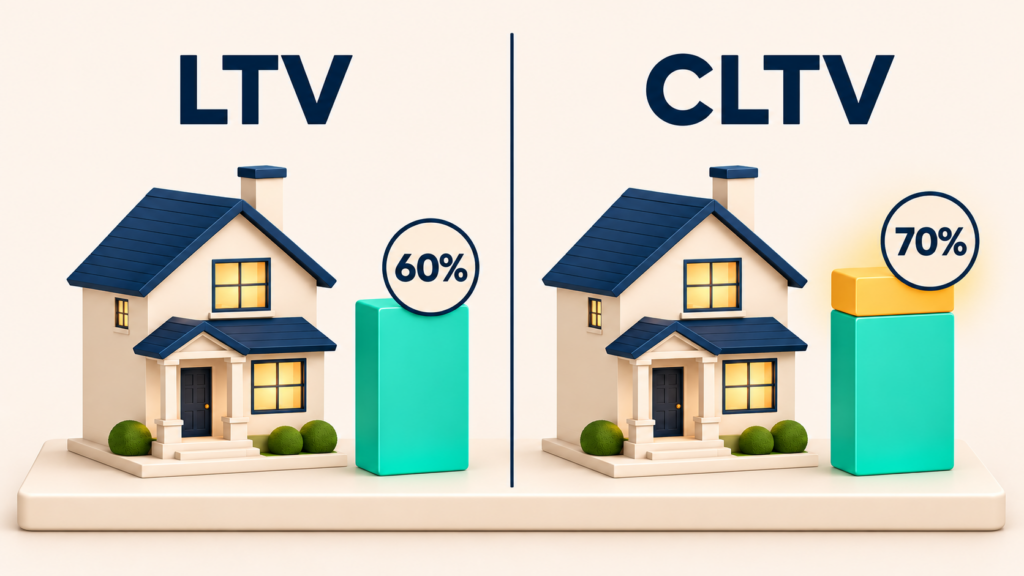
Let’s use the same numbers from before.
- Home value: $500,000
- First mortgage: $300,000
- Second mortgage: $50,000
LTV: $300,000 ÷ $500,000 × 100 = 60%
CLTV: ($300,000 + $50,000) ÷ $500,000 × 100 = 70%
The home and the first loan are the same in both lines. The only change is that CLTV also counts the second loan. In a simple setup like this one, CLTV starts with the first loan and adds more, so it will be equal to LTV or higher, never lower.
Disclaimer: This comparison uses hypothetical figures and a simplified calculation. Actual underwriting calculations may differ according to the loan program, lien structure, and applicable property valuation.
Section 05
What Loans and Liens Are Included in CLTV?
A lien is a legal claim on your home that backs up a loan. CLTV is all about these claims, so it helps to know which ones may be counted.
First Mortgages
The first mortgage is the main loan on the home. It is often the largest loan, and it sits first in line. It is the starting point for CLTV, but the amount used for it can vary. When the first mortgage is the new loan being made, Fannie Mae’s guide uses its original loan amount, not what is owed today. When you add a second loan behind a mortgage you already have, the new lender may look at your current balance instead. The simple fix is to ask which amount your lender plans to use.
Home Equity Loans and Second Mortgages
A home equity loan is a separate loan that uses your home as security. You usually get the money in one lump sum and pay it back on a set schedule. The CFPB notes that the rate on this kind of loan may be fixed or adjustable. Because it adds a new lien on the home, its balance may be part of the CLTV math.
If you are thinking about a second mortgage, look at both loans together. The new loan may seem small on its own, but once you add it to your first mortgage, it can change the picture in a big way.
Home Equity Lines of Credit (HELOCs)
A HELOC works a bit like a credit card tied to your home. You get a credit limit, and you can draw money as you need it, pay it back, and draw again. The CFPB notes that HELOCs usually have adjustable rates and that the payment changes with the balance. Because the balance moves up and down, lenders need a rule for which number to count.
Under Fannie Mae’s CLTV rule, only the drawn part of the HELOC counts. A related number called HCLTV counts the full credit line, even the part you have not used. That gap can be big, so it gets its own section below.
Other Subordinate Financing
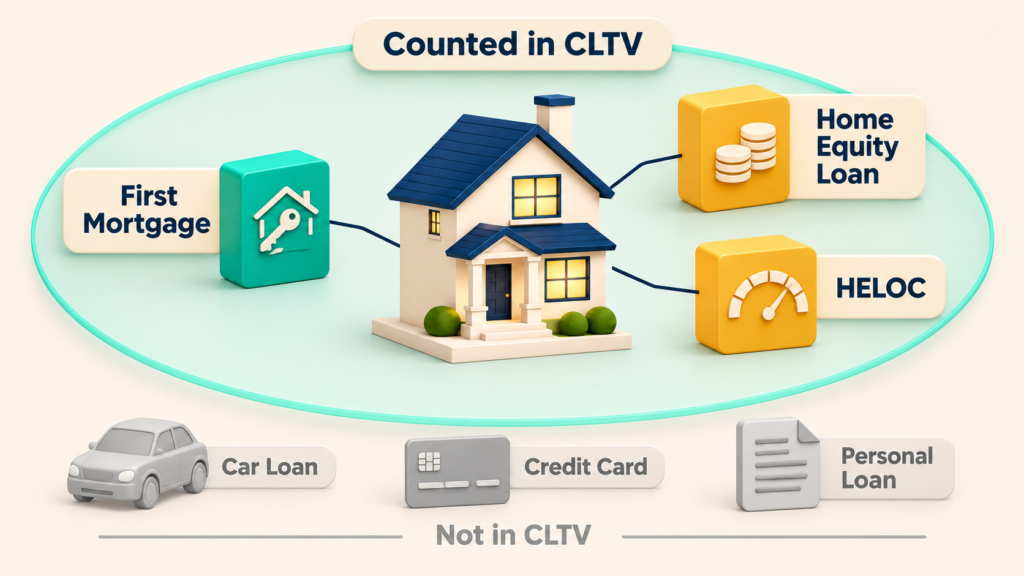
Other loans that hold a second lien on your home may count as well. How they are treated depends on the type of lien and the program.
It is just as useful to know what does not count. CLTV is about debt tied to your home, so a car loan, a credit card, or an unsecured personal loan is not part of it. Those debts still matter, but in a different way. Lenders look at them in your debt-to-income ratio, which compares your monthly debt payments to your income. That is a separate test with its own rules.
Section 06
CLTV vs. HCLTV: How Are They Different?
What Is HCLTV?
HCLTV stands for home equity combined loan-to-value ratio. Some mortgage reviews use it when a HELOC sits behind the first mortgage. Instead of counting only what you have drawn, it counts the full credit line.
Fannie Mae’s guide on HCLTV ratios adds the original first mortgage amount, the full amount of any HELOC whether or not you have drawn on it, and the unpaid balance of any closed-end second loans. It then divides by the lower of the sales price or the appraised value. The same guide also states that CLTV can never be higher than HCLTV.
Why would a lender count money you have not borrowed yet? The reason is that you could borrow it tomorrow. An open credit line is borrowing power that can turn into real debt at any time. Keep in mind that lenders do not all use the same terms or formulas, so check the current rules for the program you are looking at.
Example: A HELOC With an Unused Credit Limit
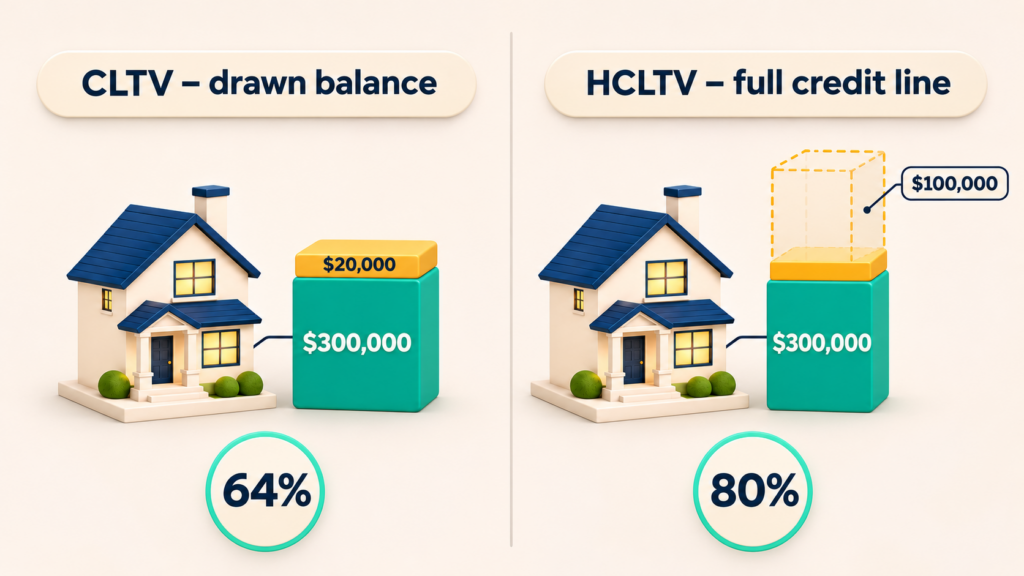
Here is how the two numbers can split apart.
- Home value used in the example: $500,000
- First mortgage amount used for the math: $300,000
- HELOC credit limit: $100,000
- HELOC amount drawn so far: $20,000
CLTV, using only the drawn HELOC amount:
($300,000 + $20,000) ÷ $500,000 × 100 = 64%
HCLTV, using the full credit line:
($300,000 + $100,000) ÷ $500,000 × 100 = 80%
The unused part of a HELOC can still count.
This borrower has drawn only $20,000, yet the two ratios are 16 points apart. The exact math depends on the program’s rules, but the lesson holds. A big open credit line can weigh on your numbers even when you barely use it.
Disclaimer: These figures are hypothetical and illustrate the conceptual difference between drawn-balance and full-line calculations. They are not a statement of eligibility or a guarantee that a lender will calculate either ratio this way in every transaction.
Why Borrowers Should Ask Which Ratio Applies
If you have a HELOC, or you plan to open one, ask your lender a simple question: which ratio will you use for my loan? It might be CLTV, HCLTV, or some other measure. The answer can change how your current HELOC is treated when you apply for a new mortgage or a refinance.
Timing matters, too. Fannie Mae’s guide says that if new or larger second loan financing turns up after the lender has made its decision, and before closing, the loan must be reviewed again. So it is smart to talk with your loan officer before you open a new credit line in the middle of a mortgage application.
Section 07
What Is a Good CLTV Ratio for a Mortgage?
There Is No Single CLTV Threshold for Every Mortgage
You may see a number online that claims to be the “good” CLTV. Be careful with that. The right range depends on the loan program, why you are borrowing, the type of property, whether you live in it, your credit, and the rules of the lender or investor. Fannie Mae, for example, lists its allowed CLTV ratios in a separate Eligibility Matrix, and the limits shift from one type of loan to another.
That means there are really two questions. The first one is about math: what is my CLTV? The second one is about fit: does that CLTV work for this loan? Only the program rules can answer the second question.
How a Lower CLTV May Affect Borrowing Options
A lower CLTV means you owe less on the home compared to its value. That gives you a larger equity cushion, which is the share of the home that is not borrowed against. Depending on the product, a bigger cushion may open up more loan choices or affect pricing and approval.
It does not promise a lower rate or a yes from the lender, though. Your credit, income, payment history, savings, and other program rules still play their part.
What a High CLTV Can Mean for a Borrower
A high CLTV can rule out some loan products, mostly those with a cap on total home debt. It can also leave less room to borrow against the home later on.
None of this means you made a bad choice. Many people carry a higher CLTV for good reasons. It is simply one more thing to weigh as you plan.
Section 08
How CLTV Can Affect Mortgage Approval and Pricing
CLTV and Loan Eligibility
When a second loan is part of the picture, CLTV may be one of the checks a lender runs on a purchase or a refinance. A lender may set a top limit for LTV, CLTV, HCLTV, or all three, based on the product and the deal.
Passing that check is not the finish line. You still need to meet the rest of the program’s rules before a loan can be approved.
CLTV and Mortgage Pricing
The amount of debt on your home can play a role in risk and pricing for some programs. For example, Fannie Mae’s CLTV guide notes that a loan-level price adjustment, which is a pricing add-on, applies to certain mortgages with second loan financing. These adjustments are listed in Fannie Mae’s LLPA Matrix.
Pricing still comes from many factors, such as credit, whether you live in the home, the loan type, the property type, the loan amount, and the pricing rules in place on the day you get a quote. No CLTV number can promise a certain rate or a certain savings.
CLTV and the Choice Between a Second Mortgage and a Refinance
Homeowners who want to use their equity often weigh two paths. One path is to keep the first mortgage you have now and add a second loan behind it. The other path is a refinance, which replaces your first mortgage with a brand-new loan.
These two paths can lead to different loan setups, fees, monthly payments, and total home debt. Neither one is always better. A good comparison starts with clear questions. What rate would each loan have? What would each one cost in total? What happens to your monthly payment? How does each option change your CLTV?
Section 09
How CLTV Affects a Cash-Out Refinance or Home Equity Loan
Using Home Equity to Borrow Additional Funds
People borrow against their homes for many reasons, like repairs, upgrades, or paying off certain debts. The amount you might be able to borrow depends on the home’s value as the lender sees it, the debt already on the home, the program’s limits, and whether you qualify.
It also helps to keep two ideas apart. Equity is the gap between your home’s value and what you owe on it. The amount a lender is willing to lend you is a different number, and it is often smaller.
Equity on paper is not cash in hand.
With a cash-out refinance, a new first mortgage pays off the old one and can give you cash at closing. If it also pays off your second loan, there may be no second lien left, and in that case CLTV and LTV can end up the same. To learn more about how replacing your current loan works, our guide to mortgage refinancing covers the basics.
Example: Estimating the Impact of Additional Borrowing
Here is a simple way to see what a new second loan does to the math.
- Home value: $600,000
- First mortgage amount used in the example: $300,000
- Proposed second mortgage: $60,000
- Total of the two loans: $360,000
$360,000 ÷ $600,000 × 100 = 60% CLTV
If these were the amounts and value the lender used, the CLTV would be 60%. That number alone does not mean the borrower qualifies for a $60,000 second mortgage. It only shows what the math looks like.
Disclaimer: This is a hypothetical illustration, not a borrowing limit or loan offer. Actual available equity and approval depend on valuation, existing liens, lender guidelines, credit, income, and other underwriting requirements.
Compare the Full Costs, Not Just the CLTV
When you look at a loan offer, look past the ratio. Compare the interest rate, the monthly payment, the closing costs, and the length of the loan. Check whether the rate can change over time, and read how repayment works from start to finish.
A ratio can fit the rules and still not fit your budget.
A Lower CLTV Does Not Automatically Make Borrowing the Right Decision
Borrowing against your home turns equity into debt that is tied to your house. If you fall behind on that debt, your home could be at risk. So the real question is not only whether your CLTV is low enough. It is also whether you can pay the loan back with ease, even if money gets tight for a while. If you are already having trouble paying your mortgage, the CFPB suggests that you talk to a housing counselor before you take out a home equity loan or HELOC.
Section 10
How to Lower Your CLTV Ratio
Pay Down Existing Secured Debt
If your home value stays the same and the math counts your lower balance, paying down your home loans lowers your CLTV. A HELOC comes with a catch, though. Paying down the drawn balance lowers a CLTV that uses the drawn amount, but it may not change an HCLTV that counts the full credit line.
Reassess the HELOC or Second-Mortgage Structure
Look at how your current home equity loan or HELOC is treated under the rules for your new loan. Under Fannie Mae’s HCLTV guide, for example, if a HELOC limit has been permanently lowered, the lender uses the lowered amount when the balance is below it, as long as there is proof of the change. Even so, closing or cutting a credit line can come with its own costs and contract terms, and you may lose access to money you were counting on. Talk with your lender before you change anything, and do not assume a lower limit will help your chances on its own.
Understand the Role of Property Value
A higher home value can lower your ratio, but only if the lender accepts that value for the deal. A rising market does not mean a lender will use a website estimate, and it does not mean a loan will be approved.
Avoid Borrowing More Than Your Budget Can Support
A low CLTV is not the only goal worth chasing. Keep enough cash saved for surprises, and make sure any new monthly payment fits easily into your budget.
Section 11
Common CLTV Calculation Mistakes to Avoid
A quick CLTV check at home is a great start, but it may not match the number a lender comes up with. Here are five mistakes that cause the gap.
- Counting only the first mortgage. An LTV based on the first loan alone can look much lower than your real total when a second loan exists. Always add in the second loans that are tied to your home.
- Using the wrong HELOC amount. Some rules use the drawn balance, while HCLTV may use the full credit line. If you guess wrong, your number could be off by a lot, as the HELOC example above shows.
- Assuming every program uses the same formula. The loan amounts and value rules can differ from one program to the next. A number that is right for one loan may be wrong for another.
- Using a value that has not been checked. An online estimate is not the same as the value a lender accepts. Your real value may come from an appraisal or another approved method.
- Treating CLTV as a sure approval. The ratio is one part of the review. Your credit, income, debts, savings, and the product’s own rules all count too.
Section 12
How to Review Your Mortgage Options With CLTV in Mind
Gather the Numbers Before Comparing Options
Start by pulling together your latest mortgage statement, any home equity loan or HELOC statement, and your HELOC credit limit. Add a fair estimate of your home’s value, and keep in mind that the lender may land on a different one. If you are thinking about a new loan, write down how much you want to borrow and what the money is for.
Compare CLTV With the Rest of Your Financial Picture
Look at CLTV next to your monthly payment, credit, income, other debts, closing costs, and cash savings. The ratio can make one part of a deal clearer, but it cannot tell you whether the loan is truly affordable for you.
Use a Mortgage Calculator to Estimate the Payment
Before deciding how much to borrow, estimate how a proposed mortgage payment could fit into your monthly budget. Use the Wonder Rates Mortgage Payment Calculator to explore different loan amounts and payment scenarios. It can help you estimate principal, interest, property taxes, homeowners insurance, PMI, and HOA dues where they apply. The result is a planning estimate, not a loan approval or a substitute for a lender’s CLTV calculation, and the tool does not work out CLTV for you.
Get a Personalized Review Before Making a Decision
A mortgage professional can look at the loans already on your home, the deal you have in mind, and the program rules that apply. From there, they can tell you which ratio matters for you and which loan setups may be open to you.
If you’re considering a home equity loan, HELOC, or refinance, your next step is to review the complete scenario rather than relying on a CLTV estimate alone. Get started with Wonder Rates to discuss your mortgage options and understand which details may affect your eligibility. If you are still in the home search stage, you can also learn more about buying a home with Wonder Rates.
Section 13
Key Takeaways About Combined Loan-to-Value Ratio
- CLTV compares the home loans that count to the value used for your home.
- LTV and CLTV are close cousins, but they answer different questions once a second loan is in the picture.
- A HELOC may be counted by its drawn balance or by its full credit line, depending on which ratio applies.
- No single CLTV number promises approval across every loan program.
- CLTV works best when you look at it next to your credit, income, monthly payment, closing costs, and overall budget.
Knowing your CLTV helps you ask better questions about your mortgage options. The right math and the terms you can get still depend on your specific deal and the rules that apply to it.
Section 14
Disclaimer
This article is provided for general educational and informational purposes only and does not constitute financial, mortgage, legal, tax, or investment advice. Combined loan-to-value (CLTV), loan-to-value (LTV), and home equity combined loan-to-value (HCLTV) calculations and requirements may vary by lender, loan program, investor guidelines, property type, transaction, lien structure, and borrower circumstances. Property values, loan balances, and other figures used in examples are hypothetical and are provided for illustration only. They do not represent a loan offer, approval, borrowing limit, interest rate, or guarantee of eligibility. A CLTV calculation alone does not determine whether a borrower qualifies for financing or whether a loan is financially appropriate. Borrowers should review their individual circumstances with a qualified mortgage professional and consult other qualified professionals when appropriate before making financial or property-related decisions.
Duc Pham, Mortgage Broker | NMLS# 844897, Wonder Rates, Inc. | NMLS# 1518655 | DRE# 02047445 | DFPI# 60DBO-59134 | Equal Housing Opportunity. Equal Housing Lender. | Licensed in: AL, AZ, CA, CO, FL, GA, LA, MI, NC, OH, OK, OR, PA, SC, TX, VA, WA.



