Section 01
What Is Mortgage Refinancing?
Refinancing means replacing your current mortgage with a new loan.
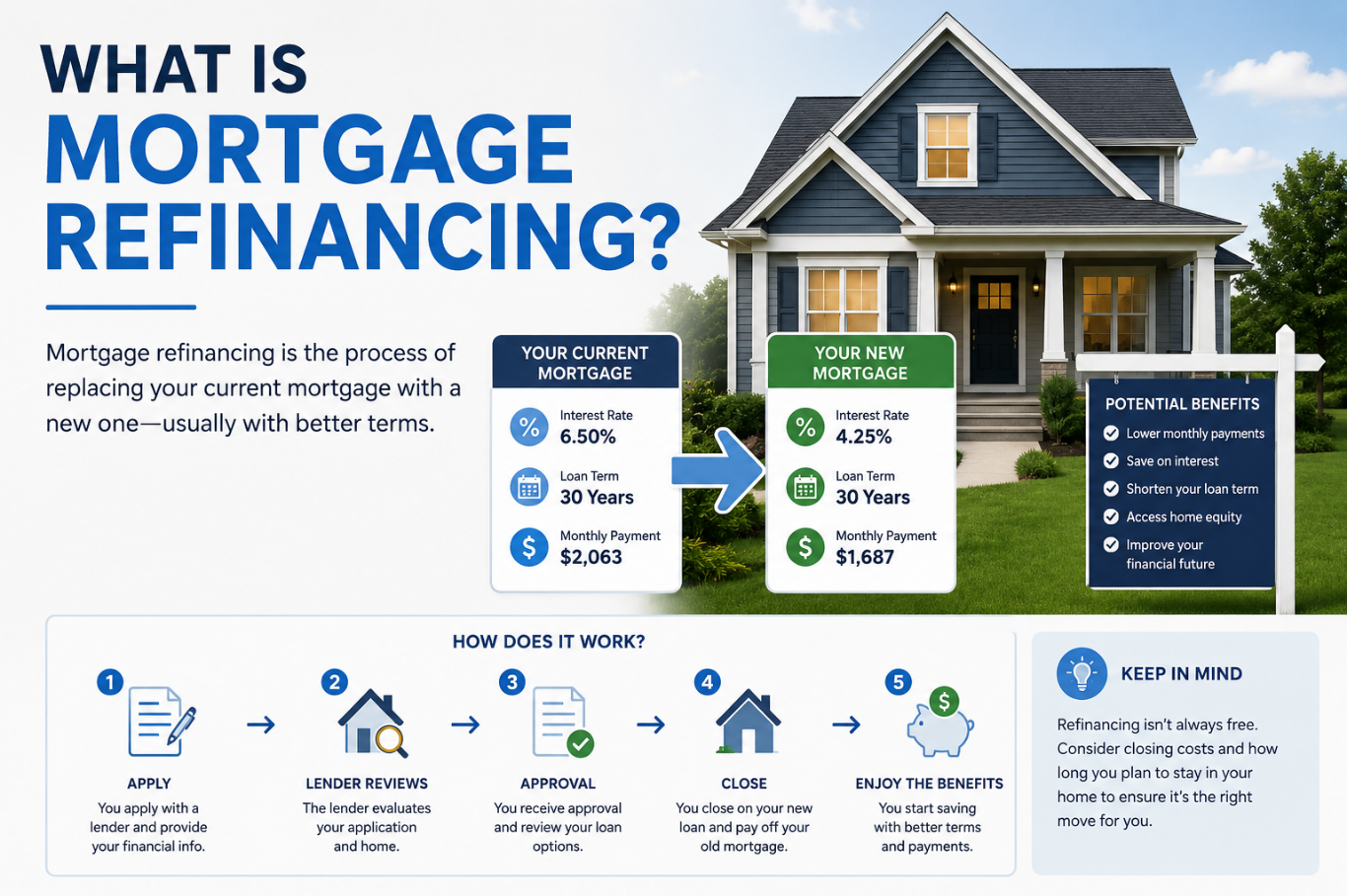
Homeowners typically refinance to:
- Lower their interest rate
- Reduce their monthly mortgage payment
- Change their loan term
- Convert from an adjustable-rate mortgage (ARM) to a fixed-rate loan
- Access home equity through a cash-out refinance
When mortgage rates fall, homeowners may be able to refinance into a loan that better fits their current financial goals, whether that means lowering their monthly payment or reducing the amount of interest paid over time.
Section 02
Does a Lower Interest Rate Automatically Mean You Should Refinance?
Not necessarily.
One of the biggest misconceptions about refinancing is that you should refinance anytime rates fall.
In reality, the decision should be based on the overall financial impact rather than the rate alone.

For example:
- Current loan balance: $450,000
- Current rate: 6.75%
- New rate: 6.00%
A 0.75% reduction may lower the principal and interest payment by several hundred dollars per month.
However, refinancing also comes with costs such as lender fees, title fees, appraisal fees, and other closing expenses. The key question becomes:
Will your monthly savings outweigh the cost of refinancing?
Section 03
Calculate Your Break-Even Point
One of the most important refinance calculations is the break-even point.

The break-even point tells you how long it will take for your monthly savings to recover the costs associated with refinancing.
Example:
- Refinance closing costs: $4,500
- Monthly savings: $250
Break-even period:
$4,500 ÷ $250 = 18 months
In this scenario, if you plan to stay in the home for more than 18 months, refinancing may provide long-term savings.
If you expect to sell the property before reaching the break-even point, refinancing may not be the best financial decision.
Section 04
Signs Refinancing May Make Sense
1. Your Interest Rate Is Significantly Higher Than Current Market Rates
If current mortgage rates are substantially lower than your existing rate, refinancing could potentially reduce your monthly payment and total interest paid over time.

Even a reduction smaller than 1% can sometimes create meaningful savings, especially for borrowers with larger loan balances.
2. You Plan to Stay in Your Home for Several More Years
The longer you remain in the property, the more time you have to benefit from the savings generated by refinancing.
Homeowners planning to move soon often find it difficult to recover the upfront refinance costs.
3. Your Financial Situation Has Improved
If your credit score has increased since obtaining your original mortgage, you may qualify for more favorable loan pricing.
Lenders typically offer better rates to borrowers with stronger credit profiles and lower risk factors.
4. You Want to Reduce Your Monthly Payment
Many homeowners refinance not only to lower rates but also to improve monthly cash flow.
Reducing monthly mortgage expenses can free up money for savings, investments, education expenses, or other financial priorities.
Section 05
Reasons You May Want to Wait
Refinancing is not always the right move.

You may want to reconsider if:
- You plan to sell the home in the near future
- The refinance costs are unusually high
- The monthly savings are relatively small
- Your credit profile has weakened since obtaining the original mortgage
- You are close to paying off your current mortgage
Every homeowner’s situation is different, which is why refinance decisions should be evaluated individually.
Section 06
Should You Wait for Rates to Fall Even More?
This is another common question.
The challenge is that no one can accurately predict future mortgage rates.
Many homeowners delay refinancing while waiting for the “perfect” rate, only to discover that rates move in the opposite direction.
Instead of trying to time the market perfectly, focus on whether refinancing makes financial sense today.
If the monthly savings, break-even period, and long-term benefits align with your goals, waiting for an additional rate drop may not necessarily improve the outcome.
Section 07
Questions to Ask Before Refinancing
Before starting a refinance application, it helps to step back and look at your full financial picture. A lower advertised rate can be appealing, but whether refinancing actually makes sense depends on your current loan, the costs involved, and your plans for the future. Working through the following questions can help you decide whether a refinance is likely to benefit you.
What is my current interest rate?
Start by confirming the exact interest rate on your existing mortgage. You can usually find it on your monthly mortgage statement, your original Closing Disclosure, or your servicer’s online account portal. Also check whether your loan has a fixed rate or an adjustable rate. If you have an adjustable-rate mortgage that is about to reset, refinancing into a fixed-rate loan may offer more payment stability even if the rate difference is small. If you already have a low fixed rate, the potential benefit of refinancing may be limited.
How much is my remaining loan balance?
Your remaining balance affects how much you can save. The same rate reduction produces much larger savings on a $350,000 balance than on a $90,000 balance. Your balance also matters because many refinance costs are calculated as a percentage of the new loan amount. In addition, knowing your balance helps you estimate your home equity, which can influence the rate you qualify for and whether you may be able to remove mortgage insurance.
How much would I save each month?
Compare your current principal and interest payment with the estimated principal and interest payment on the new loan. Keep in mind that taxes and homeowners insurance usually stay roughly the same regardless of the loan, so focusing on principal and interest gives a more accurate comparison. Also pay attention to the loan term. Refinancing into a new 30-year loan may lower your monthly payment, but it can extend the total time you are paying and increase the total interest paid over the life of the loan. A shorter term may raise your monthly payment while reducing long-term interest costs.
What are the total refinance costs?
Refinancing is not free. Closing costs commonly include lender fees, appraisal fees, title insurance, recording fees, and prepaid items, and they often total a few percent of the loan amount. Review the Loan Estimate carefully and ask the lender to explain each charge. Some offers advertise “no closing costs,” but those costs are frequently covered through a higher interest rate or added to the loan balance. Understanding the true total cost allows you to compare offers fairly.
How long is the break-even period?
The break-even period is the time it takes for your monthly savings to cover the cost of refinancing. To estimate it, divide your total refinance costs by your monthly savings. For example, if refinancing costs $6,000 and lowers your monthly payment by $200, your break-even point is about 30 months, or two and a half years. After that point, the savings begin to work in your favor. A shorter break-even period generally means less risk.
How long do I plan to stay in the home?
This question connects directly to the break-even calculation. If you plan to sell or move before reaching the break-even point, refinancing may cost more than it saves. On the other hand, if you expect to stay in the home well beyond that point, the long-term savings can be significant. Consider possible life changes as well, such as a job relocation, a growing family, or plans to downsize, since these can affect how long you actually remain in the property.
Looking Beyond the Advertised Rate
The answers to these questions often provide a clearer picture than focusing solely on the advertised interest rate. A rate that looks attractive in an advertisement may come with higher fees, discount points, or a longer loan term that reduces its real value. By reviewing your current loan, estimating your savings, calculating the break-even period, and thinking realistically about your future plans, you can approach a refinance decision with greater confidence and choose an option that fits your long-term financial goals.
Section 08
Final Thoughts
Falling mortgage rates can create valuable refinancing opportunities, but a lower rate alone does not automatically mean refinancing is the right choice.
If mortgage rates have recently declined, now may be a good time to review your current loan and compare it against available options. A careful analysis can help determine whether refinancing today could save you money in the years ahead.
Thinking about buying a home or refinancing? Try the Wonder Rates team’s mortgage calculator to estimate your monthly payment, then connect with Duc Pham and the Wonder Rates team for guidance on the loan options that fit your situation.
Sources
- Fannie Mae Selling Guide: sections on DTI and installment debt.
- HUD (hud.gov): Handbook 4000.1, sections on installment debt and collections for FHA loans.
Disclaimer: Wonder Rates NMLS #1518655, Duc Pham NMLS #844897 Equal Housing Lender Rates and terms subject to change. This article is for educational purposes only and should not be considered financial, tax, or legal advice.