
Section 01
Mortgage origination fees are charges for setting up and processing your home loan. They pay the lender, or in some cases a mortgage broker, for the work of making the loan. You will find them on your Loan Estimate and your Closing Disclosure. But they do not always show up under one tidy line called “origination fee,” so you should not judge a lender’s charges by one line alone.
Here is the real issue. One lender might charge a low origination fee but offer a higher interest rate. Another might charge more upfront but offer a lower rate. So this guide will not give you one “good” fee number. Instead, it will help you understand how origination fees work, how they fit into your total loan cost, and how to compare offers the right way.
Section 02
What Is a Mortgage Origination Fee?
Mortgage Origination Fee Definition
“Origination” is the process of creating and processing a mortgage. A mortgage origination fee is the charge tied to that process. According to the Consumer Financial Protection Bureau (CFPB), an origination fee is what the lender charges you for making the loan.
The fee can be a percentage of the loan amount or a flat dollar amount. It depends on the lender and the loan. Not every lender sets up its fees the same way, and there is no fixed fee that applies to every mortgage.
What Does a Mortgage Origination Fee Pay For?
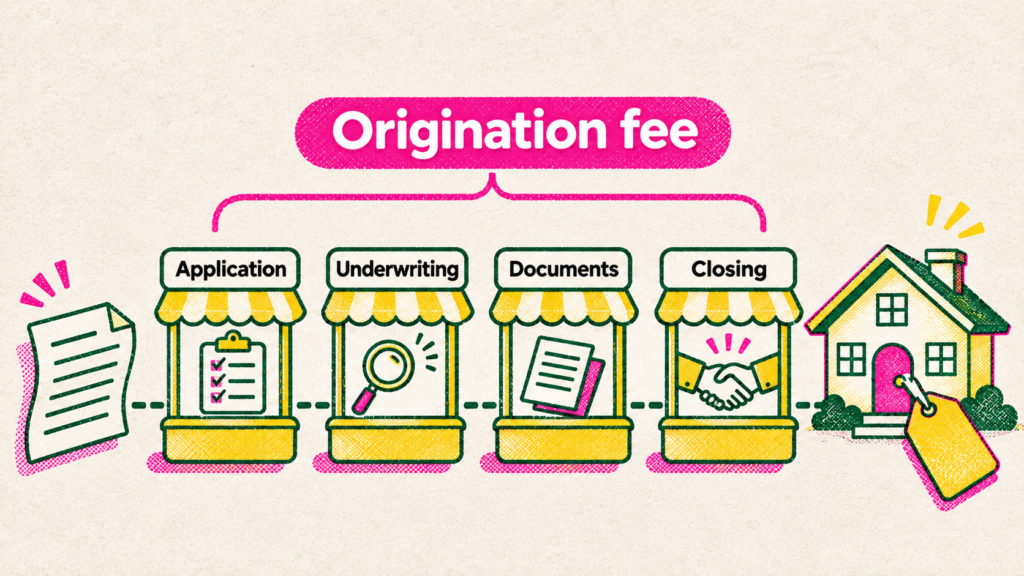
The CFPB notes that origination services may include processing your application, underwriting and funding the loan, and other administrative work. In plain terms, that can cover things like:
- Taking and processing your application
- Underwriting, which is the lender’s review of your income, credit, assets, and property
- Preparing loan documents
- Coordinating the steps needed to close the loan
If you want to know what happens during underwriting, our guide to mortgage underwriting walks through what lenders review before final approval.
It is important not to lump every closing cost into the origination fee. Many other costs, like the appraisal or title services, are separate.
Is an Origination Fee the Same as a Mortgage Closing Cost?
Not exactly. An origination fee is one type of closing cost. Closing costs are the bigger group. They can include lender charges, third-party services, government recording fees, taxes, prepaid items, and more. Our home buying costs checklistcovers the wider range of mortgage closing costs you may need to budget for.
Section 03
How Do Mortgage Origination Fees Work?
When Is the Origination Fee Charged?
The fee first shows up on your Loan Estimate, which lenders give you after you apply. It shows up again on your Closing Disclosure before closing. It is usually paid as part of your closing costs. The exact timing and how it is paid depend on your deal.
How Is an Origination Fee Calculated?
You will usually see one of two setups.
Percentage-based fee: The lender charges a set percentage of your loan amount. The math is simple: loan amount × fee percentage.
Flat-dollar fee: The lender charges a fixed dollar amount, no matter how big the loan is.
Some lenders use other setups or split their charges into several smaller fees. These are general patterns, not a pricing rule that applies everywhere.
Does a Larger Mortgage Mean a Larger Origination Fee?
If the fee is a percentage, then yes, a bigger loan usually means a bigger dollar fee. If the lender uses a flat fee or a different setup, the link between loan size and fee can be different.
Section 04
How Much Are Mortgage Origination Fees?
Is There a Standard Mortgage Origination Fee?
No. There is no single fee that applies to every mortgage. You may hear “1%” tossed around, but that is not a rule or a standard. Pricing can depend on many things, including:
- The lender
- The loan program
- The loan amount
- The type of deal, such as a purchase or a refinance
- Your credit and financial profile
- Market conditions
- The rate you choose and how fees are traded against it
- How a mortgage broker, if any, is paid
Percentage-Based vs. Flat Origination Fees
| Fee Structure | How It Works | Example |
|---|---|---|
| Percentage-based | Based on loan amount | 1% × loan amount |
| Flat fee | Fixed dollar amount | A set fee regardless of loan size |
| Other lender charges | Specific services or processing | Depends on lender |
Why Two Borrowers May See Different Origination Fees
It is natural to compare notes with friends. But do not assume you will get the same fee someone else got. Your loan type, loan amount, property, credit, chosen rate, lender, and broker setup can all be different. Any of these can change your fee.
Section 05
Mortgage Origination Fee Example
Numbers make this easier to picture. Here are two simple examples on the same loan amount.
Example of a Percentage-Based Origination Fee
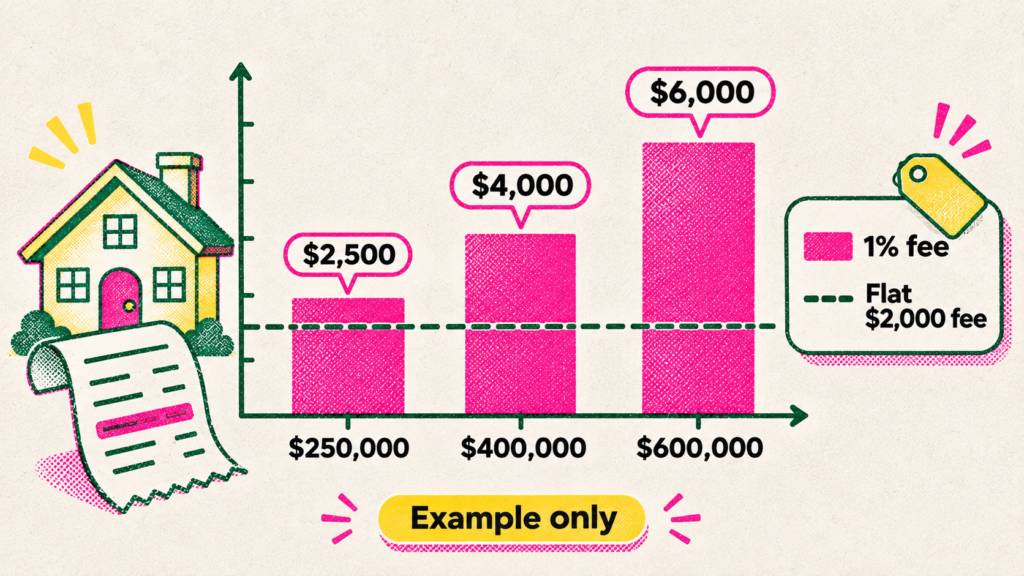
Say a borrower takes out a $400,000 loan, and the lender charges a hypothetical origination fee of 1%.
$400,000 × 1% = $4,000
That $4,000 is only an example. It is not Wonder Rates’ fee, and it is not a fee every mortgage must have.
Example of a Flat Origination Fee
Now say a different lender charges a hypothetical flat origination fee of $2,000 on the same $400,000 loan.
In this case, the flat fee is $2,000 less than the percentage fee. But the comparison can change with the loan size. On a $250,000 loan, a 1% fee would be $2,500, which is closer to the $2,000 flat fee. On a $600,000 loan, a 1% fee would be $6,000. That is why it helps to know which setup a lender uses.
Disclaimer: The examples in this article are hypothetical and provided for educational purposes only. They are not quotes, offers, commitments to lend, or representations of actual mortgage pricing. Actual origination fees vary by lender, loan program, transaction, borrower qualifications, loan amount, interest rate, and other factors.
Section 06
What Is Included in Mortgage Origination Charges?
Many borrowers look at a long list of fees and assume they are all origination fees. They are not. Here is how to sort them out.
Lender Origination Charges
These are the charges the lender lists for making your loan. On the Loan Estimate, they appear in the Origination Charges section.
Processing and Underwriting Charges
Some lenders list processing and underwriting as separate fees. Others fold them into one origination charge. Not every lender splits them out, so the names you see may vary.
Application and Administrative Charges
Some lenders also list an application fee or an administrative fee. If you see one, check your disclosure to learn what service it covers.
Why Fee Names Can Be Different From One Lender to Another
One lender may charge a single origination fee. Another may list a processing fee, an underwriting fee, and an application fee instead. The total could end up about the same, even though the names look different. Fee names change from lender to lender, but the math does not. So compare total lender charges and the overall loan pricing, not just fee names.
Section 07
What Is Not a Mortgage Origination Fee?
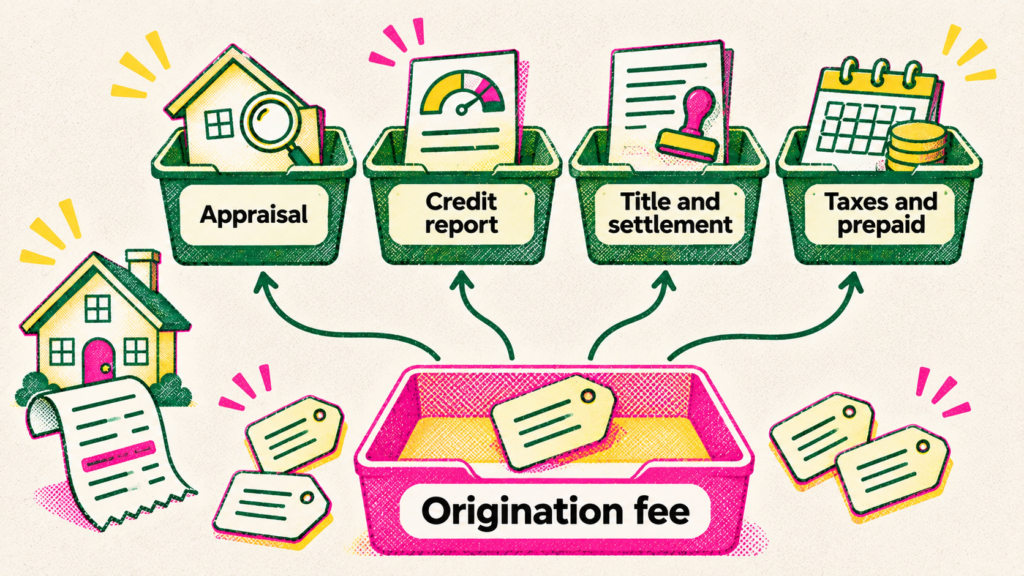
Knowing what is not an origination fee is just as helpful.
Appraisal Fee
An appraisal is usually done by an outside appraiser. It is a third-party charge, not an origination fee.
Credit Report Fee
The cost of pulling your credit report may be listed on its own line. It is not automatically part of the origination fee.
Title and Settlement Services
Title search, title insurance, and settlement or closing agent fees are third-party services. They are not lender origination fees.
Property Taxes and Prepaid Insurance
Property taxes, homeowners insurance, prepaid interest, and money set aside in an escrow account are not origination fees either. They are separate costs that often show up at closing.
Section 08
Where Do You See Mortgage Origination Fees on the Loan Estimate?
What Is a Loan Estimate?
A Loan Estimate is a standard form lenders give you after you apply. It shows your loan terms, your projected payments, and your estimated closing costs. Because every lender uses the same form, it makes side-by-side comparisons much easier.
Where Are Origination Charges Listed?
According to the CFPB, origination fees are listed in section A of page 2 of your Loan Estimate. That section is part of the Loan Costs area. The final charges then appear in section A of page 2 of your Closing Disclosure.
Still, do not just search for the words “origination fee.” Lenders may label their charges in different ways within that section.
How to Read the Origination Charges Section
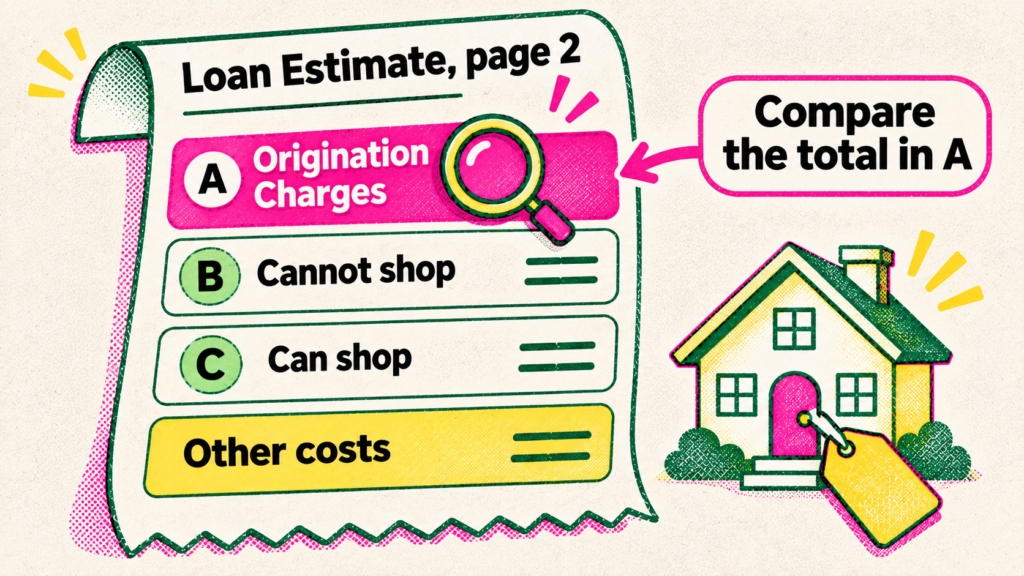
Page 2 of the Loan Estimate groups your loan costs in a set order:
- Section A, Origination Charges: what the lender charges to make the loan
- Section B, Services You Cannot Shop For: third-party services the lender picks, like the appraisal
- Section C, Services You Can Shop For: third-party services you can choose yourself, like some title services
- Other Costs: taxes, government fees, prepaid items, and escrow
When you compare offers, look at the total in section A and how it fits with the rest of the costs. A single line rarely tells the full story.
Section 09
Mortgage Origination Fee vs. Other Mortgage Costs
Origination Fee vs. Closing Costs
An origination fee is one cost. Closing costs are the full group of costs you pay to close the loan. Your origination fee is just one part of that total.
Origination Fee vs. Discount Points
This is the most important comparison. An origination fee pays for making the loan. Discount points are an upfront payment you can choose to make to lower your interest rate. The CFPB’s guide to points and lender credits explains that paying points lowers your rate compared with a zero-point loan at the same lender.
The two are not the same thing, even though both are paid upfront and both can be shown as a percentage of the loan.
Origination Fee vs. Lender Credit
A lender credit works in the opposite direction from points. According to the CFPB, lender credits lower your closing costs upfront in exchange for a higher interest rate. So a lender might offer a credit that helps cover some of your closing costs, but you would pay more interest over time.
Origination Fee vs. Mortgage Rate
A loan with a low fee is not automatically cheaper. If that low fee comes with a higher rate, you may pay more over the life of the loan. A lower fee is not the same as a cheaper loan.
Section 10
Should You Choose a Mortgage With a Lower Origination Fee?
Lower Fees Do Not Always Mean Lower Total Cost
To judge a loan’s real cost, look at more than the origination fee. Also check the interest rate, the APR, any lender credits, any discount points, the other closing costs, and how long you expect to keep the loan.
Compare Fees and Rates Together
Here is a general way to think about two offers:
| Option | Origination Fee | Interest Rate | Upfront Cost | Potential Long-Term Cost |
|---|---|---|---|---|
| Loan A | Lower | Higher | Lower | Depends |
| Loan B | Higher | Lower | Higher | Depends |
Neither option is better on its own. The answer depends on the real numbers and on how long you keep the loan.
Here is an example. Say two offers are for the same $400,000, 30-year fixed loan. Loan A has a $1,000 origination fee and a 6.75% rate. Its monthly principal and interest payment would be about $2,594. Loan B has a $4,000 origination fee and a 6.5% rate. Its payment would be about $2,528.
Loan B costs $3,000 more upfront, but it saves about $66 a month. At that pace, it would take about 46 months, or just under four years, to make up the extra $3,000. If the borrower keeps the loan longer than that, Loan B may cost less overall. If they sell or refinance sooner, Loan A may cost less.
Disclaimer: This is a simplified, hypothetical example for educational purposes only. It compares principal and interest payments and origination fees only. It ignores differences in principal paid down, other closing costs, taxes, and the time value of money. Actual rates, fees, and payments vary by lender, borrower, loan program, and market conditions. This is not a rate quote or loan offer.
Consider How Long You Expect to Keep the Loan
The example shows why your time horizon matters. The cheapest loan often depends on how long you keep it. Paying more upfront for a lower rate tends to make more sense the longer you keep the loan. If you plan to move or refinance soon, a lower upfront cost may matter more.
Section 11
How Do Mortgage Origination Fees Affect the Cost of Your Loan?
Upfront Cost
If you pay the origination fee at closing, it raises the cash you need to close. For many buyers, that cash is already stretched by the down payment and other costs.
Amount Financed
Not every fee can be added to your loan. Whether a fee is paid in cash, covered by a credit, or handled another way depends on your loan setup. Check your Loan Estimate and Closing Disclosure to see how your fees are being paid.
APR and Overall Loan Cost
The APR, or annual percentage rate, reflects your interest rate plus certain fees, shown as a yearly rate. It can give you a broader view of borrowing cost than the rate alone. Still, the APR does not replace reading your Loan Estimate line by line.
Section 12
Can Mortgage Origination Fees Be Negotiated?
Are Origination Fees Negotiable?
Sometimes. It depends on the lender, the deal, the pricing, and the loan setup. There is no promise that you can lower the fee, but it never hurts to ask.
What Can You Ask the Lender?
Here are some useful questions:
- Is the origination fee negotiable?
- Is it a percentage or a flat fee?
- What services does it cover?
- Are lender credits available?
- Is there a different rate with different upfront fees?
- Does this offer include discount points?
Compare Multiple Loan Estimates
The most practical step is to get more than one Loan Estimate and compare them. But do not just ask, “Who has the lowest origination fee?” A better question is, “Which loan has the best overall cost for how long I expect to keep it?”
Section 13
Mortgage Origination Fees and Mortgage Brokers
How Mortgage Brokers Are Compensated
A mortgage broker helps you find a loan from a lender. Brokers are paid for that work, and the pay can be set up in different ways depending on the deal and the rules that apply.
Borrower-Paid vs. Lender-Paid Compensation
In simple terms, a broker may be paid by the borrower or by the lender. As stated in Wonder Rates’ disclosures, Wonder Rates is paid either by the lender or by the borrower on a given loan, but never by both. The setup that applies to your loan is disclosed to you in writing before closing.
Why Compensation Should Be Compared With the Full Loan Offer
Lender-paid does not mean free. When a lender pays the broker, that cost is often built into the loan’s pricing, such as the rate. So look at the rate, the credits, and the other charges together, not just who pays the broker.
Section 14
How to Compare Mortgage Origination Fees Between Lenders
Compare the Same Loan Scenario
Make sure each offer is for the same loan. Keep these the same across offers:
- Loan amount
- Loan type
- Loan term
- Property type
- Down payment
- Rate scenario, including points or credits
- Rate lock period, if one applies
If the down payment differs, your loan-to-value ratio changes too, and that can change pricing and mortgage insurance. Our guide on Rate Lock Explained also covers why the lock period matters.
Compare Origination Charges
Look at the actual charges in section A of each Loan Estimate. Do not rely on ads or marketing claims.
Compare Interest Rate
A low fee with a high rate can mean higher monthly interest. So always check the rate next to the fee.
Compare Lender Credits and Discount Points
Points and credits can change both your upfront cost and your rate in a big way. The CFPB suggests asking each lender for the same amount of points or credits so the offers line up.
Compare Total Cash to Close
Cash to close is the amount you actually need to bring on closing day. It is a key number for your budget, even though it does not tell the whole story about long-term cost.
Section 15
How to Estimate Your Mortgage Payment and Loan Costs
Why Mortgage Payment Is Only Part of the Comparison
Your monthly principal and interest payment is important, but it does not include your closing costs. So two loans with similar payments can still have very different upfront costs.
Use the Wonder Rates Mortgage Payment Calculator
Before you compare loan offers, you can estimate your monthly principal and interest with the Wonder Rates Mortgage Payment Calculator. You can also add taxes, insurance, PMI, and HOA dues. If you want to compare two offers side by side, the Wonder Rates Rate Comparison Calculator shows the payment, total interest, closing costs, and APR for each one. Calculator results are estimates, not loan quotes.
Section 16
Common Mistakes When Evaluating Mortgage Origination Fees
Mistake #1: Assuming 1% Is a Universal Origination Fee
There is no single percentage that applies to every mortgage. Fees vary by lender, loan, and borrower.
Mistake #2: Comparing Fees Without Comparing Interest Rates
This is the biggest mistake. A low fee paired with a high rate can cost more over time.
Mistake #3: Treating All Closing Costs as Origination Fees
Closing costs include much more than origination charges. Appraisal, title, taxes, and insurance are separate.
Mistake #4: Looking Only at Cash to Close
Cash to close matters for your budget. But it does not show the full cost of borrowing over time.
Mistake #5: Comparing Different Loan Scenarios
If one offer has a different loan amount, term, or down payment, the comparison is not fair. Always compare apples to apples.
Section 17
What to Know Before Paying Mortgage Origination Fees
Mortgage origination fees are just one part of what a mortgage costs. Before you pay them, understand exactly what the lender is charging and what services those charges cover. Then look at how the fees work with your interest rate, any lender credits, any discount points, and your total cash to close.
The lowest origination fee does not always lead to the lowest-cost mortgage, because a low upfront fee can come with a higher rate. The most useful comparison looks at the full loan setup under the same scenario, not one fee on its own.
Section 18
Explore Your Mortgage Options
Start by estimating your payment with the Wonder Rates Mortgage Payment Calculator.
If you are comparing mortgage offers and want to understand how the rate, lender charges, and monthly payment work together, you can review your options with a mortgage professional. Get started with Wonder Rates to talk through your scenario, or explore mortgage options for buying a home.
Section 19
Disclaimer
This article is provided for general educational and informational purposes only and should not be considered mortgage, financial, tax, legal, or investment advice. Mortgage origination fees, lender charges, broker compensation, interest rates, lender credits, discount points, and other loan costs vary by lender, loan program, transaction, borrower qualifications, property, market conditions, and other factors.
Any rates, fees, percentages, calculations, examples, or scenarios presented in this article are hypothetical and are provided for illustration only. They are not mortgage quotes, offers, commitments to lend, guarantees of approval, or guarantees of specific loan terms or pricing. Actual costs may differ from the examples shown.
A Loan Estimate provides estimates of loan terms and closing costs based on the information available when the disclosure is prepared. Borrowers should review their Loan Estimate and Closing Disclosure carefully and compare the full cost of each loan option rather than relying on a single fee, interest rate, monthly payment, or cash-to-close figure.
Tax treatment of mortgage origination fees and other mortgage costs can depend on the borrower’s individual circumstances and applicable tax rules. This article does not provide tax advice. Consult a qualified tax professional regarding your specific situation.
Mortgage rules, disclosure requirements, lender practices, and applicable regulations may change over time. Information in this article should be reviewed against current official guidance and the borrower’s specific loan documents before making a financing decision.
References to government agencies or regulatory requirements are provided for informational purposes and do not constitute an endorsement of Wonder Rates or any mortgage product. Loan approval, pricing, fees, and terms are subject to applicable underwriting requirements and lender approval.
Duc Pham, Mortgage Broker | NMLS# 844897, Wonder Rates, Inc. | NMLS# 1518655 | DRE# 02047445 | DFPI# 60DBO-59134 | Equal Housing Opportunity. Equal Housing Lender. | Licensed in: AL, AZ, CA, CO, FL, GA, LA, MI, NC, OH, OK, OR, PA, SC, TX, VA, WA.



