Section 01
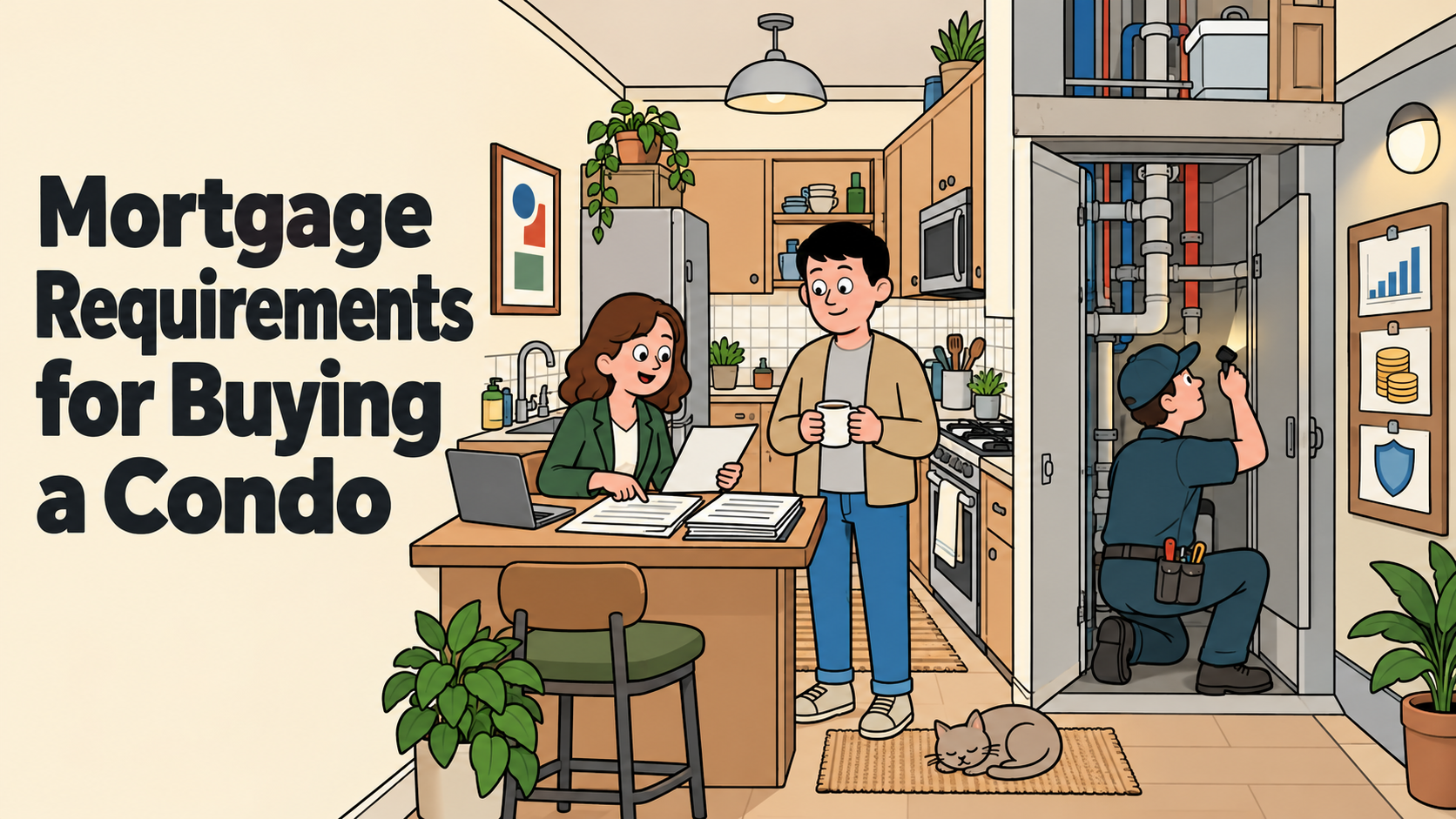
Buying a condo with a mortgage is not quite the same as buying a single-family house. The lender does not just look at you. The lender also looks at the individual unit, and at the condo project itself, including its HOA.
That means a buyer can have great credit, solid income, and plenty of savings, and still run into a financing roadblock if the condo building has problems the buyer never knew about. Getting approved for your mortgage and getting the condo project approved for financing are related, but they are not the same thing.
This guide covers both sides: what you need as a borrower, and what the condo project needs to pass review.
Disclaimer: This article is for general educational purposes only and does not constitute financial, mortgage, legal, tax, insurance, or investment advice. Condo mortgage requirements, project eligibility standards, underwriting requirements, insurance requirements, HOA requirements, and loan program guidelines vary by lender, loan type, property, location, and borrower circumstances, and they can change over time. Always verify current requirements with a qualified mortgage professional and the applicable loan program guidelines before making a mortgage or real estate decision.
Section 02
What Are the Mortgage Requirements for Buying a Condo?
There are three layers of review in a condo mortgage, and all three need to hold up for the loan to close.
Borrower requirements work the same way they would for any mortgage: your credit score, credit history, income, employment, debt-to-income ratio, assets, down payment, and reserves all get reviewed.
Condo unit requirements cover the specific unit you want to buy: its type, its occupancy, the appraisal, its condition, its insurance, and its legal status.
Condo project and HOA requirements are what make condo financing different. Lenders look at the HOA’s financial health, the project’s insurance, how well reserves are funded, any pending litigation, delinquent dues, special assessments, project characteristics, and the overall eligibility of the project under the applicable loan program’s rules.
Condo financing carries this extra layer of review because the lender’s collateral is not just your unit. It is tied to shared spaces, the building itself, and the financial stability of everyone who owns a piece of it.
Section 03
Is It Harder to Get a Mortgage for a Condo?
Not automatically. Plenty of condos finance just fine when the borrower qualifies, the project meets the applicable requirements, and the paperwork comes together cleanly.
What makes condo financing different is not difficulty for its own sake. It is the extra underwriting layer tied to the project itself: HOA finances, insurance, repairs, reserves, litigation, and special assessments. None of that exists when you buy a standalone house.
A strong borrower can still run into a condo financing problem. Picture a buyer with strong income, good credit, and 20 percent down. On paper, this buyer looks easy to approve. But if the condo project has major unresolved repairs, thin reserves, or an insurance gap, a strong borrower profile does not automatically make that project eligible. The project has to clear its own bar, separately from the buyer.
This scenario is hypothetical and for educational illustration only. Actual project eligibility and underwriting outcomes depend on the applicable loan program, lender requirements, property documentation, and the specific condo project.
Section 04
Condo Mortgage Requirements for the Borrower

Credit Score and Credit History
Your minimum credit score depends on the loan program you choose. Lenders also look at your payment history, any recent delinquencies, collections or charge-offs, and your overall credit pattern. A low score does not automatically rule out condo financing, but it does narrow which loan programs fit.
Income and Employment
Lenders want to see steady, documentable income: W-2 wages, self-employment income, commission, bonus, or income from multiple sources. The documentation standard for condo buyers is the same as for any other mortgage borrower.
Debt-to-Income Ratio
Your DTI is your monthly debt divided by your gross monthly income. With a condo, this calculation has to include your HOA dues, not just principal, interest, taxes, and insurance. Buyers sometimes forget this when estimating what they can afford, and it can meaningfully change the number.
For a deeper explanation of how DTI is calculated and how it can affect mortgage qualification, see our guide to Debt-to-Income Ratio (DTI).
Down Payment
Your required down payment depends on the loan program, your occupancy plans, your credit profile, and the loan-to-value ratio you are working with. There is no single universal down payment percentage that applies to every condo purchase.
Cash Reserves and Assets
Lenders verify your closing funds, your reserves after closing, your bank accounts, eligible investment assets, and gift funds where the loan program allows them. This review looks the same as it would for a single-family purchase.
Documentation
Expect to provide identification, pay stubs, tax documents, bank statements, debt information, and your signed purchase contract. On top of that, condo purchases require HOA and project documentation, which is covered in detail below.
Section 05
Condo Project Requirements for Mortgage Approval
This is the part that genuinely sets condo financing apart. A project review looks at the building and the HOA, not just you.
A Major Industry Change You Should Know About
Starting with loan applications dated on or after August 3, 2026, Fannie Mae and Freddie Mac retired the streamlined “Limited Review” and “Streamlined Review” pathways that used to let many established condo buildings skip a deep financial review. Under Fannie Mae’s Lender Letter LL-2026-03, loans in condo projects with more than 10 units now generally require a “Full Review,” a detailed look at the HOA’s budget, reserve funding, delinquency rate, insurance, and litigation history. Projects with 10 or fewer units may qualify for an expanded Waiver of Project Review instead. Reserve funding minimums are also scheduled to rise, from 10 percent to 15 percent of the HOA’s annual budgeted assessment income, for Full Review applications dated on or after January 4, 2027.
For buyers, this means more HOA documentation is being requested earlier in the process than in past years, and it means a condo building that sailed through financing a couple of years ago is not guaranteed to sail through the same way today. If you are shopping for a condo right now, ask your loan officer whether the specific project you are considering has gone through this review and what it found.
HOA Financial Health
Lenders look at the HOA’s operating budget, reserve funds, any delinquent assessments among owners, the overall budget structure, major planned expenses, and any special assessments on the books.
Condo Reserves
Reserves exist to pay for future repairs: the roof, the exterior, structural components, common areas, and other major capital projects. Thin reserves can be a red flag, since it may suggest the HOA is not prepared to pay for upkeep without surprising owners with a large bill later. HOA reserves are different from the cash reserves a lender may require from the borrower. If you want to understand how lenders evaluate the funds you have available after closing, see our guide to Mortgage Cash Reserves.
Special Assessments
A special assessment is a one-time or short-term charge an HOA levies on top of regular dues, usually to pay for an unexpected or underfunded repair. Lenders evaluate special assessments differently from ordinary monthly dues, since a large or recent assessment can signal a deeper financial issue in the building.
Pending Litigation
If the HOA or the project is involved in a lawsuit, the lender may need additional documentation to understand what the litigation covers and how it could affect the building’s finances. Not every lawsuit makes a project ineligible, but the nature and size of the litigation matters.
Project Insurance
This covers master property insurance for the building, liability coverage, flood insurance where the property sits in a flood zone, and any other coverage required based on the project’s location and structure.
Project Condition and Deferred Maintenance
Lenders and appraisers pay attention to structural concerns, major deferred repairs, water intrusion, roof or exterior issues, and anything that raises a safety question about the building.
Ownership and Occupancy Characteristics
Depending on the loan program, lenders may look at the owner-occupancy rate, how concentrated ownership is among investors, how many units are rented out, whether there is commercial space in the building, and other structural details about the project. There is no single universal ratio that applies to every loan program, so the exact threshold depends on which program you are using.
Section 06
What Does a Lender Look for in a Condo HOA?
In practice, this comes down to the HOA’s budget and financial statements, any reserve study the HOA has commissioned, delinquent dues among owners, special assessments, insurance coverage, major repairs or deferred maintenance, litigation or other legal issues, and the overall project documentation package.
A buyer usually does not have direct control over any of these items. That is exactly why it helps to investigate the project early, rather than waiting until the mortgage is nearly ready to close to find out there is a problem.
Section 07
Condo HOA Fees and Mortgage Qualification
HOA dues are part of your monthly housing cost, and they factor directly into your DTI. Higher dues reduce how much mortgage payment you can realistically qualify for, even if the purchase price of the unit itself looks affordable.
HOA fees sit separately from your principal, interest, property taxes, homeowners insurance, and any mortgage insurance. All of these pieces add up to your true monthly cost of owning the condo, and HOA dues are often the piece buyers underestimate.
If you’re comparing different condo prices or HOA dues, the Wonder Rates Mortgage Payment Calculator can help you estimate how the monthly housing cost may change when you factor in the major components of the payment.
Special assessments are different from regular dues. They are typically one-time or temporary charges, not part of your ongoing monthly budget, but they can still hit your finances hard if one comes up shortly after you move in.
Because of all this, it is worth requesting the HOA’s dues history, budget, and any planned assessments before you get too far into the transaction, not after you are already under contract with a tight closing deadline.
Section 08
Condo Down Payment Requirements
Your down payment depends on the loan program you choose, your credit profile, and whether the condo project itself is eligible for that type of financing in the first place.
Larger down payments do not automatically fix project problems. This is an important distinction. If the condo project does not meet a loan program’s eligibility requirements, for example because of thin reserves or unresolved litigation, a buyer cannot simply offer a bigger down payment to make the project pass review. The project’s eligibility and the buyer’s down payment are two separate questions.
Section 09
Condo Mortgage Credit Score Requirements
Your credit requirements depend on the loan program, and a low score can narrow which programs are realistically available to you. But strong credit does not guarantee condo approval on its own, because the project still has to pass its own review. Credit and project eligibility are genuinely separate questions, and it helps to think of them that way from the start.
Section 10
Condo Appraisal Requirements
An appraisal confirms the condo’s value for the lender. The appraiser looks at the unit’s characteristics, recent comparable sales, the unit’s condition, its location within the building, its overall marketability, and, where relevant, characteristics of the condo project itself.
If the condo appraises below the purchase price, a buyer typically has a few options: bring additional cash to cover the gap, try to renegotiate the purchase price with the seller, reconsider the financing structure, or review the appraisal itself for errors. There is no guarantee that any one of these options will work in every situation, and the right path depends on the specifics of the contract and the lender’s policies.
Condo comparables can be harder to find than single-family comparables, especially for unique units, buildings with limited recent sales, new developments, luxury condos, or buildings still in an early construction phase. This is one reason condo appraisals can sometimes take longer or come back with more questions attached.
Section 11
Condo Insurance Requirements for a Mortgage
There are generally two layers of insurance involved in a condo purchase. Individual unit insurance covers your personal belongings and the interior finishes of your specific unit, often called an HO-6 policy. HOA master insurance is a separate policy the HOA carries to cover the building’s structure and common areas.
Depending on the condo’s location, flood insurance or other specialized coverage may also be required, particularly if the building sits in a designated flood zone.
Insurance problems can genuinely affect condo financing. If the HOA’s master policy does not provide adequate coverage, has had major recent claims, or does not meet the requirements of your specific loan program, it can hold up or even derail your financing until the issue is resolved.
Section 12
Conventional Condo Mortgage Requirements
Conventional condo loans, backed by Fannie Mae or Freddie Mac, evaluate borrower qualification the same way any conventional loan would: credit, income, DTI, assets, and down payment. On top of that, the project has to pass its own eligibility review, now generally a Full Review for most established buildings with more than 10 units, following the 2026 changes described earlier in this article.
Project documentation typically includes the HOA budget, financial statements, and insurance details. Owner occupancy and investor concentration are also part of the review, along with a standard appraisal and insurance confirmation. Current, authoritative requirements are published in Fannie Mae’s Selling Guide, Project Standards.
Section 13
FHA Condo Mortgage Requirements
FHA borrower requirements for a condo purchase are the same as FHA requirements generally, covering credit, income, and down payment based on your credit score tier.
The key distinction for condos is FHA-approved projects versus individual unit approval. A condo project can be approved as a whole, which means every unit inside it is already eligible for FHA financing, or a single unit can go through FHA’s Single-Unit Approval (SUA) process, sometimes called spot approval, even when the broader project is not on HUD’s approved list.
FHA’s published condo eligibility standards generally require that at least 50 percent of the units be owner-occupied, and for Single-Unit Approval in a project with 10 or more units, no more than 10 percent of units can carry active FHA-insured loans at once (for projects with fewer than 10 units, that cap is generally no more than two FHA-insured units). HOA budgets are also expected to allocate a meaningful share, commonly cited around 10 percent, of their annual assessment income to capital reserves.
Because FHA eligibility depends heavily on the specific project, it is worth checking HUD’s FHA condominium approval database before assuming any particular building qualifies.
Section 14
VA Condo Mortgage Requirements
VA borrower eligibility follows the standard VA loan rules for eligible veterans, service members, and surviving spouses. For the condo project itself, the VA has traditionally required the entire condominium project to be approved and listed before any unit within it can close with a VA loan, unlike FHA’s single-unit option. This is a stricter, project-wide standard.
Because VA condo approval rules have been subject to legislative and policy updates, it is worth confirming the current process directly with a VA-approved lender rather than assuming an older rule still applies. You can check whether a specific project is already VA-approved through the VA’s Condo Report database. The project matters just as much for VA financing as it does for conventional or FHA loans. VA approval of a borrower does not eliminate the need for project-level review.
Section 15
Can You Buy a Condo as a First-Time Home Buyer?
Yes. First-time buyers can absolutely use condo financing, and in many markets a condo is a more affordable entry point than a single-family home.
What first-time buyers should budget for goes beyond the purchase price: the down payment, closing costs, HOA dues, property taxes, homeowners insurance, any mortgage insurance, cash reserves, and the possibility of a future special assessment. Condo affordability calculations that leave out HOA dues tend to badly understate the real monthly cost.
Before making an offer, first-time buyers should ask about current HOA dues, any recent or upcoming assessments, how well reserves are funded, the HOA’s insurance coverage, any major repairs on the horizon, whether the building restricts renting out units, and whether the project is already eligible for the type of financing the buyer plans to use.
Section 16
Can You Get a Condo Mortgage With an HOA?
Yes, and this is the normal situation for almost every condo purchase. Having an HOA does not automatically make a condo ineligible for financing. What matters is the financial condition and structure of that specific HOA: how it is funded, how well it is managed, and whether it meets the applicable loan program’s standards.
Before applying, it helps to review the HOA’s dues, its budget, its reserve funding, any pending litigation, and its insurance coverage, so there are no surprises once underwriting gets a closer look.
Section 17
Documents Needed for a Condo Mortgage
Borrower documents include identification, pay stubs, W-2s, tax returns where applicable, bank statements, investment statements, and debt information.
Property documents include the purchase contract, the appraisal, and insurance information for the unit itself.
Condo project documents can include the HOA budget, financial statements, insurance certificates, meeting minutes where required, reserve information, litigation disclosures, special assessment history, and any project questionnaire the lender requests.
Condo documentation can take longer than a typical single-family closing, and the bottleneck often is not the buyer at all. It can be the HOA’s management company, which may be slow to pull together the requested financial records, especially for smaller, self-managed buildings.
Section 18
Example: Buying a $500,000 Condo With a 20% Down Payment
Hypothetical buyer profile:
- Purchase price: $500,000
- Down payment: $100,000 (20 percent)
- Estimated loan amount: $400,000
- Stable W-2 income
- Good credit
- Moderate monthly debt
- HOA dues: $600 per month
What the lender evaluates on the borrower side: credit, income, DTI including the $600 monthly HOA dues, and assets.
What the lender evaluates on the property and project side: the HOA’s financial health, insurance coverage, reserve funding, overall project eligibility, and the appraisal.
Why the $100,000 down payment does not guarantee approval on its own. If this condo project has a significant unresolved issue, for example an underfunded reserve account or an unresolved lawsuit, the loan can still face delays or denial regardless of how strong this buyer’s financial profile is. The down payment strengthens the borrower side of the file. It does nothing to fix a project-level problem.
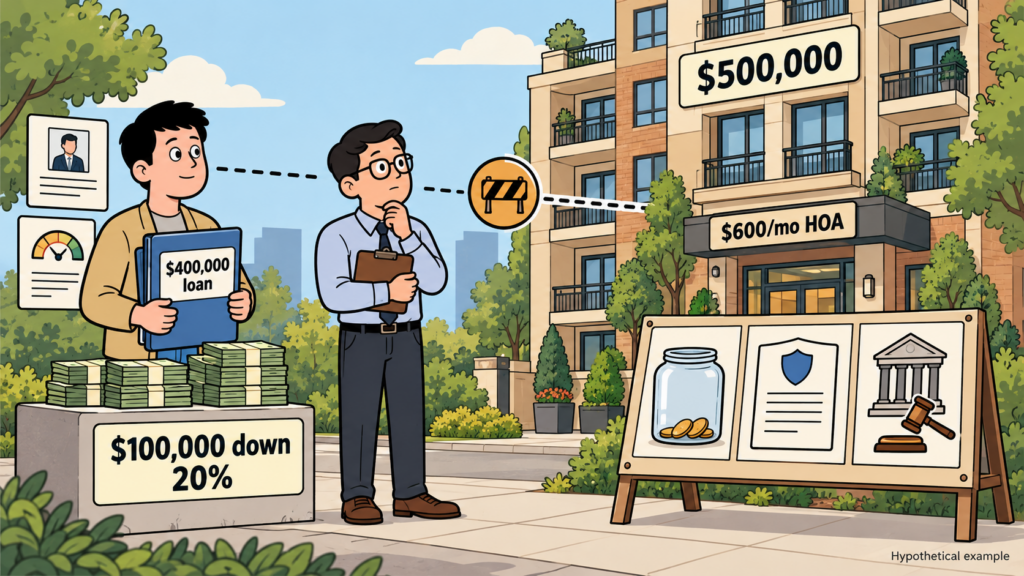
The dollar amounts and borrower profile in this example are fictional and simplified for educational purposes. They do not represent a required down payment, actual mortgage terms, underwriting result, or guaranteed approval. Actual requirements vary by loan program, lender, property, project, and borrower circumstances.
Section 19
Example: Strong Borrower, Problematic Condo Project
Borrower profile: strong credit, stable income, a low DTI, a large down payment, and strong cash reserves. On paper, this is about as clean a borrower file as a lender will see.
Project issue: the HOA has significant deferred maintenance, an insurance gap, a recent major special assessment, and incomplete financial documentation.
Why the mortgage can still run into trouble: even with every borrower-side factor working in this buyer’s favor, the project itself may not meet the applicable loan program’s eligibility standards. Until the HOA addresses the underlying issues or provides the missing documentation, this buyer may need to look at a different loan program, wait for the project to resolve its problems, or consider a different property entirely.
This scenario is fictional and is intended to illustrate the difference between borrower qualification and condo project eligibility. It does not represent a prediction of how any specific lender or loan program will evaluate a project.
Section 20
Common Reasons a Condo Mortgage Gets Delayed or Denied
On the project side, the usual culprits are incomplete HOA documentation, insurance problems, major deferred maintenance, insufficient or concerning reserves, special assessments, pending litigation, or project characteristics that simply do not meet the applicable program’s guidelines. An appraisal that comes back low or raises condition concerns can also slow things down.
On the borrower side, the usual issues are high DTI, insufficient assets, or incomplete documentation, the same issues that can delay any mortgage.
It helps to keep these two categories separate in your head. A borrower issue is something you can usually fix yourself. A condo project issue often is not something you can fix as the buyer; it depends on the HOA’s own finances and management.
Section 21
How to Prepare for a Condo Mortgage Before Making an Offer
Start by getting your own borrower profile in order: review your credit, gather income documentation, know your monthly debts, and confirm how much you have available for a down payment and reserves.
Then shift your attention to the project. Ask for condo documents early, including the HOA budget and reserve information. Review the HOA fees and ask about any recent or upcoming special assessments. Ask about the building’s insurance situation directly. Confirm financing eligibility for the specific loan program you plan to use as early in the process as possible. And once you are under contract and in underwriting, avoid making any major financial changes, since those can slow down or complicate your file just as much on a condo as on any other home purchase.
Section 22
Condo Mortgage Pre-Approval vs. Condo Project Approval
These are two different things, and mixing them up causes real confusion for buyers.
Borrower pre-approval means a lender has reviewed your credit, income, assets, and debts, and given you a sense of how much you can borrow.
Project review means the lender separately evaluates the specific condo building you want to buy, including its HOA finances, insurance, and overall eligibility.
Being pre-approved for a certain loan amount does not mean every condo under that price point is automatically financeable. “I’m pre-approved for $500,000” is not the same statement as “every condo priced under $500,000 will qualify for financing.” This is exactly why it helps to tell your loan officer about the specific condo you are considering as early as possible, ideally before you write an offer.
Section 23
Condo Mortgage vs. Single-Family Home Mortgage
| Factor | Condo | Single-Family Home |
|---|---|---|
| Borrower qualification | Required | Required |
| Credit review | Yes | Yes |
| Income and DTI review | Yes, including HOA dues | Yes |
| Appraisal | Required where applicable | Required where applicable |
| HOA or project review | Often significant | Usually not comparable at the project level |
| Master insurance | HOA or project level can matter | Owner’s own property policy |
| Reserve review | Condo project reserves often matter | Different structure entirely |
| Special assessments | A potential concern | Not relevant in the same way |
| Project eligibility | Can be a major factor | Generally not applicable |
A condo mortgage is not automatically harder than a single-family mortgage. It simply carries additional project-level considerations that a single-family purchase does not have to clear.
Section 24
Questions to Ask Before Buying a Condo With a Mortgage
About the HOA: How much are the monthly dues? Have dues increased recently? Are there upcoming special assessments? How are reserves funded? Are any major repairs planned?
About the building: Is there major deferred maintenance? What insurance does the HOA carry? Are there any pending legal issues? Are there rental restrictions? Is there commercial space in the building?
For your loan officer: Is this specific project eligible for the loan program I want to use? What condo documents will you need? Will HOA dues affect how much I qualify for? Are there any project-level concerns you already know about? Will any additional documentation be required?
Section 25
A Condo Mortgage Preparation Checklist
Borrower
- [ ] Credit reviewed
- [ ] Income documented
- [ ] DTI estimated, including HOA dues
- [ ] Down payment available
- [ ] Closing costs available
- [ ] Reserves reviewed
- [ ] Bank statements organized
Condo
- [ ] HOA dues confirmed
- [ ] Special assessments checked
- [ ] HOA financials reviewed
- [ ] Insurance reviewed
- [ ] Major repairs checked
- [ ] Project documentation available
- [ ] Appraisal completed and reviewed
- [ ] Project eligibility verified for your specific loan program
Mortgage
- [ ] Loan program selected
- [ ] Pre-approval completed
- [ ] Condo-specific requirements discussed with your loan officer
- [ ] Documents submitted early
- [ ] No major financial changes during underwriting
Section 26
Key Takeaways: Mortgage Requirements for Buying a Condo
Condo mortgage approval has two major sides: borrower qualification and condo project eligibility, and both have to hold up for the loan to close. Your credit, income, DTI, down payment, assets, and reserves still matter exactly the way they would for any mortgage. HOA finances, insurance, reserve funding, special assessments, litigation, and the overall condition of the project can also affect financing, especially following the industry-wide move to stricter Full Review standards starting in August 2026. HOA dues should always be included when you estimate what you can actually afford. A strong borrower does not automatically make an ineligible project financeable, no matter how large the down payment. The smartest move is to investigate the condo project early, ideally before you get too deep into the transaction.
The best way to approach condo financing is to evaluate both sides of the transaction from the start: can I qualify for this mortgage, and can this specific condo project qualify for this type of financing?
Section 27
Sources
- Fannie Mae Selling Guide, B4-2.1-01, General Information on Project Standards
- HUD FHA Condominium Approval Database
- HUD FHA Single Family Housing Policy Handbook 4000.1
- U.S. Department of Veterans Affairs, VA Condo Report (approved condo search)
Disclaimer: This article is for general educational purposes only and does not constitute financial, mortgage, legal, tax, insurance, or investment advice. Condo mortgage requirements, project eligibility standards, HOA requirements, insurance requirements, reserve funding standards, and loan program guidelines vary by lender, loan type, property, location, and borrower circumstances, and they are subject to change, including the industry-wide condo project review changes that took effect in 2026 and continue phasing in through 2027. All examples, figures, and scenarios in this article are hypothetical and provided solely to illustrate general mortgage concepts. They are not guarantees of loan approval, project eligibility, interest rate, loan terms, or eligibility for any individual borrower or property. Always consult a licensed mortgage professional and verify current requirements before making a mortgage or real estate decision.
Duc Pham, Mortgage Broker | NMLS# 844897, Wonder Rates, Inc. | NMLS# 1518655 | DRE# 02047445 | DFPI# 60DBO-59134 | Equal Housing Opportunity. Equal Housing Lender. | Licensed in: AL, AZ, CA, CO, FL, GA, LA, MI, NC, OH, OK, OR, PA, SC, TX, VA, WA.