
Section 01
Maybe you run your own business. Your tax returns may show less income than you really bring home. Maybe you own several rentals, or you hold most of your wealth in savings and investments instead of a paycheck. In cases like these, a standard mortgage may not fit how your money works. That is where a Non-QM loan may come in. This guide explains Non-QM mortgage requirements in plain terms. You will learn what lenders look at and how they check income and assets. You will also see how these loans compare to a conventional mortgage.
One idea runs through the whole guide. There is no single set of Non-QM rules that every lender follows. Credit score, down payment, debt limits, savings, and paperwork rules all depend on the lender.
Section 02
What Is a Non-QM Mortgage?
A Non-Qualified Mortgage, or Non-QM mortgage, is a home loan that falls outside the legal definition of a Qualified Mortgage, or QM. It may be built for borrowers whose money situation or paperwork does not fit the usual approval methods.
Non-QM describes the loan, not the borrower.

QM and Non-QM are legal labels for how a loan is set up. They are not a way of sorting good borrowers from bad ones. Some people who look at Non-QM loans earn a lot or hold large savings. They just cannot show their income the way a conventional program asks.
Three ideas are worth keeping in mind. First, Non-QM loans can use other ways to look at your finances. Second, the rules change from lender to lender and loan to loan. Third, a Non-QM label does not remove the need to check whether you can repay. The Consumer Financial Protection Bureau (CFPB) explains this well. A lender must make a good-faith effort to decide that you can repay before giving you a mortgage. This is called the ability-to-repay rule.
What Does Non-QM Mean?
A Qualified Mortgage is a legal category with set rules and protections. According to the CFPB, these rules generally limit risky features, such as balloon payments. They also cap the APR on most QM loans. They limit certain upfront points and fees too. On top of that, the lender must check your income or assets and your monthly debts.
A Non-QM loan falls outside that category. This can happen because of how your income is documented. It can also happen when the loan has a feature QM rules do not allow, like an interest-only period. To see how the two categories differ, read our guide on how Qualified Mortgage requirements differ from Non-QM financing.
Still, a Non-QM loan is not automatically high-risk or free from rules. It must follow the consumer protection laws that apply.
Why Do Borrowers Consider Non-QM Mortgages?
Some borrowers look at Non-QM loans because their income is hard to show the usual way. Others own a business, hold large assets, or invest in real estate. Their finances may call for a different kind of review.
Common examples include self-employed business owners, real estate investors, and people with complex income. Even so, the right loan depends on your real money picture, not your job title. A self-employed person with simple, clear income may fit a conventional loan just fine.
Section 03
What Are the Main Non-QM Mortgage Requirements?
No single credit score, down payment, or debt limit applies to every Non-QM program. The same is true for paperwork and savings rules. Each lender sets its own Non-QM loan requirements for each product, within the limits of the law.

Here are the main things a lender may look at:
| Requirement | What the lender may evaluate |
|---|---|
| Credit history | Credit score, payment history, recent derogatory events |
| Down payment and LTV | Borrower’s equity contribution and loan-to-value ratio |
| Income or repayment analysis | Bank statements, tax returns, rental cash flow, assets, or other accepted documentation |
| Debt obligations | Existing debts and the proposed mortgage payment |
| Cash reserves | Eligible funds remaining after closing |
| Assets and source of funds | Down payment, closing funds, account history, and documented fund sources |
| Property and occupancy | Primary residence, second home, or investment property |
| Loan terms | Loan amount, interest structure, amortization, and repayment terms |
The lender weighs all of these together under the rules for your loan. Large savings may help one kind of application. But strong assets do not cancel out every weak spot in your file.
Are There Standard Minimum Credit Score Requirements?
No. Non-QM loan credit score requirements vary by lender and product. How you use the home, your loan-to-value ratio, and other risks also matter. Some programs may be more flexible on credit than a conventional loan. That does not mean they accept everyone.
Because these numbers vary so much, be careful with any site that lists one “minimum score” for all Non-QM loans. The only number that matters is the one tied to a real, current lender program. For more on this topic, see our guide on how lenders evaluate credit history.
How Much Down Payment Is Required for a Non-QM Loan?
The Non-QM mortgage down payment depends on the product and your overall risk profile. Some situations may allow a smaller down payment. Other products may ask you to put more money in.
It also helps to know the difference between a down payment and cash to close. On top of the down payment, you may need money for closing costs and prepaid items. You may also need savings left after closing. The Wonder Rates Down Payment Calculator can help you estimate the total cash you need, not just the down payment.
Do Non-QM Loans Have a Maximum DTI Ratio?
Debt-to-income ratio, or DTI, compares your monthly debt payments to your gross monthly income. Gross income is your income before taxes. The lender uses the numbers that apply under its own method.
DTI limits differ by product and lender. Some Non-QM programs use other ways to check whether you can repay. Even so, the lender still needs a sound basis for that decision. A Non-QM loan does not allow unlimited DTI, and it does not ignore the debts you already have.
Section 04
Non-QM Income Verification Requirements
Income is often the main reason people look at Non-QM loans. So this section covers the different ways lenders may check it.
The method depends on the product. Some programs review personal or business bank statements. Others look at assets or a rental’s cash flow. Some still use tax returns but apply their own rules.
Different paperwork does not mean less paperwork.

Lenders still need enough proof for the ability-to-repay review the law requires. Non-QM lenders must make a good-faith decision that you can repay. So expect to share real records, even if they look different from a pay stub.
Bank Statement Loans for Self-Employed Borrowers
Many business owners take legal tax write-offs. These lower the income shown on their tax returns. A bank statement program may look at your deposits to estimate your income instead.
To do this, a lender may ask for personal or business bank statements. It may also want proof that you own the business. Notes that explain odd deposits are common too. These are typical bank statement mortgage requirements, but each lender sets its own list.
Here is a key point. Money coming into your business is not the same as your personal income. Your business also has costs. So the lender may apply an expense factor. This is a percentage it subtracts for business costs. Some lenders use another method instead.
Tax Returns and Profit-and-Loss Statements
Some borrowers will still need tax returns, business statements, or a profit-and-loss statement. A profit-and-loss statement, or P&L, shows a business’s income and costs over time.
A Non-QM loan does not let you pick any document you like and have it accepted. A P&L may need records that back it up, and lenders treat it in different ways.
Asset-Based or Asset-Utilization Qualification
Some programs may look at your eligible assets as part of the repayment review. These are sometimes called asset-depletion programs. The lender may use a set formula to turn your assets into an amount that can help support the loan.
This is more than just showing a big bank balance. The lender decides which assets count and confirms that you own them. It also checks how easy they are to turn into cash and what to subtract. Then it decides how the final number is used in your review.
Rental Income and DSCR-Based Qualification
Debt Service Coverage Ratio, or DSCR, loans are popular with real estate investors. With DSCR, a lender may compare a home’s eligible rent with its loan payment. In many cases, this takes the place of a full review of your personal DTI.
Here is a simple way to picture the math. Say a rental is expected to bring in $3,000 a month in rent. The full monthly payment on the property is $2,500, including principal, interest, taxes, insurance, and HOA dues. Divide $3,000 by $2,500, and the DSCR is 1.2. That means the rent covers the payment about 1.2 times.
Disclaimer: This example uses fictional figures for illustration only. Lenders define eligible rent, qualifying payment, and minimum DSCR differently, and a given ratio does not guarantee eligibility or approval for any loan.
A DSCR review looks at the property, but it does not waive every other rule. Credit, down payment, savings, the appraisal, and rent records may still matter. You can test rental numbers with the Wonder Rates DSCR Calculator before you talk to a lender.
Section 05
Non-QM Requirements for Different Borrower Situations
The right Non-QM product depends on why you do not fit a standard loan. This section can help you spot which questions to ask. It cannot pick a product for you, since that takes a full review.
Self-Employed Borrowers With Complex Income
Picture a business owner whose company brings in strong revenue. After legal deductions, their taxable income looks much smaller. For this person, a bank statement program may be worth a look, since its self-employed mortgage requirements work differently. The lender’s math still needs a fair basis for repayment.
Real Estate Investors With Multiple Properties
Investors often have income spread across many homes, business entities, and rental accounts. Some products may look at the cash flow of one property at a time. Others may need a fuller picture of the investor’s finances.
Either way, the lender will look at your current mortgages, empty months, and property costs. It will also look at your savings and how you plan to use the new home.
Borrowers With Significant Assets but Nontraditional Income
Some borrowers hold large savings or investment accounts but do not earn a steady salary. A retiree with a large investment account is one example. For this borrower, an asset-based product may be worth a look. They would still need to meet the program’s asset formula and paperwork rules.
Borrowers With Limited U.S. Credit History or Specialized Documentation Needs
Some lenders offer special programs for borrowers whose U.S. credit or income records look different. Eligibility depends on the product, lawful papers, and any residency or ID rules. The lender’s own guidelines matter too.
Being a non-U.S. citizen does not make you eligible for a Non-QM loan on its own. It does not rule out other options either. Our guide to mortgage documentation for non-U.S. citizens explains how lenders look at these situations.
Section 06
Non-QM Mortgage Credit Score, Down Payment, and Reserve Requirements
Before you talk to a lender, it helps to understand how they look at your credit, your equity, and your savings.
Credit History and Recent Credit Events
Lenders may look at your payment history, how much credit you use, and any collections. They also check for serious events such as a bankruptcy or foreclosure. Any waiting period after these events depends on the program and lender.
So do not assume a Non-QM loan will accept a recent bankruptcy or foreclosure. The lender has to review the event, when it happened, and the program rules.
Loan-to-Value Ratio and Equity Contribution
Loan-to-value ratio, or LTV, is the loan amount divided by the home’s value. For example, a $400,000 loan on a home valued at $500,000 has an LTV of 80%. In other words, you own 20% of the home’s value up front.
Disclaimer: This is a simplified, hypothetical calculation for illustration only. The value a lender uses and the LTV limits that apply depend on the loan program, the transaction, and lender guidelines.
A lower LTV generally means more equity, which is the part of the home you own outright. More equity can shape how a lender sees risk. It can also affect your pricing and eligibility. To learn more, read our guide on how loan-to-value ratio affects mortgage eligibility.
Cash Reserves and Verifiable Assets
Some Non-QM programs ask you to keep a set amount of money after closing. These savings are called reserves. They may be counted in months of mortgage payments, and the amount varies.
Lenders may check that you own the accounts and review your statements. They may also confirm where the money came from and how easy it is to access. Having enough for the down payment does not prove you can close and keep up with payments.
Section 07
Non-QM Mortgage Rates, Fees, and Loan Terms
Non-QM mortgage rates and fees may differ from those on a similar conventional loan. That is because the approval methods, loan setups, and risk reviews are not the same.
Still, there is no fixed gap for every Non-QM loan. Real pricing depends on you, the home, the product, and the market. Points, fees, and loan terms play a part too.
Why Non-QM Interest Rates May Be Different
Your credit, your LTV, and the type of paperwork you use can all affect pricing. So can how you use the home, the loan amount, and the loan’s setup. Keep in mind that the interest rate alone does not show the full cost of borrowing.
Fixed-Rate, Adjustable-Rate, and Interest-Only Features
Non-QM products may offer different ways to repay. Some have a fixed rate. Others may have an adjustable rate, an interest-only period, or a balloon payment. If your loan has one of these, learn how your payment could change over time.
Not every Non-QM loan has these features. Your loan papers and your Loan Estimate show the real terms. A Loan Estimate is a standard form lenders give you after you apply.
Compare APR, Closing Costs, and Total Payment
When you compare offers, look at more than the rate. Check the APR, which folds many upfront costs into one yearly rate. Also look at lender fees, points, and the monthly payment. Ask if there is a prepayment penalty, which is a fee for paying off the loan early.
The Wonder Rates Rate Comparison Calculator lets you compare two offers side by side. It shows the payment, total interest, closing costs, and APR for each.
Section 08
Non-QM vs. Conventional Mortgage Requirements
This table shows the main differences in a Non-QM vs. conventional mortgage. Neither one is always better.
| Comparison factor | Conventional mortgage | Non-QM mortgage |
|---|---|---|
| Qualification framework | Applicable agency or conventional program guidelines | Product-specific lender and investor guidelines, subject to applicable law |
| Income documentation | Commonly tax returns, W-2s, pay stubs, and other accepted records | May allow alternative documentation methods |
| Credit requirements | Program-specific | Vary by Non-QM product and lender |
| Down payment | Depends on program, occupancy, and eligibility | Depends on product, LTV, and borrower profile |
| Debt analysis | Uses applicable underwriting methods | May use alternative or product-specific methods |
| Pricing and fees | Vary by borrower and market | May differ based on product structure and risk factors |
| Best starting point | Borrowers who meet conventional guidelines | Borrowers whose circumstances may fit an alternative product |
If you qualify under standard rules, a conventional loan may still cost less or fit better. A Non-QM loan is worth exploring when a conventional application misses your real finances. It may also help when a special product better fits the deal.
When a Conventional Mortgage May Be the Better Fit
Think of a borrower with clear income, good credit, and finances that fit a conventional program. For this person, it makes sense to check conventional options first. That way, they avoid paying for a special product they do not need.
When a Non-QM Mortgage May Be Worth Exploring
A Non-QM loan may be worth a look if your self-employment income is complex. It may also fit if you need an asset-based review or are buying a rental. In each case, an alternative way of showing income may matter.
A lender saying yes is not the same as a loan that fits.
The goal is a loan that reflects your real finances. It should also come with a payment you can manage.
Section 09
Non-QM Mortgage Example: How a Bank Statement Loan May Be Evaluated
Let’s walk through a made-up example. It shows why bank deposits and qualifying income are often two different numbers. It is not meant to show a typical lender formula.
Example Borrower and Income Documentation
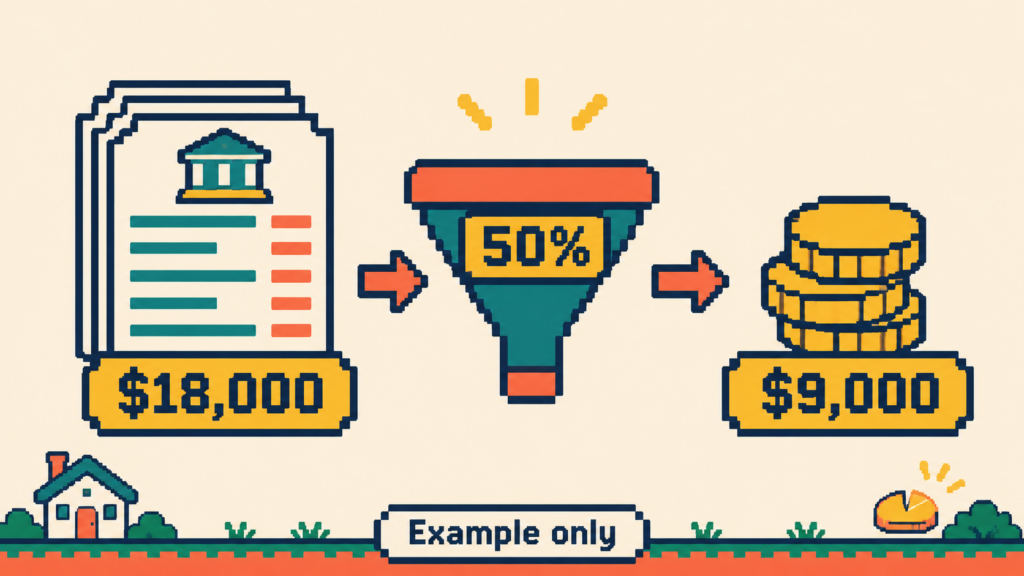
Say a self-employed business owner has eligible bank deposits that average $18,000 a month over the statement period. Now imagine a lender applies a 50% expense factor to those deposits, just for this example. Here is the math:
$18,000 × 50% = $9,000 estimated monthly income for a first-pass calculation
The 50% expense factor is made up only to show the math. Real programs may use different methods, account rules, statement periods, and expense formulas.
What the Example Does and Does Not Establish
Deposits are not the same as income.
This example shows that $18,000 in deposits does not count as $18,000 in qualifying income. The lender must decide which deposits are eligible and account for business costs. It must then review the borrower’s debts, assets, credit, and the new mortgage.
The example does not show how much this borrower could borrow. That would take a full set of facts. You would need the rate, taxes, insurance, other debts, LTV, and program rules.
This scenario uses fictional figures and a hypothetical expense factor for educational illustration only. The assumed 50% expense factor is not a standard Non-QM requirement and does not represent the guidelines of any specific lender. Actual qualifying income may be calculated differently based on eligible deposits, business expenses, account history, documentation, and the selected loan program. This example is not a loan offer, preapproval, approval decision, or guarantee of eligibility.
Section 10
How to Prepare for a Non-QM Mortgage Application
A well-organized application helps the lender understand your finances. It also helps them figure out which program rules may fit your situation.
Gather Income and Asset Documents
Depending on the product, some records may help. These include bank statements, tax returns, and P&L statements. Business ownership records, investment statements, leases, and rental records may help too.
You will not need every one of these for every product. The lender should tell you which records apply to the loan you are considering.
Review Credit, Debts, and Available Reserves
Look over your credit history and your monthly debts. Then check your money for the down payment, closing costs, and savings after closing. Fixing errors and sorting your records can make the first review go more smoothly.
Confirm Property and Loan Details
The lender will need the home’s price or value. It will also ask how you will use the home and what type of home it is. They will also need the loan amount you want and the type of loan setup you prefer. A rental may need lease or rent records, while a home you live in may be reviewed in a different way.
Compare More Than One Loan Scenario
Compare the products you may qualify for. Ask about the rate, APR, fees, payment setup, savings rules, and any prepayment penalty. The goal is not just to find a lender willing to look at your file. It is to understand the full costs of the loan before you agree to it.
Section 11
Use Mortgage Calculators Before Comparing Non-QM Loan Options
Calculators can help you test payment scenarios before you look at real Non-QM quotes.
Estimate Your Monthly Payment
With the Wonder Rates Mortgage Payment Calculator, you can estimate your monthly mortgage payment. Enter a loan amount, rate, and term to see principal and interest. Then add taxes, insurance, and other costs. If you have a Non-QM quote, use that rate instead of a conventional one.
Compare Actual Offers Carefully
Once you have real offers, the Rate Comparison Calculator can help you compare mortgage rates and loan costs. Keep in mind that calculators cannot tell you if you qualify. They also cannot copy every product’s rules or fees. Use real lender quotes and loan papers to compare the full terms.
Section 12
Explore Non-QM Mortgage Options With Wonder Rates
A Non-QM loan may make sense when standard income rules miss your full money picture. The right path depends on your income type, credit, and assets. The home, your down payment, and the loan terms matter too.
A Non-QM loan is not a sure backup plan after a conventional loan says no. It is one option to review and compare with others.
Get a Mortgage Review Based on Your Financial Profile
Your income may not fit a standard W-2 mortgage application, but that does not automatically mean you have no financing options. The key step is learning how a lender can document your income and evaluate repayment ability. From there, you can find a mortgage that fits your situation.
Wonder Rates can help you review your mortgage scenario. Together, we can explore options that may suit your finances and home-buying goals. Get started with Wonder Rates or explore home-buying options.
Section 13
Disclaimer
This article is for general educational and informational purposes only and does not constitute financial, legal, tax, investment, or mortgage advice, an offer to lend, a commitment to lend, or a guarantee of mortgage approval or eligibility. Non-QM mortgage requirements, credit criteria, down payment requirements, income documentation methods, debt-to-income limits, reserve requirements, pricing, and loan terms vary by lender, loan product, investor guidelines, applicable law, property type, occupancy, and borrower circumstances. Non-QM status does not eliminate applicable ability-to-repay or other legal requirements. Any examples or calculations are hypothetical and provided for illustration only; they do not represent an actual lender’s guidelines, loan offer, or approval decision. Calculator results are estimates and do not determine loan eligibility or guarantee actual payments. Consult a qualified mortgage professional and review the terms and disclosures for a specific loan before making a borrowing decision.
Duc Pham, Mortgage Broker | NMLS# 844897, Wonder Rates, Inc. | NMLS# 1518655 | DRE# 02047445 | DFPI# 60DBO-59134 | Equal Housing Opportunity. Equal Housing Lender. | Licensed in: AL, AZ, CA, CO, FL, GA, LA, MI, NC, OH, OK, OR, PA, SC, TX, VA, WA.



