Section 01
A condo buyer can meet the lender’s credit, income, and down-payment requirements while the project itself does not meet the requirements for the selected loan. That is why condo financing involves both borrower qualification and project eligibility.
The 2026 Fannie Mae and Freddie Mac updates include changes to project reviews, reserves, and insurance. Some introduce additional requirements, while others provide more flexibility. Buyers should confirm which rules and effective dates apply to their transaction.
Section 02
What "Warrantable" Actually Means
 A warrantable condo generally meets the project requirements applicable to the agency-backed mortgage being considered. A condo may be described as non-warrantable when it does not meet those requirements.
Ask the lender to identify the specific problem and whose rule applies: Fannie Mae, Freddie Mac, the lender, or another investor. One lender’s decline does not automatically establish that every financing option is unavailable.
A strong borrower profile does not resolve a project eligibility issue. The lender must review both the borrower and the property under the selected program.
Section 03
What Changed on March 18, 2026
Fannie Mae and Freddie Mac announced several condo project and property insurance updates on March 18, 2026. These changes have different effective dates, and the two agencies use different names for some review paths.
Fannie Mae
The 15% reserve requirement has been announced but is not yet in effect. Fannie Mae is increasing the minimum replacement-reserve allocation from 10% to 15% of annual budgeted assessment income. The higher requirement applies when the Full Review process is used for loan applications dated on or after January 4, 2027. Until then, an HOA should not be described as failing Fannie Mae’s 15% requirement solely because its current budget has not reached that threshold.
Fannie Mae’s enhanced reserve-study requirements have an earlier effective date. For loan applications dated on or after August 3, 2026, when a reserve study is used to demonstrate adequate reserves, the project budget must include the highest recommended reserve allocation in the study. That allocation cannot rely on a baseline funding method.
Limited Review was retired for applications dated on or after August 3, 2026. Projects that previously qualified for Limited Review must instead use Full Review or, when eligible, Waiver of Project Review. This does not mean every condo project with more than ten units automatically requires Full Review, because the appropriate review path still depends on the project and transaction.
The investment-property concentration limit was retired. Fannie Mae eliminated its 50% investment-property concentration limit for established projects reviewed under the Full Review option. The separate presale requirement for new and newly converted projects still applies.
Freddie Mac
Freddie Mac’s 15% reserve requirement also has not taken effect yet. Freddie Mac is increasing the minimum reserve allocation from 10% to 15% of annual budgeted assessment income for mortgages with Application Received Dates on or after January 4, 2027.
Its enhanced reserve-study requirements apply earlier. For mortgages with Application Received Dates on or after August 3, 2026, the project budget must include the highest recommended reserve allocation in the reserve study and cannot use a baseline funding method.
Streamlined Review was retired for mortgages with Application Received Dates on or after August 3, 2026. Eligible projects may instead use the Established Condominium Projects review, Reciprocal Review, or Exempt from Review path.
The owner-occupancy requirement was retired. Freddie Mac separately eliminated its 50% owner-occupancy requirement for Established Condominium Projects. Presale requirements for New Condominium Projects remain in place.
Property Insurance Deductible
For Fannie Mae loan applications dated on or after July 1, 2026, and Freddie Mac mortgages with Application Received Dates on or after July 1, 2026, a per-unit deductible under the master property insurance policy generally cannot exceed $50,000 per unit.
Section 04
Key Issues That Can Affect Condo Project Eligibility
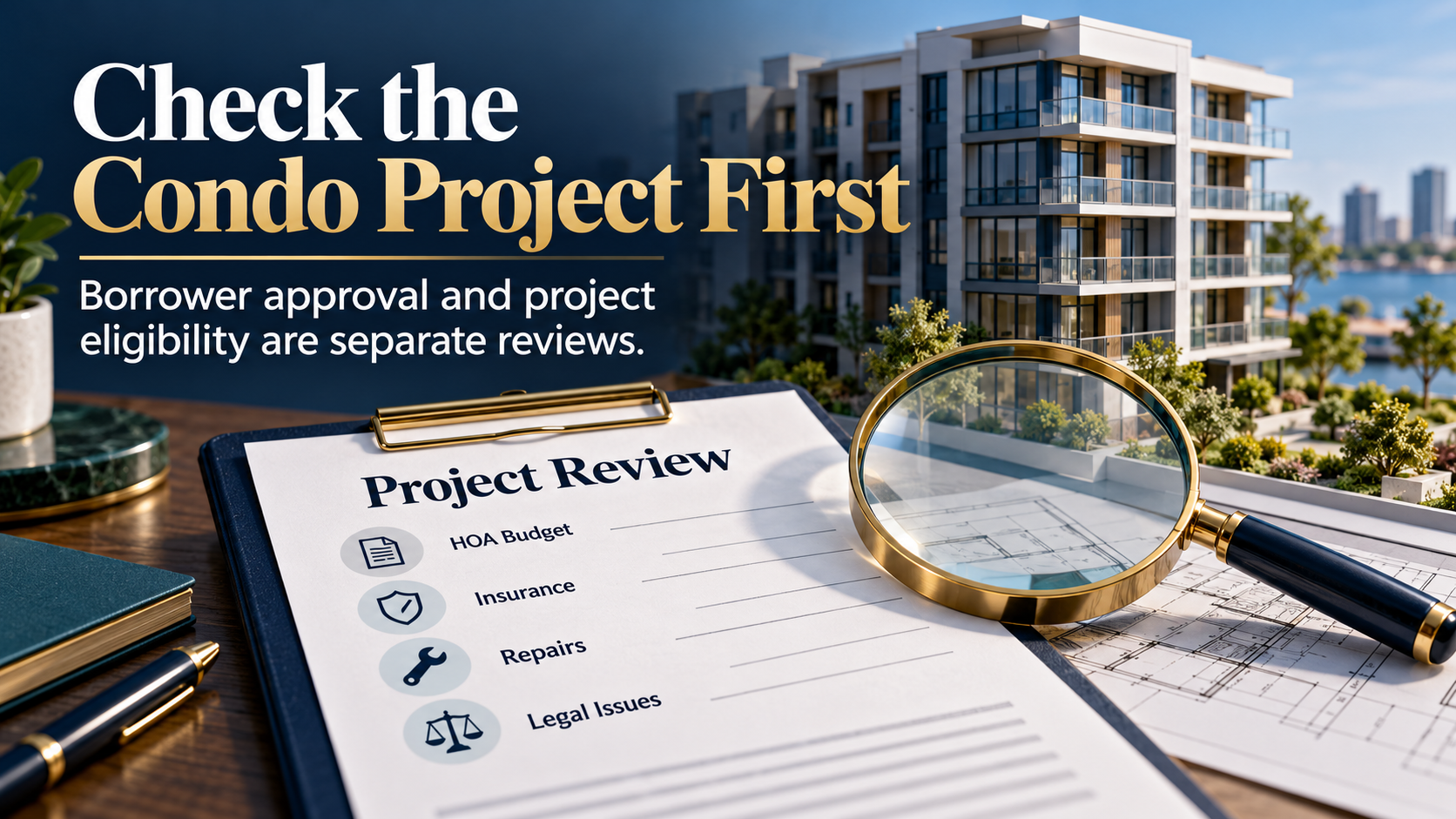 Project reviews can cover reserve funding, HOA delinquencies, ownership concentration, applicable presale requirements, insurance, commercial use, critical repairs, litigation, and special assessments.
These are review topics, not a universal six-item checklist. Ask which requirements apply and what documents are needed to resolve outstanding questions.
A unit appraisal or inspection does not replace the project review. Our guide to appraisal versus inspection explains why different property reviews serve different purposes.
Section 05
What Happens If a Condo Is Non-Warrantable
 First, ask whether the issue is missing documentation, a lender-specific restriction, or an underlying project condition. The next step depends on the reason for the decline.
Portfolio or non-QM lenders may consider some projects that do not meet agency requirements. Request the down payment, interest rate, APR, fees, reserves, and project restrictions in writing rather than assuming a standard loan-to-value range.
Paying cash removes the mortgage-approval requirement, but it does not remove building-condition, insurance, HOA, or resale risks. Waiting for the association to resolve an issue is another possibility, but the timing and outcome are not guaranteed.
Section 06
Why This Matters Even If You Are Not Buying Right Now
Warrantability is reassessed at the time of each new loan application, not locked in permanently once a building is approved. A condo that was warrantable for a buyer six months ago can lose that status. This can happen if the HOA’s reserves drop, delinquency rates rise, or new litigation is filed against the association. A building’s status can change between when you tour a unit and when you are ready to close. This is part of why it is worth checking specifically, rather than assuming a building qualifies simply because a similar unit sold there recently under different financing.
FHA and VA loans follow their own separate condo approval process. They are not directly affected by these Fannie Mae and Freddie Mac changes. This is worth knowing if a specific building’s warrantability becomes a concern during your search.
Section 07
How to Check Before You Fall in Love With a Unit
Request the HOA budget, reserve study, master insurance information, recent meeting minutes, and details of pending repairs or special assessments. Ask the lender which items remain conditional.
Insurance deserves a separate review. These insurance questions for homes in climate-risk areas can help you discuss deductibles, coverage gaps, and community exposure with an insurance professional.
Use the Wonder Rates Max Purchase Price Calculator to explore an estimated purchase budget. Review HOA dues, insurance, assessments, and reserve needs separately with the loan officer. Calculator results do not establish condo project eligibility.
Bring these questions to ask a loan officer when discussing financing options and unresolved conditions.
Section 08
Frequently Asked Questions
What makes a condo non-warrantable?
A condo may be considered non-warrantable for a particular conventional loan when the project does not satisfy the applicable Fannie Mae, Freddie Mac, lender, or investor requirements. Relevant factors may include reserve funding, HOA delinquencies, ownership concentration, presale requirements, insurance coverage, critical repairs, litigation, special assessments, and commercial space.
Is the new 15% reserve requirement already in effect?
No. Fannie Mae and Freddie Mac announced the increase from 10% to 15%, but the higher requirement applies to loan applications dated or received on or after January 4, 2027.
For Fannie Mae, the 15% requirement applies when the Full Review process is used. Freddie Mac applies its corresponding requirement under its applicable project review guidelines.
The enhanced reserve-study requirements have a different effective date and apply to applications dated or received on or after August 3, 2026.
Was Limited Review eliminated immediately?
No. Fannie Mae retired Limited Review for loan applications dated on or after August 3, 2026. Freddie Mac separately retired its Streamlined Review path for mortgages with Application Received Dates on or after August 3, 2026.
The available replacement paths differ between the agencies. Not every condo project automatically requires a Fannie Mae Full Review.
When did the $50,000 per-unit deductible requirement take effect?
For Fannie Mae loan applications dated on or after July 1, 2026, and Freddie Mac mortgages with Application Received Dates on or after July 1, 2026, a per-unit deductible under the master property insurance policy generally cannot exceed $50,000 per unit.
Can I still get financing on a non-warrantable condo?
Potential options may include portfolio loans, non-QM financing, or paying cash. Availability, interest rates, down payment requirements, and project restrictions vary by lender and program.
Did the 2026 updates make condo financing harder or easier?
It depends on the project and application date. The retirement of Fannie Mae Limited Review and Freddie Mac Streamlined Review, the enhanced reserve-study standards, and the insurance requirements may create additional review issues for some projects. The 15% reserve requirement does not apply until January 4, 2027. Separately, the retirement of certain Fannie Mae investment-property concentration and Freddie Mac owner-occupancy requirements may help some projects qualify.
Can a warrantable condo become non-warrantable later?
Yes. A previous approval or successful closing does not guarantee eligibility for a new transaction. Project conditions and applicable guidelines may change, so eligibility must be confirmed for the new application.
Do FHA and VA loans use the same condo rules as Fannie Mae and Freddie Mac?
No. FHA and VA maintain separate condo project approval processes. These Fannie Mae and Freddie Mac updates do not replace FHA or VA requirements.
Section 09
This Article Is for General Education
This article is for educational purposes only and is not a commitment to lend. Condo warrantability rules are complex, vary by lender, and can change over time. Confirm a specific building’s current status with a loan officer before making an offer.
Next Steps
Before committing to a condo purchase, talk with a Wonder Rates loan officer about the project and your financing options. Share the property address and available HOA documents so the lender can identify the required review and remaining eligibility questions.
Duc Pham, Mortgage Broker | NMLS# 844897
Wonder Rates, Inc. | NMLS# 1518655
Equal Housing Lender.
AZ, CA, CO, FL, GA, LA , MI, OK, PA, SC, TX, VA, WA, OH, AL, OR, NC
This article is for educational purposes only and is not a commitment to lend. Loan approval is subject to creditworthiness, income verification, property eligibility, and current underwriting guidelines. Loan programs, interest rates, and lender fees may change without notice. Always review your official Loan Estimate before making a financing decision.