Section 01
You have some extra cash each month. Do you put it toward your mortgage principal, or do you invest it instead? Financial professionals genuinely disagree on this. The honest answer is that it depends on your numbers, your other debts, and how you personally feel about carrying debt. This guide lays out both sides plainly, without pretending there is one right answer for everyone.
Section 02
Why This Question Does Not Have a Universal Answer
The math side of this debate compares two things. First, the interest rate on your mortgage, which is a cost you avoid by paying down debt faster. Second, the return you might reasonably expect from investing that same money elsewhere. If your mortgage rate is relatively high, paying it down early tends to look more attractive. That is a guaranteed way to avoid future interest. If your mortgage rate is relatively low, the case for investing gets stronger. Long-term investment returns have historically outpaced low borrowing costs over long periods. This is never guaranteed, though, and past performance does not predict future results.
That comparison only covers the math. It leaves out something just as real: how you feel about debt. Some people experience genuine stress from carrying a mortgage balance, regardless of what the numbers say. Peace of mind has value too, even if it does not show up on a spreadsheet.
Section 03
How Paying Down a Mortgage Actually Works

Every scheduled mortgage payment generally includes principal and interest. If the loan is escrowed, the total payment may also include property taxes, homeowners insurance, and other applicable charges. Amortization determines how the scheduled principal-and-interest payment is divided over the loan term.
An extra payment applied correctly to principal reduces the outstanding loan balance. Because future interest is calculated using that lower balance, additional principal can reduce total interest and shorten the effective payoff timeline. The effect depends on the loan balance, interest rate, remaining term, timing, and amount of the extra payment.
Before sending additional money, confirm that the servicer will apply it to principal rather than treating it as an early scheduled payment. You can use the Wonder Rates Extra Payment Calculator to compare estimated interest and payoff timing under different extra-payment scenarios. Calculator results are educational estimates and do not change the legal terms of your loan.
Also review your mortgage documents for a prepayment penalty. The Consumer Financial Protection Bureau explains that a prepayment penalty is a fee some lenders may charge when part or all of a mortgage is paid off early. Not every mortgage has one, and the circumstances in which it applies depend on the loan terms.
Section 04
The Case for Paying Off Your Mortgage Early
nvestments may provide greater long-term growth
A diversified investment portfolio may earn more than the interest avoided by paying down a lower-rate mortgage, but the result is never certain. Market values can fall, returns vary, and the time at which you need the money can affect the outcome.
Investor.gov explains that investment risk includes uncertainty about returns and the possibility that results will differ from what the investor expected. A projected return should not be treated as a promised return.
The money may remain more accessible
Money sent to the mortgage becomes home equity. Accessing it later may require selling the property, qualifying for a refinance, obtaining a home equity product, and paying applicable costs. Money held in a liquid savings or investment account may be easier to access, although selling investments at an unfavorable time can create losses or tax consequences.
Investing may improve diversification
Putting every available dollar into the home can concentrate more of a household’s wealth in one property and one local housing market. The U.S. Securities and Exchange Commission’s Investor.gov describes diversification as spreading money among different investments to reduce risk.
Diversification cannot prevent every loss, but it can help avoid depending on a single asset for the household’s entire long-term financial outcome.
Retirement contributions may have additional value
Employer matching contributions, tax-advantaged accounts, and a long investment horizon may affect the decision. These considerations depend on the specific account, plan rules, taxes, and household goals. A licensed financial professional or qualified tax professional can help evaluate those factors.
Section 05
The Case for Investing the Extra Money Instead
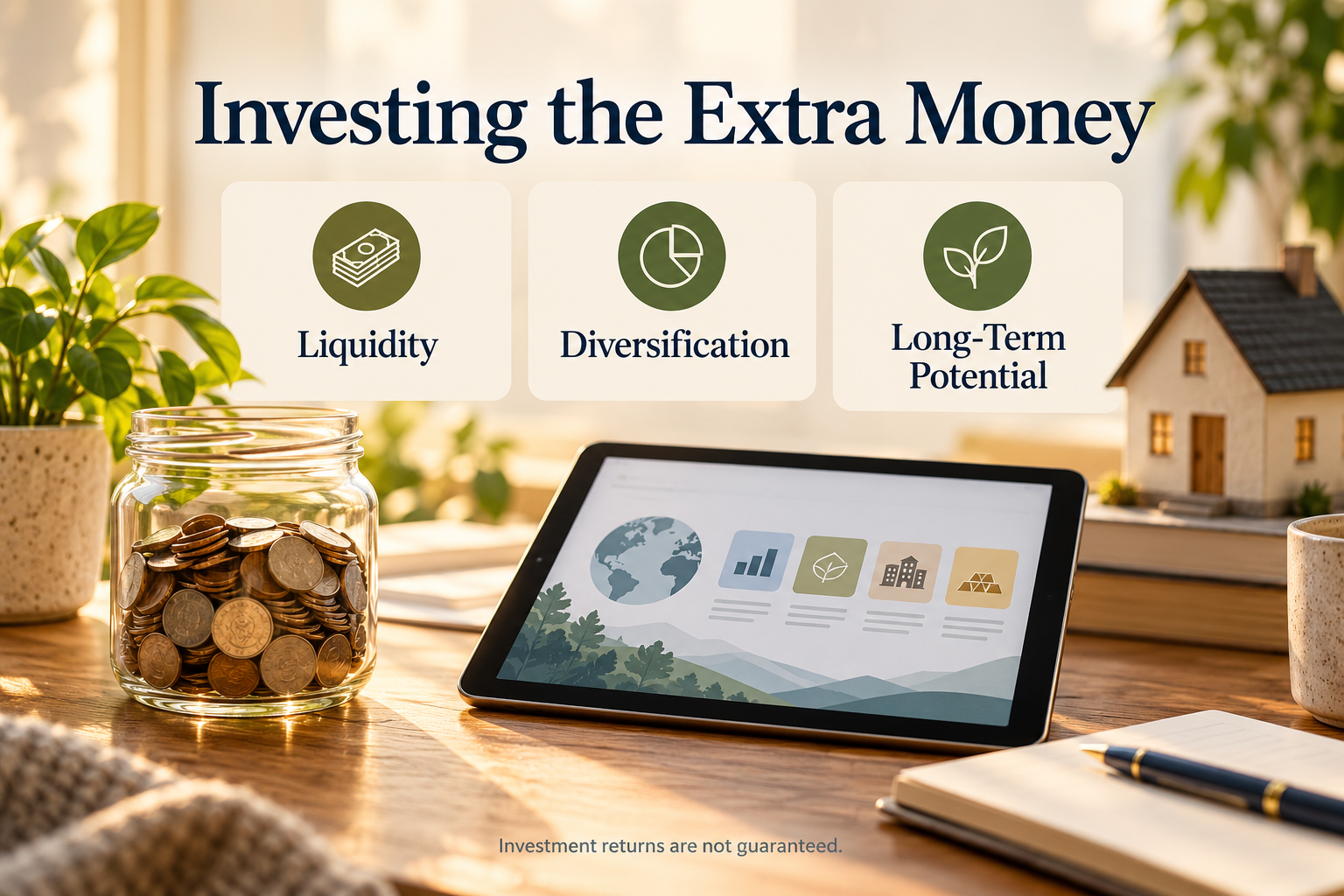 Investments may provide greater long-term growth
A diversified investment portfolio may earn more than the interest avoided by paying down a lower-rate mortgage, but the result is never certain. Market values can fall, returns vary, and the time at which you need the money can affect the outcome.
Investor.gov explains that investment risk includes uncertainty about returns and the possibility that results will differ from what the investor expected. A projected return should not be treated as a promised return.
The money may remain more accessible
Money sent to the mortgage becomes home equity. Accessing it later may require selling the property, qualifying for a refinance, obtaining a home equity product, and paying applicable costs. Money held in a liquid savings or investment account may be easier to access, although selling investments at an unfavorable time can create losses or tax consequences.
Investing may improve diversification
Putting every available dollar into the home can concentrate more of a household’s wealth in one property and one local housing market. The U.S. Securities and Exchange Commission’s Investor.gov describes diversification as spreading money among different investments to reduce risk.
Diversification cannot prevent every loss, but it can help avoid depending on a single asset for the household’s entire long-term financial outcome.
Retirement contributions may have additional value
Employer matching contributions, tax-advantaged accounts, and a long investment horizon may affect the decision. These considerations depend on the specific account, plan rules, taxes, and household goals. A licensed financial professional or qualified tax professional can help evaluate those factors.
Section 06
Why Liquidity Should Be Considered First
Home equity is valuable, but it is not the same as cash in a checking or savings account. A homeowner who sends nearly all available cash to the mortgage may have difficulty covering a roof repair, medical expense, job interruption, insurance deductible, or another unexpected cost.
Before making a large additional principal payment, review whether your household has adequate accessible savings. The Wonder Rates guide on how to build an emergency fund explains why emergency money should remain available for unplanned expenses rather than being committed to a long-term asset.
This does not mean every homeowner needs the same savings amount. The appropriate cushion depends on household expenses, income stability, dependents, insurance coverage, property condition, and other risks.
Section 07
A Middle-Ground Approach
 The choice does not need to be all or nothing. A homeowner may decide to:
- Pay off higher-cost debt before directing extra money toward the mortgage or investments
- Build accessible emergency savings first
- Contribute enough to receive an available employer retirement match
- Split the remaining amount between additional principal and investing
- Make occasional lump-sum principal payments rather than increasing every monthly payment
- Review the strategy after major changes in income, rates, expenses, or retirement plans
If you are considering a large lump-sum payment but still want a lower required monthly payment, read how a mortgage recast differs from refinancing. An extra principal payment by itself generally does not reduce the required monthly principal-and-interest payment unless the loan is paid off or the servicer completes an eligible recast.
Section 08
Questions to Ask Before Choosing
Use these questions to organize the decision:
- Do I have higher-cost debt that should be addressed first?
- Do I have enough accessible savings for emergencies and home repairs?
- Does my mortgage include a prepayment penalty or special payment instructions?
- How long do I plan to keep this mortgage and property?
- Is becoming mortgage-free before retirement an important goal?
- How would I react if my investments lost value while my mortgage balance remained?
- Would I invest the extra money consistently, or is it likely to be spent?
- Would a lump-sum payment leave enough cash for other priorities?
- Have I considered taxes with a qualified professional?
- Am I comparing realistic scenarios rather than an assumed investment return?
Answering these questions will not produce the same result for every household. It can, however, reveal which trade-offs matter most in your situation.
Section 09
Frequently Asked Questions
Is there a penalty for paying off a mortgage early?
Some mortgages may include a prepayment penalty, while many do not. Review the note, Loan Estimate, Closing Disclosure, and current servicer information. Confirm the terms before making a large payment or requesting a full payoff.
Does paying extra always reduce my required monthly payment?
Usually not. Additional principal can reduce the balance, future interest, and effective payoff period without changing the scheduled payment. An eligible recast may lower the required principal-and-interest payment after a lump-sum reduction, subject to the servicer’s rules.
Should I pay off the mortgage before investing for retirement?
There is no rule that applies to everyone. The decision may depend on the mortgage rate, available employer match, retirement timeline, taxes, emergency savings, other debts, and tolerance for investment risk.
Is investing always better when the mortgage rate is low?
No. A lower mortgage rate may strengthen the mathematical case for investing, but investment returns remain uncertain. Liquidity needs, behavior, taxes, time horizon, and comfort with debt also matter.
Can I pay extra and invest at the same time?
Yes. Splitting available money between additional principal and investing can balance debt reduction with liquidity and long-term growth goals. The allocation can be reviewed as circumstances change.
Section 10
Review the Mortgage Side of the Decision
Wonder Rates does not provide investment, tax, or legal advice. However, a loan officer can help you review your current mortgage balance, remaining term, payment structure, equity, potential recast or refinance options, and the effect of additional principal on your loan scenario.
If you want to understand the mortgage numbers before deciding where to direct extra cash, talk with a Wonder Rates loan officer about your options.
Duc Pham, Mortgage Broker | NMLS# 844897
Wonder Rates, Inc. | NMLS# 1518655
Equal Housing Lender.
AZ, CA, CO, FL, GA, LA, MI, OK, PA, SC, TX, VA, WA, OH, AL, OR, NC
This article is for educational purposes only and is not a commitment to lend or a recommendation to invest. Wonder Rates is not an investment adviser, tax adviser, or legal adviser. Loan approval is subject to creditworthiness, income verification, property eligibility, and current underwriting guidelines. Loan programs, interest rates, and lender fees may change without notice. Consider consulting appropriately licensed financial, tax, or legal professionals before making a major financial decision. Always review your official Loan Estimate before making a financing decision.