
Section 01
Picture this. A buyer has saved enough for the down payment, found a home, and gotten pre-approved. Underwriting starts, and suddenly the lender wants bank statements and is asking about a few specific deposits. The buyer is confused. The money is already sitting right there in the account. Why does that matter?
Here is the piece that is easy to miss: having enough money is only half the job. Lenders generally need to verify that you have sufficient eligible funds for your down payment, closing costs, and any required reserves. Depending on where that money came from, and which loan program you are using, they may also need to confirm exactly where it originated, and whether it secretly comes with a repayment obligation attached. This guide walks through what counts as proof, which documents different funding sources typically need, how large deposits get handled, and what to do before you start moving money around.
Disclaimer: This article is provided for general educational and informational purposes only and does not constitute financial, mortgage, tax, legal, or other professional advice. Proof of down payment requirements, acceptable sources of funds, asset verification procedures, documentation standards, and mortgage underwriting decisions vary by loan program, lender, applicable agency guidelines, transaction details, and the borrower’s individual circumstances. The documents and scenarios discussed in this article are illustrative and may not reflect the requirements applicable to a specific mortgage application. Hypothetical examples do not guarantee that particular funds will be accepted, that a borrower will qualify for a mortgage, or that a transaction will close. Requirements and guidelines may change. Borrowers should consult their loan officer for instructions specific to their mortgage application and seek qualified professional advice where appropriate.
Section 02
What Is Proof of Down Payment for a Mortgage?
Proof of down payment is the documentation your lender uses to verify the funds you plan to put toward your home purchase. The exact requirements shift depending on your loan program, your lender, the underwriting findings on your file, and your own individual circumstances.
Proof of Funds vs. Proof of Source of Funds
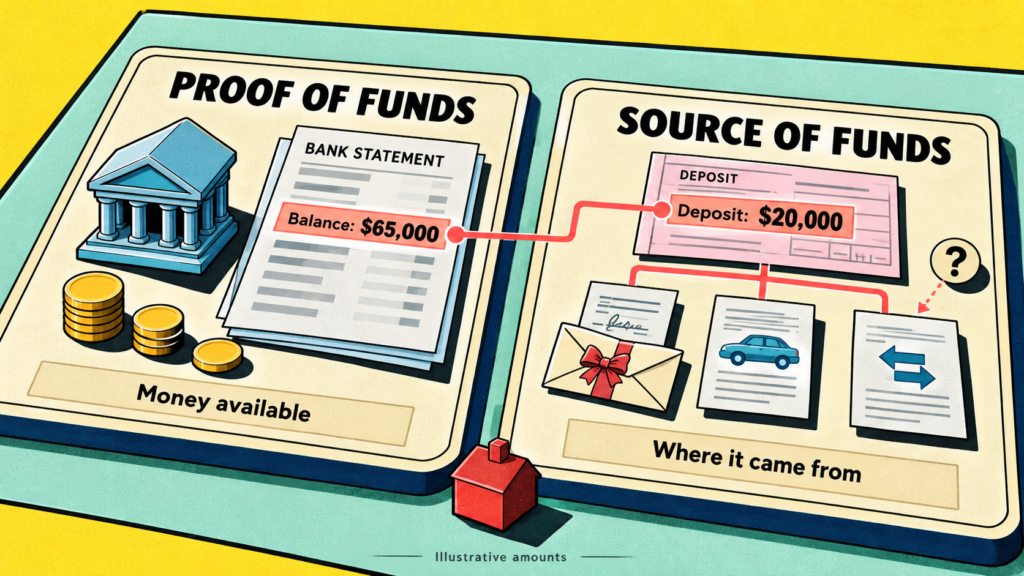
These two ideas sound similar, but they are genuinely different. Proof of funds is evidence that you actually have enough money available, like a qualifying bank statement or an asset verification report. Proof of source of funds is evidence explaining where that money actually came from, which matters most when it involves a gift, a recent large deposit, an asset sale, or another source that needs a closer look.
Here is a simple way to see the difference: a bank statement might show $65,000 sitting in an account, but a recent $20,000 deposit inside that same account may still need its own separate documentation if your lender needs to establish where it actually came from. A healthy balance alone does not automatically resolve every question. Under Fannie Mae’s guidance for purchase transactions, funds used in the transaction must be verified, and certain large deposits specifically must be documented as coming from an acceptable source.
Why Lenders Verify Down Payment Funds
Your lender wants to confirm sufficient funds are actually available for the transaction. They need to establish whether those funds are eligible under your specific loan program. They want to catch money that looks like savings but is actually borrowed. They need to verify gift funds and other third-party contributions when those apply. And they need to reconcile any account activity that does not match the rest of your documented financial profile.
Here is the one thing worth remembering before anything else: a request for more documents is not an accusation.It usually just means your existing records have not yet answered every question your lender needs answered. It does not mean they suspect wrongdoing, and it does not mean your loan is in trouble.
Section 03
Documents Needed to Prove Your Mortgage Down Payment
Treat this as a starting checklist. Follow your loan officer’s specific request rather than assuming every single item here applies to your exact loan.
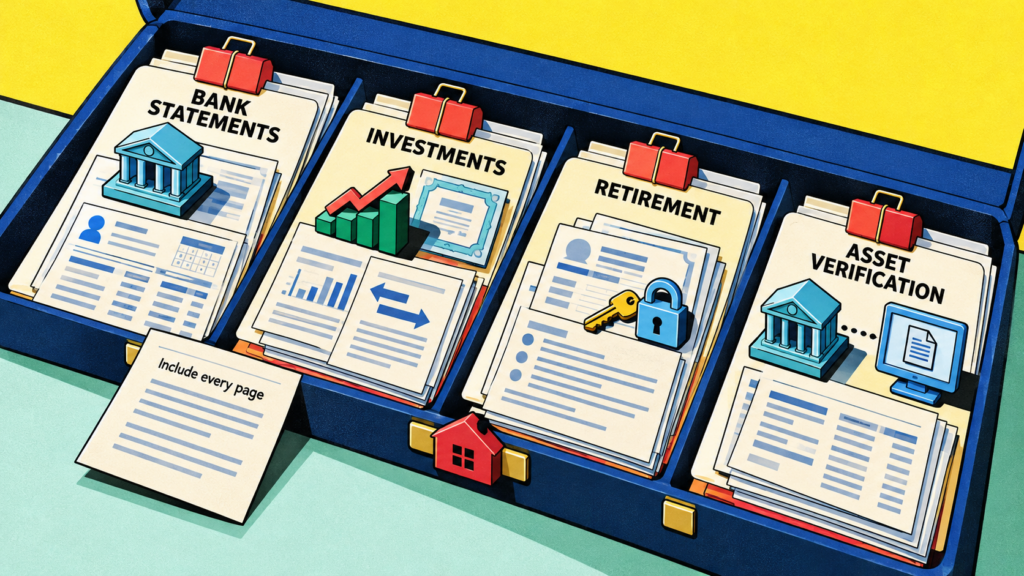
Bank Statements
Checking, savings, money market, and other eligible deposit accounts can all be used to document available funds. A qualifying statement should generally identify the financial institution and the account holder, show the relevant account details and statement period, include the required transaction history, and show the ending balance. Fannie Mae’s guidance describes bank and investment statements as one acceptable way to document funds, and spells out exactly what information those statements need to contain. For purchase transactions, the standard documentation period generally covers the most recent full two months of account activity, though alternatives and exceptions can apply depending on the transaction. Expect your lender to ask for more history or supporting records if there are unusual deposits, unexplained transfers, inconsistent balances, or other questions that come up during the review.
Investment Account Statements
Brokerage statements can help document assets held in stocks, bonds, mutual funds, or other investments. If you plan to sell investments to help fund your purchase, your lender may need to verify both your ownership of those assets and the actual proceeds available for the transaction. An investment account balance is not always the same thing as cash immediately available at closing. You may need to liquidate assets first and then document the resulting transfer into an eligible account. Confirm with your lender exactly which statements and transaction records they will need to see.
Retirement Account Statements
Retirement accounts can factor into your available funds or reserves, but the lender typically needs to establish your ownership, your vested balance, the account’s withdrawal terms, and the actual amount you can access. Do not assume the full balance shown on a statement is automatically available. Taxes, penalties, vesting restrictions, your plan’s own rules, and specific loan-program requirements can all limit the amount that actually counts. Ask your lender before you count on retirement funds to cover your down payment.
Verification of Deposit or Electronic Asset Verification
Lenders can use a formal verification of deposit from your financial institution, or an approved third-party asset verification service, instead of relying only on the statements you provide, when the applicable rules permit it. When your lender asks for a document, provide the complete thing, including every page of a multi-page statement, even pages that look blank. The CFPB specifically advises borrowers against submitting incomplete documentation, since missing pages often just trigger another request and slow everything down.
Section 04
How to Prove Different Sources of Down Payment Funds
This is the heart of the guide. The documents needed for money you have saved gradually over years look nothing like the documents needed for a gift you just received last week.
Personal Savings and Regular Income
Money you have built up gradually through salary, business income, or regular saving habits can usually be documented through account statements, along with records connecting specific deposits to a legitimate source when necessary. Keep your pay deposits and transfers traceable. If your savings are spread across several accounts, prepare statements for each relevant one, and make any transfers between them easy to follow at a glance. Not every single routine paycheck deposit needs separate documentation. What your lender actually asks for depends on what the existing records already show and the applicable underwriting rules.
Gift Money from Family or Other Eligible Donors
Gift funds can be used for certain mortgage transactions, but eligibility depends on your loan program, how you plan to occupy the property, rules around who qualifies as an eligible donor, and other requirements. Fannie Mae, for example, allows qualifying personal gifts for principal residences and second homes under its rules, but does not permit personal gift funds for investment properties at all.
Documentation typically includes a signed gift letter identifying the donor, the recipient, the amount, and a clear statement that repayment is not expected. It can also include evidence of the donor’s ability to actually provide the funds, records showing the transfer from donor to borrower (or directly to the closing agent, depending on the arrangement), and bank statements, deposit records, check copies, or wire confirmations, depending on exactly how the money moved.
Tell your loan officer about a planned gift before the money changes hands. Your lender may have specific documentation and transfer instructions that are much easier to follow before the transfer happens than after. A gift has to actually be a gift. Money that must eventually be repaid should never be described as a gift just to make it look cleaner on paper.
Money Transferred Between Your Own Bank Accounts
Moving money between accounts you own is not inherently a problem. But a transfer shows up as a withdrawal on one statement and a brand-new deposit on another, so your lender may need a clear record connecting the two. Keep statements or transaction histories for both the sending and receiving accounts, with matching dates and amounts wherever possible. If the money passed through several accounts along the way, hold onto the records for every leg of that journey. The goal here is simply establishing continuity and ownership, not treating a routine internal transfer like it is somehow new income.
Proceeds from Selling a Car, Stocks, or Other Personal Assets
Proceeds from selling a personal asset can be an acceptable source of funds when the applicable requirements are met. Documentation typically includes evidence that you actually owned the asset, a bill of sale or other proof the ownership transferred, and proof that you received the proceeds. For a car, that might be the vehicle title and a bill of sale. For securities, it might be a brokerage statement showing the sale and the resulting funds. Either way, you will likely also need a bank statement or deposit record showing the proceeds actually arriving in your account. A deposit by itself rarely establishes where the money came from. You generally need documents that connect the sale directly to that deposit.
Proceeds from Selling Another Property
If you are using proceeds from selling an existing home, your lender will likely need to document both the sale itself and the amount of equity left over after paying off your existing mortgage and transaction costs. Useful records here include the settlement statement, the closing disclosure or equivalent closing documents, mortgage payoff information, and bank or wire records showing the proceeds actually landing in your account. The exact combination depends on whether the sale has already closed and how the funds are being transferred. There is a real difference between proceeds you expect to receive and proceeds you have already received. If your current home has not sold yet, ask your lender how the upcoming sale and its timing affect your purchase transaction.
Inheritance, Trust Distributions, or Other One-Time Payments
One-time funds like these typically need documentation showing the actual legal or financial event that generated the money, alongside evidence that you received it. Depending on the situation, that might be an estate or trust distribution statement, a formal letter from the administrator, other transaction documentation, or bank records showing the deposit. There is no single document that always applies here. What counts as acceptable evidence depends on the source and your loan’s specific underwriting requirements.
Funds Transferred from Overseas
Money coming from an overseas account usually needs more coordination, since your lender has to understand where the funds originated and trace the entire transfer into your U.S. account. Keep the overseas account statement, evidence of your ownership, a transfer confirmation, a receiving-bank record, and whatever else your lender requests. If any documents are not in English, ask whether a certified translation, or some other specific translation format, is required. Not every international transfer is automatically ineligible, and the exact documentation does not look identical for every country. Your lender has to evaluate the specific source, the transfer path, your program’s requirements, and any applicable compliance considerations tied to the transaction.
Business Account Funds
If you are self-employed and want to use money sitting in a business account, that money is not automatically treated the same way as funds in a personal savings account, even though you own the business. Your lender may need to evaluate your ownership, your actual access to the funds, how withdrawing them could affect business operations, and whatever rules apply under your specific loan program. Notify your loan officer early, rather than transferring a large sum into your personal account first and asking questions about documentation afterward.
Section 05
Large Deposits and Unexplained Transactions Before Closing
What Counts as a Large Deposit?
A large deposit is any deposit your lender has to investigate or document under the applicable underwriting rules. There is no single, universal dollar figure that applies everywhere. The definition and the required response can shift depending on the loan program, the underwriting system used, the specific transaction, and whether the funds are actually needed to complete the purchase.
Here is a concrete, real example worth knowing: under Fannie Mae’s guidance, a large deposit for a purchase transaction is defined as a single deposit that exceeds 50 percent of your total monthly qualifying income. If you earn $5,000 a month, a single deposit over $2,500 meets that definition. When a large deposit is needed to complete the purchase, meaning it is going toward the down payment, closing costs, or reserves, the lender must document that it came from an acceptable source. If you can only document part of a deposit, only the unexplained portion gets measured against that 50 percent threshold. A $3,000 deposit with $2,500 clearly documented leaves only $500 unexplained, which on a $4,000 monthly income falls well under the threshold and would not count as a large deposit at all. One more helpful detail: if a deposit’s source is already clear right on the statement itself, like a payroll deposit, a Social Security payment, a tax refund, or a transfer between your own verified accounts, your lender generally does not need any further explanation.
Why a Lender May Ask About a Deposit
A cash deposit with no clear source attached. Money that came from a relative or friend. A recent transfer from an account that was not previously disclosed. Proceeds from selling an asset. Or a deposit that might actually represent money you borrowed rather than money you already had. In every case, your lender is simply trying to determine whether the funds are eligible, and whether the transaction created a liability that needs to be factored into underwriting.
How to Document a Large Deposit
Identify the exact deposit on your statement. Pin down the actual source of that money. Gather documents that clearly connect the source to the deposit itself. Provide a written explanation if your lender asks for one. And ask your loan officer directly whether any additional records are needed before moving forward with anything else. Your explanation should always be accurate and backed by real records wherever that is possible. A written explanation can help clarify a transaction, but it never guarantees your lender will accept the funds on that explanation alone.
What If You Cannot Document the Deposit?
Your lender may simply be unable to count some or all of the questioned funds toward your transaction if the source cannot be adequately established. At that point, you may need to document an alternative eligible source, adjust your funding plan, or talk the issue through directly with your loan officer. The actual outcome depends on the applicable rules and the rest of your file.
Section 06
Can You Use Cash Savings for a Mortgage Down Payment?
There is a real difference between money already sitting in a financial account and physical cash kept outside the banking system entirely. Physical cash is genuinely hard to verify, since there is often no reliable record showing how it was accumulated, or whether it actually represents borrowed money.
Do not assume undocumented cash will simply be accepted just because it belongs to you. Your lender still has to follow the applicable asset-verification and source-of-funds rules. Fannie Mae’s guidance is direct about this: unverified funds are not acceptable for the down payment, closing costs, or reserves under its applicable rules.
Contact your loan officer before depositing a substantial amount of cash. Explain the true origin of the funds honestly, and ask what documentation, if any, could establish an acceptable source. Never split a deposit into smaller amounts, create an artificial transfer, or describe cash as coming from a different source just to avoid extra scrutiny. That kind of move tends to create far bigger problems than the one it was meant to solve.
Section 07
Does Proof of Down Payment Differ by Mortgage Loan Type?
The underlying goal, verifying your funds, stays the same across every loan type. What actually differs is the documentation rules and which sources of funds count as acceptable.
Conventional Loans
Conventional loans commonly rely on bank and investment statements, verification services, documentation for relevant large deposits, gift funds, and other eligible assets under your selected program. Fannie Mae’s guidance is a useful, concrete example here, but your specific lender can layer on additional requirements, and Freddie Mac’s rules can differ in certain situations. Never assume one agency’s rulebook automatically applies to every conventional loan out there.
FHA Loans
FHA borrowers still need to document the funds required for their transaction, following current FHA and lender requirements. Gift funds and other sources get reviewed under FHA’s own applicable rules, which are not automatically identical to conventional requirements. Confirm the current HUD Handbook and your specific lender’s documentation checklist before assuming any particular figure applies to your FHA loan.
VA Loans
Borrowers using VA financing still need to prepare documentation for whatever funds are required at closing, along with any borrower-paid costs. A VA loan can offer eligible borrowers favorable down payment terms, but that does not mean every VA transaction skips asset documentation entirely. Keep the distinction clear in your head between the down payment itself and other closing funds that might still be due.
USDA Loans and Down Payment Assistance Programs
Eligible USDA transactions can have their own distinct down payment structure, while separate assistance programs bring their own eligibility, source, and documentation rules on top of that. A grant, an approved assistance payment, or another program benefit may require its own documentation directly from the relevant agency or program administrator. Flag any assistance program early, so your loan officer can coordinate the mortgage requirements and the assistance program’s requirements together, rather than discovering a conflict later.
Section 08
When Should You Prepare Your Down Payment Documents?
Before Applying for a Mortgage
Identify every account that holds your intended down payment funds. Collect recent statements. Review any large or unusual deposits sitting in those accounts. Gather records for any gifts or asset sales ahead of time. The CFPB specifically recommends preparing bank statements and down payment source documentation as part of your mortgage application packet, rather than scrambling for them after the fact.
During Underwriting
Your lender may ask for updated statements, additional records, or written explanations while reviewing your application. Respond promptly, provide complete records every time, and ask questions whenever a request seems unclear rather than guessing at what they actually need.
Before Closing
Documentation needs do not necessarily stop once you get your initial approval. New deposits, transfers, or a change in your source of funds can all raise fresh questions, even late in the process. Confirm the required form of payment with your closing agent ahead of time, and never assume physical cash will be accepted at the closing table.
Section 09
Common Mistakes That Can Delay Down Payment Verification
Moving money without keeping a paper trail. Transferring funds between your own personal accounts is not inherently a problem, but missing statements make it much harder to connect a withdrawal with its matching deposit. Keep records from both accounts, and document every step if the money passed through more than one.
Accepting gift money before checking the requirements. Receiving gift funds without first talking to your loan officer can mean reconstructing the entire transfer history later, or scrambling for a gift letter after the fact. Some funding arrangements are not even eligible for certain loan programs. Confirm eligibility and documentation requirements before the money moves, not after.
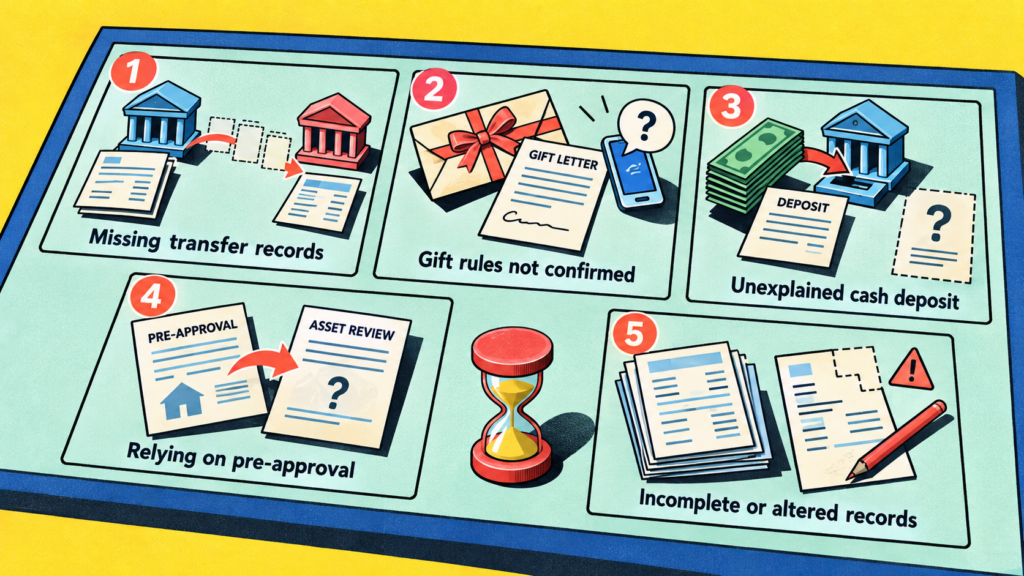
Making large cash deposits without supporting records. A deposit receipt shows that money entered your account. It does not show where that money actually came from. Hold onto legitimate records of the original source rather than assuming the deposit itself proves anything.
Assuming pre-approval means the funds are fully verified. Pre-approval is not the same thing as final underwriting approval. Your lender may still need updated documents or further explanations before clearing your loan to close. Keep your financial records clean and organized all the way through the transaction, not just at the start.
Submitting incomplete or altered documents. Submit complete, accurate statements, and respond directly to whatever your lender requests. Never crop out transactions, alter a PDF, or leave out pages just to make your account activity look simpler. If a document genuinely contains an error, explain the issue and ask your lender how to provide the correct evidence instead.
Section 10
Practical Examples of Proof of Down Payment Requirements
Example 1: A Borrower Has Savings and a Recent $15,000 Deposit
A buyer has $55,000 in savings and recently deposited another $15,000. The combined balance looks sufficient for the planned contribution, but the lender asks about that recent deposit specifically. The buyer explains it came from selling a personal vehicle. Depending on the lender’s exact requirements, supporting records could include the vehicle title, the bill of sale, proof of payment, and bank records showing those proceeds actually entering the account. Fannie Mae’s guidance identifies asset ownership, proof of the ownership transfer, and proof of receiving the sale proceeds as the relevant documentation here. The real lesson: having enough money in the account and documenting exactly where it came from are two related, but genuinely separate, steps.
This is a hypothetical scenario for educational purposes only. The documents needed to verify a personal asset sale and whether the proceeds can be used for a mortgage transaction depend on the applicable loan program, lender requirements, and individual circumstances. This example does not guarantee that the funds will be accepted.
Example 2: A Parent Gifts the Borrower $25,000
A buyer plans to use personal savings plus a $25,000 contribution from a parent toward a home purchase. Before the gift is transferred, the buyer tells the loan officer and asks exactly which records will be needed. The lender may request a signed gift letter, evidence of the donor’s own funds, and records documenting the actual transfer. The buyer follows those instructions and keeps all the relevant documentation, instead of just trusting the balance shown in the receiving account. The lesson: confirm gift eligibility and documentation requirements before the money moves, since acceptable donors and permitted uses genuinely vary by program.
This is a hypothetical scenario for educational purposes only. Gift eligibility, acceptable donors, required documentation, and minimum borrower contribution rules vary by mortgage program and transaction. The example does not guarantee that a particular gift will qualify.
Example 3: A Borrower Transfers $30,000 Between Two Personal Accounts
A buyer moves $30,000 from an investment account into a checking account to prepare for closing. The receiving account shows a substantial deposit, even though the money never came from any new outside source. The borrower provides the relevant investment account records and transaction history, connecting the withdrawal, the liquidation (where applicable), and the deposit into the receiving account. The lender reviews all of it to establish the source and availability of the funds. The lesson: preserve a clear trail whenever you move money, even when both accounts belong to the same person.
This is a hypothetical scenario for educational purposes only. The documentation needed for transfers between accounts depends on how the funds are held, the transaction history, the applicable mortgage guidelines, and lender requirements. This example does not guarantee acceptance of the transferred funds.
Example 4: A Borrower Plans to Use Money from an Overseas Account
A buyer has savings in a foreign bank account and wants to transfer part of that balance to a U.S. account before closing. The borrower contacts the loan officer first and asks how to document account ownership, the original funds, and the transfer itself. The lender identifies exactly which statements, transfer records, translations, or other supporting documents this particular file needs. The buyer follows those instructions and allows time for everything to be reviewed properly. The lesson: plan international transfers early, instead of waiting until the closing date is already bearing down.
This is a hypothetical scenario for educational purposes only. The acceptability of overseas funds and the documentation required depend on the source of the funds, transfer circumstances, applicable mortgage and compliance requirements, and lender policies. No particular transfer or loan approval outcome is guaranteed.
Section 11
Down Payment Documentation Checklist Before Applying
Identify every account intended to fund your down payment and closing costs. Gather recent bank statements, plus any additional periods your lender requests. Confirm your statements clearly show the account holder, the financial institution, the statement period, the transaction history, and the ending balance. Collect investment or retirement account records if you plan to use those assets. Identify any large or unusual deposits and gather the supporting records where they are needed. Keep documentation for every transfer between your own personal accounts. Get the required gift documentation lined up before you rely on gifted funds. Preserve sale documents and proof of receipt for proceeds from selling assets or property. Tell your loan officer if any funds come from overseas, a business account, or another source that might need extra review. Ask whether updated statements or additional documentation will be needed again before closing.
This checklist is a preparation tool, not a universal underwriting standard. Your lender’s specific document request always takes priority, since requirements genuinely vary by loan program and by borrower.
Section 12
Final Takeaways: How to Prepare Proof of Down Payment
Proof of down payment is about demonstrating both the availability of your funds and, when required, where those funds actually came from. Bank statements are a common starting point, but gifts, asset sales, overseas transfers, business funds, and certain deposits often need additional evidence on top of that. There is no single document checklist that applies to every borrower and every mortgage program out there. Keeping clear records of transfers and significant financial transactions genuinely reduces avoidable delays. Ask your loan officer about any unusual deposits or planned transfers early in the process, not after underwriting has already flagged them.
If you are getting ready to buy a home, start organizing your financial records now, and ask your loan officer which documents your specific loan will actually need, rather than waiting for underwriting to come asking first.
Section 13
Sources
- Consumer Financial Protection Bureau, Create a Loan Application Packet
- Consumer Financial Protection Bureau, Submit Documents and Answer Requests from the Lender
- Fannie Mae Selling Guide, B3-4.2-01, Verification of Deposits and Assets
- Fannie Mae Selling Guide, B3-4.2-02, Depository Accounts
- Fannie Mae Selling Guide, B3-4.3-04, Personal Gifts
- Fannie Mae Selling Guide, B3-4.3-18, Sale of Personal Assets
This article also touches on cash reserve requirements for a mortgage when discussing funds needed beyond the down payment, and loan-to-value ratio when explaining how your contribution relates to the loan amount.
Duc Pham, Mortgage Broker | NMLS# 844897, Wonder Rates, Inc. | NMLS# 1518655 | DRE# 02047445 | DFPI# 60DBO-59134 | Equal Housing Opportunity. Equal Housing Lender. | Licensed in: AL, AZ, CA, CO, FL, GA, LA, MI, NC, OH, OK, OR, PA, SC, TX, VA, WA.



