

Section 01
Trust income may help a borrower qualify for a mortgage when the borrower has an enforceable right to receive it and the lender can document the amount, payment frequency, history, and expected continuance. Money held in a trust is not automatically the borrower’s usable income or available cash.
The analysis begins by separating trust income from trust assets. One may support monthly qualification while the other may support closing funds or reserves.
Section 02
Trust Income Mortgage Qualification Starts With Legal Access
A trust can distribute income, principal, or both. It can make fixed payments, discretionary payments, or distributions triggered by specific events. The lender needs to understand what the governing documents actually allow.
A beneficiary who may request money is different from a beneficiary who is entitled to regular payments. Likewise, a trustee’s discretion can affect whether future income is considered stable.
Fannie Mae provides program-specific guidance for trust income. Other programs and lenders may use different documentation or calculation methods.

Section 03
Documents the Lender May Request
The file may require:
- Trust agreement or relevant certified pages
- Trustee statement or verification
- Evidence of the borrower’s beneficiary interest
- Distribution schedule
- Bank statements showing receipt
- Tax returns or tax forms when applicable
- Current value and composition of trust assets
- Evidence supporting expected continuance
- Documentation of restrictions, termination dates, or discretionary language
Do not submit only a screenshot of a deposit. It proves money arrived, but not why it arrived or whether it will continue.

Section 04
Fixed and Variable Distributions
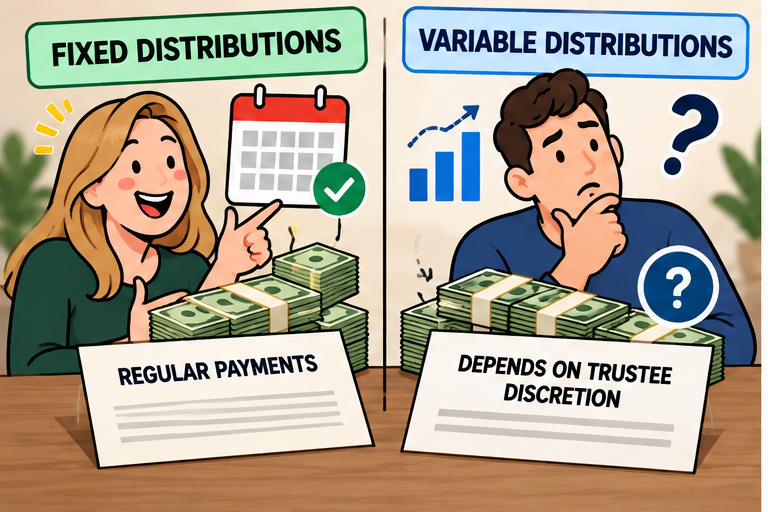
Fixed distributions can be easier to understand when the trust requires a stated payment for a defined period. Variable distributions may require a history and an averaging method under the applicable program.
A large one-time distribution should not be presented as recurring monthly income. It may instead be evaluated as an asset, subject to ownership, access, and program requirements.
Fixed Payments: Check When the Trust Was Established
Under Fannie Mae’s trust income requirements, a trust providing fixed payments generally must have been established for at least 12 months. An exception may apply when the documents establish fixed payments, the borrower is not the grantor, and at least one payment is received before closing.
The lender converts the documented fixed payment to a monthly amount when necessary. These are program-specific requirements; other programs and lender overlays may differ.
Section 05
Trust Assets Used for Closing
If trust funds will cover the down payment, closing costs, or reserves, the lender may verify that the borrower can access the funds and that withdrawing them will not invalidate the income calculation.
This interaction matters. Using a large portion of trust principal at closing can reduce the assets available to support future distributions.
Wonder Rates’ guide to mortgage source of funds explains why ownership and transfer records must form a clean paper trail.
Continuance depends on the underlying income source. Under Fannie Mae’s guidance, fixed payments from a depleting asset require evidence that payments can continue for at least three years from the application date. This is not a universal three-year rule for every type of trust income.
Trust assets allocated to the down payment, closing costs, or reserves must be deducted before evaluating the assets available to support continued income. Ask the lender to review the planned purchase withdrawals before deciding how much trust income can be used. Fannie Mae

Section 06
Prepare a Trust Income Summary Before Applying
Create a short summary for the loan officer and trustee. Include the trust’s establishment date, your role, payment amount and frequency, whether payments vary, and any stated end date.
Also identify whether the same trust will provide funds for the purchase. A clear summary helps the parties spot missing information, but it does not replace the governing documents or underwriting review.
| Information to organize | Question to resolve |
|---|---|
| Distribution terms | What payments do the documents provide for? |
| Receipt records | Where can the lender trace the payments received? |
| Restrictions | Are there conditions, withdrawal limits, or termination provisions? |
| Purchase funds | How much would be withdrawn for closing? |
| Remaining resources | What would remain after the purchase? |
Ask the loan officer which documents are needed before requesting additional records from the trustee. Provide complete statements and retain explanations for unusual transfers or changes in payment amounts.
Separate Qualification From Household Affordability
A lender’s accepted income figure is one part of the decision. Review how the proposed housing payment fits your actual spending, other obligations, and expected access to cash.
For example, if an eligible distribution is paid quarterly, plan how the household will cover monthly expenses between payments. Do not assume that a large account balance removes the need for a cash-flow plan.
Consider comparing two budgets: one using the income the lender has reviewed, and another showing how you would manage a delayed or smaller distribution. This is a planning exercise, not an alternative underwriting calculation.
Use the Wonder Rates Max Purchase Price Calculator to explore an estimated homebuying budget using the qualifying income reviewed by your loan officer. Do not enter the entire trust balance as annual income.
Calculator results are educational estimates. They do not determine access rights, trust-income eligibility, or the documentation required for approval.
Section 07
Questions to Ask Before Pre-Approval
- Is the distribution mandatory or discretionary?
- How often is it paid?
- When does it end?
- Can principal be withdrawn?
- Who controls the trust?
- Are assets sufficient to support continued payments?
- Will closing funds come from the same trust?
- Are tax or legal restrictions involved?
Section 08
Common Mistakes
- Calling trust principal monthly income
- Assuming every beneficiary controls the assets
- Omitting a termination date
- Moving trust funds before confirming documentation
- Providing incomplete pages that remove important conditions
- Treating projected investment returns as certain income
- Asking the loan officer to interpret legal rights under the trust
Section 09
Coordinate With the Right Professionals
The loan officer can explain the mortgage documentation requested but should not provide legal or tax interpretation of the trust. A qualified estate-planning attorney, trustee, and tax professional may need to clarify the borrower’s rights and consequences of a distribution.
Wonder Rates’ article on legacy planning for homeowners provides related questions about holding and transferring real estate.
Section 10
Frequently Asked Questions
Can a new trust distribution count immediately?
Possibly, but the lender may need evidence of the legal right, actual receipt, stability, and expected continuance under the selected program.
Can trust assets count as reserves?
They may be considered when the borrower has acceptable access and the assets meet program requirements.
Does the entire trust agreement have to be provided?
Requirements vary. The lender may need complete documents or certified relevant provisions sufficient to verify rights and restrictions.
Can discretionary distributions qualify?
They may be more difficult to establish as stable income because future payment can depend on trustee discretion. The exact analysis is program-specific.
Does receiving trust income make the borrower self-employed?
No. Trust income is a separate income source, though the borrower may also have self-employment income.
Section 11
Final Takeaway
Trust income can support a mortgage only when the documents show a reliable and usable payment stream. Separate income from assets, disclose restrictions, preserve the transfer trail, and involve legal and tax professionals before changing the trust or taking a major distribution.
Before relying on trust distributions for a home purchase, talk with a Wonder Rates loan officer about your payment history, trust documentation, and planned closing funds. Coordinate legal questions with your attorney and distribution details with the trustee so the mortgage review uses consistent information
Duc Pham, Mortgage Broker | NMLS# 844897
Wonder Rates, Inc. | NMLS# 1518655
Equal Housing Lender.
AZ, CA, CO, FL, GA, LA, MI, OK, PA, SC, TX, VA, WA, OH, AL, OR, NC
This article is for educational purposes only and is not a commitment to lend or legal, trust, estate-planning, tax, or investment advice. Income calculations, asset treatment, documentation, and eligibility depend on the trust, borrower, program, lender, investor, and current guidelines.



