
Section 01
FHA UFMIP stands for Upfront Mortgage Insurance Premium. It is a mortgage insurance charge that comes with most FHA-insured home loans. You generally pay it at the start of the loan, either in cash at closing or by adding it to your loan balance. UFMIP is not the same as the annual MIP that is usually built into your monthly payment. Knowing the difference matters, because adding UFMIP to your loan raises the amount you borrow and can change the total cost of your mortgage.
This guide explains what UFMIP is, how it is calculated, and how you can pay it. You will also see how it differs from annual MIP and what can happen to it when you refinance or pay off an FHA loan.
Section 02
What Is FHA UFMIP?
What Does UFMIP Stand For?
UFMIP means Upfront Mortgage Insurance Premium. It is a premium tied to FHA-insured loans. In plain terms, it is a one-time insurance charge, not a fee your lender keeps for itself.
You will usually see it listed on your Loan Estimate and your Closing Disclosure. Those are the official forms that show your loan terms and costs.
Why Does the FHA Charge UFMIP?
The Federal Housing Administration, or FHA, is part of the U.S. Department of Housing and Urban Development (HUD). The FHA does not lend money itself. Instead, it insures loans made by approved lenders.
According to HUD, FHA insurance on the loan is what lets lenders offer features like low down payments and easier credit qualifying. That insurance protects the lender against losses if a borrower stops paying, under the program’s rules. UFMIP is one of the two premiums that help pay for that insurance.
Is UFMIP the Same as FHA MIP?
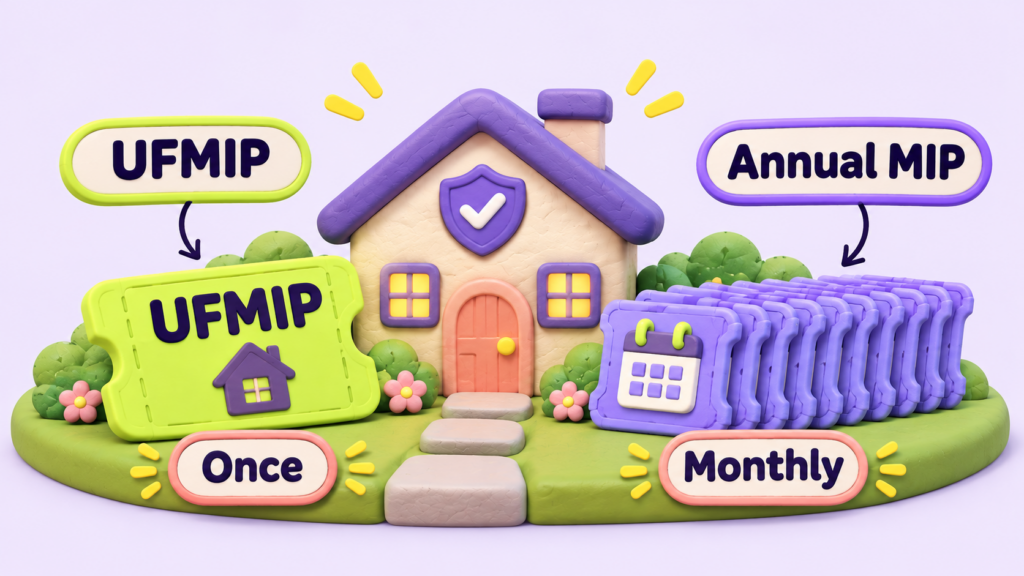
No, and this is the most important point in this guide. FHA mortgage insurance has two parts. UFMIP is the upfront premium. Annual MIP is a recurring premium.
The word “annual” can be confusing. You do not usually write one check for annual MIP each year. Instead, the yearly amount is split into twelve pieces and added to your monthly mortgage payment. One is paid once at the start; the other shows up every month.
Section 03
How Does FHA UFMIP Work?
When Is UFMIP Charged?
UFMIP is charged when the loan is made. It is figured as part of your closing costs and shows up on your closing documents. From there, you decide whether to pay it in cash or add it to the loan.
How Is FHA UFMIP Calculated?
The basic formula is simple:
UFMIP = UFMIP rate × base loan amount
HUD sets the rate. Under HUD Mortgagee Letter 2023-05, the UFMIP for FHA forward mortgages is 175 basis points, or 1.75% of the base loan amount, with a few program exceptions. A basis point is one hundredth of a percent, so 175 basis points equals 1.75%. That rate is still in effect for FHA loans in 2026, but HUD can change it, so always check your own loan disclosures.
What Is the Base Loan Amount?
The base loan amount is the loan amount before any UFMIP is added. This is where many people get mixed up. Your base loan amount is not the same as your total loan amount after a financed UFMIP.
If you choose to finance UFMIP, it is added on top of the base loan amount. The result is your total mortgage amount. HUD’s rules note that UFMIP is not counted when figuring the area-based FHA loan limits and loan-to-value limits. In other words, those limits apply to the base loan amount.
Section 04
How Much Is FHA UFMIP?
FHA UFMIP Example
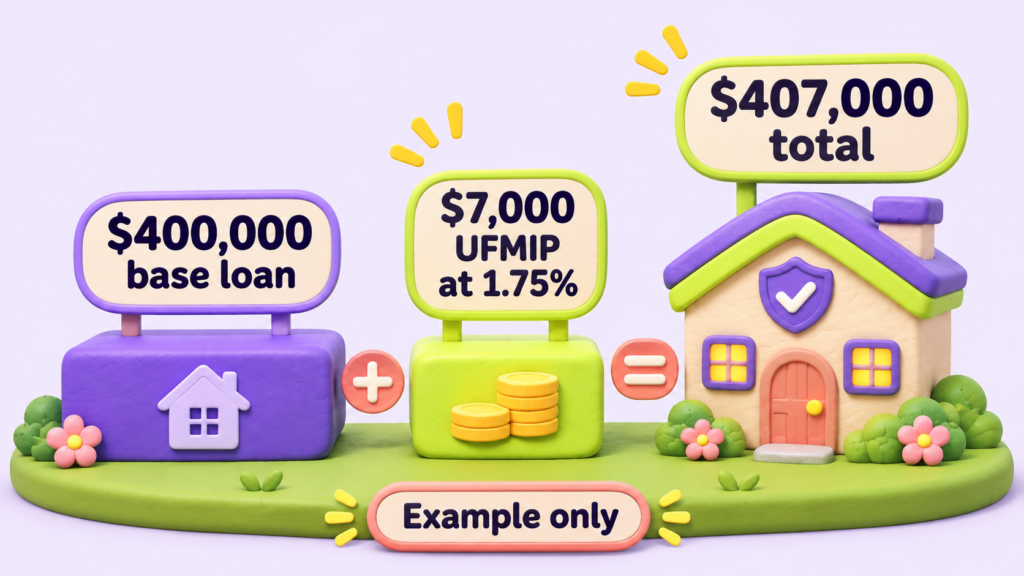
Let’s put the formula to work. Say a borrower has a base FHA loan amount of $400,000 and the UFMIP rate is 1.75%.
$400,000 × 1.75% = $7,000 UFMIP
If the borrower chooses to finance it, the total loan amount becomes:
$400,000 + $7,000 = $407,000
Keep in mind that FHA loan limits, maximum mortgage rules, and other program rules still apply to your specific loan.
Disclaimer: This is a hypothetical illustration for educational purposes only. The assumed loan amount and UFMIP rate are not a quote, offer, or guarantee of available FHA financing. Actual UFMIP may depend on current FHA requirements, loan characteristics, applicable loan limits, and the borrower’s specific transaction. Financing UFMIP may also be subject to FHA rules and maximum mortgage limitations.
Does FHA UFMIP Change With the Loan Amount?
Yes. Since UFMIP is a percentage, a larger base loan amount means a larger dollar premium when the rate stays the same.
For example, at 1.75%, a $250,000 base loan amount would have a UFMIP of $4,375. A $400,000 base loan amount would have a UFMIP of $7,000. The rate is the same, but the dollar amount grows with the loan.
Disclaimer: These figures are hypothetical and are used only to show how the math works. Actual UFMIP depends on current HUD rules, the loan program, and the details of your transaction.
Section 05
How Do You Pay FHA UFMIP?
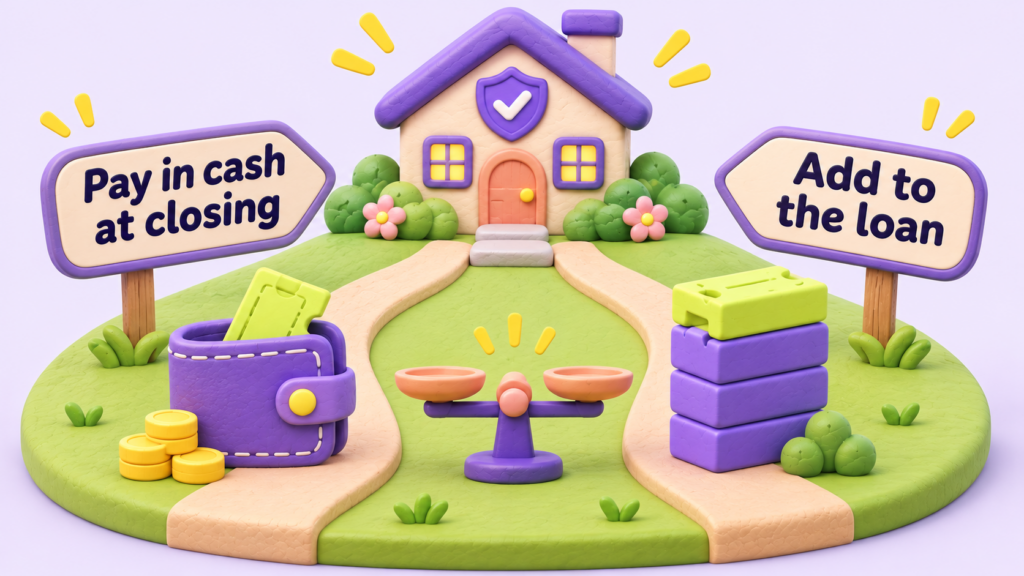
You generally have two choices. HUD’s rules say the UFMIP must be either entirely financed into the loan or paid entirely in cash. You cannot pay part in cash and finance the rest, apart from very small amounts under one dollar.
Pay UFMIP Upfront
You can pay the full UFMIP in cash at closing. In that case, the premium is added to the cash you need to bring to closing. Your loan balance stays at the base loan amount.
Paying in cash means you need more money on closing day. On the other hand, you do not pay interest on the premium over the life of the loan.
Finance UFMIP Into the FHA Mortgage
Instead of paying the full UFMIP from your savings, you may be able to add it to your mortgage. Many FHA borrowers choose this option because it lowers the cash needed at closing.
Financing does come with tradeoffs, though. Your starting loan balance is higher. More of your loan is principal. Interest is charged on the financed premium, too. As a result, your total cost of borrowing can be higher over time.
Does Financing UFMIP Mean It Is Free?
Not at all. When you finance UFMIP, you are borrowing money to pay the premium. That borrowed amount is paid back over time, with interest, just like the rest of your loan. Moving a cost into your loan is not the same as making it disappear.
Section 06
FHA UFMIP vs. Annual MIP
Since these two premiums are easy to confuse, let’s look at each one, then compare them side by side. For a broader look at how mortgage insurance works across loan types, the CFPB’s guide to mortgage insurance is a helpful place to start.
FHA UFMIP
UFMIP is charged once, at the start of the loan. It is figured as a percentage of your base loan amount using the current FHA rate. You can pay it in cash or finance it. If you finance it, it raises your starting loan balance.
Annual FHA MIP
Annual MIP is an ongoing premium. It is usually collected each month as part of your mortgage payment. HUD Mortgagee Letter 2023-05 sets these rates. For most FHA loans longer than 15 years with base loan amounts up to $726,200, annual MIP is 0.50% or 0.55% a year. The exact rate depends on the loan-to-value ratio. Loans that are larger or shorter have their own rates.
How long you pay annual MIP depends on your loan. Under that same letter, if your starting loan-to-value ratio is 90% or less, annual MIP generally lasts 11 years. If it is above 90%, which is common when the down payment is under 10%, annual MIP generally lasts for the full term of the loan.
FHA UFMIP vs. Annual MIP Comparison
| Feature | UFMIP | Annual MIP |
|---|---|---|
| Full name | Upfront Mortgage Insurance Premium | Annual Mortgage Insurance Premium |
| Timing | Upfront | Recurring |
| Payment structure | Paid upfront or financed when permitted | Generally collected monthly |
| Affects initial loan balance | Yes, if financed | No direct addition to initial principal |
| Purpose | Part of FHA mortgage insurance structure | Ongoing FHA mortgage insurance |
Remember, “annual” MIP is generally paid in monthly installments. So it is not one big bill that arrives once a year.
Section 07
Does FHA UFMIP Increase Your Mortgage Payment?
How Financed UFMIP Changes the Loan Balance
If you finance UFMIP, your monthly principal and interest payment is based on the higher balance. Using the earlier example, a $400,000 base loan with a financed $7,000 UFMIP starts at $407,000.
Now assume a 30-year fixed rate of 6.5%. The principal and interest payment on $400,000 would be about $2,528 a month. On $407,000, it would be about $2,573 a month. That is roughly $44 more each month. If the loan were kept for the full 30 years, the financed premium would add about $8,928 in interest on top of the $7,000 itself.
Disclaimer: These figures are rounded, hypothetical estimates of principal and interest only, using an assumed 6.5% fixed rate over 30 years. They exclude annual MIP, taxes, insurance, and other costs. They are not rate quotes or loan offers, and actual rates and payments vary by borrower, lender, loan program, and market conditions.
UFMIP and Your Total FHA Mortgage Payment
Your full monthly FHA payment can include several parts:
- Principal: the part that lowers your loan balance.
- Interest: the cost of borrowing.
- Property taxes: often collected monthly through an escrow account.
- Homeowners insurance: often paid through escrow as well.
- Annual MIP: the ongoing FHA mortgage insurance premium.
- HOA dues: if the home is part of a homeowners association.
UFMIP does not become its own monthly charge just because you financed it. Instead, it becomes part of your loan balance, and that balance shapes your principal and interest payment.
Use a Mortgage Payment Calculator
You can use the Wonder Rates Mortgage Payment Calculator to compare estimated payments with different loan amounts and assumptions. When you compare FHA scenarios, keep in mind that the estimate may not capture every FHA-specific cost, such as annual MIP, unless you enter it yourself.
Section 08
Does FHA UFMIP Affect Your FHA Loan Amount?
Base Loan Amount vs. Total Mortgage Amount
Your base loan amount is what you borrow for the home itself, before UFMIP. Your total mortgage amount is what you owe after any financed UFMIP is added. If you pay UFMIP in cash, the two numbers are the same.
What Happens When UFMIP Is Financed?
Here is the flow, step by step. First, the lender sets your base loan amount. Next, the lender figures the UFMIP using the current rate. Then the financed UFMIP is added to the base loan amount. The result is your total mortgage amount.
FHA loan limits and maximum mortgage rules still apply. Under HUD’s rules, those limits are measured against the base loan amount, not the total that includes the financed premium.
Can You Finance All of Your Closing Costs Into an FHA Loan?
Not in the same way. Financing UFMIP is a specific FHA feature. It does not mean you can add every closing cost to your loan balance. Other costs, like title fees, appraisal fees, and prepaid taxes, follow their own rules and are often paid in cash or covered by credits. Our home buying costs checklist walks through the other upfront costs you may need to plan for.
Section 09
Is FHA UFMIP Refundable?
Can You Get an FHA UFMIP Refund?
In most cases, no. HUD’s rules state that UFMIP is not refundable except when you refinance into a new FHA-insured loan. So you do not get a refund just because you sell the home or pay off the loan.
FHA UFMIP Refund and FHA Refinancing
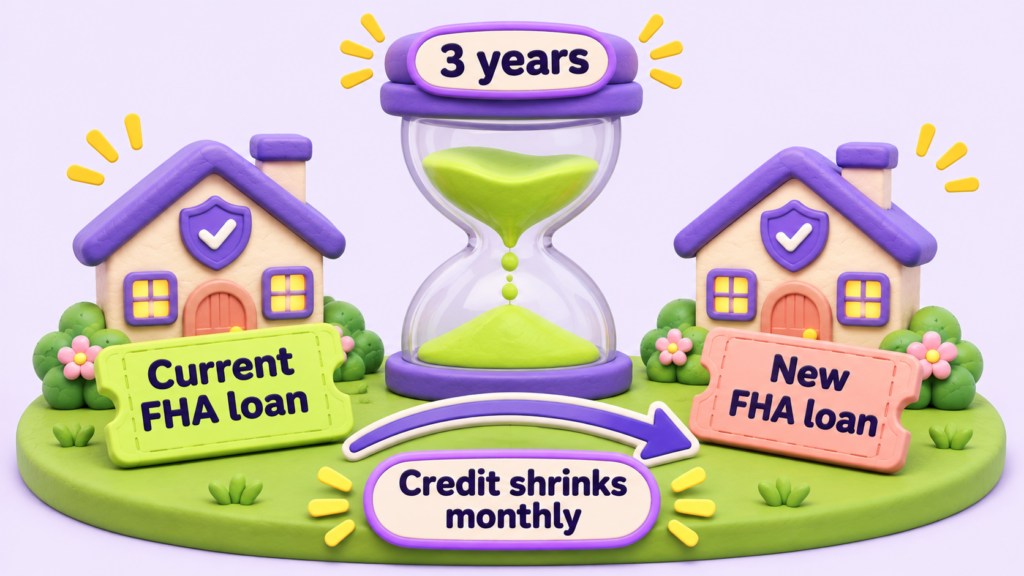
If you refinance your current FHA loan into another FHA loan within three years, HUD applies a refund credit. That credit lowers the UFMIP you owe on the new loan. It is not a check mailed to you. It is a credit toward the new premium.
The refund credit follows a HUD schedule and shrinks each month after your loan closes. After three years, it is no longer available. So it is not accurate to say you always get your UFMIP back when you refinance.
What Happens to UFMIP When You Pay Off an FHA Loan?
Paying off the loan, whether through a sale, a payoff, or a refinance into a non-FHA loan, does not create a refund under current rules. Your annual MIP ends when the loan is paid off. However, the UFMIP you already paid or financed stays part of what that loan cost you.
Section 10
FHA UFMIP When Refinancing
Refinancing From FHA to Conventional
When you refinance from an FHA loan into a conventional loan, your FHA loan is paid off. The new conventional loan has its own mortgage insurance rules, if any apply. Your old UFMIP does not transfer to the new loan. Leaving FHA does not bring the upfront premium back. To learn how refinancing works in general, read our guide on mortgage refinancing.
Refinancing From FHA to FHA
An FHA-to-FHA refinance can be treated differently. The new FHA loan generally has its own UFMIP. If you refinance within three years of your current loan’s closing, the refund credit described above may reduce that new premium.
Why Timing Can Matter
Because the refund credit shrinks each month and ends after three years, timing can make a real difference in what you pay. If you are thinking about an FHA-to-FHA refinance, ask your loan officer to show the new UFMIP and any refund credit on your Loan Estimate.
Section 11
FHA UFMIP and FHA Streamline Refinance
What Is an FHA Streamline Refinance?
An FHA Streamline Refinance is a simpler way to refinance one FHA loan into another. It often has fewer paperwork steps than a full refinance. Specific rules and eligibility apply, so it is not available to every borrower.
How UFMIP Can Be Treated in an FHA Streamline Refinance
A Streamline Refinance is still a new FHA loan, so a new UFMIP generally applies. The refund credit from your current loan may lower it if you refinance within three years. HUD also has reduced premium rules for Streamline Refinances of older FHA loans endorsed on or before May 31, 2009. Your loan officer can confirm which rules apply to you.
Does an FHA Streamline Refinance Eliminate UFMIP?
No. A Streamline Refinance does not wipe out mortgage insurance. The new loan has its own premiums, and any credit or reduced rate depends on HUD’s rules and your loan’s history.
Section 12
Does FHA UFMIP Go Away?
Not in the way annual MIP can. UFMIP is a one-time premium, so there is nothing left to “fall off” after you make payments for a while. Once you pay it in cash or finance it, that cost is set.
Annual MIP is different. It is the recurring premium, and depending on your starting loan-to-value ratio, it may end after 11 years or last for the full loan term. When you sell, refinance, or pay off the loan, the insurance on that loan ends, subject to HUD’s rules.
Section 13
FHA UFMIP vs. Conventional Mortgage Insurance

FHA Mortgage Insurance Structure
FHA loans generally carry two premiums: UFMIP at the start and annual MIP over time. HUD sets these rates, and they do not change based on your credit score.
Conventional PMI Structure
Conventional loans may use private mortgage insurance, or PMI, when the down payment is under 20%. PMI follows different rules than FHA mortgage insurance. According to the CFPB’s guide to PMI, on many conventional loans you can generally ask to cancel PMI once your balance reaches 80% of the home’s original value. It generally ends on its own at 78%, as long as you are current on payments.
Why This Difference Matters When Comparing Loans
Neither option is always cheaper or better. Borrowers comparing FHA and conventional loans should look at the whole loan setup. That includes upfront mortgage insurance, monthly mortgage insurance, the interest rate, the down payment, closing costs, and eligibility rules. Credit also plays a role in which loans you can get. Our guide to mortgage requirements with a low credit score explains how FHA and conventional credit rules compare.
Section 14
FHA UFMIP Example: Buying a Home With a Financed Premium
Picture a buyer who qualifies for an FHA mortgage. They have saved enough for the down payment, but not much more. To keep more cash on hand for moving and emergencies, they choose to finance the UFMIP rather than pay it at closing.
Here is what that choice means. Their cash needed at closing is lower, since the premium is not part of it. But their starting loan balance is higher, because they are financing both the base loan amount and the premium. So their monthly principal and interest payment is a bit higher, and they pay interest on the premium over time. On top of that, they will still pay annual MIP each month as part of their payment.
For this buyer, financing may make sense if keeping cash on hand matters more than saving on interest. Another buyer with more savings might choose to pay the premium in cash instead.
Disclaimer: This scenario is for educational purposes only and does not represent a loan offer, approval, rate quote, or prediction of actual costs. Actual FHA loan amounts, insurance premiums, financing limits, and closing costs vary based on current FHA requirements, loan characteristics, property details, borrower qualifications, and lender underwriting.
Section 15
How to Compare an FHA Loan With UFMIP to Other Mortgage Options
Compare the Upfront Cost
Start with the cash you need at closing. Look at the down payment, closing costs, and whether you plan to pay UFMIP in cash or finance it.
Compare the Monthly Cost
Next, look at the full monthly payment. That includes principal, interest, annual MIP or PMI, taxes, homeowners insurance, and any HOA dues.
Compare the Long-Term Cost
Then think about the long run. Add up total interest, mortgage insurance over time, and upfront costs. Also think about how long you plan to keep the loan, since that affects which costs matter most.
Compare Eligibility
Finally, remember that FHA and conventional loans use different approval rules. One may be easier to qualify for based on your credit, down payment, and debts. Compare the whole loan, not one line on the Loan Estimate.
Section 16
What to Know Before Taking Out an FHA Loan
UFMIP is an upfront FHA mortgage insurance premium. It is separate from annual MIP, which is the recurring premium built into your monthly payment. Eligible borrowers can usually finance UFMIP into the mortgage instead of paying it at closing. Financing it, however, raises the amount you borrow and can increase your total borrowing cost.
Because FHA insurance costs are only one part of the mortgage, compare the complete payment and your estimated cash to close rather than focusing on UFMIP alone.
Section 17
Explore Your FHA Mortgage Options
Use the Wonder Rates Mortgage Payment Calculator to explore how different loan amounts and assumptions can affect an estimated monthly payment.
If you are considering an FHA loan and want to understand how UFMIP, annual MIP, and other mortgage costs could apply to your situation, you can get started with Wonder Rates.
If you are still comparing loan options for a home purchase, explore the home buying process and available mortgage options.
Section 18
Disclaimer
This article is provided for general educational and informational purposes only and does not constitute financial, mortgage, tax, legal, or investment advice. FHA mortgage insurance premiums, loan limits, eligibility requirements, underwriting guidelines, interest rates, fees, and other loan terms may change and may vary based on the borrower’s circumstances, property, loan program, lender, and applicable federal requirements. Examples and calculations shown in this article are hypothetical and are intended only to explain how FHA UFMIP may work. They do not represent a loan offer, commitment to lend, approval, rate quote, or guarantee of specific terms.
Actual FHA UFMIP and other mortgage costs should be confirmed using current FHA requirements and the disclosures provided for a specific transaction. A borrower’s eligibility and final loan terms are subject to applicable underwriting requirements, including factors such as credit, income, assets, debt obligations, property characteristics, appraisal, and other conditions. Financing UFMIP, available loan amounts, and any potential refund or credit are subject to applicable FHA rules and transaction-specific requirements. Borrowers should consult a licensed mortgage professional regarding their individual circumstances and review their official Loan Estimate and other closing disclosures carefully.
Duc Pham, Mortgage Broker | NMLS# 844897, Wonder Rates, Inc. | NMLS# 1518655 | DRE# 02047445 | DFPI# 60DBO-59134 | Equal Housing Opportunity. Equal Housing Lender. | Licensed in: AL, AZ, CA, CO, FL, GA, LA, MI, NC, OH, OK, OR, PA, SC, TX, VA, WA



