
Section 01
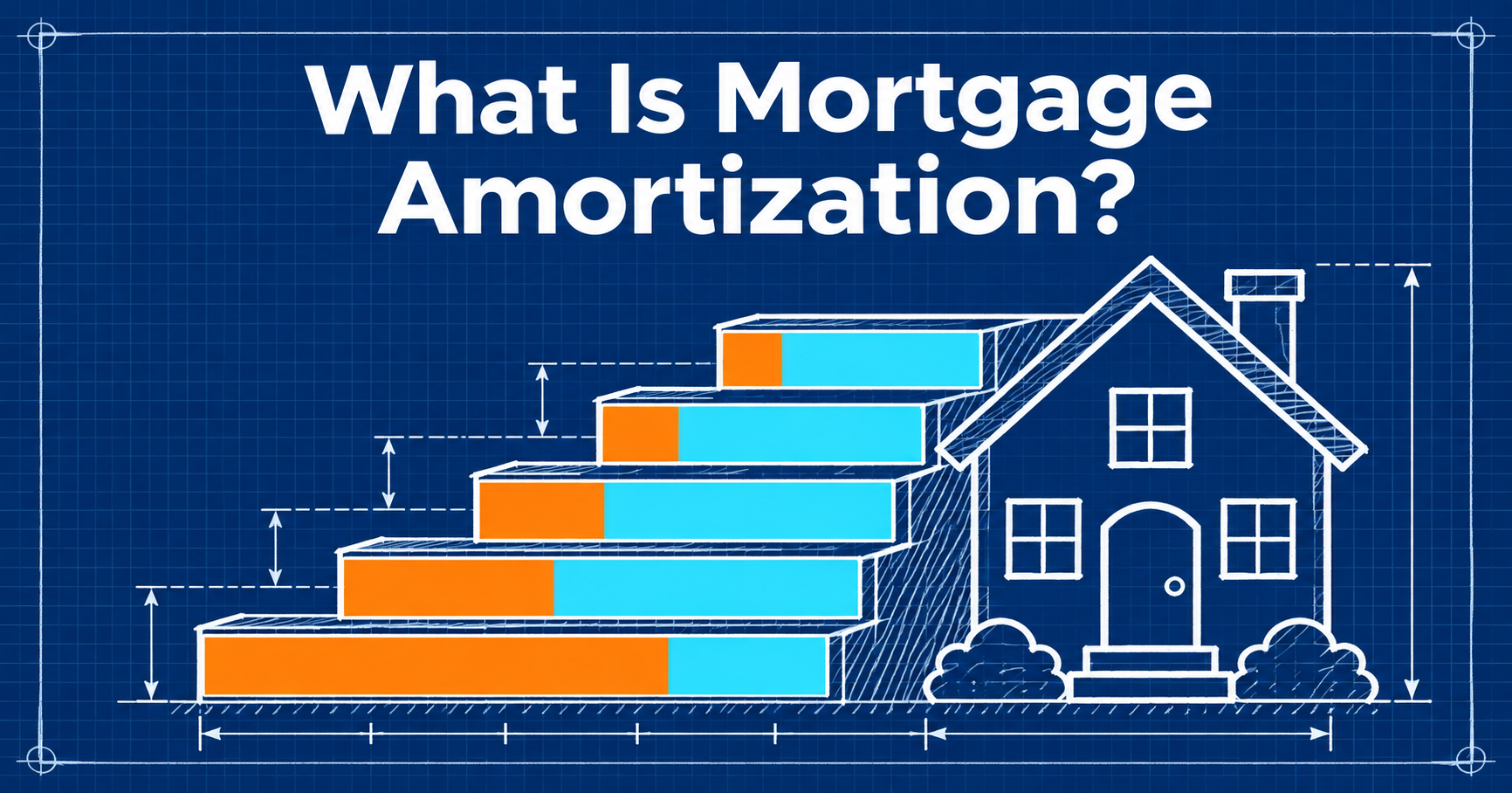
Mortgage amortization is the process of paying off a home loan, little by little, with set payments over time. Each payment usually covers both principal and interest. But the split between the two changes as the loan goes on. Early on, more of each payment tends to go to interest. Later, more of it goes to paying down what you owe. An amortization schedule shows how your balance, principal, interest, and remaining payments change over the life of the loan.
Why does this matter? Amortization helps explain why two loans for the same amount can cost very different totals. The rate and the length of the loan make the difference. It also explains why extra payments can shrink your balance faster, and why a refinance can change your payoff timeline.
In this guide, you will learn what mortgage amortization means, how it works, and how to read a schedule. We will also walk through a full example and show how loan length, rate, extra payments, and refinancing change the picture.
Section 02
What Is Mortgage Amortization?
Mortgage Amortization Definition
In simple terms, amortization means paying off a debt with regular payments over a set time. The Consumer Financial Protection Bureau (CFPB) puts it simply. You pay off a loan with regular payments, so the amount you owe goes down with each one.
For a mortgage, here is how that plays out. You make a payment on schedule. Part of it covers the interest owed for that period. The rest goes toward principal, which is the money you borrowed. As a result, your balance slowly goes down.
What Does “Amortized Mortgage” Mean?
A fully amortizing mortgage is built so the balance reaches $0 by the end of the schedule. You just need to make every payment as agreed. Most standard fixed-rate home loans work this way.
Not every loan does, though. Some loans have an interest-only period. Others have a large balloon payment due at the end. And some allow payments so small that the balance grows, which is called negative amortization. We cover these later in the guide.
Is Mortgage Amortization the Same as the Loan Term?
Not always. The loan term is how long the loan agreement lasts. The amortization period is the schedule used to pay off principal and interest.
On many 30-year fixed-rate loans, the two match. Both the term and the amortization period are 30 years. But that is not true for every loan. Take a balloon loan. It might use a 30-year schedule to set the payment. Yet the rest of the balance could be due in full much sooner.
Section 03
How Does Mortgage Amortization Work?
Each Mortgage Payment Has Principal and Interest
Principal is the amount you borrowed and still owe. Interest is the cost of borrowing that money. Your monthly payment is figured from your loan balance, your interest rate, and the repayment setup.
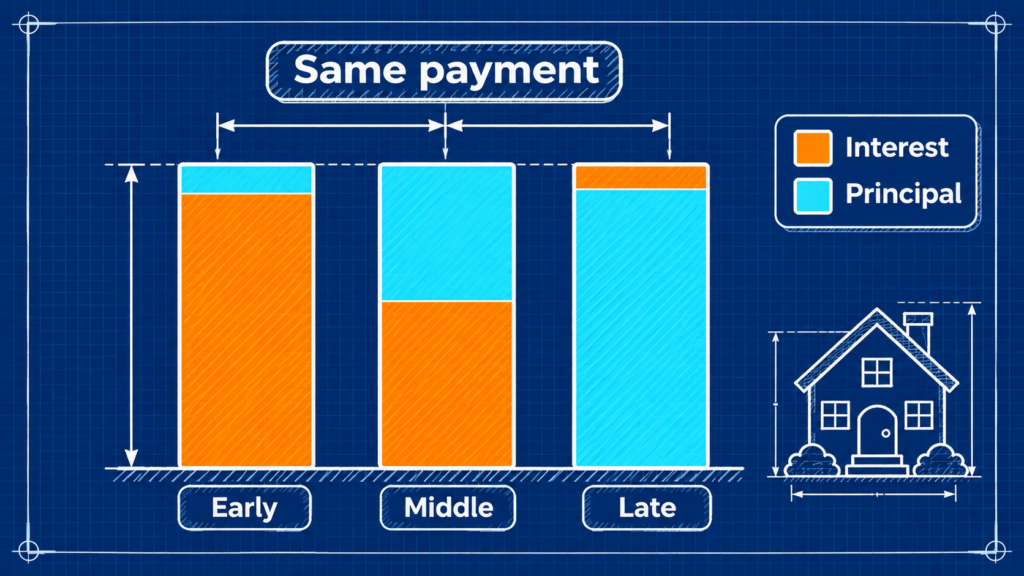
On a standard fixed-rate loan, the principal and interest payment stays the same each month. Your payment stays the same. What it pays for does not.
Why the Interest Portion Is Higher at the Beginning
Interest is generally charged on the balance you still owe. At the start of the loan, your balance is at its highest. So the interest charged each month is at its highest too.
Here is the key point. Interest does not come first by design. It is simply that interest is figured on a large balance early on. As the balance shrinks, the interest charged each period generally shrinks with it.
Why More of the Payment Goes Toward Principal Later
On a fixed payment, as the interest part gets smaller, more of the same payment is left over for principal. So over time, more of each payment goes to paying down the loan.
How fast this shift happens depends on the loan. The rate, the term, the payment setup, and the loan type all play a part. So there is no single rule for when principal starts to take up most of the payment.
Section 04
What Is a Mortgage Amortization Schedule?
A mortgage amortization schedule is a table that shows every scheduled payment on your loan. It breaks each one into principal and interest, and it shows your balance after each payment.
What Information Appears on an Amortization Schedule?
Most schedules include these columns:
- Payment number: which payment it is, such as 1, 2, or 360.
- Payment date: when the payment is due.
- Beginning balance: what you owe before that payment.
- Principal: the part of the payment that lowers your balance.
- Interest: the part that pays the cost of borrowing for that period.
- Ending balance: what you still owe after that payment.
How to Read a Mortgage Amortization Schedule
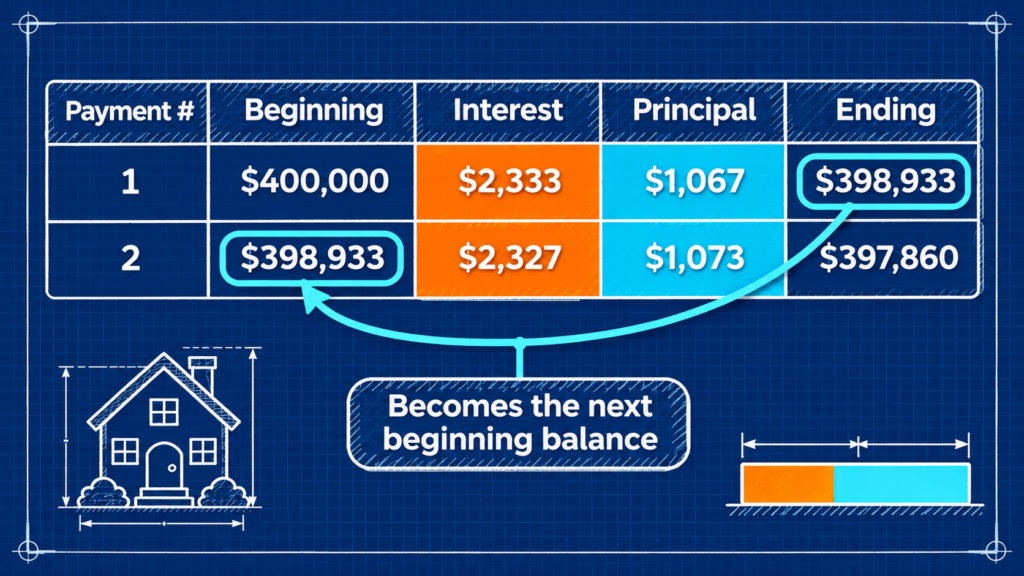
Read each row from left to right. Payment 1 starts with the original loan balance. The lender figures the interest owed for that period. Your payment covers that interest first, and the rest lowers your principal. The ending balance then becomes the beginning balance for the next payment.
What Does the Remaining Balance Mean?
The remaining balance, or ending balance, is the principal you still owe after a given payment. It does not include future interest. It is roughly what you would need to pay off the loan at that point. A real payoff quote may also add interest owed since your last payment and other charges.
Why the Schedule Changes Over Time
Each row builds on the one before it. As your balance goes down, the interest charged goes down. As the interest goes down, more of your fixed payment goes to principal. That cycle repeats until the loan is paid off.
Section 05
Mortgage Amortization Example
Let’s put this into numbers. Say a borrower takes out a $400,000 fixed-rate mortgage with a 30-year amortization period. For this example, we use an assumed fixed rate of 6.5%. The monthly principal and interest payment would be about $2,528.27.
Here is how a few rows of the schedule would look:
| Payment | Beginning Balance | Interest | Principal | Ending Balance |
|---|---|---|---|---|
| 1 | $400,000.00 | $2,166.67 | $361.61 | $399,638.39 |
| 2 | $399,638.39 | $2,164.71 | $363.56 | $399,274.83 |
| 12 | $395,912.84 | $2,144.53 | $383.74 | $395,529.10 |
| 60 | $374,941.25 | $2,030.93 | $497.34 | $374,443.91 |
| 120 | $339,792.24 | $1,840.54 | $687.73 | $339,104.51 |
| 180 | $291,187.57 | $1,577.27 | $951.01 | $290,236.56 |
| 240 | $223,976.20 | $1,213.20 | $1,315.07 | $222,661.13 |
| 300 | $131,035.15 | $709.77 | $1,818.50 | $129,216.65 |
| 360 | $2,514.65 | $13.62 | $2,514.65 | $0.00 |
Look at the first row. The interest is $400,000 times 6.5%, divided by 12 months, which is about $2,166.67. The rest of the $2,528.27 payment, about $361.61, goes to principal.
Now look at payment 360. Almost the whole payment goes to principal, because the balance is so small that the interest is only $13.62.
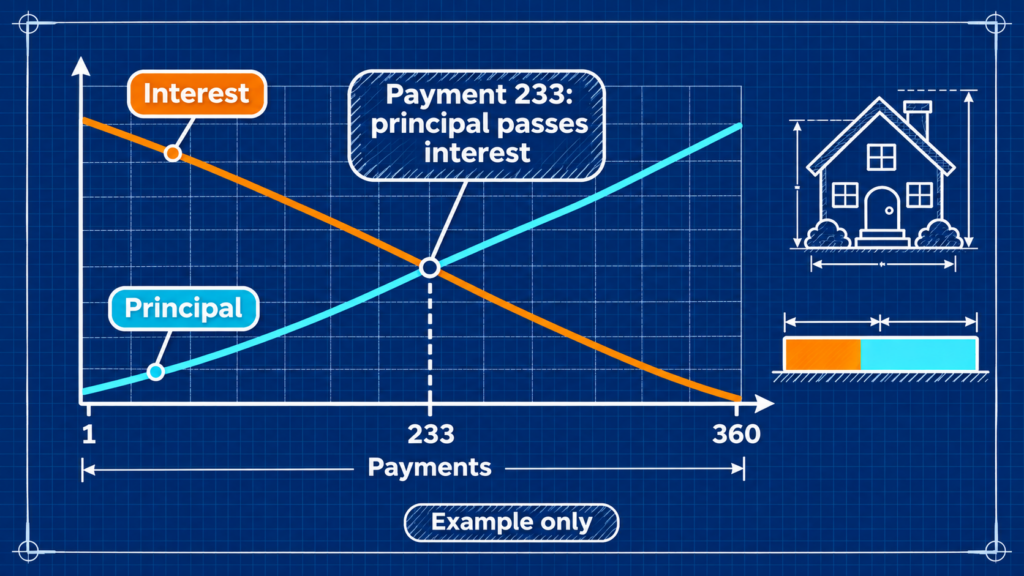
In this example, the principal part first becomes larger than the interest part at payment 233, a little over 19 years in. If the loan were kept for the full 30 years, the total interest paid would be about $510,178.
Disclaimer: This is a hypothetical illustration for educational purposes only. The payment amounts, interest allocation, remaining balance, and total interest will vary based on the actual loan amount, interest rate, loan term, payment frequency, rounding, and other loan terms. The example is not a rate quote, loan offer, or representation of actual mortgage terms available to any borrower.
Section 06
How Mortgage Amortization Changes Over the Life of the Loan
Early Mortgage Payments
In the early years, your balance is at its highest. So more of each payment goes to interest, and less goes to principal. In the example above, the first payment put about $362 toward principal and about $2,167 toward interest.
Middle of the Mortgage
By the middle of the loan, your balance has gone down a fair amount. The interest charged each month is lower, so more of your payment goes to principal. In the example, payment 180 put about $951 toward principal.
Later Mortgage Payments
Near the end, the interest part becomes small. Most of each payment goes to principal, and the balance drops quickly. In the example, payment 300 put about $1,819 toward principal.
Why the Mortgage Balance Does Not Drop Quickly at First
This is plain math, not a penalty. In the early years, a large balance means a large interest charge. That leaves a smaller part of your payment for principal. So the balance falls slowly at first and then speeds up as the years go by. In the example, the balance fell by only about $25,556 in the first five years.
Section 07
How Loan Term Affects Mortgage Amortization
The length of your loan has a big effect on your amortization schedule.
30-Year Mortgage Amortization
A 30-year schedule spreads the payments over 360 months. That usually means a lower required principal and interest payment. But principal goes down more slowly, and you generally pay more total interest if you keep the loan for the full term.
15-Year Mortgage Amortization
A 15-year schedule packs the payments into 180 months. That usually means a higher required payment. In return, you pay down principal faster and generally pay less total interest.
Here is a side-by-side look using the same $400,000 loan and the same assumed 6.5% rate. The 15-year payment would be about $3,484 a month, with about $227,197 in total scheduled interest. The 30-year payment would be about $2,528 a month, with about $510,178 in total scheduled interest.
Disclaimer: These figures are rounded, hypothetical estimates of principal and interest only, using the same assumed 6.5% fixed rate for both terms. In practice, 15-year and 30-year loans often have different rates. Actual payments, interest, and available terms vary by borrower, lender, loan program, and market conditions.
15-Year vs. 30-Year Amortization
| Feature | 15-Year | 30-Year |
|---|---|---|
| Scheduled payments | 180 | 360 |
| Monthly P&I | Generally higher | Generally lower |
| Principal reduction | Faster | Slower |
| Total scheduled interest | Generally lower | Generally higher |
| Required monthly cash flow | Higher | Lower |
Neither one is better for everyone. The right choice depends on your budget, your goals, and how long you plan to keep the loan.
Section 08
How Mortgage Interest Rate Affects Amortization
Higher Interest Rate
A higher rate means a larger interest charge on the same balance. So more of each payment goes to interest, and principal goes down more slowly. For example, on the same $400,000, 30-year loan, a 7% rate would mean a payment of about $2,661 a month.
Lower Interest Rate
A lower rate means less interest each month, assuming everything else stays the same. More of each payment goes to principal. At 6%, the same loan would have a payment of about $2,398 a month.
Disclaimer: These payments are rounded, hypothetical estimates of principal and interest only. They are not rate quotes or loan offers. Actual rates and payments depend on the borrower, the lender, the loan program, and market conditions.
Why Loan Term and Interest Rate Should Be Compared Together
It is easy to think a lower rate is always cheaper. But the full cost depends on several things working together. These include the loan amount, the rate, the term, any fees or points, and how long you expect to keep the loan. Looking at just one of these can give you the wrong idea. The Wonder Rates Rate Comparison Calculator lets you compare two loan offers side by side.
Section 09
How Extra Mortgage Payments Affect Amortization
What Happens When You Pay Extra Principal?
When you send extra money toward principal, your balance drops faster than the schedule planned. Your next interest charge is then figured on a smaller balance.
Does Paying Extra Reduce Future Interest?
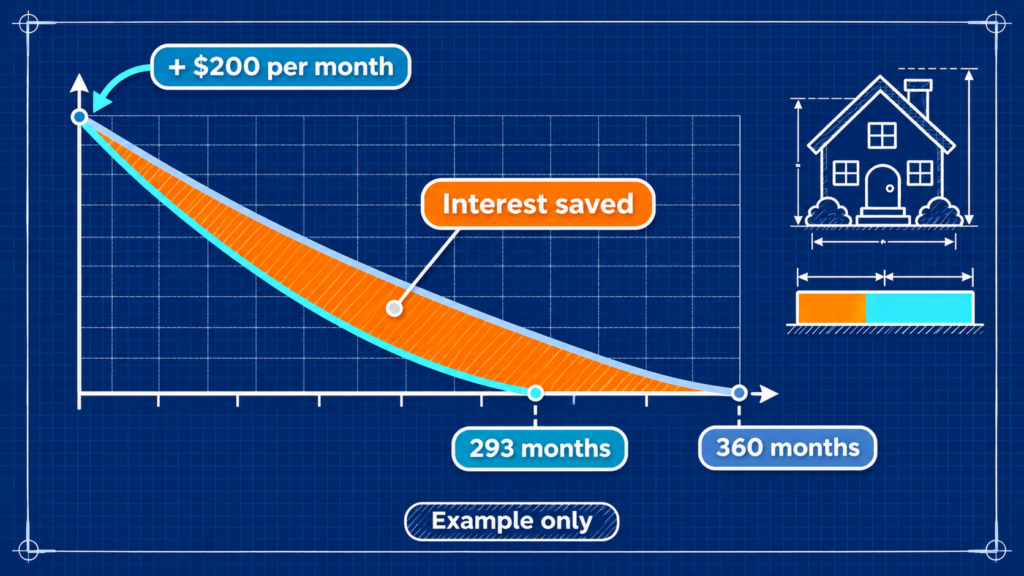
Generally, yes. Since interest is charged on the balance you owe, lowering that balance earlier means less interest down the road.
Here is an example. Take the same $400,000 loan at 6.5% over 30 years. Say the borrower adds $200 a month toward principal from the start. The loan would then be paid off in about 293 months instead of 360. That is a little over 24 years. The borrower would also save about $111,892 in interest over the life of the loan.
Disclaimer: This is a hypothetical example for educational purposes only. It assumes the extra amount is applied to principal every month, a fixed 6.5% rate, and no other changes to the loan. Actual results depend on your loan terms, how your servicer applies extra payments, and any prepayment provisions.
Can You Shorten Your Mortgage Amortization Period?
Often, yes. Extra principal payments can shorten the time it takes to pay off your loan, as the example shows. Check your loan papers first, and make sure your servicer applies the extra amount to principal. You can test different amounts with the Wonder Rates Extra Payment Calculator.
Should You Make Extra Mortgage Payments?
That depends on your full money picture. Before paying extra, think about whether you have enough cash saved for emergencies. Look at any other debts you have, especially ones with higher rates. Check whether your loan has a prepayment penalty. And think about your other goals, such as saving for retirement. Paying extra can be a smart move, but it is not the right move for everyone.
Section 10
Mortgage Amortization and Home Equity
How Principal Reduction Builds Equity
Home equity is the part of your home you own outright. As your loan balance goes down, your equity can grow, assuming your home’s value stays about the same. So each principal payment helps build equity.
Home Value Also Affects Equity
Equity is not just the principal you have paid. It is your home’s value minus what you owe. If your home’s value goes up, your equity grows even faster. If the value drops, your equity can shrink, even as you pay down the loan. Our guide to the loan-to-value ratio explains how lenders compare what you owe with what your home is worth.
Why Amortization Matters When Selling a Home
When you sell, the sale money is first used to pay off your remaining mortgage balance. What is left goes to you, before other selling costs. So the further along you are on your amortization schedule, the more of the sale price you may keep.
Section 11
Mortgage Amortization and Refinancing
What Happens to Amortization When You Refinance?
A refinance replaces your current mortgage with a new loan. The new loan has its own balance, rate, term, and amortization schedule. To learn more about the basics, see our guide on how mortgage refinancing works.
Does Refinancing Restart Amortization?
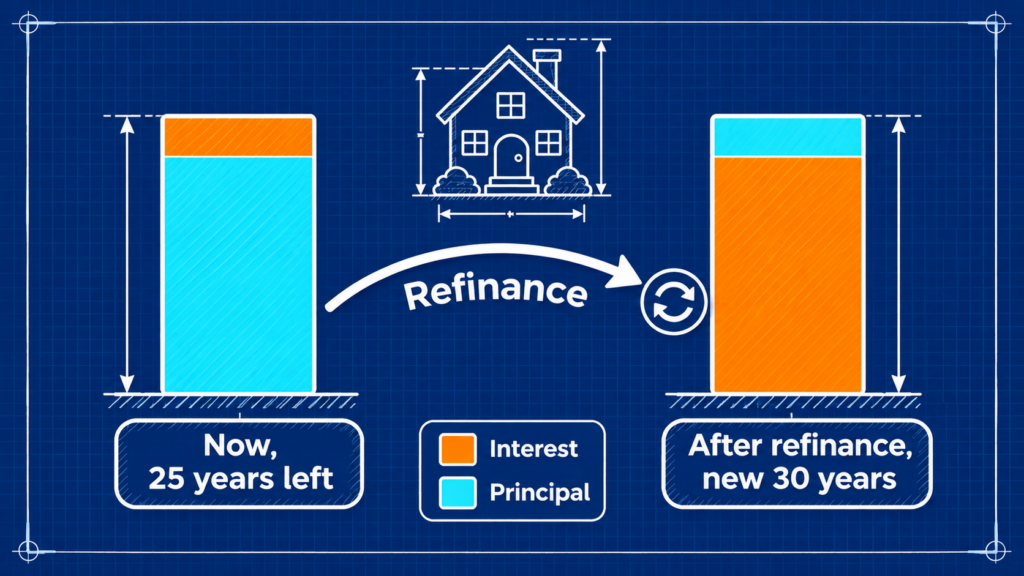
In practice, it often can. Say you have 25 years left on your loan and you refinance into a new 30-year loan. The new loan spreads repayment over 30 years again. That means you are back near the start of a new schedule, where more of each payment goes to interest.
Why a Lower Payment Does Not Always Mean Lower Total Interest
A refinance can lower your monthly payment in a few ways. You might get a lower rate, a longer repayment period, or a smaller balance. But stretching the repayment period can raise your total interest compared with keeping your current loan.
Here is an example. Go back to the $400,000 loan at 6.5%. After five years, the balance is about $374,444. If the borrower keeps the loan, the remaining 25 years of payments would include about $384,038 in interest.
Now say the borrower refinances that balance into a new 30-year loan at 6%. The new payment would be about $2,245 a month, which is about $283 less than before. But the new loan would charge about $433,749 in interest over its full 30 years. That is roughly $49,700 more, even with a lower rate. A smaller payment can still mean a bigger bill.
Disclaimer: This is a hypothetical example for educational purposes only. It shows principal and interest only and does not include refinance closing costs, points, or fees, which would also affect the comparison. Actual results depend on your loan balance, rates, terms, costs, and how long you keep each loan.
Section 12
What Is Negative Amortization?
Negative Amortization Explained
Negative amortization happens when your payment does not cover all the interest owed. The unpaid interest is added to your balance, so the amount you owe goes up. The CFPB notes that this can be risky, because you could end up owing more than your home is worth.
Here is a simple example. On a $400,000 balance at 6.5%, the interest for one month is about $2,167. If a loan allowed a payment of only $1,800, the missing $367 would be added to the balance. The borrower would then owe about $400,367, even after making a payment.
Disclaimer: This is a hypothetical illustration for educational purposes only. It does not represent any specific loan product. Actual loan terms vary, and many common mortgages do not allow negative amortization.
How Is Negative Amortization Different From Normal Amortization?
With normal amortization, your balance goes down over time. With negative amortization, your balance goes up. Standard fixed-rate mortgages are designed so the balance falls with each payment.
Is Negative Amortization the Same as an Interest-Only Mortgage?
No. With an interest-only payment, you pay the interest owed, but you do not pay down principal. So the balance stays about the same. With negative amortization, you pay less than the interest owed, so unpaid interest is added to the balance and it grows.
Section 13
Mortgage Amortization vs. Interest-Only Payments
Fully Amortizing Mortgage
On a fully amortizing loan, each scheduled payment covers interest and some principal. If you make every payment, the loan is paid off by the end of the schedule.
Interest-Only Mortgage
On an interest-only loan, the payment may cover only interest for a set period. During that time, your principal does not go down. Take the same $400,000 balance at 6.5%. An interest-only payment would be about $2,167 a month, and the balance would stay at $400,000. After the interest-only period ends, payments usually rise, because principal must then be repaid over a shorter time.
Disclaimer: This is a hypothetical example for educational purposes only. It does not represent any specific loan product, and actual interest-only terms, payment changes, and eligibility vary by lender and program.
Why the Difference Matters
If you are comparing these options, look closely at a few things. Check the payment amount now and later. Ask how much principal you will pay down. Find out when and how your payment could change. And check what your balance will be at key points. Neither option is right for everyone, but you should understand both before you choose.
Section 14
How to Use a Mortgage Amortization Calculator
What an Amortization Calculator Can Show
A good calculator can show your monthly payment and the split between principal and interest. It can also show your remaining balance, total interest, and payoff timeline.
Which Inputs Matter?
The main inputs are the loan amount, the interest rate, and the loan term. If you are buying, the down payment also matters, since it affects how much you borrow. Some calculators also let you add extra principal payments.
Use the Wonder Rates Mortgage Payment Calculator
The Wonder Rates Mortgage Payment Calculator can help here. It estimates how loan amount, rate, and term affect your monthly payment. It also lets you add taxes, insurance, PMI, and HOA dues for a fuller picture. Calculator results are estimates and should not be treated as a loan quote or guarantee of available terms.
Section 15
How to Read Your Mortgage Statement Using Amortization Concepts
Your monthly mortgage statement puts amortization into action. Here is what to look for.
Current Principal Balance
This is how much principal you still owe. It should match where you are on your amortization schedule, plus or minus any extra payments.
Principal Paid
This shows how much of your last payment, and often your year-to-date payments, went to principal. Over time, you should see this number slowly grow.
Interest Paid
This shows how much of your payment went to interest. On a standard fixed-rate loan, this number should slowly shrink over time.
Escrow and Other Charges
Not every dollar you send to your lender pays down your loan. Your monthly payment may also include property taxes, homeowners insurance, and mortgage insurance, often held in an escrow account. HOA dues are usually paid separately, but it depends on your setup. Only the principal and interest parts are directly tied to the amortization of your loan.
Section 16
Does Mortgage Amortization Affect Your Total Cost?
Total Interest Over the Loan
Your schedule shows the interest you will pay if you keep the loan for its full length. That assumes you make every payment on time.
Loan Term
A longer term usually lowers your payment but raises your total interest. A shorter term usually does the opposite.
Interest Rate
A higher rate raises the interest charged each month. A lower rate reduces it, assuming other things stay the same.
Additional Principal Payments
Extra principal payments can cut your total interest and shorten your payoff time.
Mortgage amortization shapes how the debt is repaid over time. But the total cost of borrowing depends on more than the schedule alone. Fees, points, closing costs, and how long you keep the loan all matter too.
Section 17
What to Know About Mortgage Amortization Before Choosing a Loan
Mortgage amortization determines how principal and interest are split across your repayment period. The same loan amount can lead to very different payments and total interest, depending on the rate and the term.
A longer amortization period generally lowers your required monthly payment but gives interest more time to build up. A shorter period generally raises your required payment but shortens the time you are in debt.
So compare the monthly payment with the total cost of borrowing, and think about how long you expect to keep the loan. Looking at an amortization schedule can make those trade-offs much easier to see.
Section 18
Explore Your Mortgage Options
If you are comparing mortgage options, look beyond the monthly payment. That helps you see how the loan may affect your finances over time. You can use the Wonder Rates Mortgage Payment Calculator to compare different loan amounts, rates, and terms. Then discuss the available options with a licensed mortgage professional.
When you are ready, get started with Wonder Rates to review your options. If you are shopping for a home, you can also explore buying a home with Wonder Rates.
Section 19
Disclaimer
This article is provided for general educational and informational purposes only and does not constitute financial, mortgage, tax, legal, or investment advice. Mortgage amortization examples and calculations are hypothetical and are intended only to explain general concepts. Actual mortgage payments, interest charges, principal balances, loan terms, rates, fees, and repayment schedules vary based on the specific loan, borrower, lender, and applicable loan terms. Calculator results are estimates and should not be interpreted as a rate quote, loan offer, approval, or commitment to lend.
Actual mortgage payments may also include amounts for property taxes, homeowners insurance, mortgage insurance, HOA dues, or other applicable costs that are separate from principal and interest. The treatment of additional principal payments, prepayment provisions, refinancing, and other changes to a mortgage depends on the specific loan agreement and applicable requirements. Borrowers should review their Loan Estimate, Closing Disclosure, mortgage statement, and other official loan documents and consult a licensed mortgage professional regarding their individual circumstances.
Duc Pham, Mortgage Broker | NMLS# 844897, Wonder Rates, Inc. | NMLS# 1518655 | DRE# 02047445 | DFPI# 60DBO-59134 | Equal Housing Opportunity. Equal Housing Lender. | Licensed in: AL, AZ, CA, CO, FL, GA, LA, MI, NC, OH, OK, OR, PA, SC, TX, VA, WA.



