

Section 01
For many first-generation immigrants, buying a home is one of life’s biggest milestones. It may take years of saving, building credit, and working toward a financial goal. Then one day, you get the keys.
For many people, that is where the story ends. But it is really where a new chapter begins.
Owning a home is not just about making monthly mortgage payments. Depending on where you live and how your circumstances change, you may become eligible for property tax exemptions, assistance with home repairs, senior homeowner programs, or disaster recovery resources.
These programs do not automatically apply to every homeowner. Some require an application, proof of eligibility, or renewal by a specific deadline. Others are limited to certain counties, cities, income levels, ages, or property types.
This guide explains the homeowner benefits worth checking after closing, where to find reliable information, and how to keep track of opportunities as your life changes.
Section 02
Why Homeowner Benefits Matter After Buying a Home
Buying a home is often the goal. Owning one for 20 or 30 years is the longer commitment.
During that time, your circumstances may change. You may raise children, retire, care for aging parents, experience a reduction in income, or need to make significant repairs to your property. Local and state programs may offer assistance for some of these situations.
For example, a homeowner may qualify for a property tax exemption after meeting a state residency requirement. Another homeowner may become eligible for a senior tax relief program after reaching a specified age. A household whose property is damaged in a qualifying disaster may be able to apply for recovery assistance.
The important point is that eligibility can depend on more than simply owning a home. Location, income, age, disability status, military service, property use, and other program-specific requirements may matter.
Staying informed can help you identify benefits that may apply to your circumstances instead of assuming that every available program will be applied automatically.
Section 03
Common Homeowner Benefits You May Qualify For
Homeowner benefits vary significantly across the United States. The following are common categories worth investigating, but availability and eligibility must be confirmed with the agency responsible for each program.
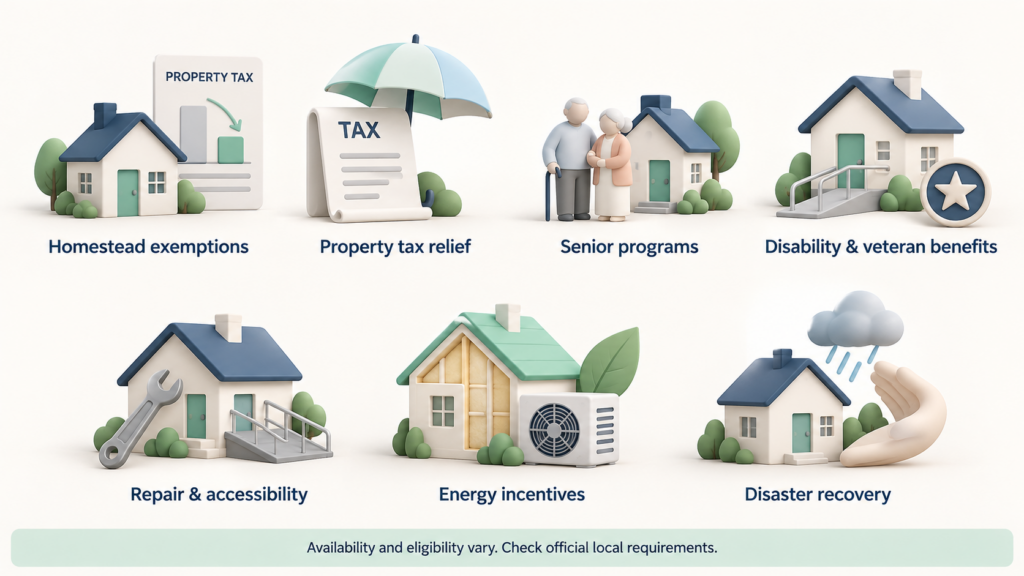
Homestead Exemptions
A homestead exemption may reduce the assessed value of an eligible primary residence for property tax purposes. In some jurisdictions, homeowners may also qualify for other protections or tax benefits associated with a homestead designation.
The rules are not uniform nationwide. Some states provide exemptions to eligible owner-occupants, while the amount of the benefit, application process, deadlines, and eligibility conditions vary.
In many cases, homeowners must apply through a county assessor, appraisal district, or local tax authority. You may need to establish that the property is your primary residence and provide documentation requested by the local office.
Do not assume that a homestead exemption is automatically applied when you close on a home. Check the requirements in the county where your property is located and confirm whether an application is necessary.
Property Tax Relief Programs
Some states, counties, and cities offer property tax relief to eligible homeowners. Depending on the jurisdiction, programs may include exemptions, credits, caps, freezes, or payment deferrals.
Eligibility may depend on factors such as household income, age, disability status, military service, or length of residence. Some programs are designed to help homeowners with limited income manage rising property tax bills.
The details matter. A property tax exemption may reduce the amount of assessed value subject to taxation, while a tax deferral may postpone payment rather than eliminate the amount owed.
Before applying, confirm what the program actually provides, whether the benefit must be renewed, and whether any deferred amount or other obligation becomes due later.
Senior Homeowner Programs
Homeowners who reach a certain age may qualify for additional property tax relief or other local assistance.
Depending on state and local rules, these programs may include senior exemptions, tax freezes, income-based relief, or deferrals. Some programs also require applicants to meet income, residency, or ownership conditions.
For example, a homeowner who recently turned 65 may discover that their county offers a property tax exemption for eligible older residents. However, the age requirement, benefit amount, filing deadline, and documentation may differ from one jurisdiction to another.
If you or a family member is approaching an age threshold, contact the local tax authority before assuming the benefit will be applied automatically.
Disability and Veteran Homeowner Benefits
Some jurisdictions provide property tax exemptions or other homeowner assistance for eligible people with disabilities, qualifying veterans, or certain surviving spouses.
These benefits are not identical across states. Some require documentation from a government agency, proof of disability or qualifying service, or confirmation that the property is the applicant’s primary residence.
If you believe you may qualify, start with your state or county tax authority and the relevant veterans affairs agency. Ask about application deadlines, required documents, renewal rules, and whether the benefit can be combined with other exemptions.
Home Repair and Accessibility Assistance
Homeowners may also find programs that support essential repairs, accessibility modifications, weatherization, or improvements needed to make a home safer.
Depending on the program, assistance may be available as a grant, a low-interest loan, or another form of financial support. Eligibility can depend on household income, location, property condition, age, disability, or other factors.
Some programs focus on health and safety issues, such as unsafe electrical systems, plumbing problems, or accessibility needs. Others may support energy efficiency or weatherproofing.
Before beginning work, check whether the program requires an application, inspection, contractor approval, or authorization before repairs start. Completing the work first may affect eligibility under some programs.
You can start by checking your state housing agency, local housing department, or HUD’s housing counseling resources. A HUD-approved housing counselor may help you identify relevant resources and understand the steps involved.
Energy Efficiency Incentives
Homeowners may encounter programs that support energy efficiency improvements, such as insulation, heating and cooling upgrades, or other qualifying improvements.
These programs can change over time. Some are administered by state or local agencies, some are offered through utilities, and others may have specific federal eligibility requirements.
Do not assume that every energy improvement qualifies for a tax credit or rebate. The type of improvement, installation date, property, household circumstances, and rules in effect may affect eligibility.
Before committing to a project, verify current requirements with the relevant government agency or utility provider. If the program offers a tax benefit, check the current IRS guidance and consult a qualified tax professional about your circumstances.
Disaster Recovery Assistance
Homeowners affected by a qualifying disaster may be able to access assistance through federal, state, or local programs.
The availability of assistance depends on the type of disaster, the affected location, the applicable declaration or program, and the damage or financial hardship involved.
Some assistance may help eligible households address temporary housing needs or certain essential recovery expenses. Other programs may focus on repairs, rebuilding, or longer-term recovery.
Start with official government resources rather than social media posts or unsolicited messages. The Federal Emergency Management Agency (FEMA) provides information about individual disaster assistance and eligibility when applicable.
Be cautious of anyone who guarantees disaster aid or requests unusual payments or sensitive information to help you apply. Use official channels to verify program details and application instructions.
Section 04
Homeowner Tax Benefits: What to Check Before Filing
Some homeowners may qualify for federal tax deductions or credits, but homeownership does not automatically reduce everyone’s tax bill.
The tax treatment depends on the expense, the property, the use of the home, the applicable tax rules, and the homeowner’s individual tax situation.
According to the Internal Revenue Service’s homeowner tax guidance, eligible taxpayers may be able to deduct qualifying mortgage interest and state and local real estate taxes, subject to applicable limitations and filing requirements.
A key distinction is whether you itemize deductions. Paying mortgage interest or property taxes does not, by itself, mean that you will receive an additional tax benefit. Your overall deductions and tax circumstances determine whether itemizing is beneficial.
Homeowners should also avoid assuming that every expense associated with the property is deductible. Principal repayment, homeowners insurance, utilities, HOA fees, and most routine home repairs generally do not qualify as deductible homeowner expenses under the ordinary federal rules.
Tax laws can change, so check current IRS publications and consult a qualified tax professional before relying on a deduction or credit in your financial planning.
Section 05
Why Many First-Generation Immigrants Miss These Opportunities
Many first-generation immigrants spend years learning how to build credit, qualify for a mortgage, and save for a down payment. Those are essential steps, but they are only part of the financial picture.
After closing, homeowners may not know which local agencies administer property tax exemptions or where to look for repair assistance. Program information can be spread across county websites, state agencies, local offices, and nonprofit organizations.
Language barriers and unfamiliar application processes may make the search more difficult. Some homeowners may also assume that a program will automatically notify them when they become eligible.
That assumption can lead to missed opportunities. A benefit may require an application, and some programs have specific filing windows or renewal requirements.
A practical approach is to keep a list of relevant agencies for your property and review their programs periodically. If you need help understanding eligibility or application steps, a qualified housing counselor or the agency administering the program may be able to guide you.
Section 06
When Should You Check for New Homeowner Benefits?
You do not have to wait until a financial problem arises to review available programs. Consider checking at several points during homeownership.
After buying the home: Confirm whether your property qualifies for a homestead exemption or another benefit that requires an application after closing.
When your household circumstances change: A change in income, disability status, age, family size, or military status may affect eligibility for certain programs.
Before filing your taxes: Review current IRS guidance and discuss potentially applicable deductions or credits with a tax professional.
Before starting major repairs: Search for local repair, accessibility, or energy efficiency programs before signing a contract or beginning work. Some programs require prior approval.
After a declared disaster: Use official government resources to check whether assistance is available for your location and circumstances.
During your regular financial review: Revisit property taxes, homeowners insurance, mortgage costs, and local programs every year or whenever a major change occurs.
A recurring review does not guarantee that you will qualify for new benefits. It helps you identify changes in eligibility and avoid relying on outdated information.
Section 07
Where Should Homeowners Look for Reliable Information?
The best source depends on the benefit you are investigating. Start with the agency responsible for administering the program.
- County assessor or local tax authority: Ask about homestead exemptions, property tax relief, senior benefits, and application deadlines.
- State housing agency or local housing department: Look for home repair assistance, accessibility programs, and other housing resources.
- Internal Revenue Service: Review current federal tax rules and official publications for homeowners.
- HUD-approved housing counselor: Find guidance on housing-related resources and options through HUD’s counseling directory.
- FEMA and state emergency management agencies: Check for disaster recovery assistance when a qualifying event affects your area.
- Utility provider or relevant state agency: Verify whether energy efficiency rebates or related programs are currently available.
Social media and word of mouth can help you discover a program, but they should not be your final source for eligibility, deadlines, or benefit amounts. Rules can change, and a program available in one county may not exist in another.
When contacting an agency, ask what documents are required, how to apply, whether the benefit must be renewed, and when the benefit takes effect.
Section 08
Review Your Homeownership Costs Alongside Available Benefits
Finding a homeowner benefit is useful, but it is only one part of managing the long-term cost of owning a home.
Property taxes, homeowners insurance, maintenance, utilities, and mortgage payments can change over time. A tax exemption may help reduce one expense, but it will not necessarily offset an increase in insurance premiums or the cost of an unexpected repair.
If your homeowners insurance premium has increased, review the coverage and renewal terms carefully. Wonder Rates also explains common factors behind rising homeowners insurance premiums.
You can use the Wonder Rates Mortgage Payment Calculator to estimate principal, interest, property taxes, insurance, and other applicable monthly housing costs. Adjust the inputs to compare scenarios and understand how changes in taxes or insurance could affect your budget.
The calculator provides an estimate, not a guarantee of future expenses or a loan offer. Your actual costs depend on the property, location, insurance coverage, loan terms, and other individual circumstances.
If you are planning to buy a home, visit Wonder Rates’ homebuying page to explore the next steps. If you would like to discuss a mortgage scenario with the team, you can get started here.
Section 09
Questions Worth Asking Every Few Years
Your financial life is not static, and neither is homeownership. A short review can help you identify issues that deserve attention.
Consider asking yourself:
- Have property tax exemptions or relief programs changed in my county?
- Am I eligible for a homestead exemption, and have I completed the application?
- Have I become eligible for a senior, disability-related, or veteran benefit?
- Are there home repair or energy efficiency programs relevant to my property?
- Do I understand my current homeowners insurance coverage and renewal costs?
- Have my property taxes, insurance, or HOA expenses changed significantly?
- Do I have a plan for maintenance, emergency repairs, and other unexpected costs?
- Do I need to review my mortgage or broader financial plan because my circumstances have changed?
You do not need to qualify for every program for this review to be worthwhile. The goal is to understand your options, keep your records current, and make decisions based on verified information.
Section 10
Final Thoughts
For many first-generation immigrants, buying a home represents years of effort and sacrifice. But closing is not the end of the financial journey. It is the beginning of a new stage of planning.
Depending on where you live and how your circumstances change, you may be eligible for property tax exemptions, senior or veteran benefits, repair assistance, disaster recovery resources, or certain tax benefits.
None of these benefits is guaranteed simply because you own a home. Eligibility requirements, application procedures, deadlines, and available funding can differ substantially by location and program.
The best next step is to identify the agencies responsible for your property, verify current requirements, and keep track of important deadlines. Review your homeownership costs regularly, too, so you can understand both the assistance that may be available and the expenses you remain responsible for.
Staying informed may help you make better use of the home you worked so hard to own.
Section 11
Disclaimer
This article is for general educational and informational purposes only. It does not constitute financial, tax, legal, real estate, or mortgage advice. Homeowner benefits, tax rules, exemptions, assistance programs, eligibility criteria, deadlines, and funding availability vary by state, county, city, and individual circumstances. Programs may change, and inclusion in this article does not guarantee eligibility or approval. Verify current information with the relevant government agency or program administrator and consult qualified professionals regarding your specific situation.
Duc Pham, Mortgage Broker | NMLS# 844897, Wonder Rates, Inc. | NMLS# 1518655 | DRE# 02047445 | DFPI# 60DBO-59134 | Equal Housing Opportunity. Equal Housing Lender. | Licensed in: AL, AZ, CA, CO, FL, GA, LA, MI, NC, OH, OK, OR, PA, SC, TX, VA, WA.