
Section 01
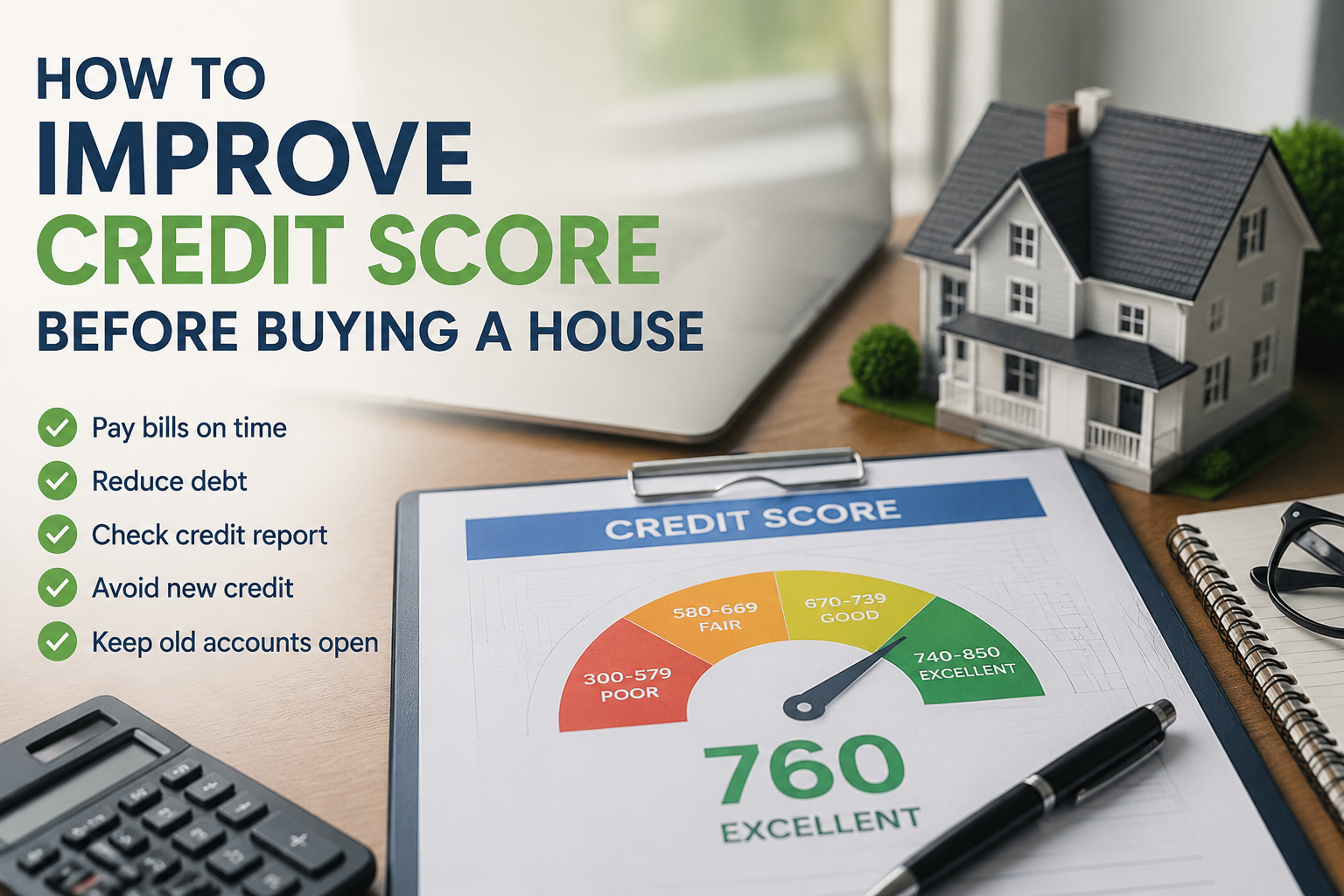
Improve credit score before buying a house is one of the most important steps before applying for a mortgage. It can directly affect your approval chances, interest rate, and monthly payment.
Most homebuyers spend months saving for a down payment. But many overlook one number that can have just as much impact on the cost of buying a home: their credit score.
Your credit score doesn’t just affect whether you get approved. It can influence your interest rate, your monthly payment, and how much you pay over the life of your mortgage.
On a $350,000 loan, even a small difference in interest rate can meaningfully change your long-term borrowing costs.
Section 02
A Small Rate Difference Can Add Up
Example
- Loan Amount: $350,000
- Loan Term: 30-Year Fixed
- Scenario A: 6.5% interest rate
- Scenario B: 6.0% interest rate
| Scenario | Monthly Payment (Principal & Interest) | Total Interest Paid (30 Years) |
|---|---|---|
| 6.5% Rate | Approximately $2,212 | Approximately $446,000 |
| 6.0% Rate | Approximately $2,098 | Approximately $405,000 |
Difference:
- About $114 less per month
- More than $40,000 in potential interest savings over the life of the loan
Illustrative example based on a $350,000, 30-year fixed-rate mortgage with principal and interest payments only. Excludes taxes, insurance, HOA dues, and mortgage insurance. Actual rates and payments vary.
That gap is why your credit profile before applying for a mortgage can make a meaningful difference.
I’ve watched borrowers waste months saving for their down payment. They often miss a credit issue that affects their rate even more. Sometimes a few months of credit planning can create meaningful long-term savings.
Section 03
Understand What Makes Up Your Credit Score
Before trying to improve your score, it helps to understand how it is built.
Most mortgage lenders use FICO scoring models, which generally consider five key factors:
| Factor | Weight | What It Means |
|---|---|---|
| Payment History | 35% | On-time versus late payments |
| Credit Utilization | 30% | How much of your available credit you’re using |
| Length of Credit History | 15% | How long your accounts have been open |
| Credit Mix | 10% | The types of credit accounts you have |
| New Credit | 10% | Recent applications and inquiries |
Payment history and credit utilization account for roughly 65% of your score. That’s where many borrowers see the biggest opportunities for improvement.
Section 04
Pay Down Credit Card Balances First
Credit utilization is often one of the fastest ways to improve your score.
For example, if you have:
- Total credit limit: $10,000
- Credit card balances: $7,000
Your utilization rate is 70%, which can significantly suppress your score.
Lowering balances helps a lot. The credit bureaus see the changes. Then, you may notice improvements.
General Credit Utilization Guidelines
| Utilization | General Impact |
|---|---|
| Below 10% | Typically considered optimal |
| 10%–30% | Generally favorable |
| 30%–50% | Moderate impact |
| 50%–90% | Higher negative impact |
| Above 90% | Severe negative impact |
Credit score impacts and utilization thresholds are general guidelines and may vary based on individual credit profiles and scoring models.
For many borrowers, the strongest gains come from bringing utilization below 30%, and ideally below 10%.
In fact, some of the largest score improvements happen within one or two billing cycles after high balances are paid down and reported.
If you’re trying to improve your score quickly, start with the cards that are closest to their limits. That’s often where borrowers see the biggest impact.
Section 05
Avoid Opening or Closing Accounts Before Applying
Once you’re preparing for a mortgage, stability matters.
Opening new credit accounts can:
- Trigger hard inquiries
- Increase your debt obligations
- Lower your average credit age
- Potentially affect underwriting before closing
Closing accounts can also have unintended consequences. When you close an account, you reduce your available credit, which may increase your utilization ratio even if your spending stays the same.
Simple Rule
If you’re planning to apply for a mortgage within the next six months, avoid opening or closing credit accounts unless you’ve discussed it with your loan officer first.
Section 06
Review Your Credit Reports Early
Credit report errors are more common than many buyers realize.
Examples include:
- Accounts that don’t belong to you
- Incorrect late payments
- Inaccurate balances
- Duplicate accounts
- Outdated information
You can access your reports from all three major credit bureaus at:
If you find errors, dispute them directly with the reporting bureau.
Disputes often take 30 to 45 days to resolve, which is why reviewing your reports at least three to six months before applying for a mortgage is a good idea.
Section 07
Create a Credit Improvement Timeline
Improving your credit usually doesn’t happen overnight, but it can become much more manageable with a plan.
| Time Before Applying | Recommended Action |
|---|---|
| 6 Months Out | Pull credit reports and review for errors |
| 5 Months Out | Pay down high credit card balances |
| 4 Months Out | Confirm disputes have been resolved |
| 3 Months Out | Reassess your credit progress |
| 2 Months Out | Avoid new debt and large purchases |
| 1 Month Out | Prepare for pre-approval |
The goal isn’t necessarily to have a perfect score.
The goal is to put yourself in the strongest pricing position possible before your lender pulls your credit.
Section 08
What Credit Score Do You Need for a Mortgage?
The answer depends on the loan program.
- Conventional Loans: Borrowers with scores of 740 or higher may qualify for some of the most favorable pricing tiers.
- FHA Loans: Minimum score requirements can start at 580 with a 3.5% down payment, although lender overlays may apply.
- DSCR Loans: Many programs look for scores in the 660 to 680 range or higher, depending on the lender and property.
A higher score doesn’t guarantee a better loan, but it can expand your options and potentially lower your borrowing costs.
Section 09
Frequently Asked Questions
How much can my credit score improve in six months?
It depends on your starting point and what is affecting your score.
If high utilization is the primary issue, improvements of 30 to 60 points within a few billing cycles may be possible after balances are reduced.
Late payments, collections, or other negative items can slow improvements. These items usually need time to age.
Should I pay off a collection account before applying?
It depends on the situation.
- Paying a collection account does not always increase your score immediately.
- Older collections may have limited scoring impact.
- Medical collections may be treated differently under certain scoring models.
Because every situation is different, it may be helpful to review your options with a loan officer before making a payment.
Does checking my credit hurt my score?
No.
Checking your own credit is considered a soft inquiry and does not affect your score.
Hard inquiries from lenders during a credit application may have a small impact on your credit profile.
Section 10
Final Thoughts
Improving your credit score isn’t about perfection.
It’s about preparing your financial profile before you apply for a mortgage.
Small changes in how you use credit, when you use it, and your borrowing habits can improve your options. They can also lower your long-term borrowing costs.
That’s why many buyers start working on their credit several months before they plan to purchase a home.
Section 11
Final Thoughts
Want to know your credit status? Check it before starting your mortgage application. Look at your financial profile first.
A loan officer can help you evaluate your credit, debt, and income so you have a better understanding of what to expect before you apply.
This information is provided for educational purposes only and should not be considered financial, legal, or tax advice. Mortgage eligibility, interest rates, and loan terms vary by borrower, lender, and program guidelines.
Duc Pham, Mortgage Broker | NMLS# 844897,
Wonder Rates, Inc. | NMLS# 1518655 | DRE# 02047445 | DFPI# 60DBO-59134 |
Equal Housing Opportunity. Equal Housing Lender. |
Licensed in: AL, AZ, CA, CO, FL, GA, LA, MI, NC, OH, OK, OR, PA, SC, TX, VA, WA.