
Section 01
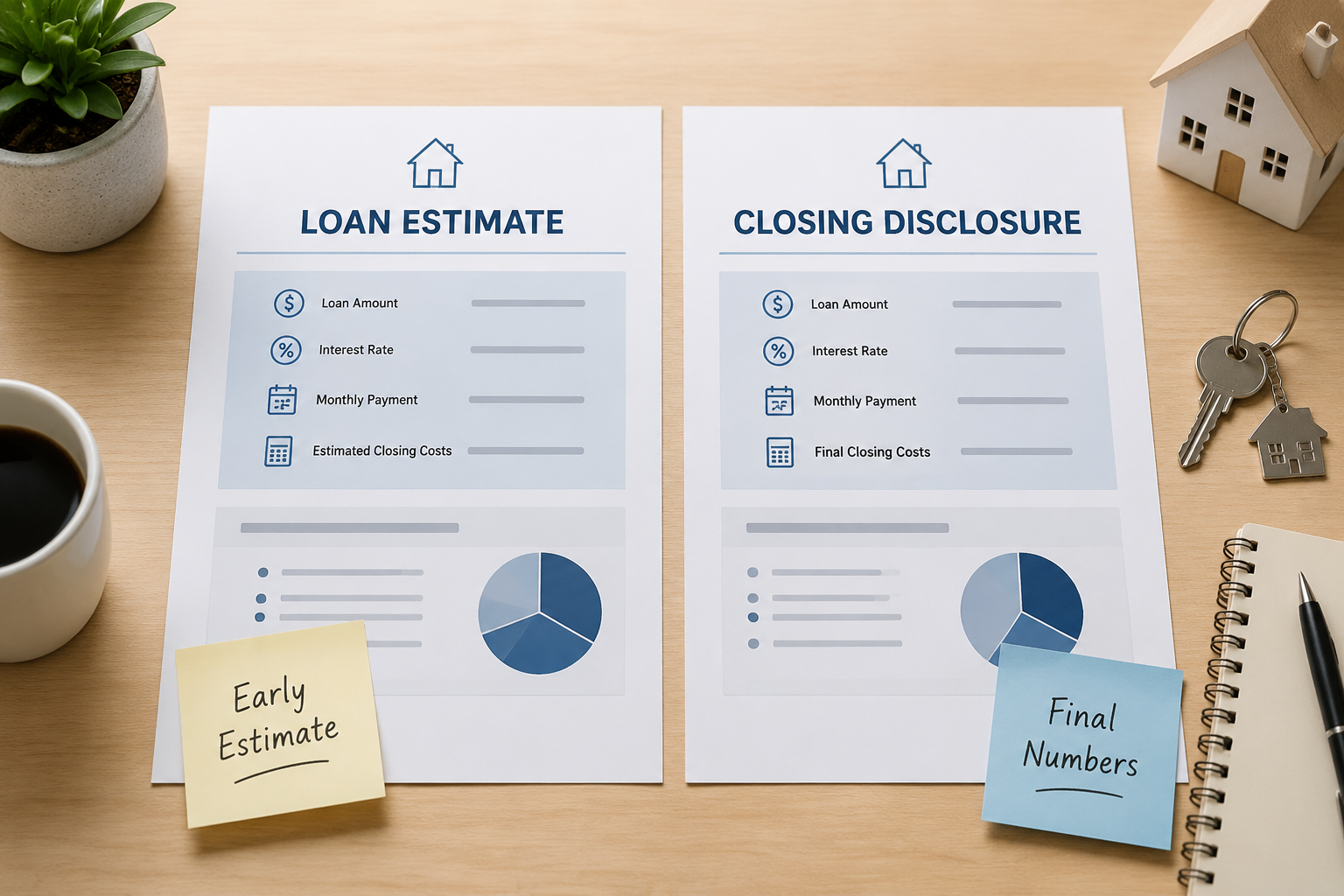
Loan Estimate vs Closing Disclosure are two of the most important documents in the mortgage process. They look almost identical at first glance, but they serve different purposes at different stages of your home loan journey.
Same format. Same general categories of information. Both show your loan amount, interest rate, monthly payment, and closing costs. Many buyers flip through one and assume it is basically the same as the other.
It is not. The Loan Estimate and the Closing Disclosure serve different purposes, arrive at different stages of the process, and give you different opportunities to review your loan before closing. Understanding the differences between them is not paperwork trivia. It can help you spot unexpected changes, compare your final costs with your earlier estimate, and ask the right questions before closing.
Here are the seven differences that actually matter.
Section 02
Difference 1: When You Receive the Loan Estimate and Closing Disclosure
The Loan Estimate arrives early. Federal law under TILA requires lenders to provide it within three business days after receiving the six pieces of information that make up an application: your name, income, Social Security number, property address, estimated property value, and desired loan amount. According to the Consumer Financial Protection Bureau (CFPB), the Loan Estimate helps borrowers understand key loan terms and estimated costs before deciding whether to move forward.
The initial Loan Estimate must generally be received at least seven business days before consummation. This waiting period may be modified or waived only in limited circumstances involving a bona fide personal financial emergency.
The Closing Disclosure arrives later. Lenders must ensure that you receive it at least three business days before consummation. This gives you time to review the final loan terms and closing costs, compare them with your Loan Estimate, and ask questions before closing.
The timing difference matters because the Loan Estimate is the document you use to review and compare loan offers, while the Closing Disclosure is the final disclosure you use to review the terms and costs of the loan before closing.
Section 03
Difference 2: The Legal Purpose of Each Document
The Loan Estimate is an early disclosure of the loan terms and estimated costs. It is not a loan commitment, and receiving one does not mean your loan has been approved. The lender may continue to verify your information and determine whether you qualify for the loan.
The Closing Disclosure shows the loan terms, projected payments, closing costs, and cash to close before consummation. You receive it before closing so you can review the information and ask questions about anything that does not match your expectations.
Signing or acknowledging receipt of the Closing Disclosure does not by itself mean that you have committed to the loan. The disclosure is provided so you can review the final terms before consummation.
Section 04
Difference 3: Which Numbers Can Change and by How Much
This is one of the most important differences to understand because federal rules limit how much certain closing costs can increase.
Interest rate is different from closing-cost tolerance rules. It is a loan term shown on both the Loan Estimate and Closing Disclosure, but it is not a fee subject to the zero-tolerance or 10% aggregate tolerance categories. If the interest rate changes, ask your loan officer why it changed and whether your rate was locked.
Some charges on the Loan Estimate are subject to a zero-tolerance rule, meaning they generally cannot increase at closing unless an exception applies, such as a valid change requested by the borrower or another permitted changed circumstance. This category generally includes lender charges and certain required services that the borrower is not permitted to shop for.
Certain charges are subject to a 10% aggregate tolerance. This generally includes certain services the borrower is permitted to shop for but chooses from a provider on the lender’s written list, along with certain other charges covered by the regulation.
A third category generally has no specific tolerance cap. These charges may change without a set percentage limit, although they remain subject to applicable disclosure and good-faith requirements. Examples can include certain prepaid items and certain services the borrower was permitted to shop for but obtained from a provider outside the lender’s written list.
| Fee Category | Tolerance Rule | Examples |
|---|---|---|
| Zero tolerance | Generally cannot increase unless a permitted exception applies | Lender charges, required services the borrower cannot shop for |
| 10% aggregate tolerance | The total of applicable charges can generally increase by no more than 10% | Certain required services the borrower can shop for but selects from the lender’s written provider list |
| No specific tolerance cap | No specific tolerance cap, but charges must still meet applicable good-faith requirements | Certain prepaid items and services the borrower shops for and obtains outside the lender’s written list |
Tolerance rules depend on the specific charge and circumstances of the transaction. They are based on current TILA and RESPA requirements and may change. Consult your loan officer if you have questions about a specific fee.
If a charge subject to a zero-tolerance limit increases beyond the permitted amount without a valid exception, the creditor generally must reimburse the borrower for the excess amount as required by federal law. Depending on the circumstances, the cure may involve a refund to the borrower or another permitted adjustment. This is an important protection when reviewing your final closing costs.
Section 05
Difference 4: When a Revised Loan Estimate May Be Issued
You may receive more than one Loan Estimate during the mortgage process. A revised Loan Estimate may be permitted when a valid changed circumstance or another permitted event affects the disclosed loan terms or costs.
Examples may include certain changes to the property or loan terms, a borrower-requested change to the loan or down payment, or a rate lock that occurs after the original Loan Estimate was issued. However, these events do not automatically mean that a revised Loan Estimate must be issued. Whether the lender may or must redisclose depends on the type of change, the applicable tolerance rules, and when the change occurs.
A revised Loan Estimate is subject to specific timing requirements. In general, it must be provided no later than four business days before consummation, when the applicable rules permit or require a revised Loan Estimate.
Importantly, a lender cannot simply issue a revised Loan Estimate because an earlier estimate was inaccurate. There must be a valid basis for the revision under the applicable rules. If your loan terms or closing costs change during the process, ask your loan officer what changed, why it changed, and whether the change resulted in a revised Loan Estimate.
Section 06
Difference 5: What You Should Review During the Three-Day Period
The three-business-day period after receiving the Closing Disclosure gives you time to review the final disclosed loan terms and closing costs before consummation. Use this time to compare the Closing Disclosure with your most recent Loan Estimate and look for changes you do not understand.
Start with the loan terms, including the interest rate, loan amount, loan term, and loan product. Then review the projected monthly payment, closing costs, lender credits, seller credits, and cash to close. Pay particular attention to any fees that increased from your most recent Loan Estimate and determine whether the applicable tolerance rules allow the change.
The three-business-day period is not simply a waiting period. It is an opportunity to ask questions and resolve discrepancies before closing. If you see a significant change or a charge you did not expect, contact your loan officer and ask for an explanation before consummation.
A corrected Closing Disclosure does not automatically restart the three-business-day waiting period. A new three-business-day period is generally required only if the correction makes the APR inaccurate, changes the loan product, or adds a prepayment penalty. Other corrections can generally be disclosed without starting a new three-day waiting period.
Section 07
Difference 6: How to Compare Them
When your Closing Disclosure arrives, the most important thing you can do is compare it directly to your most recent Loan Estimate, line by line.
Focus specifically on the loan terms, interest rate, monthly payment, and cash to close. Then review Section A for origination charges and Section B for services you were not permitted to shop for. Section C covers services you were permitted to shop for, so the tolerance that applies depends on how you selected the provider.
| Section | What It Shows | What to Check |
|---|---|---|
| Loan Terms (Page 1) | Rate, loan amount, monthly payment | Compare with your most recent Loan Estimate |
| Projected Payments | Monthly payment breakdown | Compare with your most recent Loan Estimate |
| Section A: Origination Charges | Lender charges | Generally subject to zero tolerance |
| Section B: Services You Cannot Shop For | Services the borrower could not shop for | Generally subject to zero tolerance |
| Section C: Services You Can Shop For | Services the borrower could shop for | Tolerance depends in part on provider selection |
| Cash to Close | Total cash needed at closing | Compare with your Loan Estimate |
If a charge that is subject to a zero-tolerance limit is higher on the Closing Disclosure than permitted, ask your loan officer to explain the change. If there is no valid exception, the creditor generally must cure the excess amount as required by applicable rules.
Section 08
Difference 7: What Happens After Each Document
After the Loan Estimate, you are still in an earlier stage of the mortgage process. You can continue comparing loan offers, discuss changes with your lender, or decide whether to proceed.
After you receive the Closing Disclosure, you are in the final review phase. The disclosure generally must be received at least three business days before consummation. However, not every change to a Closing Disclosure resets the three-business-day waiting period. A new three-business-day waiting period is generally required only when a correction causes the APR to become inaccurate, changes the loan product, or adds a prepayment penalty.
Other changes can generally be disclosed on a corrected Closing Disclosure without starting a new three-day waiting period. That means a change to the Closing Disclosure does not automatically mean your closing will be delayed.
The practical implication is that you should review your Closing Disclosure as soon as you receive it. If the loan terms, fees, or cash to close differ from what you expected, ask your loan officer to explain the change before closing. The CFPB recommends comparing the Closing Disclosure with your most recent Loan Estimate and asking questions about significant differences.
Section 09
Frequently Asked Questions
What if my Loan Estimate vs Closing Disclosure are different?
Your Loan Estimate and Closing Disclosure may have some differences because the Loan Estimate is based on estimated costs, while the Closing Disclosure reflects the final loan terms and closing costs. Not every difference means there is an error or a tolerance violation. Compare both documents carefully and ask your loan officer about any unexpected changes, especially increases in fees with tolerance limits.
Can I change lenders after Closing Disclosure?
You can choose a different lender, but switching lenders this late in the process can delay closing because the new lender will need to complete its own underwriting and disclosure process. If you are considering a switch, discuss the timing and potential impact on closing with your real estate and lending professionals.
What does cash to close include?
Cash to close is the total amount you need to bring to the closing table. It typically includes your down payment, closing costs, prepaid expenses, and other amounts due, minus credits such as seller concessions or lender credits.
Section 10
Conclusion
If you are currently in the mortgage process and want to make sure you understand what you are looking at on these documents before closing, or if you are preparing to apply and want to know what to watch for, that is a conversation worth having before you need it.
Have questions about your Loan Estimate or Closing Disclosure? Reach out to Duc Pham or the Wonder Rates team. We can help you understand your loan documents and what to review before closing.
All information in this article is for educational purposes only and does not constitute legal or financial advice. RESPA and TILA regulations governing Loan Estimates and Closing Disclosures are subject to change. Tolerance rules and cure requirements described are based on current federal regulations. Consult your loan officer and legal advisor for guidance specific to your transaction.
Duc Pham, Mortgage Broker | NMLS# 844897 | 408-600-1900 | dp@wonderrates.com
Wonder Rates, Inc. | NMLS# 1518655 | DRE# 02047445 | DFPI# 60DBO-59134
Equal Housing Opportunity. Equal Housing Lender.
Licensed in: AL, AZ, CA, CO, FL, GA, LA, MI, NC, OH, OK, OR, PA, SC, TX, VA, WA